A human oversight log is an auditable record that chronologically captures every instance of human-machine interaction during an AI system's decision-making lifecycle. It serves as the evidentiary foundation for demonstrating meaningful human intervention, documenting the operator's identity, the timestamp of the action, the system's proposed output, the operator's final decision, and the specific rationale for any override or approval.

Glossary
Human Oversight Log
An auditable record that captures the real-time interactions between a human operator and an AI system, documenting instances of override, intervention, and the operator's situational awareness during critical decisions.
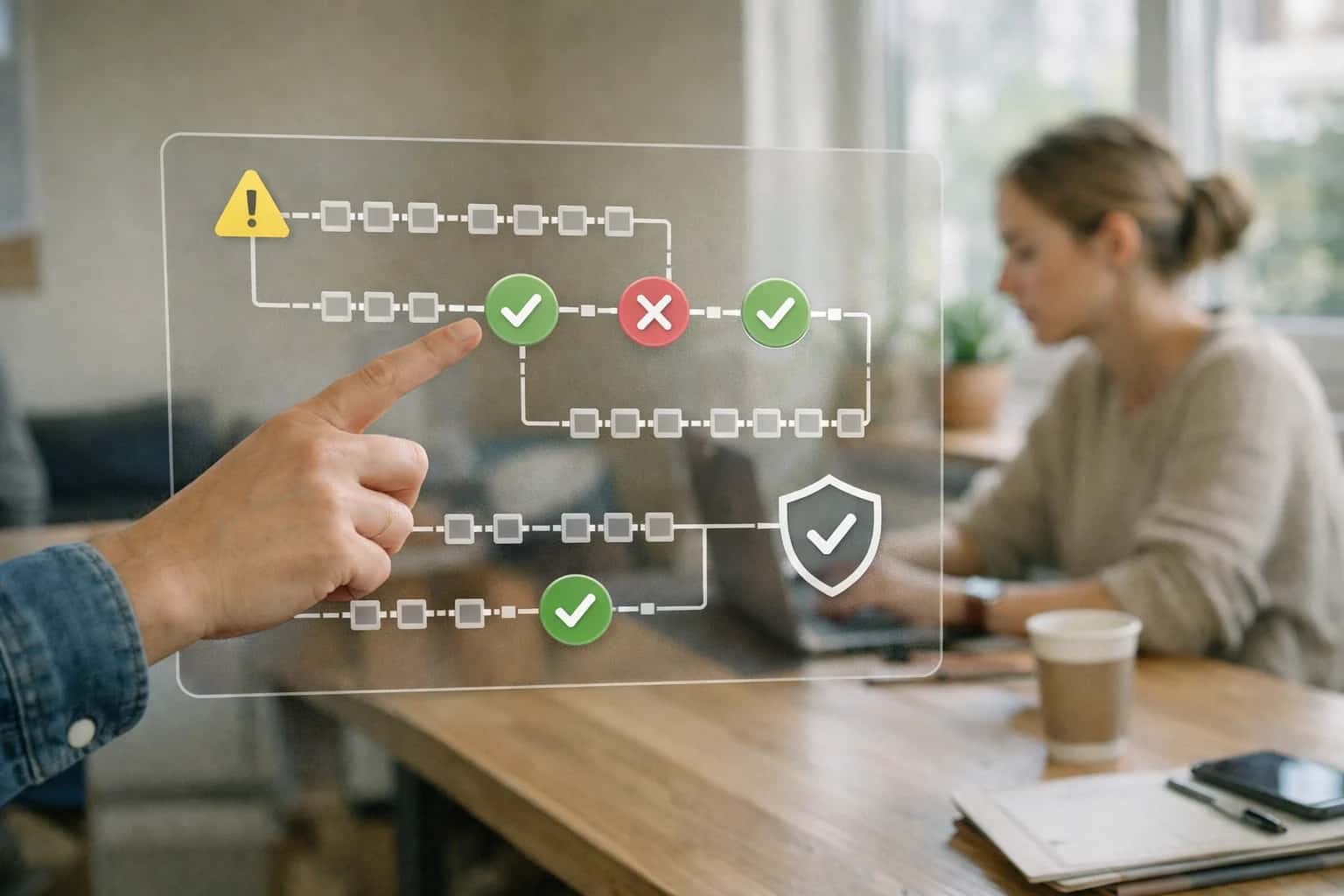
AUDITABLE INTERVENTION RECORD
What is a Human Oversight Log?
A human oversight log is a structured, immutable record that captures the real-time interactions between a human operator and an AI system, documenting instances of override, intervention, and the operator's situational awareness during critical decisions.
Under frameworks like the EU AI Act, the log is a critical component of the mandatory risk management system for high-risk AI systems, providing technical documentation that proves human control was not merely a tokenistic rubber-stamp. It ensures non-repudiation of oversight actions and enables post-hoc audits by market surveillance authorities to verify that the human reviewer possessed the competence and authority to override the automated decision.
Audit Architecture
Key Features of an Effective Oversight Log
An auditable record capturing real-time human-AI interactions, documenting overrides, interventions, and operator situational awareness during critical decisions.
01
Immutable Chronological Ledger
The log must function as a write-once, read-many (WORM) data structure. Every entry is timestamped with a verified source, ensuring the sequence of events cannot be altered retroactively. This provides the non-repudiation necessary for legal discovery.
- Uses cryptographic hashing to chain entries
- Prevents after-the-fact manipulation of operator actions
- Essential for Serious Incident Reporting under the EU AI Act
02
Contextual Decision Capture
Logging must go beyond a simple binary 'accept/reject' flag. The record must capture the full situational context presented to the human operator, including the model's confidence score, the specific input data, and the time window provided for the decision.
- Records the exact AI recommendation and its confidence interval
- Captures the latency between alert and human response
- Validates the standard of Meaningful Human Intervention
03
Structured Intervention Taxonomy
Raw log data is noisy. An effective log enforces a strict taxonomy to classify the nature of the override. This allows compliance officers to query for specific risk patterns rather than parsing free-text notes.
- Override Types: Safety halt, bias correction, factual error, procedural deviation
- Severity Levels: Critical, major, minor
- Enables automated trend analysis for Post-Market Monitoring
04
Operator Identity and Authorization
The log must irrefutably link an action to a specific, authorized identity. This includes the operator's role, the specific credentials used for authentication, and a record of the mandatory training or competency check required to intervene on that specific High-Risk AI System.
- Integrates with enterprise SSO and RBAC systems
- Validates that the reviewer had the authority to override
- Supports the chain of responsibility required by the Conformity Assessment
05
Real-Time Telemetry Integration
The log should not exist in a vacuum. It must be correlated with system telemetry to prove the operator was not set up to fail by a malfunctioning interface. This links human action to machine state.
- Correlates human input with system latency and UI errors
- Proves the system was responsive during the override window
- Provides defense against claims of automation bias or interface negligence
06
Tamper-Proof Export and Archiving
Data must be exportable in a standardized, signed format for external auditors and regulators. The export mechanism must maintain the chain of custody and prove that the log has not been truncated or edited by the provider or deployer.
- Supports standardized formats like JSON with JWS signatures
- Enables offline verification by Market Surveillance Authorities
- Critical for demonstrating Presumption of Conformity during an audit
HUMAN OVERSIGHT LOG
Frequently Asked Questions
Clear answers to the most common questions about maintaining auditable records of human-AI interaction during critical decision-making processes.
A Human Oversight Log is a structured, auditable record that captures the real-time interactions between a human operator and an AI system, specifically documenting instances of override, intervention, and the operator's situational awareness during critical decisions. It is a mandatory component under the EU AI Act for high-risk systems, serving as the primary evidence that meaningful human intervention—not mere rubber-stamping—occurred. The log proves that the human reviewer possessed the competence, authority, and actual capacity to override the automated output. Without this immutable record, an organization cannot demonstrate compliance with the provider obligations and deployer obligations for human oversight, exposing them to regulatory action by a market surveillance authority.
Enabling Efficiency, Speed & Accuracy
Intelligent Analysis, Decision & Execution
We build AI systems for teams that need search across company data, workflow automation across tools, or AI features inside products and internal software.
Talk to Us
Search across company data
Give teams answers from docs, tickets, runbooks, and product data with sources and permissions.
Useful when people spend too long searching or get different answers from different systems.
Enterprise searchRAGPermissions
Read more
Automate internal workflows
Use AI to route work, draft outputs, trigger actions, and keep approvals and logs in place.
Useful when repetitive work moves across multiple tools and teams.
AI agentsWorkflow automationGovernance
Read more
Add AI to products and internal tools
Build assistants, guided actions, or decision support into the software your team or customers already use.
Useful when AI needs to be part of the product, not a separate tool.
AI integrationDecision supportModel routing
Read more
About the author
Prasad Kumkar
CEO & MD, Inference Systems
Prasad Kumkar is the CEO & MD of Inference Systems and writes about AI systems architecture, LLM infrastructure, model serving, evaluation, and production deployment. Over 5+ years, he has worked across computer vision models, L5 autonomous vehicle systems, and LLM research, with a focus on taking complex AI ideas into real-world engineering systems.
His work and writing cover AI systems, large language models, AI agents, multimodal systems, autonomous systems, inference optimization, RAG, evaluation, and production AI engineering.
LinkedIn
Limited slotsGet a Free AI Consultation
Partnered with leading AI, data, and software stack.





How We Work
Custom AI workflows for your Business
One-fit-all AI don't work for modern businesses. At Inferensys, we aim to understand your business & custom requirements; which we use to define most efficient agentic workflows, the data, and the tools for your business.
01
Review the use case
We understand the task, the users, and where AI can actually help.
Read more02
Pick the right approach
We define what needs search, automation, or product integration.
Read more03
Build the first useful version
We implement the part that proves the value first.
Read more04
Improve from there
We add the checks and visibility needed to keep it useful.
Read moreThe first call is a practical review of your use case and the right next step.
Talk to Us