A consequential decision is a specific output of an algorithmic system that materially alters an individual's legal status, rights, or access to critical opportunities. Unlike trivial automated suggestions, these determinations carry significant weight, directly affecting a person's economic livelihood, personal freedom, or access to essential public and private services. The defining characteristic is the gravity of the outcome, not the complexity of the underlying model.

Glossary
Consequential Decision
An automated or semi-automated decision that has a legal effect or similarly significant impact on an individual, such as those related to employment, credit, or access to essential services.
AUTOMATED DECISION-MAKING
What is a Consequential Decision?
A consequential decision is an automated or semi-automated determination that produces a legal effect or similarly significant impact on an individual, such as those related to employment, credit, or access to essential services.
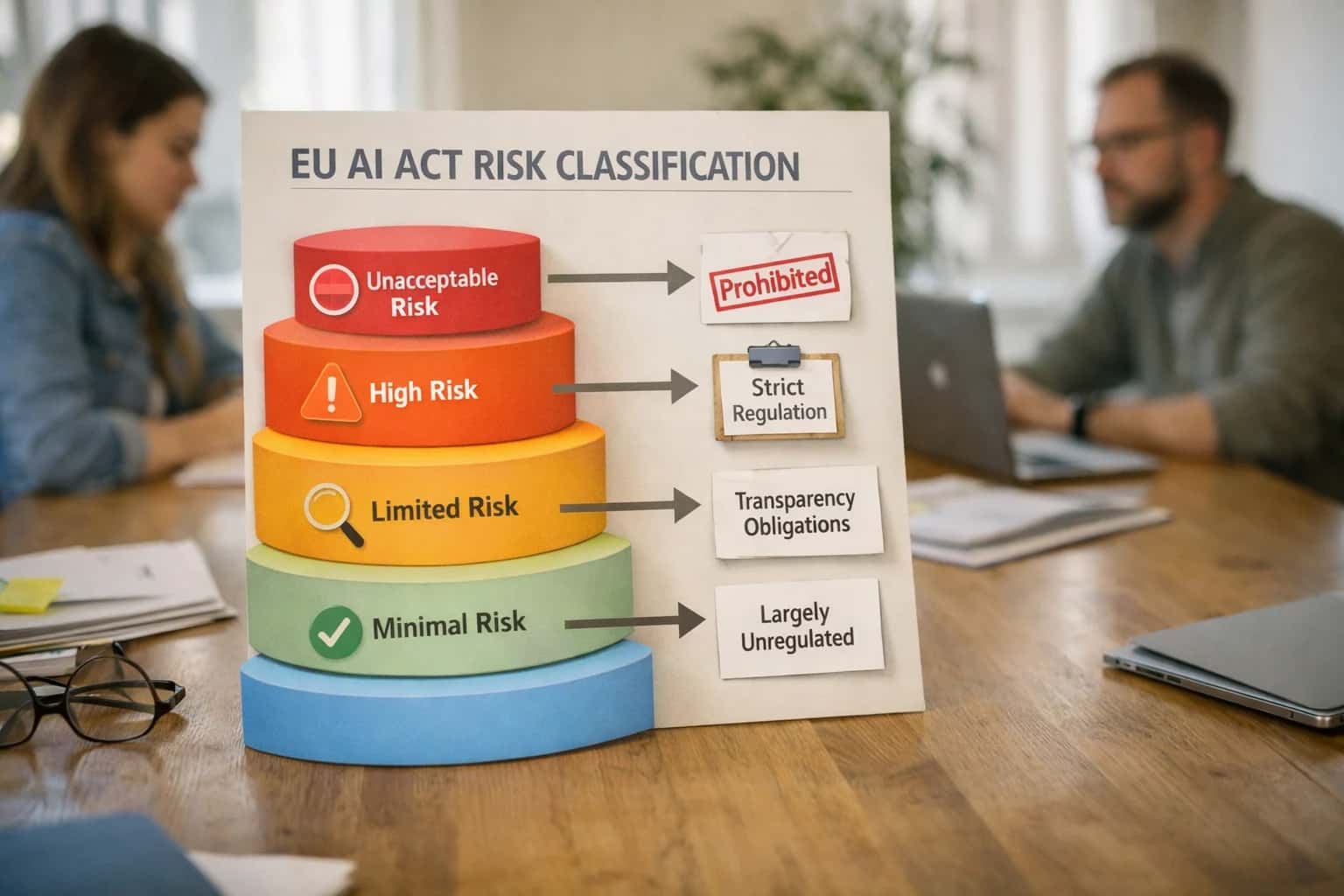
Under frameworks like the EU AI Act and GDPR Article 22, individuals are granted specific rights regarding these decisions, including the right to meaningful human intervention and a clear explanation of the logic involved. Common examples include automated hiring rejections, algorithmic loan denials, and predictive policing risk scores. The regulatory focus mandates strict human oversight and conformity assessments to prevent opaque, unchallengeable outcomes.
DEFINING CRITERIA
Core Characteristics of a Consequential Decision
A consequential decision is not merely any automated output. It is a specific legal and technical classification defined by the magnitude of its impact on an individual's life. The following characteristics distinguish a consequential decision from standard algorithmic processing.
01
Legal Effect
The decision must produce a binding change in an individual's legal status or rights. This goes beyond mere influence or recommendation.
- Contractual: Dissolution, denial, or alteration of a binding agreement.
- Entitlement: Granting or revoking a legal right, such as citizenship or custody.
- Legal Recourse: Affecting the ability to seek legal remedy or defense.
A decision that merely causes disappointment or inconvenience does not meet this threshold unless a statutory right is directly altered.
02
Similarly Significant Impact
This criterion captures effects that, while not strictly legal, are of equivalent gravity. The impact must substantially alter the circumstances of an individual's life.
- Economic Livelihood: Denial of credit, employment termination, or insurance premium hikes that block access to essential services.
- Educational Access: Rejection from a mandatory educational program or institution.
- Essential Services: Restriction of access to healthcare, housing, or social welfare benefits.
The key test is whether the outcome creates a serious, lasting, or irreversible disadvantage for the individual.
03
Solely Automated Processing
The decision must be made without any meaningful human intervention in the final determination. The system's output is the final verdict.
- No Rubber-Stamping: A human merely clicking 'approve' on a machine-generated decision does not constitute intervention.
- Profiling Basis: The decision is often based on automated profiling—evaluating personal aspects like work performance, economic situation, or health.
- Full Autonomy: The system autonomously executes the decision logic, such as an algorithm instantly rejecting a loan application without a loan officer's review.
If a human has actual authority and competence to override the algorithmic output, it is not 'solely' automated.
04
Specific Domain Triggers
Regulatory frameworks explicitly list domains where consequential decisions are presumed to occur due to inherent power imbalances.
- Employment: Algorithmic hiring, performance-based termination, or task assignment.
- Credit & Finance: Automated mortgage approvals, credit scoring, and fraud flagging that blocks accounts.
- Law Enforcement: Predictive policing, risk assessment for bail, or border control watchlists.
- Migration: Automated visa application filtering and asylum eligibility triage.
These sectors are under strict scrutiny because the decision directly impacts fundamental rights and economic survival.
05
Irreversibility & Finality
The decision carries a high degree of immediate finality, where the negative effect is difficult or impossible to unwind quickly.
- Temporal Sensitivity: A rejected emergency loan or a blocked organ transplant list entry cannot be retroactively fixed without severe harm.
- Cascading Effects: A single denial (e.g., a background check failure) can trigger a cascade of secondary denials (housing, employment).
- No Parallel Path: The individual has no alternative manual process to bypass the automated system in real-time.
This characteristic distinguishes a consequential decision from a low-stakes recommendation engine where the user can easily choose an alternative.
06
Individual vs. Collective Impact
The decision must target a specific, identifiable natural person, not a group or demographic aggregate.
- Singular Focus: The algorithm processes data points tied to a unique identity to produce a personalized outcome.
- Differentiation from Policy: A government algorithm deciding a tax rate for a population bracket is a policy rule, not a consequential decision. However, an algorithm deciding your specific tax audit risk score is.
- Right to Explanation: This individual targeting triggers the data subject's right to an explanation under GDPR and the EU AI Act, requiring specific logic disclosure for that single outcome.
CONSEQUENTIAL DECISIONS
Frequently Asked Questions
Clarifying the definition, scope, and regulatory implications of automated decisions that produce legal or similarly significant effects on individuals.
A consequential decision is an automated or semi-automated determination that produces a legal effect or a similarly significant impact on an individual. This definition, central to modern AI regulation, encompasses decisions that alter a person's legal rights, duties, or contractual status, as well as those that affect access to essential services or economic opportunities. The concept is a cornerstone of the EU AI Act and GDPR Article 22, which grants individuals the right not to be subject to solely automated decisions producing such effects. Consequential decisions are not merely inconvenient; they fundamentally shape a person's life circumstances through algorithmic processing.
- Legal Effect: Decisions that change an individual's legal status, such as granting or revoking a license, determining eligibility for social benefits, or executing a binding contract.
- Similarly Significant Impact: Decisions that, while not strictly legal, have a profound and lasting effect, such as denying credit, terminating employment, or restricting access to housing or education.
- Automated Processing: The decision is made without meaningful human intervention, relying entirely on algorithmic analysis of input data.
The classification of a decision as 'consequential' triggers mandatory obligations for human oversight, explainability, and impact assessments under frameworks like the EU AI Act.
Enabling Efficiency, Speed & Accuracy
Intelligent Analysis, Decision & Execution
We build AI systems for teams that need search across company data, workflow automation across tools, or AI features inside products and internal software.
Talk to Us
Search across company data
Give teams answers from docs, tickets, runbooks, and product data with sources and permissions.
Useful when people spend too long searching or get different answers from different systems.
Enterprise searchRAGPermissions
Read more
Automate internal workflows
Use AI to route work, draft outputs, trigger actions, and keep approvals and logs in place.
Useful when repetitive work moves across multiple tools and teams.
AI agentsWorkflow automationGovernance
Read more
Add AI to products and internal tools
Build assistants, guided actions, or decision support into the software your team or customers already use.
Useful when AI needs to be part of the product, not a separate tool.
AI integrationDecision supportModel routing
Read more
About the author
Prasad Kumkar
CEO & MD, Inference Systems
Prasad Kumkar is the CEO & MD of Inference Systems and writes about AI systems architecture, LLM infrastructure, model serving, evaluation, and production deployment. Over 5+ years, he has worked across computer vision models, L5 autonomous vehicle systems, and LLM research, with a focus on taking complex AI ideas into real-world engineering systems.
His work and writing cover AI systems, large language models, AI agents, multimodal systems, autonomous systems, inference optimization, RAG, evaluation, and production AI engineering.
LinkedIn
Limited slotsGet a Free AI Consultation
Partnered with leading AI, data, and software stack.





How We Work
Custom AI workflows for your Business
One-fit-all AI don't work for modern businesses. At Inferensys, we aim to understand your business & custom requirements; which we use to define most efficient agentic workflows, the data, and the tools for your business.
01
Review the use case
We understand the task, the users, and where AI can actually help.
Read more02
Pick the right approach
We define what needs search, automation, or product integration.
Read more03
Build the first useful version
We implement the part that proves the value first.
Read more04
Improve from there
We add the checks and visibility needed to keep it useful.
Read moreThe first call is a practical review of your use case and the right next step.
Talk to Us