Shadow Mode is a deployment pattern where a new or candidate machine learning model runs in parallel with the current production model, receiving identical live traffic. The shadow model generates predictions and logs them for offline analysis, but its output is discarded and never returned to the user. This allows teams to evaluate real-world performance, latency, and stability under genuine load without introducing risk.

Glossary
Shadow Mode
A deployment pattern where a new model runs in parallel with the production model, receiving live traffic and logging predictions without affecting the user-facing response.
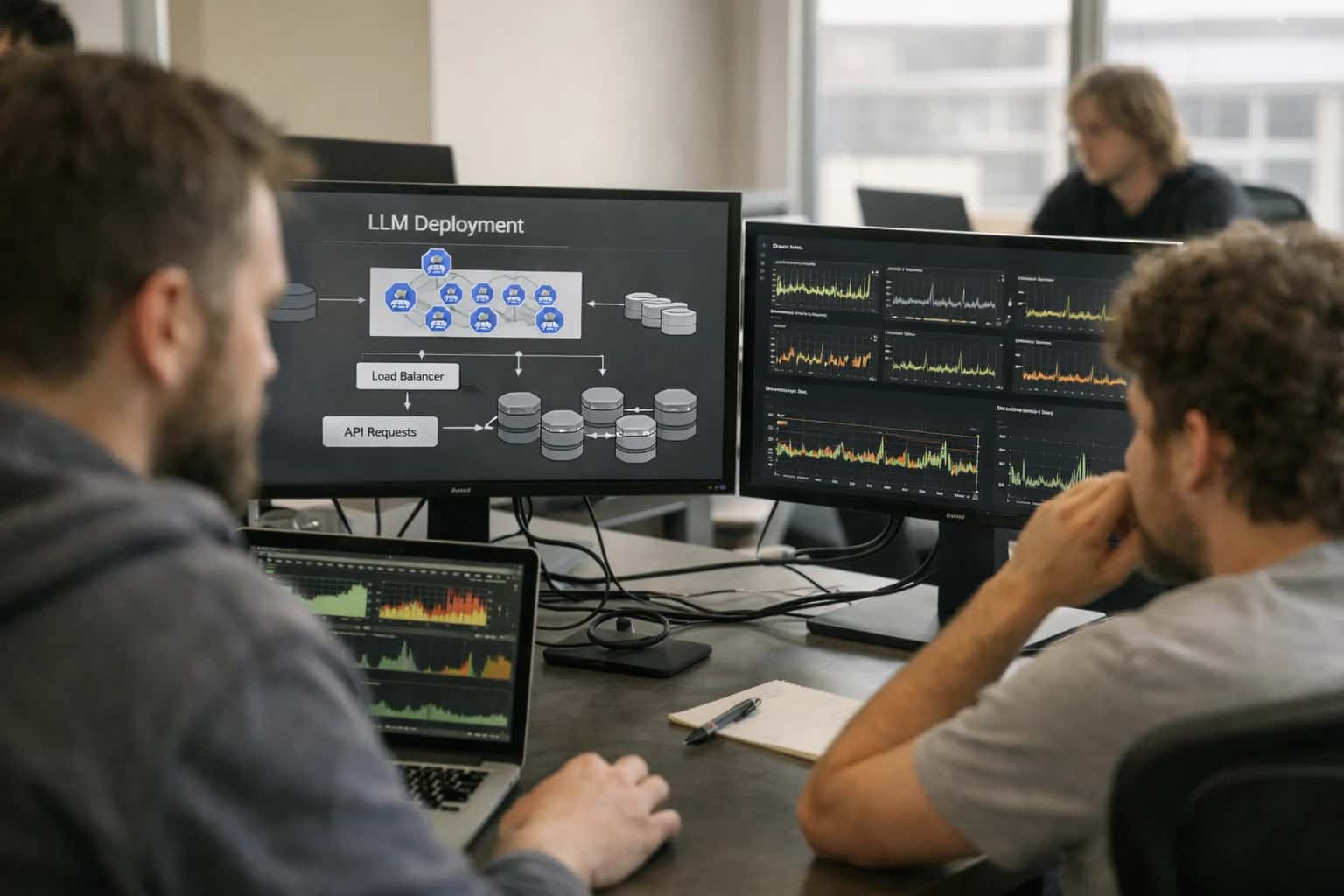
DEPLOYMENT PATTERN
What is Shadow Mode?
A risk-mitigation strategy for validating new machine learning models against live production traffic without impacting end users.
This technique is critical for model validation prior to canary deployment or full rollout. By comparing the shadow model's predictions against the production model's decisions and logged outcomes, engineers can detect drift, regressions, or unexpected behavior. Shadow Mode provides a safe, high-fidelity testing environment that synthetic benchmarks cannot replicate, forming a key component of AI incident response readiness.
DEPLOYMENT PATTERN
Key Characteristics of Shadow Mode
Shadow mode is a safe deployment pattern where a new model runs in parallel with the production model, receiving live traffic and logging predictions without affecting the user-facing response. This enables rigorous validation against real-world data before committing to a full rollout.
01
Silent Execution
The shadow model processes 100% of live production traffic but its outputs are never returned to the end user. Instead, predictions are logged to a data warehouse or observability platform for offline analysis. This creates a zero-risk environment where the model can encounter edge cases, adversarial inputs, and distribution shifts that synthetic test suites cannot replicate. The production response path remains completely untouched, ensuring no latency impact on the user experience.
02
Traffic Mirroring Architecture
Implementation typically involves a sidecar proxy or service mesh (e.g., Istio, Envoy) that duplicates incoming inference requests:
- The primary request is routed to the champion model for the user-facing response
- A cloned request is sent asynchronously to the challenger model running in shadow
- Responses from the shadow are captured in a dead letter queue or log sink for comparison This decoupling ensures the shadow model's latency or failures never degrade the production service level objective (SLO).
03
Prediction Diffing
The core analytical workflow compares shadow predictions against production outputs to quantify behavioral divergence. Key metrics include:
- Exact match rate: Percentage of identical predictions between champion and challenger
- Confidence delta: Difference in probability scores for the same input
- Regression detection: Cases where the shadow model performs worse on known benchmarks
- Novel disagreement analysis: Identifying input patterns where models diverge, revealing blind spots Tools like Great Expectations or custom dbt models automate this comparison pipeline.
04
Gradual Promotion Criteria
Shadow mode serves as the final validation gate before canary deployment. Promotion gates typically require:
- Statistical parity with production on key business metrics (e.g., click-through rate, fraud recall) over a minimum observation window (often 1-2 weeks)
- No regression on protected class segments, verified via fairness metrics like demographic parity
- Latency budget compliance: Shadow model inference time must stay within the production p99 threshold
- Error budget preservation: The shadow must not introduce new failure modes that would consume the team's error budget if promoted Only after passing all gates does the model proceed to a canary deployment targeting a small percentage of real users.
05
Infrastructure Cost Considerations
Running a shadow model effectively doubles inference compute costs since every request is processed twice. Mitigation strategies include:
- Traffic sampling: Mirroring only 10-20% of requests instead of 100% to reduce GPU/hardware expenditure
- Spot instance utilization: Running shadow inference on preemptible cloud instances to lower cost
- Model distillation: Deploying a compressed or quantized version of the challenger for shadow evaluation, trading some fidelity for cost efficiency
- Time-bound shadowing: Defining a fixed evaluation window (e.g., 7 days) rather than running indefinitely Cost-benefit analysis should weigh shadowing expense against the risk of a bad deployment causing revenue loss or safety incidents.
06
Relationship to Drift Detection
Shadow mode is a leading indicator for data and concept drift before they impact users. By comparing shadow predictions against production over time, teams can detect:
- Feature drift: Shifts in input distributions that the shadow model handles differently
- Concept drift: Changes in the underlying relationship between inputs and target variables
- Model staleness: Gradual degradation in the champion model that the shadow (trained on fresher data) does not exhibit This transforms shadow mode from a one-time validation tool into a continuous monitoring signal that can trigger automated retraining pipelines or alert on-call engineers before the error budget is breached.
SHADOW MODE EXPLAINED
Frequently Asked Questions
Clear, technical answers to the most common questions about running machine learning models in shadow mode for safe, low-risk validation against live production traffic.
Shadow mode is a deployment pattern where a new or candidate machine learning model runs in parallel with the existing production model, receiving a copy of live traffic and logging its predictions without affecting the user-facing response. The production model continues to serve all requests, while the shadow model's outputs are captured asynchronously for offline analysis. This allows engineering teams to validate performance, measure latency, and detect regressions against real-world data distributions without introducing any user-facing risk. The shadow model's predictions are typically compared against the production model's outputs or ground-truth labels that arrive later, enabling precise measurement of accuracy, drift, and behavioral differences before a full rollout.
Enabling Efficiency, Speed & Accuracy
Intelligent Analysis, Decision & Execution
We build AI systems for teams that need search across company data, workflow automation across tools, or AI features inside products and internal software.
Talk to Us
Search across company data
Give teams answers from docs, tickets, runbooks, and product data with sources and permissions.
Useful when people spend too long searching or get different answers from different systems.
Enterprise searchRAGPermissions
Read more
Automate internal workflows
Use AI to route work, draft outputs, trigger actions, and keep approvals and logs in place.
Useful when repetitive work moves across multiple tools and teams.
AI agentsWorkflow automationGovernance
Read more
Add AI to products and internal tools
Build assistants, guided actions, or decision support into the software your team or customers already use.
Useful when AI needs to be part of the product, not a separate tool.
AI integrationDecision supportModel routing
Read more
About the author
Prasad Kumkar
CEO & MD, Inference Systems
Prasad Kumkar is the CEO & MD of Inference Systems and writes about AI systems architecture, LLM infrastructure, model serving, evaluation, and production deployment. Over 5+ years, he has worked across computer vision models, L5 autonomous vehicle systems, and LLM research, with a focus on taking complex AI ideas into real-world engineering systems.
His work and writing cover AI systems, large language models, AI agents, multimodal systems, autonomous systems, inference optimization, RAG, evaluation, and production AI engineering.
LinkedIn
Limited slotsGet a Free AI Consultation
Partnered with leading AI, data, and software stack.





How We Work
Custom AI workflows for your Business
One-fit-all AI don't work for modern businesses. At Inferensys, we aim to understand your business & custom requirements; which we use to define most efficient agentic workflows, the data, and the tools for your business.
01
Review the use case
We understand the task, the users, and where AI can actually help.
Read more02
Pick the right approach
We define what needs search, automation, or product integration.
Read more03
Build the first useful version
We implement the part that proves the value first.
Read more04
Improve from there
We add the checks and visibility needed to keep it useful.
Read moreThe first call is a practical review of your use case and the right next step.
Talk to Us