Orchestration is the automated configuration, coordination, and management of computer systems, applications, and services. In robotics and embodied intelligence, this extends to managing the lifecycle of containerized software, synchronizing distributed perception-planning-action loops, and ensuring deterministic communication between sensors, controllers, and actuators. Tools like Kubernetes automate the deployment and scaling of software components, while frameworks like ROS 2 (built on DDS) orchestrate real-time data flow across the robot's computational graph.

Glossary
Orchestration
Orchestration is the automated configuration, coordination, and management of computer systems, applications, and services to execute complex workflows.
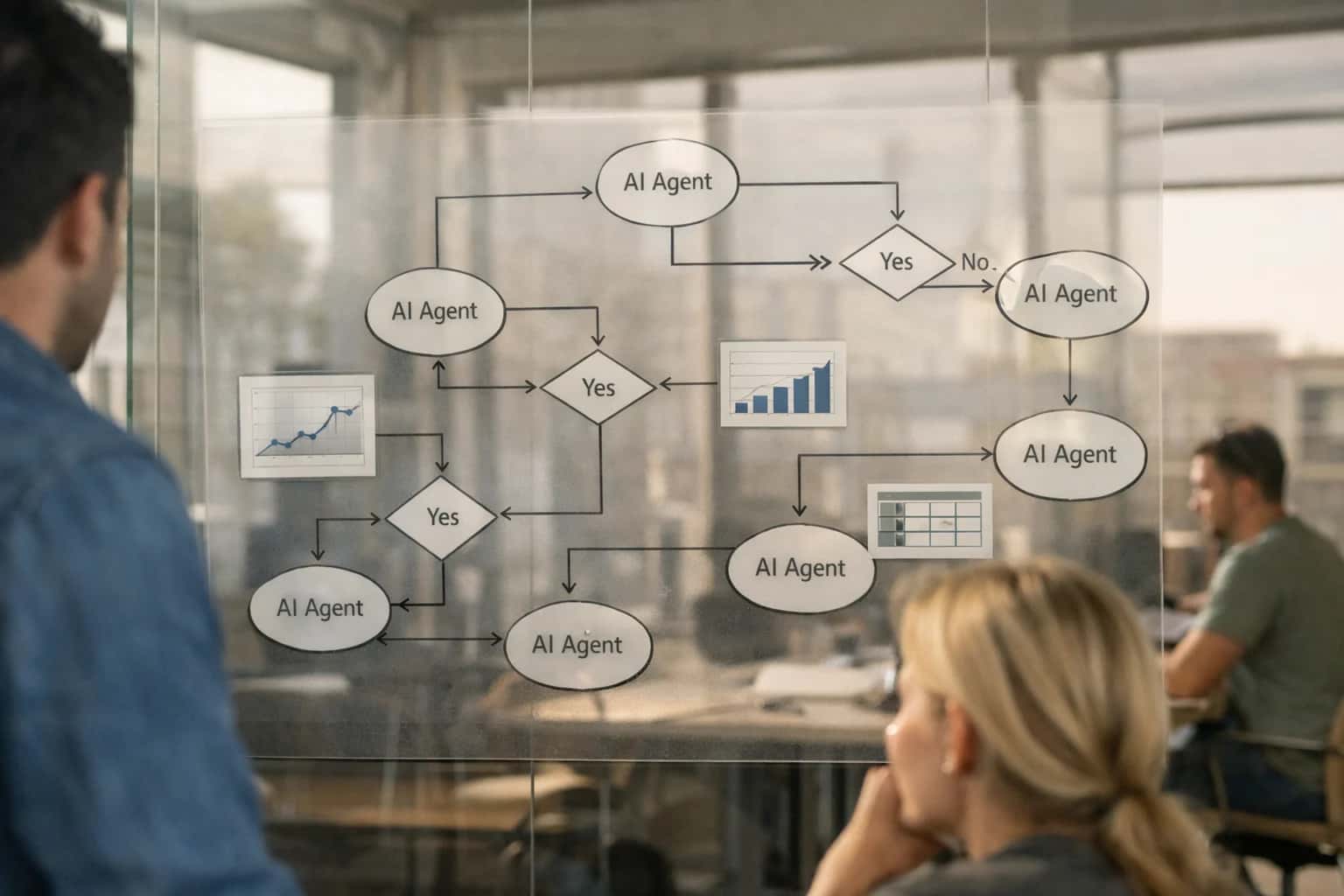
ROBOTIC SYSTEM INTEGRATION
What is Orchestration?
In robotic systems, orchestration is the automated configuration, coordination, and management of software processes, hardware components, and network communication to execute complex, multi-step tasks reliably.
Effective orchestration is critical for heterogeneous fleet management, sim-to-real transfer pipelines, and continuous integration/continuous deployment (CI/CD) for robotic software. It abstracts the complexity of hardware-in-the-loop (HIL) testing, sensor fusion, and real-time control systems, enabling engineers to define desired system behaviors declaratively. This automation ensures deterministic execution, manages fault detection and diagnostics, and is foundational for scalable, resilient autonomous systems operating in dynamic physical environments.
ROBOTIC SYSTEM INTEGRATION AND TESTING
Core Concepts of Orchestration
Orchestration is the automated configuration, coordination, and management of computer systems, applications, and services. In robotics, this extends to managing the lifecycle and interactions of heterogeneous hardware and software components to achieve a unified, functional system.
01
Workflow Automation
Orchestration automates multi-step processes, known as workflows or pipelines. In robotics, this involves sequencing tasks like sensor data ingestion, perception, planning, and actuation. The orchestrator manages dependencies, retries failed steps, and ensures the entire sequence executes deterministically. For example, a robotic pick-and-place workflow might be orchestrated to:
- Trigger a 3D scan.
- Run a grasp planning algorithm.
- Execute the arm trajectory.
- Verify placement via a camera.
02
Resource Scheduling & Allocation
A core function is the intelligent placement and management of computational workloads across available hardware resources. This involves:
- Scheduling tasks (e.g., a SLAM algorithm) onto specific CPU cores or a GPU.
- Scaling resources up or down based on demand.
- Managing contention for shared resources like network bandwidth or sensor buses. In a multi-robot fleet, the orchestrator acts as a central scheduler, ensuring compute nodes are not overloaded and tasks meet their real-time deadlines.
03
Service Discovery & Communication
Orchestration frameworks provide mechanisms for distributed software components to find and communicate with each other dynamically. Key concepts include:
- Service Discovery: A perception module advertises itself as a service; a planning module discovers its network endpoint without hard-coded addresses.
- Publish-Subscribe Messaging: Components communicate asynchronously via topics (e.g.,
/camera/image). - Health Checking: The orchestrator continuously monitors services, restarting them if they crash. This is foundational for systems built on middleware like ROS 2 and DDS.
04
State Management & Desired State Reconciliation
Orchestrators operate on a declarative model. Engineers define the desired state of the system (e.g., 'run 3 instances of the navigation node'). The orchestrator's control loop constantly observes the actual state and executes actions to reconcile any difference. This applies to:
- Software service counts.
- Network configurations.
- Deployed firmware versions. If a node fails, the orchestrator automatically recreates it to maintain the declared desired state, ensuring system resilience.
05
Configuration Management
Orchestration centralizes and automates the distribution of configuration parameters across a complex system. Instead of config files on individual devices, settings (e.g., PID controller gains, sensor calibration matrices, SLAM parameters) are defined as code and pushed by the orchestrator. This ensures:
- Consistency across all robot instances in a fleet.
- Version Control for configuration changes.
- Rollback Capability to a previous known-good state if a new config causes issues. This is closely related to Infrastructure as Code (IaC) practices.
06
Lifecycle Management
Orchestrators manage the full lifecycle of software components within a robotic system. This encompasses:
- Deployment: Packaging and distributing software (often in containers) to target hardware.
- Rolling Updates: Upgrading software across a fleet with zero downtime, by updating robots in subsets.
- Rollback: Automatically reverting to a previous version if an update fails health checks.
- Decommissioning: Gracefully shutting down and removing services. This capability is essential for implementing CI/CD pipelines for robotics, enabling safe, continuous improvement of deployed systems.
COMPARISON
Orchestration Across Different Contexts
A comparison of orchestration paradigms, highlighting their primary focus, abstraction level, and typical use cases in modern software and robotic systems.
| Feature / Dimension | Container Orchestration (e.g., Kubernetes) | Workflow Orchestration (e.g., Apache Airflow) | Multi-Agent System Orchestration | Robotic Fleet Orchestration |
|---|---|---|---|---|
Primary Abstraction | Containerized application services | Directed Acyclic Graphs (DAGs) of tasks | Autonomous, communicative agents | Physical robots and their missions |
Core Objective | Declarative deployment, scaling, and lifecycle management of stateless/stateful services | Scheduling, dependency management, and execution of batch data pipelines or business logic | Coordinating goal-directed behavior, communication, and conflict resolution between intelligent agents | Managing the state, task allocation, and safe navigation of a heterogeneous physical fleet |
Key Managed Resource | Compute (CPU/Memory), Network, Storage | Task execution slots, DAG run history | Agent policies, communication channels, shared knowledge | Robot battery/health, physical location, task queue, environmental map |
Temporal Granularity | Seconds to minutes (service lifecycle) | Minutes to hours (job execution) | Milliseconds to seconds (agent decision cycles) | Sub-second to minutes (real-time control, mission planning) |
State Management Paradigm | Desired State Reconciliation (control loop) | Task State Persistence (success/failure/retry) | Distributed, often eventual consistency (beliefs, intentions) | Centralized or distributed with strong real-time constraints |
Scheduling Determinism | Best-effort, prioritization via QoS classes | Time-based or event-driven, predictable | Often probabilistic or negotiation-based | Hard real-time requirements for safety-critical actions |
Failure Handling | Automatic restart, pod rescheduling | Task retries, alerting, DAG failure branching | Re-planning, role re-assignment, graceful degradation | Safe stop, contingency mission plans, manual takeover protocols |
Typical Environment | Cloud or on-premise data centers | Data centers (batch processing) | Simulated or digital environments (can be embodied) | Unstructured, dynamic physical world (warehouse, factory, outdoors) |
Integration Testing Focus | Service discovery, network policies, rolling updates | Data pipeline integrity, idempotency, data lineage | Protocol adherence, emergent system behavior, collaboration metrics | Hardware-in-the-Loop (HIL), sensor fusion, safety interlocks, real-time performance |
CORE ARCHITECTURAL ELEMENTS
Key Components in Robotic System Orchestration
Orchestration in robotics refers to the automated configuration, coordination, and management of heterogeneous hardware and software components to execute complex, multi-step physical tasks. This involves deterministic scheduling, state management, and fault handling across distributed systems.
01
Task Scheduler & Dispatcher
The central brain that decomposes high-level mission commands into a sequence of atomic actions and allocates them to specific hardware resources. It manages priority queues, handles preemption for urgent tasks, and ensures deterministic execution to meet real-time deadlines. For example, in a warehouse robot, this component would sequence navigation, picking, and placing actions while ensuring the arm does not move before the base is stable.
02
Resource Manager & Health Monitor
A dynamic inventory system that tracks the status, capability, and availability of all system assets. This includes:
- Hardware resources: CPU load on compute units, battery levels, actuator temperatures, and sensor health.
- Software services: Latency and uptime of perception pipelines or planning modules. It performs heartbeat monitoring and can trigger graceful degradation or failover procedures if a critical component fails.
03
State Machine & Workflow Engine
Manages the discrete operational states of the robot and the conditional logic governing transitions between them. This engine executes finite state machines or more complex behavior trees that define task logic. For instance, a manipulation workflow might have states for APPROACH, GRASP, LIFT, and PLACE, with transitions conditioned on successful grasp verification from a vision system.
04
Inter-Process Communication (IPC) Layer
The messaging backbone that enables data exchange between decoupled software modules (nodes). In modern systems, this is often implemented via a Data Distribution Service (DDS) or ROS 2 middleware, which provides publish-subscribe and request-reply patterns with quality-of-service (QoS) policies. This layer ensures sensor data from a LiDAR node reaches the perception and planning nodes with deterministic latency.
05
Fault Handler & Recovery System
A dedicated subsystem for detecting, diagnosing, and recovering from errors. It implements strategies like:
- Retry logic for transient network failures.
- Fallback behaviors (e.g., switching to a secondary navigation algorithm if the primary fails).
- Safe-state transitions (e.g., executing an emergency stop and broadcasting a fault code). This component is critical for functional safety and system resilience.
06
Configuration & Deployment Manager
Handles the distribution and activation of software packages, parameters, and calibration files across the robot's compute landscape. It uses Infrastructure as Code (IaC) principles and often leverages containerization (e.g., Docker) to ensure consistent runtime environments. This manager facilitates Over-the-Air (OTA) updates and A/B testing of new algorithms without taking the entire system offline.
ORCHESTRATION
Frequently Asked Questions
Orchestration is the automated configuration, coordination, and management of complex systems, applications, and services. In the context of robotic system integration, it refers to the software platforms that manage the lifecycle, communication, and execution of distributed components to achieve a unified operational goal.
Orchestration in robotics is the automated coordination of software processes, hardware resources, and data flows across a distributed system to execute complex, multi-step tasks. It works by using a central orchestrator—a software platform like Kubernetes or a specialized fleet management system—that defines tasks as declarative states. The orchestrator continuously monitors the system's actual state, compares it to the desired state, and issues commands to individual components (e.g., a perception node, a planner, a motor controller) to reconcile any differences. It handles service discovery, load balancing, failure recovery, and scaling, ensuring that the entire robotic application behaves as a cohesive unit.
Enabling Efficiency, Speed & Accuracy
Intelligent Analysis, Decision & Execution
We build AI systems for teams that need search across company data, workflow automation across tools, or AI features inside products and internal software.
Talk to Us
Search across company data
Give teams answers from docs, tickets, runbooks, and product data with sources and permissions.
Useful when people spend too long searching or get different answers from different systems.
Enterprise searchRAGPermissions
Read more
Automate internal workflows
Use AI to route work, draft outputs, trigger actions, and keep approvals and logs in place.
Useful when repetitive work moves across multiple tools and teams.
AI agentsWorkflow automationGovernance
Read more
Add AI to products and internal tools
Build assistants, guided actions, or decision support into the software your team or customers already use.
Useful when AI needs to be part of the product, not a separate tool.
AI integrationDecision supportModel routing
Read more
About the author
Prasad Kumkar
CEO & MD, Inference Systems
Prasad Kumkar is the CEO & MD of Inference Systems and writes about AI systems architecture, LLM infrastructure, model serving, evaluation, and production deployment. Over 5+ years, he has worked across computer vision models, L5 autonomous vehicle systems, and LLM research, with a focus on taking complex AI ideas into real-world engineering systems.
His work and writing cover AI systems, large language models, AI agents, multimodal systems, autonomous systems, inference optimization, RAG, evaluation, and production AI engineering.
LinkedIn
Limited slotsGet a Free AI Consultation
Partnered with leading AI, data, and software stack.





How We Work
Custom AI workflows for your Business
One-fit-all AI don't work for modern businesses. At Inferensys, we aim to understand your business & custom requirements; which we use to define most efficient agentic workflows, the data, and the tools for your business.
01
Review the use case
We understand the task, the users, and where AI can actually help.
Read more02
Pick the right approach
We define what needs search, automation, or product integration.
Read more03
Build the first useful version
We implement the part that proves the value first.
Read more04
Improve from there
We add the checks and visibility needed to keep it useful.
Read moreThe first call is a practical review of your use case and the right next step.
Talk to Us