Teleoperation is the direct, real-time remote control of a robotic manipulator by a human operator. It bridges the gap between human cognition and physical actuation, allowing an operator to perform complex dexterous manipulation or operate in hazardous environments like nuclear facilities or deep-sea exploration. The operator typically uses a master controller—which can be a replica arm, a haptic device, or a simple joystick—to command the motion of the remote slave robot. This direct control loop is foundational for Learning from Demonstration (LfD), where teleoperated sessions generate the expert data used to train autonomous policies.

Glossary
Teleoperation
Teleoperation is the direct, real-time remote control of a robotic manipulator by a human operator, enabling operation in hazardous or inaccessible environments.
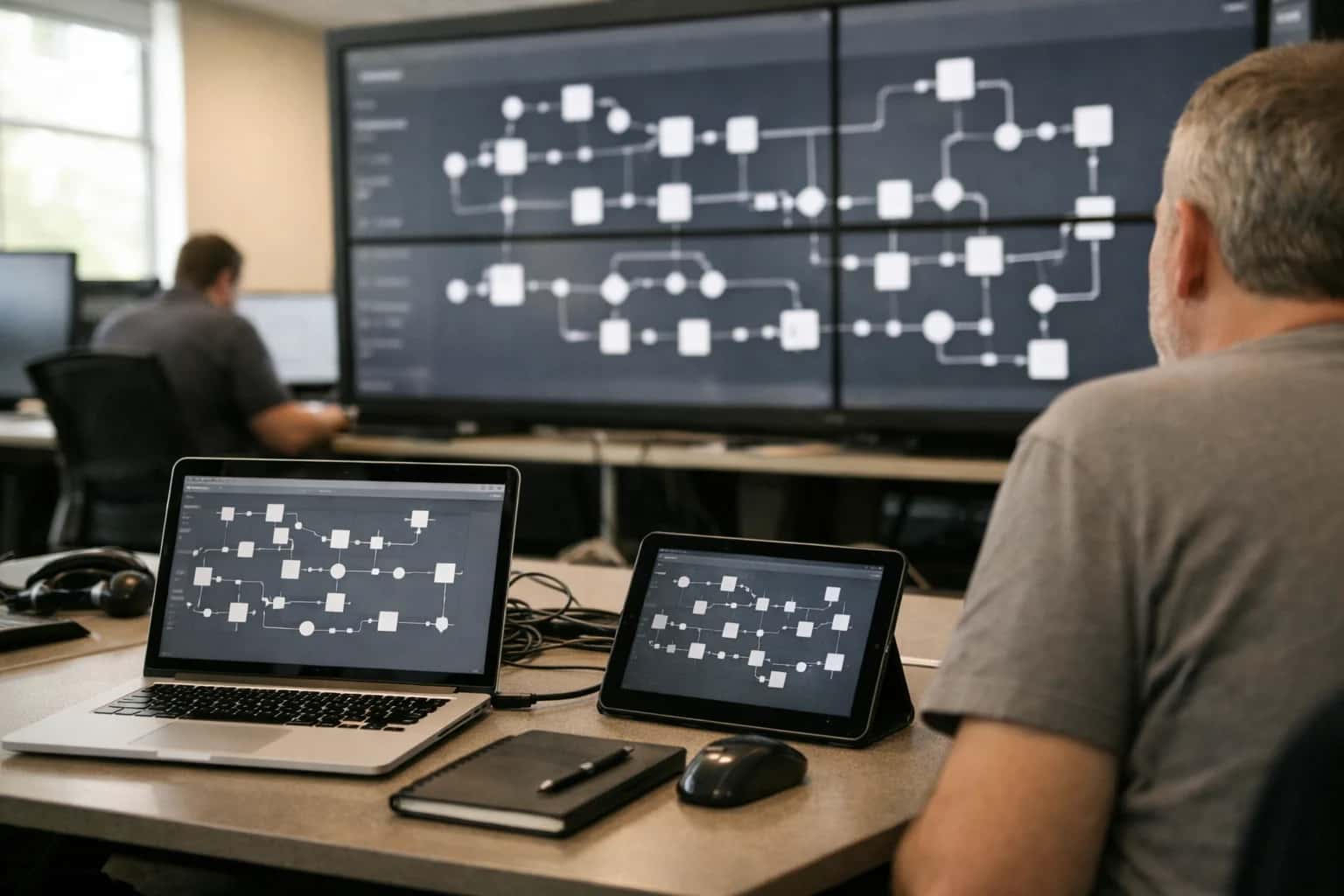
ROBOT MANIPULATION AND GRASPING
What is Teleoperation?
Teleoperation is the direct, real-time remote control of a robotic manipulator by a human operator.
Effective teleoperation systems require low-latency communication and often incorporate force/torque sensing and haptic feedback to provide the operator with a sense of touch. This bilateral control enables precise tasks like compliant assembly or surgery. While distinct from autonomous Task and Motion Planning (TAMP), teleoperation is a critical tool for data collection, remote intervention, and tasks where full autonomy remains unreliable. Modern approaches increasingly blend direct control with autonomous assists, such as shared control, where the robot handles low-level stability while the operator guides high-level intent.
ROBOT MANIPULATION AND GRASPING
Core Characteristics of Teleoperation Systems
Teleoperation systems enable direct human control of a remote robotic manipulator. Their effectiveness is defined by several key engineering characteristics that determine performance, safety, and usability.
01
Master-Slave Architecture
The fundamental control paradigm of teleoperation, consisting of two distinct subsystems. The master device is the human-operated input controller (e.g., a haptic joystick, exoskeleton, or 3D mouse). The slave manipulator is the remote robot that replicates the master's commanded motions. The system's control loop continuously maps the master's position/velocity to the slave's actuators. Key design considerations include the control mapping (position-to-position, position-to-velocity) and the degree of kinematic similarity between master and slave, which affects operator intuitiveness.
02
Bilateral Teleoperation & Haptic Feedback
Advanced teleoperation systems feature bilateral control, where force/torque data flows in both directions. While the master sends motion commands to the slave, sensors on the slave (e.g., force/torque sensors) measure contact forces. This data is sent back to actuate motors on the master device, providing the operator with kinesthetic haptic feedback. This allows the operator to 'feel' contact, texture, and stiffness, enabling:
- Force-reflective control for delicate tasks (e.g., assembly, surgery).
- Detection of unexpected collisions.
- Improved task performance and reduced mental load. Without haptics, the system is unilateral, relying solely on visual feedback, which can lead to excessive forces and task failure.
03
Time Delay & Stability
Latency between command and execution is the primary technical challenge. Time delay arises from signal transmission over distance (e.g., satellite links, internet) and computational processing. Even delays of a few hundred milliseconds can cause operator disorientation, oscillatory instability, and loss of control. Engineers combat this with:
- Predictive displays: Overlaying a ghost model of the robot's predicted future state on the video feed.
- Wave variables & passivity theory: Mathematical control frameworks that guarantee stability despite unknown, constant time delays by ensuring the network does not generate energy.
- Supervisory control: Automating low-level stability (e.g., grip force) while the operator provides high-level guidance.
04
Transparency & Fidelity
Transparency is the ideal where the teleoperation system becomes 'invisible' to the operator, making the remote environment feel directly manipulable. It is measured by the accuracy with which the mechanical impedance (the dynamic relationship between motion and force) of the remote environment is reproduced at the master device. High transparency requires:
- High-fidelity, low-latency haptic feedback.
- Minimal inertia and friction in the master device.
- Precise kinematic and dynamic scaling (e.g., moving the master 1 cm moves the slave 10 cm for microsurgery). Poor transparency increases cognitive load and reduces task performance, as the operator must mentally compensate for the system's dynamics.
05
Shared & Supervisory Control Modes
Modern systems blend direct human control with autonomous assistance to improve outcomes. Shared control combines human and autonomous inputs in real-time (e.g., the human guides direction while an algorithm enforces obstacle avoidance or stabilizes a tool). Supervisory control places the human in a high-level monitoring role, where they specify goals or constraints (e.g., 'grasp the valve') and autonomous subsystems execute the detailed perception, planning, and low-level control. This spectrum reduces operator fatigue and leverages machine precision for subtasks while retaining human judgment for high-level decision-making.
06
Primary Application Domains
Teleoperation is deployed where direct human presence is impossible, dangerous, or impractical.
- Surgery: Robotic-assisted systems like the da Vinci Surgical System provide surgeons with tremor-filtered, scaled motions and 3D vision for minimally invasive procedures.
- Hazardous Environments: Handling radioactive materials, explosive ordnance disposal (EOD), and deep-sea/subsea infrastructure maintenance.
- Space Robotics: Controlling robotic arms on the International Space Station (ISS) or future planetary rovers from Earth, facing significant multi-second time delays.
- Demonstration Collection: A primary method for gathering expert trajectories for Imitation Learning (LfD), where a robot learns a policy by observing teleoperated demonstrations.
CONTROL ARCHITECTURE
Teleoperation Control Modes: Direct vs. Supervisory
A comparison of the two primary paradigms for human-in-the-loop remote robotic control, detailing their operational characteristics, latency tolerance, and typical use cases.
| Feature / Characteristic | Direct Control (Continuous, 1:1) | Shared Control (Assisted) | Supervisory Control (Intermittent) |
|---|---|---|---|
Primary Control Input | Continuous joystick, haptic device, or motion capture | Continuous input with automated assistance (e.g., virtual fixtures) | High-level commands (e.g., 'grasp object A', 'move to pose B') |
Control Loop Frequency | High (≥ 30 Hz), real-time | High (≥ 30 Hz), real-time | Low (0.1 - 5 Hz), deliberative |
Human Role | Low-level actuator | Co-pilot | Supervisor / planner |
Autonomy Level | None (Full manual) | Low (Assistance for stability, guidance) | High (Autonomous execution of sub-tasks) |
Latency Tolerance | Very Low (< 100-200 ms critical) | Low (< 200-500 ms) | High (Seconds to minutes) |
Operator Cognitive Load | Very High (Demands constant attention) | Moderate (Shared with automation) | Low (Monitoring and high-level decision) |
Bandwidth Requirement | High (Continuous high-rate command stream) | High (Continuous command + sensor data) | Low (Intermittent commands, status updates) |
Typical Feedback | Visual (live video), haptic (force reflection) | Visual, haptic, augmented reality overlays | Visual (processed video), symbolic state updates |
Primary Use Case | Unstructured, dynamic tasks (e.g., disaster response, surgery) | Precision tasks with structure (e.g., assembly, welding) | Structured, repetitive tasks in known environments (e.g., warehouse tele-picking) |
Error Correction Responsibility | Entirely operator | Shared (operator + assistance system) | Primarily autonomous system, operator intervenes on failure |
Example System | Da Vinci Surgical System, bomb disposal robot | Robot-assisted machining with path guidance | Autonomous mobile manipulator with human oversight for exception handling |
KEY TECHNICAL CHALLENGES AND SOLUTIONS
Teleoperation
Teleoperation is the direct, real-time remote control of a robotic manipulator by a human operator, often used for complex tasks, demonstration collection, or operation in hazardous environments.
Teleoperation is the direct, real-time remote control of a robotic manipulator by a human operator. It is a foundational technique in embodied intelligence systems, enabling robots to perform complex tasks in environments too dangerous or inaccessible for humans. The core challenge is creating a low-latency, high-fidelity control loop that translates the operator's inputs into precise physical actions while providing sufficient sensory feedback, such as video and force/torque sensing, to maintain situational awareness and control.
Modern solutions address the inherent latency and bandwidth limitations of remote operation. Bilateral control architectures transmit both motion commands and haptic feedback, allowing the operator to 'feel' contact forces. Predictive displays and model predictive control (MPC) can compensate for signal delay. Furthermore, teleoperation is a primary method for learning from demonstration (LfD), where recorded operator sessions generate training data for autonomous imitation learning policies, bridging the gap between direct human control and full autonomy.
TELEOPERATION
Frequently Asked Questions
Teleoperation is the direct, real-time remote control of a robotic manipulator by a human operator. This FAQ addresses its core mechanisms, applications, and relationship to modern robotics and AI.
Teleoperation is the direct, real-time remote control of a robotic manipulator or mobile robot by a human operator. It works by establishing a bidirectional control loop: the operator's commands (from a master controller) are transmitted to the robot (the slave), while sensor data (video, force feedback, joint states) is streamed back to the operator's interface. This creates a closed-loop system where the human provides high-level perception, planning, and adaptability, while the robot executes precise physical actuation. Key enabling technologies include low-latency communication links, haptic feedback devices, and intuitive control interfaces like exoskeletons or space-mouse controllers.
Enabling Efficiency, Speed & Accuracy
Intelligent Analysis, Decision & Execution
We build AI systems for teams that need search across company data, workflow automation across tools, or AI features inside products and internal software.
Talk to Us
Search across company data
Give teams answers from docs, tickets, runbooks, and product data with sources and permissions.
Useful when people spend too long searching or get different answers from different systems.
Enterprise searchRAGPermissions
Read more
Automate internal workflows
Use AI to route work, draft outputs, trigger actions, and keep approvals and logs in place.
Useful when repetitive work moves across multiple tools and teams.
AI agentsWorkflow automationGovernance
Read more
Add AI to products and internal tools
Build assistants, guided actions, or decision support into the software your team or customers already use.
Useful when AI needs to be part of the product, not a separate tool.
AI integrationDecision supportModel routing
Read more
About the author
Prasad Kumkar
CEO & MD, Inference Systems
Prasad Kumkar is the CEO & MD of Inference Systems and writes about AI systems architecture, LLM infrastructure, model serving, evaluation, and production deployment. Over 5+ years, he has worked across computer vision models, L5 autonomous vehicle systems, and LLM research, with a focus on taking complex AI ideas into real-world engineering systems.
His work and writing cover AI systems, large language models, AI agents, multimodal systems, autonomous systems, inference optimization, RAG, evaluation, and production AI engineering.
LinkedIn
Limited slotsGet a Free AI Consultation
Partnered with leading AI, data, and software stack.





How We Work
Custom AI workflows for your Business
One-fit-all AI don't work for modern businesses. At Inferensys, we aim to understand your business & custom requirements; which we use to define most efficient agentic workflows, the data, and the tools for your business.
01
Review the use case
We understand the task, the users, and where AI can actually help.
Read more02
Pick the right approach
We define what needs search, automation, or product integration.
Read more03
Build the first useful version
We implement the part that proves the value first.
Read more04
Improve from there
We add the checks and visibility needed to keep it useful.
Read moreThe first call is a practical review of your use case and the right next step.
Talk to Us