
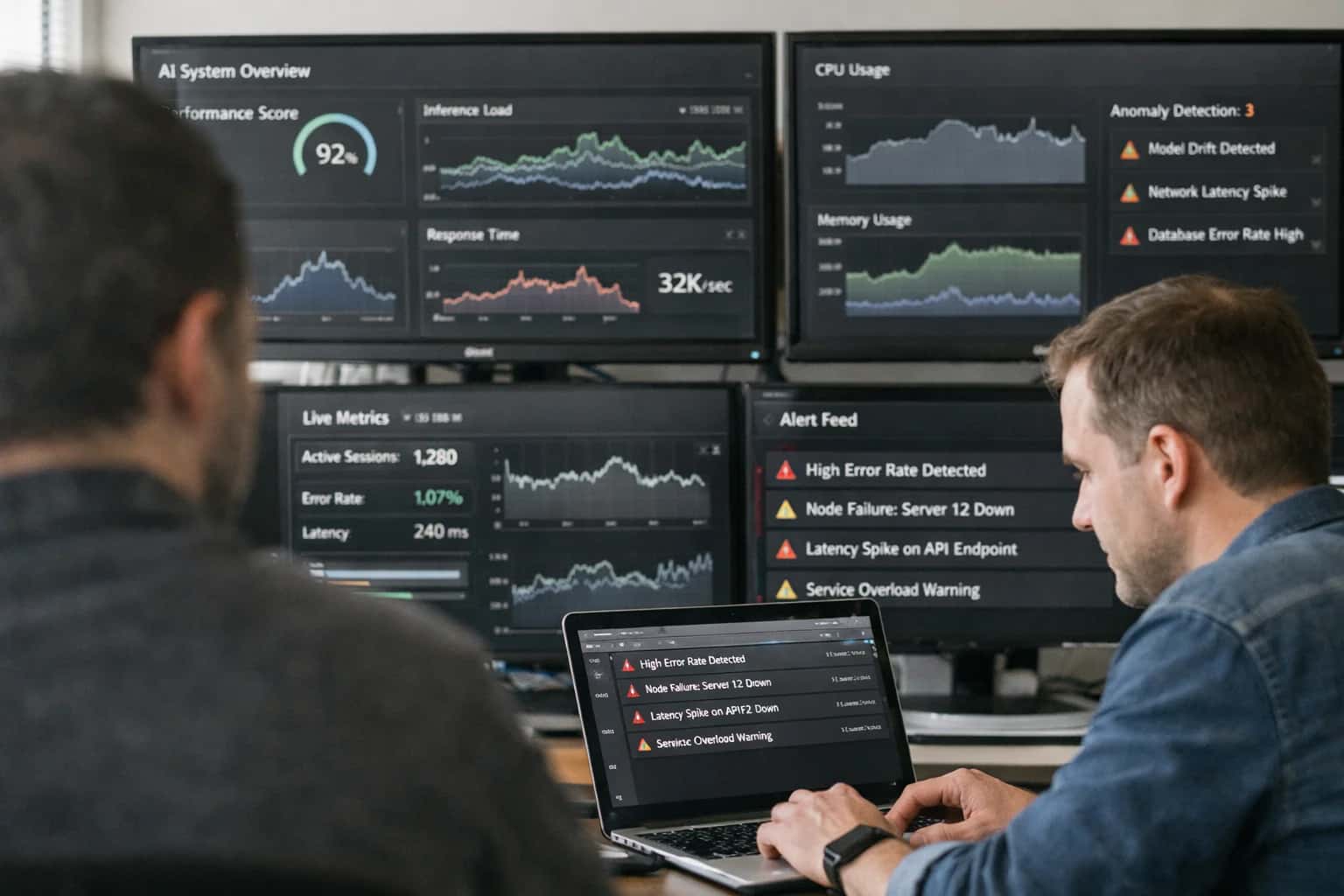
A digital twin is a dynamic, data-driven virtual representation of a physical asset, system, or process that mirrors its real-world counterpart throughout its lifecycle. It is continuously synchronized via sensor telemetry and operational data, enabling real-time monitoring, predictive analysis, and what-if scenario testing in a risk-free virtual environment. This bidirectional data flow distinguishes it from a static 3D CAD model or offline simulation.
DIGITAL TWIN
Primary Use Cases in AI & Robotics
A digital twin is a dynamic virtual model of a physical system, continuously synchronized with real-world data. In AI and robotics, it serves as a foundational tool for simulation, analysis, and autonomous system development.
01
Virtual Prototyping & Design Optimization
Digital twins enable virtual prototyping, allowing engineers to design, test, and iterate on robotic systems entirely in simulation before physical manufacturing. This accelerates development cycles and reduces costs.
- Key Process: Engineers model the robot's kinematics, dynamics, and sensors in a high-fidelity physics engine (e.g., MuJoCo, NVIDIA Isaac Sim).
- Optimization Loop: The digital twin is used to run thousands of simulated stress tests, evaluate different materials, and optimize for performance metrics like energy efficiency or payload capacity.
- Example: An automotive manufacturer uses a digital twin of a robotic welding arm to simulate millions of cycles, identifying fatigue points and optimizing the arm's design to extend its operational lifespan by 30%.
02
Predictive Maintenance & Health Monitoring
By streaming real-time sensor data (vibration, temperature, current draw) from a physical robot to its digital twin, AI models can predict failures before they occur.
- Mechanism: The twin acts as a baseline model of normal operation. Machine learning algorithms, such as anomaly detection models, compare live telemetry against this baseline to identify deviations.
- Outcome: This enables condition-based maintenance, scheduling repairs only when needed, which minimizes unplanned downtime. For example, a digital twin of a fleet of autonomous mobile robots (AMRs) in a warehouse can predict motor bearing failures weeks in advance.
- Integration: This use case is tightly linked with Data Observability pillars, ensuring the sensor data pipeline feeding the twin is reliable and accurate.
03
Sim-to-Real Training for Robotic AI
Digital twins provide the simulated environments essential for training AI-driven robots via reinforcement learning (RL) and imitation learning. This is the core of the Sim-to-Real Transfer paradigm.
- Training Ground: Robots practice complex tasks—like manipulation or locomotion—millions of times in the risk-free digital twin. Techniques like Domain Randomization (varying textures, lighting, physics parameters) are applied to the twin to create robust policies that bridge the reality gap.
- Workflow: A policy trained in the digital twin is deployed to the physical robot. The twin can then be used for ongoing adaptation, where data from the real world is used to refine the simulation model, creating a continuous learning loop.
- Tooling: Platforms like NVIDIA Isaac Lab are built specifically for this use case, leveraging digital twins for large-scale parallel RL training.
04
Operational Planning & What-If Analysis
Digital twins serve as a command and control sandbox, allowing operators to simulate and evaluate different operational scenarios for robotic fleets or automated production lines.
- Process: The current state of a physical system (e.g., a smart factory) is mirrored in the twin. Planners can then inject virtual events—like a machine breakdown or a priority order—and use the twin to test different robotic responses and scheduling algorithms.
- Outcome: This enables optimal decision-making by identifying the most efficient recovery path or workflow adjustment before issuing commands to the physical system. It is critical for Heterogeneous Fleet Orchestration in logistics.
- Example: A port authority uses a digital twin of its container yard to simulate the impact of a new vessel arrival, automatically generating an optimal sequence for autonomous straddle carriers to maintain throughput.
05
Human-Robot Collaboration & Safety Validation
Digital twins model not just robots, but also their dynamic environments, including human workers. This is vital for designing and validating safe Human-Robot Interaction (HRI).
- Safety Simulation: The twin can run worst-case scenario simulations to validate that a robot's speed, force, and emergency stop protocols (governed by standards like ISO/TS 15066) will prevent injury during collaborative tasks.
- Digital Shadowing: A human operator's motions, captured via sensors, can be imported into the twin to test new collaborative workflows virtually. The robot's AI can be trained in the twin to predict human intent and motion for smoother cooperation.
- Application: In Software-Defined Manufacturing, a digital twin of a collaborative assembly cell is used to program and certify new tasks without ever stopping the physical production line.
06
Closed-Loop Autonomous Control
A digital twin can function as a high-fidelity predictive model within a Model Predictive Control (MPC) or other advanced control scheme, enabling more agile and stable autonomous operation.
- Mechanism: The control algorithm uses the digital twin to predict the system's future state over a short time horizon (e.g., the next 0.5 seconds) based on potential control inputs. It then selects the optimal input sequence to achieve a goal.
- Advantage: This allows the robot to anticipate and compensate for dynamics, delays, and external disturbances in real-time. For legged robots, this is essential for maintaining balance on uneven terrain.
- Integration: This requires a Real-Time Robotic Control System and a twin with extremely high Simulation Fidelity to ensure predictions are accurate enough for physical actuation.









