Robot Fleet Management (RFM) is the centralized software platform responsible for the high-level monitoring, task orchestration, health diagnostics, and logistical coordination of a large-scale deployment of commercial or industrial robots, such as autonomous mobile robots (AMRs) in a warehouse or fulfillment center. It functions as the supervisory control and data acquisition (SCADA) system for physical automation, translating business-level orders into executable robot missions while ensuring system-wide efficiency and safety.

Glossary
Robot Fleet Management (RFM)
Robot Fleet Management (RFM) is the software system responsible for the high-level monitoring, tasking, health-checking, and orchestration of a large number of commercial or industrial robots.
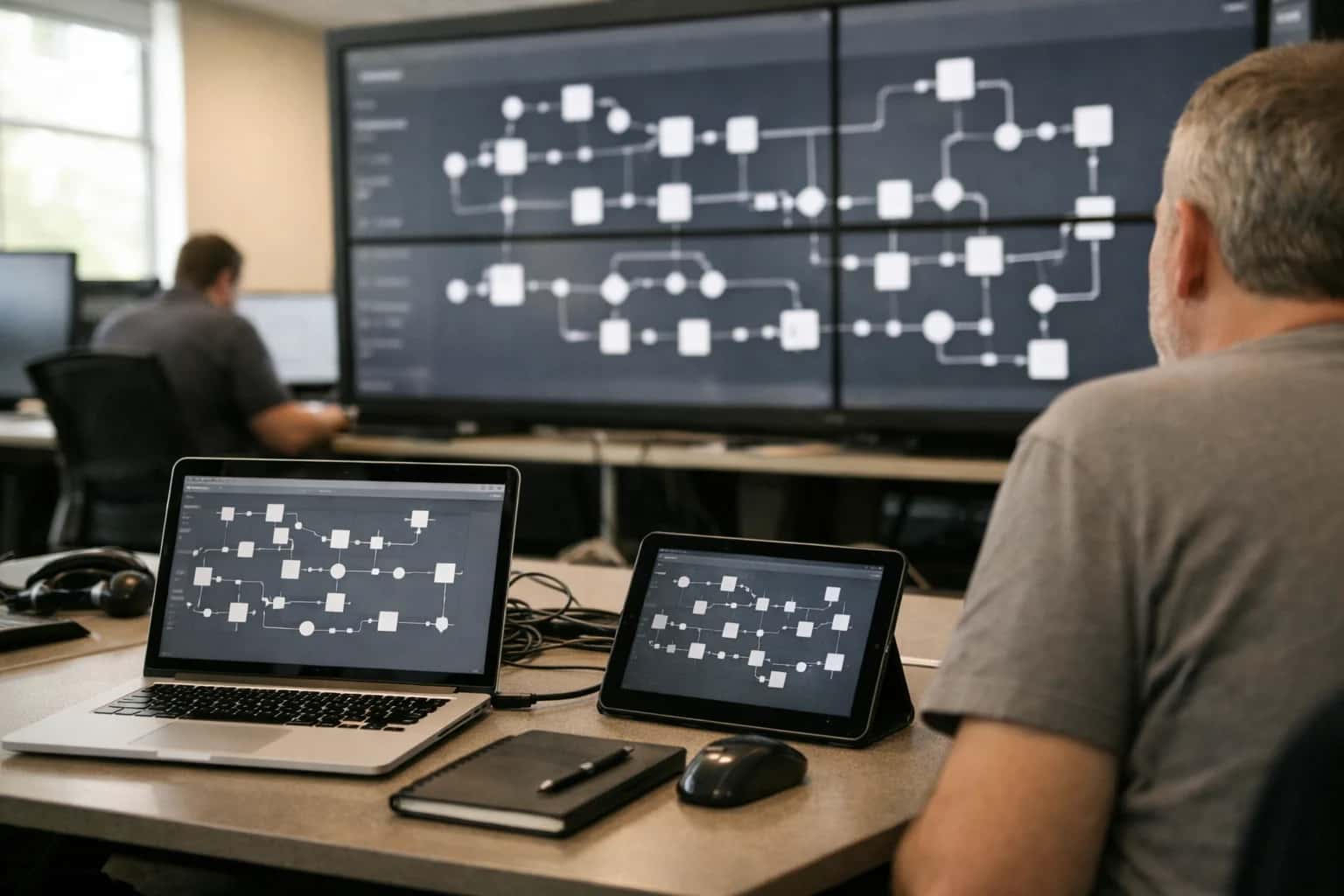
MULTI-ROBOT COORDINATION SYSTEMS
What is Robot Fleet Management (RFM)?
A technical overview of the centralized software systems for orchestrating large-scale deployments of commercial robots.
Core RFM capabilities include Multi-Robot Task Allocation (MRTA) to optimally assign jobs, real-time fleet telemetry for monitoring battery and system health, and traffic management to prevent deadlocks and collisions. It integrates with higher-level warehouse management systems and lower-level robot operating systems (ROS), providing a critical abstraction layer that enables scalable, heterogeneous fleet operations. This shifts control from individual robot programming to system-level optimization of throughput and resource utilization.
SYSTEM ARCHITECTURE
Core Functions of an RFM System
A Robot Fleet Management (RFM) system is the central nervous system for a team of physical robots. It provides the high-level software layer responsible for monitoring, tasking, and maintaining the operational health of an entire fleet.
01
Centralized Task Orchestration
The RFM system acts as a central dispatcher, decomposing high-level mission objectives (e.g., 'fulfill these 100 warehouse orders') into atomic tasks and assigning them to individual robots. This involves solving a dynamic Multi-Robot Task Allocation (MRTA) problem, optimizing for factors like:
- Proximity to reduce travel time.
- Robot capability matching (e.g., a robot with a lift attachment for pallets).
- Battery state to prevent mid-task depletion.
- Task dependencies (e.g., fetch item A before delivering to station B). Algorithms like auction-based coordination or centralized optimizers are used to maximize overall fleet throughput and efficiency.
02
Fleet-Wide Health Monitoring & Diagnostics
This function provides a real-time dashboard of the operational status of every robot in the fleet. It continuously ingests telemetry data to monitor:
- Battery levels and charging state.
- Component health (motor currents, sensor status, compute load).
- Software version and update status.
- Error codes and fault conditions. The system implements predictive maintenance by analyzing trends to flag potential failures before they cause downtime (e.g., a degrading wheel encoder). It triggers automated alerts for human intervention when thresholds are breached, ensuring high fleet availability.
03
Multi-Agent Traffic Management & Collision Avoidance
The RFM system manages the shared physical workspace to prevent deadlocks and collisions. While low-level, reactive Optimal Reciprocal Collision Avoidance (ORCA) handles instantaneous avoidance, the RFM provides strategic coordination. It does this by:
- Reserving spatial resources (e.g., a narrow aisle) for one robot at a time.
- Solving Multi-Agent Path Finding (MAPF) problems to plan conflict-free routes from the start.
- Implementing traffic rules like virtual lanes, right-of-way protocols, and no-stop zones.
- Detecting and resolving deadlocks (e.g., when two robots block each other) by issuing high-level re-routing commands.
04
Map Management & Global State Estimation
The RFM maintains the authoritative, fused representation of the operational environment. It aggregates data from individual robots performing Simultaneous Localization and Mapping (SLAM) to create and update a consistent global map. This map includes:
- Static infrastructure (walls, racks, charging stations).
- Semantic labels (pick stations, packing areas, no-go zones).
- Dynamic obstacles (temporarily blocked aisles, parked equipment). The system uses techniques like cooperative localization to improve individual robot positioning accuracy by sharing relative observations, ensuring all robots operate from a single source of truth.
05
Interfacing with Enterprise Systems
A commercial RFM is not an island; it integrates deeply with existing business infrastructure. It acts as a robotics middleware layer, translating business commands into robot actions. Key integrations include:
- Warehouse Management Systems (WMS): Receiving pick lists and sending completion confirmations.
- Enterprise Resource Planning (ERP): Updating inventory counts in real-time as robots move goods.
- Manufacturing Execution Systems (MES): Delivering components to assembly lines just-in-time.
- External APIs: For summoning elevators, opening automatic doors, or triggering conveyor belts. This bidirectional data flow is critical for end-to-end automation.
06
Scalable Deployment & Configuration Management
This function handles the 'fleet' aspect at scale. It allows operators to manage hundreds of robots as a single logical entity. Core capabilities include:
- Mass configuration: Pushing navigation parameters, speed limits, or new task behaviors to the entire fleet or specific subgroups.
- Over-the-Air (OTA) updates: Safely rolling out new software or map data in phases.
- Robot provisioning: Onboarding new robots, calibrating them to the global map, and integrating them into the active fleet.
- Performance analytics: Aggregating metrics like tasks/hour, mean time between failures, and total distance traveled to measure fleet ROI and identify optimization opportunities.
SYSTEM OVERVIEW
How Robot Fleet Management Works: System Architecture
Robot Fleet Management (RFM) is the central software system responsible for the high-level monitoring, tasking, health-checking, and orchestration of a large number of commercial or industrial robots, such as autonomous mobile robots (AMRs) in a warehouse.
The core RFM architecture is a centralized server-client model where a central Fleet Manager acts as the brain. This server communicates with each robot via a real-time communication protocol, receiving telemetry (position, battery, status) and issuing high-level commands. It maintains a global world model integrating a shared map, robot states, and task assignments, enabling it to perform optimal task allocation and multi-agent path planning to prevent conflicts and deadlocks.
For execution, the Fleet Manager decomposes business orders into atomic tasks and assigns them via a dispatcher. A separate health monitor continuously checks robot vitals, triggering automated recovery or alerts. This architecture provides a single pane of glass for operators, abstracting the complexity of individual robot control while ensuring the heterogeneous fleet operates as a cohesive, efficient system to meet throughput and safety objectives.
ROBOT FLEET MANAGEMENT
Primary Use Cases and Applications
Robot Fleet Management (RFM) software is the central nervous system for commercial robotic deployments, enabling the scalable, efficient, and safe operation of dozens to thousands of autonomous units. Its applications span industries where automation, logistics, and repetitive physical tasks are critical.
ROBOT FLEET MANAGEMENT (RFM)
Frequently Asked Questions
Robot Fleet Management (RFM) is the central nervous system for commercial and industrial robotic deployments. This FAQ addresses the core technical questions systems engineers and robotics architects have about orchestrating, monitoring, and scaling heterogeneous fleets.
Robot Fleet Management (RFM) is a centralized software system responsible for the high-level orchestration, monitoring, health-checking, and tasking of a large number of commercial or industrial robots, such as Autonomous Mobile Robots (AMRs) in a warehouse or logistics yard. It works by acting as a centralized command and control server that communicates with individual robots via wireless networks (e.g., Wi-Fi, 5G). The RFM system ingests high-level mission commands (e.g., "fulfill order #12345"), decomposes them into atomic tasks, and allocates them to the most suitable robots using Multi-Robot Task Allocation (MRTA) algorithms. It continuously monitors each robot's state (location, battery, health), manages traffic and collision avoidance through Multi-Agent Path Finding (MAPF) planners, and provides a unified dashboard for human operators to oversee the entire fleet's performance.
Enabling Efficiency, Speed & Accuracy
Intelligent Analysis, Decision & Execution
We build AI systems for teams that need search across company data, workflow automation across tools, or AI features inside products and internal software.
Talk to Us
Search across company data
Give teams answers from docs, tickets, runbooks, and product data with sources and permissions.
Useful when people spend too long searching or get different answers from different systems.
Enterprise searchRAGPermissions
Read more
Automate internal workflows
Use AI to route work, draft outputs, trigger actions, and keep approvals and logs in place.
Useful when repetitive work moves across multiple tools and teams.
AI agentsWorkflow automationGovernance
Read more
Add AI to products and internal tools
Build assistants, guided actions, or decision support into the software your team or customers already use.
Useful when AI needs to be part of the product, not a separate tool.
AI integrationDecision supportModel routing
Read more
About the author
Prasad Kumkar
CEO & MD, Inference Systems
Prasad Kumkar is the CEO & MD of Inference Systems and writes about AI systems architecture, LLM infrastructure, model serving, evaluation, and production deployment. Over 5+ years, he has worked across computer vision models, L5 autonomous vehicle systems, and LLM research, with a focus on taking complex AI ideas into real-world engineering systems.
His work and writing cover AI systems, large language models, AI agents, multimodal systems, autonomous systems, inference optimization, RAG, evaluation, and production AI engineering.
LinkedIn
Limited slotsGet a Free AI Consultation
Partnered with leading AI, data, and software stack.





How We Work
Custom AI workflows for your Business
One-fit-all AI don't work for modern businesses. At Inferensys, we aim to understand your business & custom requirements; which we use to define most efficient agentic workflows, the data, and the tools for your business.
01
Review the use case
We understand the task, the users, and where AI can actually help.
Read more02
Pick the right approach
We define what needs search, automation, or product integration.
Read more03
Build the first useful version
We implement the part that proves the value first.
Read more04
Improve from there
We add the checks and visibility needed to keep it useful.
Read moreThe first call is a practical review of your use case and the right next step.
Talk to Us