Anomaly detection is the machine learning task of identifying rare items, events, or observations that deviate significantly from the majority of data or an established pattern of 'normal' behavior. In Tiny Machine Learning (TinyML), this involves deploying highly optimized models directly onto microcontrollers (MCUs) and sensors to perform real-time, on-device analysis of time-series or sensor data streams, such as vibration, temperature, or acoustic signals. The goal is to flag potential faults, intrusions, or failures—like a bearing wear in industrial machinery—without reliance on cloud connectivity.

Glossary
Anomaly Detection
Anomaly detection is the identification of rare events, outliers, or deviations from normal patterns in data, typically performed by machine learning models deployed on edge devices and sensors.
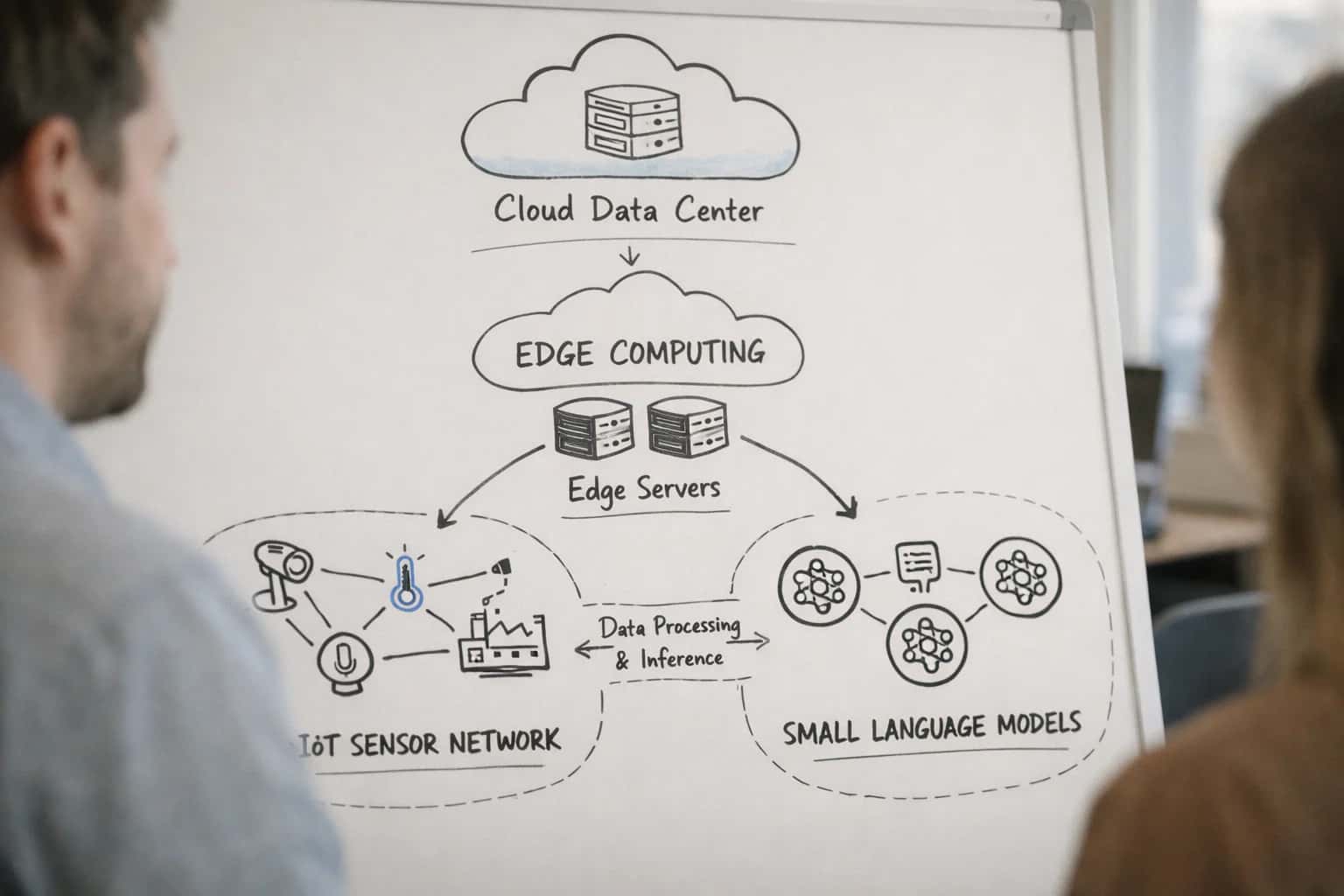
TINY MACHINE LEARNING
What is Anomaly Detection?
A core machine learning task for identifying rare events or outliers in data, particularly critical for autonomous monitoring on resource-constrained edge devices.
These edge-deployed models are engineered for extreme efficiency, utilizing techniques like model quantization and pruning to operate within severe memory footprint and milliwatt computing constraints. Common algorithmic approaches include autoencoders, one-class SVMs, and isolation forests, all trained to model 'normal' operational data. The output is a simple, low-bandwidth alert, enabling immediate local action or selective transmission, which is fundamental for applications in predictive maintenance, cybersecurity, and healthcare monitoring where latency, privacy, and operational continuity are paramount.
ALGORITHMIC METHODS
Key Approaches in TinyML Anomaly Detection
TinyML anomaly detection employs specialized, resource-efficient algorithms to identify outliers in sensor data directly on microcontrollers. These methods are designed to operate within severe constraints of memory, compute, and power.
01
Statistical & Threshold-Based Methods
The most fundamental approach, using lightweight statistical models to establish a normal operating baseline. Anomalies are flagged when sensor readings exceed pre-defined static or adaptive thresholds.
- Key Techniques: Z-score analysis, moving average, percentile-based bounds.
- Advantages: Extremely low computational cost, deterministic execution, and minimal memory footprint (often just a few bytes for thresholds).
- Use Case: Ideal for detecting simple, rule-based failures like temperature spikes or pressure drops in industrial monitoring.
02
One-Class Classification (OCC)
A machine learning approach that trains solely on normal data to learn a tight boundary around it. Any new data point falling outside this boundary is classified as an anomaly.
- Common Algorithms: One-Class Support Vector Machine (OC-SVM), Support Vector Data Description (SVDD).
- TinyML Adaptation: Requires significant optimization via quantization and pruning. The inference involves computing a distance or similarity metric to the learned boundary.
- Use Case: Detecting novel fault patterns in vibration data from motors where only healthy operation data is available for training.
03
Autoencoder-Based Reconstruction
Uses a compressed neural network (autoencoder) trained to reconstruct normal input data with minimal error. The model's reconstruction error serves as the anomaly score; high error indicates an outlier.
- Mechanism: The encoder compresses input to a latent-space bottleneck; the decoder reconstructs it. Anomalous patterns are poorly reconstructed.
- TinyML Challenge: The autoencoder architecture must be extremely small. Techniques like depthwise separable convolutions and 8-bit integer quantization are critical.
- Use Case: Identifying subtle, multi-sensor anomalies in complex time-series data from smart bearings or pumps.
04
Isolation Forest
An ensemble method efficient for TinyML because it builds binary trees based on random feature splitting rather than distance measures. Anomalies are isolated in fewer splits, resulting in shorter path lengths in the tree.
- Efficiency: Training is non-parametric and can be done offline. Inference involves traversing a few short trees, making it fast and memory-efficient.
- Deployment: The trained forest (a set of split rules) can be implemented as a simple decision function in C, requiring only comparisons and counters.
- Use Case: Effective for high-dimensional sensor data in condition monitoring where anomalies are few and distinct.
05
Temporal Modeling with Tiny RNNs/CNNs
Captures time-dependent patterns in sensor streams using micro-optimized recurrent or convolutional networks. These models learn the sequential nature of normal operation and flag deviations.
- Architectures: Tiny GRU/LSTM cells or 1D Convolutional Neural Networks (CNNs).
- Optimization: Weight pruning and projection layers drastically reduce parameters. Fixed-point arithmetic is essential for RNN cells.
- Use Case: Predictive maintenance on sequential data, such as detecting irregular pressure cycles in a hydraulic system or anomalous sound patterns over time.
06
K-Nearest Neighbors (KNN) with Quantized Embeddings
A memory-based approach where anomaly detection is performed by comparing a new sample to a stored dictionary of normal exemplars in an embedded space. The distance to the k-nearest neighbors determines the anomaly score.
- TinyML Implementation: The exemplar dictionary is stored in Flash memory. The embedding model (e.g., a tiny CNN) and distance metric (e.g., L2) are heavily quantized.
- Trade-off: Accuracy scales with dictionary size, which conflicts with memory limits. Advanced vector quantization techniques are used to compress the dictionary.
- Use Case: Visual anomaly detection on low-resolution camera feeds for security or quality inspection.
ARCHITECTURAL COMPARISON
Cloud vs. Edge Anomaly Detection
A comparison of the core technical and operational characteristics between centralized cloud-based and distributed edge-based anomaly detection systems, focusing on implications for TinyML deployments.
| Feature / Metric | Cloud-Centric Detection | Edge-Centric Detection (TinyML) |
|---|---|---|
Primary Compute Location | Centralized data centers | On-device microcontroller (MCU) |
Latency (Inference) | 100ms - 2 sec (network dependent) | < 10 ms (deterministic, local) |
Network Dependency | Absolute requirement for inference | Optional; operates fully offline |
Data Privacy | Raw sensor data transmitted to cloud | Raw data processed locally; only alerts/aggregates may be transmitted |
Power Consumption | High (device radio + cloud DC) | Milliwatt-scale (MCU-only inference) |
Operational Cost Model | Recurring cloud/bandwidth fees | Primarily upfront hardware cost |
Model Update Mechanism | Centralized retraining & OTA push | Federated learning or scheduled OTA updates |
Scalability for Fleet | Central server scaling challenge | Inherently scalable; per-device compute |
Typical Use Case | Historical batch analysis, non-real-time monitoring | Real-time fault detection (e.g., predictive maintenance), intrusion detection |
TINYML
Frequently Asked Questions
Common questions about deploying anomaly detection models on microcontrollers and ultra-constrained edge devices.
In TinyML, anomaly detection is the deployment of highly optimized machine learning models on microcontrollers and sensors to identify rare events, outliers, or deviations from normal operational patterns in real-time sensor data. These models are designed to run within severe constraints of memory footprint (often <100KB RAM/Flash) and milliwatt computing power. The core task is to establish a baseline of 'normal' behavior—typically from time-series data like vibration, temperature, or acoustic signals—and flag significant deviations that may indicate faults, security breaches, or unusual activity, all without cloud connectivity.
Enabling Efficiency, Speed & Accuracy
Intelligent Analysis, Decision & Execution
We build AI systems for teams that need search across company data, workflow automation across tools, or AI features inside products and internal software.
Talk to Us
Search across company data
Give teams answers from docs, tickets, runbooks, and product data with sources and permissions.
Useful when people spend too long searching or get different answers from different systems.
Enterprise searchRAGPermissions
Read more
Automate internal workflows
Use AI to route work, draft outputs, trigger actions, and keep approvals and logs in place.
Useful when repetitive work moves across multiple tools and teams.
AI agentsWorkflow automationGovernance
Read more
Add AI to products and internal tools
Build assistants, guided actions, or decision support into the software your team or customers already use.
Useful when AI needs to be part of the product, not a separate tool.
AI integrationDecision supportModel routing
Read more
About the author
Prasad Kumkar
CEO & MD, Inference Systems
Prasad Kumkar is the CEO & MD of Inference Systems and writes about AI systems architecture, LLM infrastructure, model serving, evaluation, and production deployment. Over 5+ years, he has worked across computer vision models, L5 autonomous vehicle systems, and LLM research, with a focus on taking complex AI ideas into real-world engineering systems.
His work and writing cover AI systems, large language models, AI agents, multimodal systems, autonomous systems, inference optimization, RAG, evaluation, and production AI engineering.
LinkedIn
Limited slotsGet a Free AI Consultation
Partnered with leading AI, data, and software stack.





How We Work
Custom AI workflows for your Business
One-fit-all AI don't work for modern businesses. At Inferensys, we aim to understand your business & custom requirements; which we use to define most efficient agentic workflows, the data, and the tools for your business.
01
Review the use case
We understand the task, the users, and where AI can actually help.
Read more02
Pick the right approach
We define what needs search, automation, or product integration.
Read more03
Build the first useful version
We implement the part that proves the value first.
Read more04
Improve from there
We add the checks and visibility needed to keep it useful.
Read moreThe first call is a practical review of your use case and the right next step.
Talk to Us