Federated Learning (FL) is a decentralized machine learning paradigm where a global model is trained collaboratively across multiple edge devices or servers, each holding local data samples, without exchanging the raw data itself. Instead of centralizing sensitive information, local model updates—typically weight gradients or new parameters—are computed on-device and transmitted to a central server for secure aggregation. This approach directly addresses core challenges in Edge Artificial Intelligence, including data privacy, bandwidth constraints, and the need for real-time, localized intelligence in distributed systems.

Glossary
Federated Learning (FL)
Federated Learning is a decentralized machine learning paradigm where a global model is trained collaboratively across multiple edge devices or servers holding local data samples, without exchanging the raw data itself.
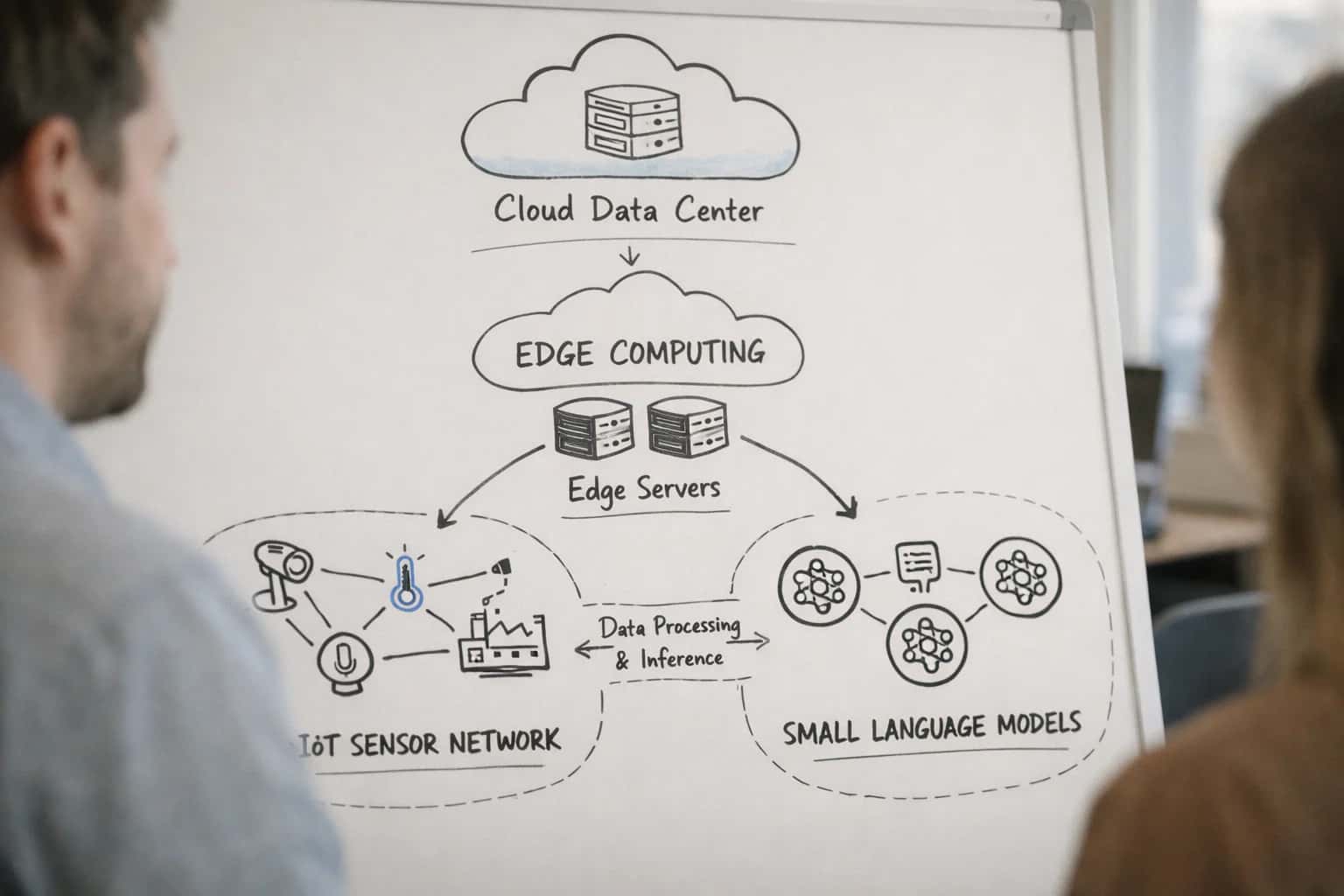
ON-DEVICE LEARNING
What is Federated Learning (FL)?
Federated Learning (FL) is a decentralized machine learning paradigm where a global model is trained collaboratively across multiple edge devices or servers holding local data samples, without exchanging the raw data itself.
The process operates in iterative communication rounds: a central server distributes the current global model to a selected subset of clients, each device trains the model on its local data, and then sends only the model updates back for aggregation into an improved global model. This architecture is foundational to privacy-preserving machine learning, enabling model improvement across non-IID data distributions while keeping raw user data on the originating device. It is a cornerstone of modern on-device learning strategies for highly regulated industries and resilient systems requiring operational continuity without cloud dependency.
ON-DEVICE LEARNING
Key Characteristics of Federated Learning
Federated Learning is defined by its core architectural principles that enable collaborative model training across decentralized data sources. These characteristics distinguish it from traditional centralized machine learning.
01
Data Decentralization
The fundamental principle of Federated Learning is that raw training data never leaves its source device or local server (the 'client'). Instead of a central data lake, the model is sent to where the data resides. This is critical for privacy-sensitive domains like healthcare (Healthcare Federated Learning) and finance, where data sovereignty and regulatory compliance (e.g., GDPR, HIPAA) are paramount. The training process is inverted: compute moves to the data, not data to the compute.
02
Privacy-Preserving Aggregation
Federated Learning employs cryptographic and statistical techniques to aggregate learnings while minimizing privacy leakage. Core methods include:
- Secure Aggregation: A multi-party computation protocol that allows a server to compute the sum of client model updates without decrypting any individual update.
- Differential Privacy (DP): Adding calibrated mathematical noise to model updates or the aggregation process to guarantee that the output does not reveal whether any single user's data was used.
- Homomorphic Encryption (HE): Enabling computations on encrypted model updates. These layers work together to provide Privacy-Preserving Machine Learning guarantees.
03
Statistical Heterogeneity (Non-IID Data)
A defining technical challenge. Data across clients is Non-IID—not Independent and Identically Distributed. Each device's local dataset is a biased sample of the overall population (e.g., a user's typing habits, a hospital's patient demographics). This violates the core assumptions of traditional distributed optimization and can cause the global model to converge poorly or be biased towards dominant clients. Algorithms like FedProx are specifically designed to handle this heterogeneity by constraining local updates.
04
Partial & Asynchronous Participation
In real-world deployments, especially in Cross-Device Federated Learning (e.g., millions of smartphones), client availability is unreliable. Devices may be offline, have limited battery, or be on slow networks. Therefore, in each communication round, only a subset of available clients is selected (Client Selection). Training must be robust to this partial participation and tolerate stragglers. Systems are designed to proceed asynchronously, aggregating updates as they arrive, rather than waiting for all selected clients.
05
Communication Efficiency
The primary bottleneck is often network bandwidth, not local compute. Transmitting full model updates every round is prohibitive. Key optimization techniques include:
- Gradient Compression: Using sparsification (sending only the largest values) and quantization (reducing numerical precision) to shrink update size.
- Local Epochs: Performing multiple training passes on local data before communicating, reducing the total number of rounds.
- Knowledge Distillation: Sometimes used to train smaller, more communication-efficient student models. The goal is to minimize total bytes transmitted while maximizing model utility.
06
System Heterogeneity
The federated network consists of devices with vastly different capabilities. This includes variations in:
- Hardware: From powerful servers in Cross-Silo FL to resource-constrained IoT sensors and smartphones.
- Network Speeds: From gigabit Ethernet to sporadic cellular connectivity.
- Software/Frameworks: Clients may use different machine learning frameworks (PyTorch, TensorFlow). Frameworks like Flower are designed to be framework-agnostic to handle this. Furthermore, On-Device Model Compression techniques like quantization are often applied locally to ensure models can run on all targeted devices.
COMPARISON
Federated Learning vs. Centralized & Other Distributed Methods
A technical comparison of Federated Learning against centralized training and other distributed learning paradigms, highlighting key architectural and operational differences.
| Feature / Metric | Centralized Training | Federated Learning (FL) | Split Learning |
|---|---|---|---|
Data Location | Centralized Server | Distributed on Client Devices | Split between Client & Server |
Data Privacy | |||
Primary Communication Cost | Data Transfer to Center | Model Update Transfer | Intermediate Activation Transfer |
Typical Client Count | 1 (Server) | Massive (10^3 - 10^9) | Moderate (10 - 10^3) |
Client Reliability Assumption | High (Controlled) | Low (Unreliable, Partial Participation) | Moderate to High |
Handles Non-IID Data | |||
Primary Optimization Challenge | Dataset Scale | Statistical Heterogeneity, Communication | Layer Partitioning, Latency |
Model Ownership / Control | Central Server | Central Server (Global), Client (Local) | Shared (Client has initial layers, Server has rest) |
INDUSTRY CASE STUDIES
Real-World Applications of Federated Learning
Federated Learning's core value—training models on decentralized data without central collection—enables transformative applications across industries where data privacy, bandwidth, or sovereignty are paramount constraints.
02
Healthcare Diagnostics
Hospitals and research institutions can collaboratively train diagnostic models (e.g., for detecting tumors in medical images) without sharing sensitive Protected Health Information (PHI).
- Cross-Silo FL: A few large, reliable organizations (hospitals) act as data silos.
- Regulatory Compliance: Enables collaboration compliant with HIPAA and GDPR.
- Rare Disease Research: Allows pooling statistical power to study rare conditions across multiple institutions, overcoming data scarcity.
03
Autonomous Vehicle Perception
Fleets of vehicles can learn from real-world driving experiences encountered by other cars without transmitting vast amounts of video and sensor data.
- On-Device Adaptation: Models improve at recognizing edge cases (e.g., unusual weather, road debris) locally.
- Bandwidth Efficiency: Transmitting small model updates is vastly more efficient than streaming petabytes of raw sensor data.
- Continual Learning: The global fleet model continuously adapts to new driving environments and scenarios.
04
Industrial IoT & Predictive Maintenance
Manufacturing equipment and sensors in factories can learn collective failure patterns without exposing proprietary operational data.
- Edge Device Training: Models train locally on vibration, temperature, and acoustic data from individual machines.
- Proprietary Data Protection: Factories protect their unique production secrets and processes.
- Improved Uptime: A globally improved model can predict machine failures more accurately across an entire industrial ecosystem.
05
Financial Fraud Detection
Banks can collaboratively build more robust fraud detection models by learning from transaction patterns across institutions, without revealing customer identities or sensitive transaction details.
- Privacy-Preserving Collaboration: Combats sophisticated, cross-institutional fraud rings.
- Non-IID Data Handling: Learns from diverse customer demographics and regional spending habits.
- Real-Time Security: Enables faster identification of novel fraud patterns as they emerge across the network.
06
Smart Assistant Personalization
Voice assistants can learn personalized speech patterns, accents, and command preferences directly on a user's device, improving accuracy without sending private audio recordings to the cloud.
- On-Device Fine-Tuning: The acoustic and language models adapt locally.
- Reduced Latency: Improved local models can handle more commands offline.
- User Trust: Strengthens user trust by keeping voice data private by design.
FEDERATED LEARNING
Frequently Asked Questions
Federated Learning (FL) is a decentralized machine learning paradigm enabling collaborative model training across multiple devices or servers without centralizing raw data. This FAQ addresses core technical concepts, deployment models, and security considerations for CTOs and research engineers.
Federated Learning is a decentralized machine learning paradigm where a global model is trained collaboratively across multiple edge devices or servers, each holding local data samples, without exchanging the raw data itself. The canonical workflow, defined by the Federated Averaging (FedAvg) algorithm, operates in iterative communication rounds: a central server distributes the current global model to a selected subset of clients; each client performs local training (e.g., stochastic gradient descent) on its private data; clients then send only their computed model updates (e.g., weight gradients or new weights) back to the server; finally, the server aggregates these updates—often via a weighted average—to produce an improved global model. This cycle repeats, enabling learning from distributed data while preserving data locality and privacy.
Enabling Efficiency, Speed & Accuracy
Intelligent Analysis, Decision & Execution
We build AI systems for teams that need search across company data, workflow automation across tools, or AI features inside products and internal software.
Talk to Us
Search across company data
Give teams answers from docs, tickets, runbooks, and product data with sources and permissions.
Useful when people spend too long searching or get different answers from different systems.
Enterprise searchRAGPermissions
Read more
Automate internal workflows
Use AI to route work, draft outputs, trigger actions, and keep approvals and logs in place.
Useful when repetitive work moves across multiple tools and teams.
AI agentsWorkflow automationGovernance
Read more
Add AI to products and internal tools
Build assistants, guided actions, or decision support into the software your team or customers already use.
Useful when AI needs to be part of the product, not a separate tool.
AI integrationDecision supportModel routing
Read more
About the author
Prasad Kumkar
CEO & MD, Inference Systems
Prasad Kumkar is the CEO & MD of Inference Systems and writes about AI systems architecture, LLM infrastructure, model serving, evaluation, and production deployment. Over 5+ years, he has worked across computer vision models, L5 autonomous vehicle systems, and LLM research, with a focus on taking complex AI ideas into real-world engineering systems.
His work and writing cover AI systems, large language models, AI agents, multimodal systems, autonomous systems, inference optimization, RAG, evaluation, and production AI engineering.
LinkedIn
Limited slotsGet a Free AI Consultation
Partnered with leading AI, data, and software stack.





How We Work
Custom AI workflows for your Business
One-fit-all AI don't work for modern businesses. At Inferensys, we aim to understand your business & custom requirements; which we use to define most efficient agentic workflows, the data, and the tools for your business.
01
Review the use case
We understand the task, the users, and where AI can actually help.
Read more02
Pick the right approach
We define what needs search, automation, or product integration.
Read more03
Build the first useful version
We implement the part that proves the value first.
Read more04
Improve from there
We add the checks and visibility needed to keep it useful.
Read moreThe first call is a practical review of your use case and the right next step.
Talk to Us