Shadow deployment is a release strategy where a new version of a machine learning model processes live input data in parallel with the production version, but its predictions are not served to users. This technique, also known as dark launching or mirror traffic, allows for performance validation and real-world testing of a model's inference latency, resource consumption, and prediction quality against the exact operational data distribution, all without any risk to the live service. It is a critical practice in MLOps for ensuring model reliability before a full rollout.

Glossary
Shadow Deployment
Shadow deployment is a release strategy where a new version of a machine learning model processes live input data in parallel with the production version, but its predictions are not served to users, allowing for performance validation without impacting the live system.
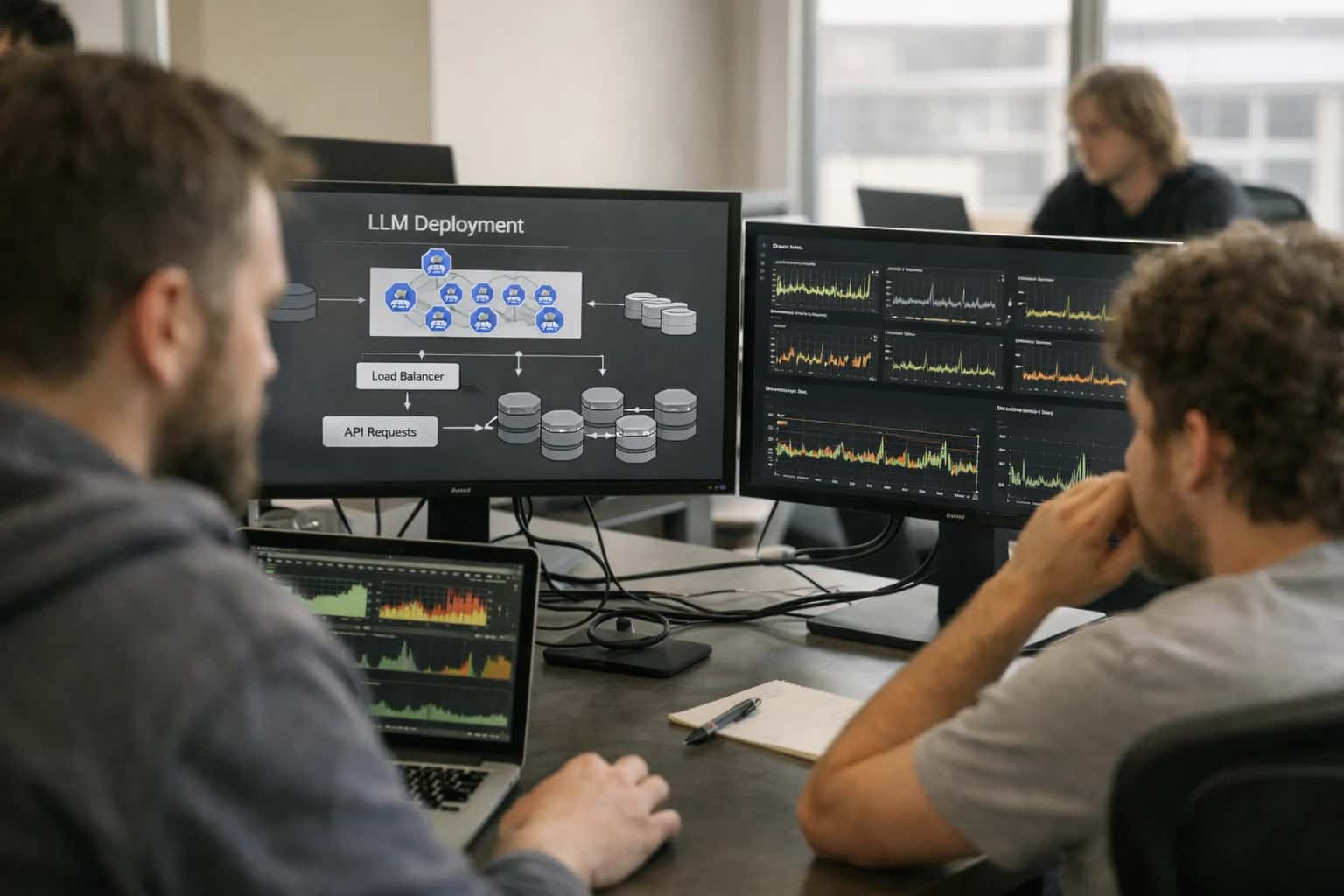
EDGE MODEL DEPLOYMENT
What is Shadow Deployment?
A release strategy for validating new machine learning models in production without impacting live users.
In edge computing architectures, shadow deployment is particularly valuable for validating models on constrained hardware where performance is non-linear and difficult to simulate. The orchestrator replicates incoming inference requests, sending them to both the production model and the shadow model. The shadow model's outputs are compared to the production model's or to a ground truth (if available) to detect regressions, latency spikes, or concept drift. This provides empirical evidence for a go/no-go decision on a promotion to canary deployment or a full release, forming a key stage in a robust continuous deployment pipeline for AI.
EDGE MODEL DEPLOYMENT
Key Characteristics of Shadow Deployment
Shadow deployment is a release strategy where a new version of a model processes live input data in parallel with the production version, but its predictions are not served to users, allowing for performance validation without impacting the live system.
01
Zero-Risk Validation
The core principle of shadow deployment is zero operational risk. The new model (the "shadow") runs alongside the production model, processing identical live input data. However, only the production model's outputs are served to users or downstream systems. This creates a perfect, real-world test environment where the new model's performance, latency, and resource consumption can be measured against the ground truth of the live system without any chance of causing user-facing errors or degraded service.
02
Performance & Drift Benchmarking
Shadow deployment provides the most accurate method for A/B testing and drift detection. By comparing the shadow model's predictions against the production model's outputs (or actual business outcomes), engineers can calculate key metrics:
- Prediction Drift: Statistical differences in output distributions.
- Performance Delta: Changes in accuracy, precision, or recall on live data.
- Latency & Throughput: Real resource usage under true load.
- Business Logic Consistency: Ensures the new model adheres to all critical rules and guardrails before it handles any real traffic.
03
Architecture & Data Flow
A shadow deployment requires a specific pipeline architecture. Live inference requests are duplicated or forked after ingress. One copy goes to the production model serving path; the other is sent to the shadow model's inference endpoint. This is often implemented using:
- Service Mesh sidecar proxies to mirror traffic.
- Message Queue systems (e.g., Apache Kafka) to fan out requests.
- Specialized ML serving platforms (e.g., Seldon Core, KServe) with built-in shadow mode. Crucially, the shadow path must not block the production path. It is typically asynchronous and may use a lower quality-of-service tier to avoid resource contention.
04
Use Cases & Examples
Shadow deployment is critical for high-stakes or regulated edge AI applications.
- Autonomous Vehicle Perception: A new object detection model runs in shadow mode, its predictions logged and compared to the production model's outputs and later human-reviewed sensor data, validating safety before activation.
- Financial Fraud Detection: A next-generation anomaly detection model processes live transaction streams. Its flagged transactions are reviewed by analysts against the production model's results to verify improved precision, avoiding false positives that could block customer payments.
- Medical Diagnostic Assistants: A new imaging analysis model evaluates live X-rays in parallel. Radiologists compare its findings to the current model and their own diagnosis, ensuring clinical accuracy before the model influences patient care pathways.
05
Comparison to Canary & A/B Testing
Shadow deployment is often confused with canary deployment and A/B testing, but it serves a distinct, earlier phase in the release lifecycle.
- Shadow Deployment: Validation Phase. The new model gets no real traffic. It is purely observational. Goal: "Does it work correctly under real conditions?"
- Canary Deployment: Limited Release Phase. The new model gets a small percentage of real traffic (e.g., 5%). Goal: "Does it work correctly for real users?"
- A/B Testing: Experiment Phase. Two or more models get split real traffic. Goal: "Which model performs better on a business metric?" Shadow is the prerequisite safety check before canary or A/B testing begins.
06
Implementation Challenges
While powerful, shadow deployment introduces specific engineering complexities:
- Resource Cost: Running two models doubles the compute, memory, and potentially GPU load during the validation period. This must be factored into infrastructure planning.
- Data Logging & Comparison: A robust telemetry system must log inputs, both sets of predictions, and associated metadata (latency, confidence scores) for offline analysis. This can generate significant data volume.
- State Management: For stateful models or those requiring session consistency, ensuring the shadow model receives an identical state sequence as the production model adds complexity.
- Synchronization: In highly latency-sensitive edge applications, ensuring the shadow inference does not inadvertently delay the production response requires careful asynchronous design and priority queuing.
EDGE MODEL DEPLOYMENT
How Shadow Deployment Works
Shadow deployment is a release strategy where a new version of a model processes live input data in parallel with the production version, but its predictions are not served to users, allowing for performance validation without impacting the live system.
In a shadow deployment, the new model (the shadow) runs alongside the production model in the same inference pipeline. Both models receive identical, real-time input data, but only the production model's outputs are returned to the end-user or downstream application. The shadow model's predictions are logged and compared offline against the production version's outputs and, where available, ground truth. This creates a zero-risk validation environment for observing the new model's behavior under actual operational load and data distribution.
The primary technical mechanism involves duplicating inference requests and routing them to both model endpoints. This is often managed by the inference server or a dedicated traffic mirroring layer within the serving infrastructure. Key metrics like latency, throughput, and prediction drift are monitored. In edge AI contexts, this strategy is crucial for validating models on heterogeneous hardware before a full rollout, ensuring performance and stability without service disruption. It is a foundational practice for achieving continuous model learning and safe iteration in production systems.
COMPARISON
Shadow Deployment vs. Other Release Strategies
A feature-by-feature comparison of shadow deployment with other common strategies for releasing machine learning models in edge and cloud environments.
| Feature / Metric | Shadow Deployment | Canary Deployment | Blue-Green Deployment | A/B Testing |
|---|---|---|---|---|
Primary Goal | Validate performance & safety on live traffic | Validate stability with a small user subset | Achieve zero-downtime releases & instant rollback | Measure business impact of different variants |
User Impact | None (predictions are not served) | Limited to a small percentage of users | All users switched simultaneously | Traffic split between variants for measurement |
Risk Level | Very Low | Moderate | Low | Moderate (depends on metric) |
Rollback Speed | Instant (no traffic to cut off) | Fast (redirect traffic from canary) | Instant (switch traffic back to stable env) | Fast (redirect traffic to winning variant) |
Validation Data Source | 100% of live production input data | Subset of live production traffic | 100% of live production traffic post-switch | Split of live production traffic |
Performance Metrics Collected | Latency, throughput, accuracy, resource usage | Error rates, latency, business metrics | Uptime, error rates post-switch | Primary business metric (e.g., conversion rate) |
Infrastructure Overhead | High (requires dual execution) | Low to Moderate | High (requires duplicate environment) | Moderate (requires routing logic) |
Typical Use Case in Edge AI | Validating a new vision model on live sensor feeds | Rolling out a new NLP model to 5% of kiosks | Updating the inference server on all edge gateways | Testing two recommendation models in a retail app |
SHADOW DEPLOYMENT
Use Cases and Examples
Shadow deployment is a critical validation strategy in edge AI, allowing new models to be tested against real-world data without operational risk. Below are key scenarios and architectures where it provides essential safeguards.
01
Validating Model Upgrades on Edge Devices
Before replacing a production model on a fleet of devices, the new candidate model runs in shadow mode. It processes the same sensor inputs as the live model, but its outputs are only logged for comparison. This is crucial for:
- Performance Benchmarking: Measuring latency, accuracy, and power consumption on real hardware.
- Detecting Edge Cases: Identifying scenarios where the new model fails or behaves unexpectedly with live data from the field.
- Ensuring Determinism: Verifying that quantized or compiled models produce stable, bit-identical results across heterogeneous edge silicon.
02
Mitigating Concept & Data Drift
Shadow deployment acts as a continuous monitoring tool for model decay. A challenger model, trained on more recent data, can run in shadow to detect concept drift—where the relationship between inputs and outputs changes. For example:
- A vision model for defect detection in a factory may degrade as lighting or raw materials change.
- By comparing the shadow model's predictions against the production model's and ground-truth labels (when available), teams can quantify drift and trigger retraining before accuracy falls below a threshold, preventing costly production errors.
03
Safety-Critical Systems: Autonomous Vehicles & Robotics
In embodied intelligence systems like autonomous mobile robots or drones, a failed model update can cause physical damage. Shadow deployment is used to:
- Test new perception models (e.g., object detectors) against the live video stream from the vehicle's cameras.
- Compare planning algorithms by simulating actions the shadow model would take versus the production model's actual commands.
- **Validate sim-to-real transfer by running a model trained in simulation against real-world sensor data before it assumes control, bridging the digital-to-physical gap safely.
04
A/B Testing Foundation for Edge AI
Shadow deployment provides the observability backbone for rigorous A/B testing at the edge. Instead of immediately splitting user traffic, you first run models in parallel to gather performance telemetry. This allows you to:
- Establish a robust baseline for key metrics (inference latency, accuracy) under identical load conditions.
- Design statistically valid experiments by pre-determining the sample size and duration needed based on real variance observed in the shadow data.
- Confidently progress to a canary deployment, where the new model is served to a small percentage of devices, having already validated its core functionality in shadow mode.
05
Architecture for Federated Learning Validation
In federated edge learning, models are improved using data on devices without central aggregation. Validating a new global model before a federated update is critical. Shadow deployment enables:
- Silent validation rounds: The central server sends a new global model to devices to run in shadow. Devices compute performance metrics (e.g., loss on local data) and report back aggregate statistics without affecting user experience.
- Detection of harmful updates: Identifying if a new global model performs poorly on specific device cohorts or data distributions before mandating a full update, preventing catastrophic forgetting across the fleet.
06
Integration with MLOps & Orchestration Platforms
Shadow deployment is not a manual process; it is integrated into edge AI orchestration platforms. Key components include:
- Orchestrator (e.g., Kubernetes with KubeEdge): Manages the lifecycle of shadow pods alongside production pods using DaemonSets or custom operators.
- Telemetry Pipeline: Shadows emit logs and metrics to a centralized model monitoring system for comparison.
- Over-the-Air (OTA) Update Systems: Use shadow results to gate the promotion of a model from a testing to a production desired state.
- Immutable Infrastructure: Shadow models are deployed as versioned containers, ensuring consistency and enabling instant rollback based on performance data.
SHADOW DEPLOYMENT
Frequently Asked Questions
Shadow deployment is a critical release strategy in MLOps for validating new machine learning models in production without risk. This FAQ addresses common technical questions about its implementation, benefits, and role in edge AI architectures.
Shadow deployment is a release strategy where a new version of a machine learning model processes live input data in parallel with the currently deployed production model, but its predictions are not served to end-users or downstream systems.
This technique allows for the performance validation of the new model under real-world conditions—measuring latency, accuracy, and resource consumption—without impacting the live service. It is a form of dark launch or silent launch that de-risks the promotion of a model to a canary deployment or full production. In edge AI contexts, shadow deployment is crucial for testing models on actual device hardware and network conditions before they assume any operational responsibility.
Enabling Efficiency, Speed & Accuracy
Intelligent Analysis, Decision & Execution
We build AI systems for teams that need search across company data, workflow automation across tools, or AI features inside products and internal software.
Talk to Us
Search across company data
Give teams answers from docs, tickets, runbooks, and product data with sources and permissions.
Useful when people spend too long searching or get different answers from different systems.
Enterprise searchRAGPermissions
Read more
Automate internal workflows
Use AI to route work, draft outputs, trigger actions, and keep approvals and logs in place.
Useful when repetitive work moves across multiple tools and teams.
AI agentsWorkflow automationGovernance
Read more
Add AI to products and internal tools
Build assistants, guided actions, or decision support into the software your team or customers already use.
Useful when AI needs to be part of the product, not a separate tool.
AI integrationDecision supportModel routing
Read more
About the author
Prasad Kumkar
CEO & MD, Inference Systems
Prasad Kumkar is the CEO & MD of Inference Systems and writes about AI systems architecture, LLM infrastructure, model serving, evaluation, and production deployment. Over 5+ years, he has worked across computer vision models, L5 autonomous vehicle systems, and LLM research, with a focus on taking complex AI ideas into real-world engineering systems.
His work and writing cover AI systems, large language models, AI agents, multimodal systems, autonomous systems, inference optimization, RAG, evaluation, and production AI engineering.
LinkedIn
Limited slotsGet a Free AI Consultation
Partnered with leading AI, data, and software stack.





How We Work
Custom AI workflows for your Business
One-fit-all AI don't work for modern businesses. At Inferensys, we aim to understand your business & custom requirements; which we use to define most efficient agentic workflows, the data, and the tools for your business.
01
Review the use case
We understand the task, the users, and where AI can actually help.
Read more02
Pick the right approach
We define what needs search, automation, or product integration.
Read more03
Build the first useful version
We implement the part that proves the value first.
Read more04
Improve from there
We add the checks and visibility needed to keep it useful.
Read moreThe first call is a practical review of your use case and the right next step.
Talk to Us