Immutable infrastructure is a deployment paradigm where servers and their software components are never modified in-place after being provisioned. Instead of applying patches or configuration updates to a live system, any change requires building a complete, new artifact—like a virtual machine image or container—from a known, versioned source. This new instance is then deployed to replace the old one, which is terminated. This approach, central to modern Infrastructure as Code (IaC) and GitOps practices, eliminates configuration drift and ensures that every deployment is consistent, reproducible, and defined entirely by code.

Glossary
Immutable Infrastructure
Immutable infrastructure is a deployment paradigm where servers and components are never modified after deployment; instead, changes are made by replacing the entire component with a new, versioned instance.
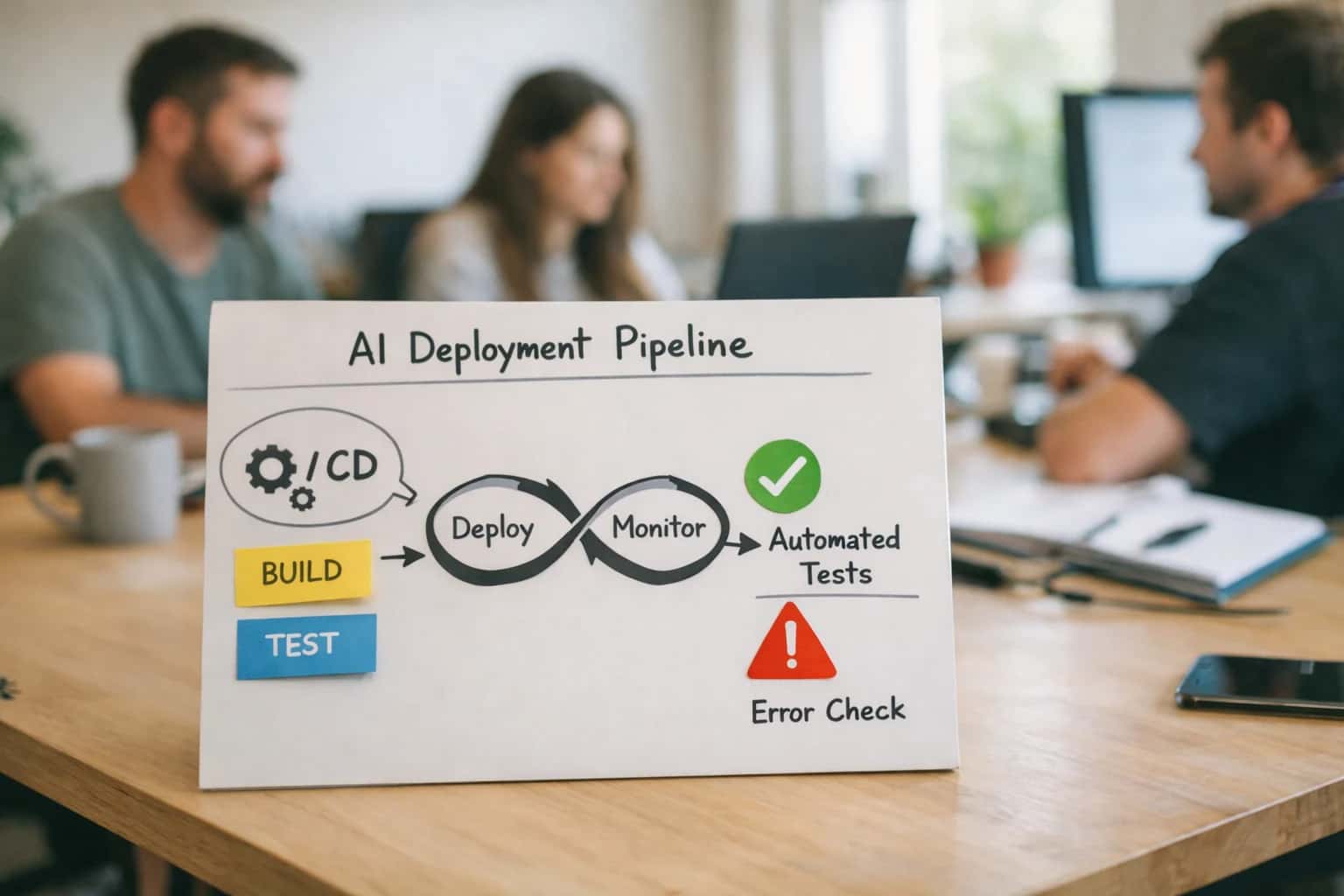
EDGE MODEL DEPLOYMENT
What is Immutable Infrastructure?
A deployment paradigm where servers and components are never modified after deployment; instead, changes are made by replacing the entire component with a new, versioned instance.
For edge AI deployments, immutability is critical for managing large, remote fleets. A new machine learning model version is packaged into a container, validated, and deployed as a unit via an orchestrator like Kubernetes. The old container is destroyed. This guarantees that every device runs an identical, tested environment, simplifying rollbacks and enhancing security by preventing unauthorized runtime modifications. It complements strategies like canary deployments and over-the-air (OTA) updates, providing a robust foundation for reliable, scalable edge model serving.
DEPLOYMENT PARADIGM
Key Characteristics of Immutable Infrastructure
Immutable infrastructure is defined by its core principle: components are never modified in-place. This section details the architectural patterns and operational benefits that result from this foundational rule.
01
Versioned Artifacts
Every deployable component—such as a container image, virtual machine template, or firmware binary—is built once, assigned a unique, immutable identifier (like a cryptographic hash), and stored in a registry. Changes require building and versioning a new artifact. This eliminates configuration drift between environments (development, staging, production) and guarantees that what is tested is exactly what is deployed.
- Example: A Docker image tagged with a Git commit SHA (
inference-server:sha-a1b2c3d) is built from a specific, reproducible code state.
02
Replace, Don't Modify
Updates are performed by provisioning entirely new instances from the new versioned artifact and decommissioning the old ones. This is in stark contrast to mutable infrastructure, where servers are updated via SSH commands or configuration management tools (like Ansible) that change the state of a running system. The replacement strategy ensures a clean, known-good state for every deployment and simplifies rollback to a previous, known-stable version.
- Primary Mechanism: Orchestrators like Kubernetes perform this via rolling updates, replacing pods in a controlled sequence.
03
Declarative Configuration
The desired state of the entire system—what software runs, its configuration, and its resources—is defined in declarative code (e.g., Kubernetes YAML, Terraform HCL). An orchestrator continuously reconciles the actual state of the system with this declared state. If an instance deviates (e.g., crashes), the orchestrator automatically replaces it to match the declaration. This approach is foundational to GitOps, where the declarative configuration is the single source of truth stored in a version control system.
04
Ephemeral Instances
Servers and containers are treated as disposable, stateless commodities. No unique data or long-term state is stored locally on the instance. All persistent state (model parameters, inference logs, telemetry) is externalized to dedicated services like databases, object storage, or network-attached volumes. This design allows any instance to be terminated and recreated without data loss or service interruption, enabling robust auto-scaling and recovery from failures.
05
Deterministic Deployment & Rollback
Because every deployment uses a pre-built, versioned artifact, the process is deterministic and repeatable. Deploying version 1.2.0 always results in the same binary environment. If a new version (1.3.0) exhibits errors, rolling back is as simple and fast as redeploying the known-good 1.2.0 artifact. This eliminates the "it works on my machine" problem and provides a straightforward escape hatch for production issues, contrasting with complex rollback scripts often needed in mutable systems.
06
Enhanced Security & Compliance
Immutability reduces the attack surface and aids auditability. Temporary patches and unauthorized runtime changes are impossible—any change requires a new, auditable build pipeline. This prevents persistent malware and configuration tampering. For regulated industries, the entire lifecycle—from source code to build hash to deployed instance—can be traced. Security scans can be performed once on the immutable artifact, rather than on a fleet of potentially diverging live servers.
DEPLOYMENT PARADIGM
How Immutable Infrastructure Works
Immutable infrastructure is a deployment and management paradigm where servers and software components are never modified after they are provisioned.
Immutable infrastructure is a deployment paradigm where servers and software components are never modified after they are provisioned; instead, any change requires building and deploying a new, versioned instance from a known, tested artifact. This approach treats infrastructure components like software releases, promoting deterministic deployments, eliminating configuration drift, and ensuring that every environment is an identical, reproducible artifact derived from a single source of truth, such as a container image or Infrastructure as Code (IaC) template.
In practice, an orchestrator like Kubernetes manages the lifecycle by replacing old pods with new ones based on the updated image. This model is foundational for reliable edge AI deployments, as it guarantees that a model serving a thousand devices is functionally identical, simplifies rollback to a previous version, and integrates seamlessly with continuous deployment (CD) pipelines. The result is a system where the desired state declared in version control is the only valid state for the fleet.
DEPLOYMENT PARADIGM COMPARISON
Immutable vs. Mutable Infrastructure
A comparison of the core architectural principles, operational characteristics, and lifecycle management approaches between immutable and mutable infrastructure paradigms, particularly relevant for edge AI deployments.
| Feature / Characteristic | Immutable Infrastructure | Mutable Infrastructure |
|---|---|---|
Core Principle | Servers and components are never modified after deployment. Changes are made by replacing the entire component with a new, versioned instance. | Servers and components are updated in-place through configuration changes, patches, and software installations. |
State Management | State is strictly externalized (e.g., to databases, object storage). The infrastructure component itself is stateless. | State often accumulates on the server itself through logs, temporary files, and runtime application data. |
Deployment Artifact | Uses a complete, versioned machine image or container image (e.g., AMI, Docker image, OCI artifact). | Relies on a base OS image or VM, which is then configured at runtime via scripts (e.g., Ansible, shell scripts). |
Change Process | Provisioning of new resources from a known artifact, followed by traffic shift and decommissioning of old resources. | Direct modification (SSH, configuration management) of existing, running resources. |
Consistency & Reproducibility | High. Every deployment starts from an identical, versioned artifact, eliminating environment drift. | Variable. Consistency depends on the perfection of configuration scripts and the absence of manual changes, leading to potential drift. |
Rollback Capability | Fast and reliable. Rollback involves re-deploying a previous, known-good artifact version. | Complex and error-prone. Requires reversing configuration steps, which may not perfectly restore the prior state. |
Security & Compliance | Enhanced. Known, scanned artifacts can be promoted. Reduced attack surface as no runtime patching is required. | Weakened by drift. Requires continuous vulnerability scanning and patching of live systems, which can introduce instability. |
Lifecycle Automation | Fully automatable via Infrastructure as Code (IaC) and orchestrators (e.g., Kubernetes, Terraform). Suits GitOps workflows. | Automation is possible but must account for and reconcile existing state, making it more complex and prone to edge cases. |
Suitability for Edge AI | Ideal. Ensures identical model runtime environments across a fleet, simplifies OTA updates via image replacement, and enforces declarative state. | Challenging. Managing drift and consistent configurations across thousands of heterogeneous, remote devices is operationally burdensome. |
DEPLOYMENT PARADIGM
Immutable Infrastructure in Edge AI
Immutable infrastructure is a deployment paradigm where servers and components are never modified after deployment; instead, changes are made by replacing the entire component with a new, versioned instance, promoting consistency and reliability.
01
Core Principle: Replace, Don't Modify
The foundational rule of immutable infrastructure is that a deployed component—be it a virtual machine, container, or full device image—is never patched, reconfigured, or updated in-place. Any change, from a security patch to a new model version, requires building a complete new artifact from a known source. This artifact is then deployed as a fresh replacement, and the old instance is terminated.
- Eliminates Configuration Drift: Since the runtime environment is created from a single, versioned source, the 'snowflake server' problem is avoided.
- Guarantees Consistency: Every deployment is identical, removing the 'it works on my machine' dilemma common in mutable environments.
- Simplifies Rollback: Reverting to a previous state is as simple as redeploying a previous, known-good artifact version.
02
Declarative Configuration & Infrastructure as Code
Immutable infrastructure is inherently tied to Infrastructure as Code (IaC) and declarative configuration management. The desired state of the entire system—including the OS, dependencies, application, and the machine learning model itself—is defined in code (e.g., Dockerfiles, Kubernetes manifests, Terraform modules).
- Single Source of Truth: The code repository defines the exact, reproducible environment.
- Automated Provisioning: Tools like Ansible, Packer, and cloud-init are used to bake complete system images automatically.
- GitOps Integration: The declarative manifests become the source for GitOps workflows, where a merge to the main branch can automatically trigger a fleet-wide, immutable rollout.
03
Benefits for Edge AI Model Deployment
This paradigm offers specific, critical advantages for deploying AI to distributed, often unreliable edge networks.
- Deterministic Model Execution: The model's runtime environment (library versions, OS patches) is frozen, guaranteeing identical inference behavior on every device in the fleet.
- Enhanced Security: Vulnerable packages cannot be patched live, forcing a rebuild and redeploy. This creates an auditable chain for security updates and eliminates persistent runtime malware.
- Simplified Orchestration: Orchestrators like Kubernetes treat pods as immutable units. A model update is a pod replacement, which the orchestrator handles seamlessly, managing health checks and traffic routing.
- Robust Rollback & Recovery: A failed update simply means re-scheduling the previous, known-working image. Device failure recovery involves provisioning a new device with the same golden image.
04
Implementation Patterns: Containers & VM Images
Immutable infrastructure is implemented through two primary artifact types, each with trade-offs for edge AI.
- Container Images (e.g., Docker/OCI): The most common pattern. The model, inference server, and all dependencies are packaged into a single, versioned container image stored in a registry. Orchestrators pull and run these images. Ideal for devices with container runtime support.
- Virtual Machine Images (e.g., AMI, VHD): The entire machine disk, including the OS, is baked into an immutable image. Booting a device from this image guarantees absolute consistency. Used for bare-metal edge devices or when strict OS-level isolation is required.
- Unikernels: A specialized, single-address-space image that compiles the application and a minimal OS kernel into a sealed, secure unit, offering extreme lightweight immutability.
05
Lifecycle & Orchestration with Kubernetes
Kubernetes is the dominant orchestrator for managing immutable containerized workloads at scale, including on edge clusters.
- Deployment Object: Manages the rollout and lifecycle of a set of identical, immutable pods. A model update changes the container image tag in the Deployment spec, triggering a rolling update.
- DaemonSet: Ensures a copy of an immutable pod (e.g., a device driver or monitoring sidecar) runs on all or selected edge nodes.
- StatefulSet: For stateful edge AI services (e.g., a local vector database), it manages immutable pods with stable, persistent identities and storage.
- Operators: Use custom controllers to manage the lifecycle of complex, stateful applications (like an inference pipeline) in an immutable, declarative way.
06
Challenges & Considerations at the Edge
While powerful, the immutable pattern introduces specific challenges in constrained edge environments.
- Bandwidth & Update Size: Replacing entire images for small model changes is inefficient. Solutions include:
- Delta Updates: Transmitting only the binary differences between image versions.
- Layered Images: Using shared base layers to reduce download size.
- State Management: AI applications often have local state (cache, telemetry). Immutable infrastructure requires externalizing state to persistent volumes or external services.
- Device Provisioning: The initial 'golden image' must be reliably delivered to potentially offline devices via Over-the-Air (OTA) update systems.
- Testing Complexity: Full integration testing of the complete image is required before rollout, as no in-place hotfixes are possible.
IMMUTABLE INFRASTRUCTURE
Frequently Asked Questions
Immutable infrastructure is a core deployment paradigm for reliable edge AI systems. This FAQ addresses common questions about its principles, implementation, and benefits for managing machine learning models on distributed devices.
Immutable infrastructure is a deployment and management paradigm where servers, containers, or application components are never modified in-place after they are deployed; instead, any change or update requires replacing the entire component with a new, versioned instance built from a common, version-controlled image.
This approach treats infrastructure artifacts—like virtual machine images or container images—as immutable. Once created, they are never patched, reconfigured, or updated directly on a running system. To deploy a new software version, security patch, or updated machine learning model, you build a new image with the change, increment its version, and deploy it as a fresh replacement. The orchestrator then terminates the old instance and routes traffic to the new one. This ensures that every deployment environment is identical and derived from a single source of truth, eliminating configuration drift and the "it works on my machine" problem common in mutable, manually configured systems.
Enabling Efficiency, Speed & Accuracy
Intelligent Analysis, Decision & Execution
We build AI systems for teams that need search across company data, workflow automation across tools, or AI features inside products and internal software.
Talk to Us
Search across company data
Give teams answers from docs, tickets, runbooks, and product data with sources and permissions.
Useful when people spend too long searching or get different answers from different systems.
Enterprise searchRAGPermissions
Read more
Automate internal workflows
Use AI to route work, draft outputs, trigger actions, and keep approvals and logs in place.
Useful when repetitive work moves across multiple tools and teams.
AI agentsWorkflow automationGovernance
Read more
Add AI to products and internal tools
Build assistants, guided actions, or decision support into the software your team or customers already use.
Useful when AI needs to be part of the product, not a separate tool.
AI integrationDecision supportModel routing
Read more
About the author
Prasad Kumkar
CEO & MD, Inference Systems
Prasad Kumkar is the CEO & MD of Inference Systems and writes about AI systems architecture, LLM infrastructure, model serving, evaluation, and production deployment. Over 5+ years, he has worked across computer vision models, L5 autonomous vehicle systems, and LLM research, with a focus on taking complex AI ideas into real-world engineering systems.
His work and writing cover AI systems, large language models, AI agents, multimodal systems, autonomous systems, inference optimization, RAG, evaluation, and production AI engineering.
LinkedIn
Limited slotsGet a Free AI Consultation
Partnered with leading AI, data, and software stack.





How We Work
Custom AI workflows for your Business
One-fit-all AI don't work for modern businesses. At Inferensys, we aim to understand your business & custom requirements; which we use to define most efficient agentic workflows, the data, and the tools for your business.
01
Review the use case
We understand the task, the users, and where AI can actually help.
Read more02
Pick the right approach
We define what needs search, automation, or product integration.
Read more03
Build the first useful version
We implement the part that proves the value first.
Read more04
Improve from there
We add the checks and visibility needed to keep it useful.
Read moreThe first call is a practical review of your use case and the right next step.
Talk to Us