Continuous Deployment (CD) is a software engineering practice where every code change that passes automated testing is automatically released to a production environment, enabling rapid, reliable, and frequent delivery of updates. In the context of Edge AI, a CD pipeline automates the packaging, validation, and distribution of new machine learning models across a distributed fleet of devices, ensuring they receive updates without manual intervention. This is critical for maintaining model performance and security at scale.

Glossary
Continuous Deployment (CD Pipeline)
Continuous Deployment (CD) is a software engineering practice where every code change that passes automated tests is automatically released to production, enabling rapid and reliable delivery.
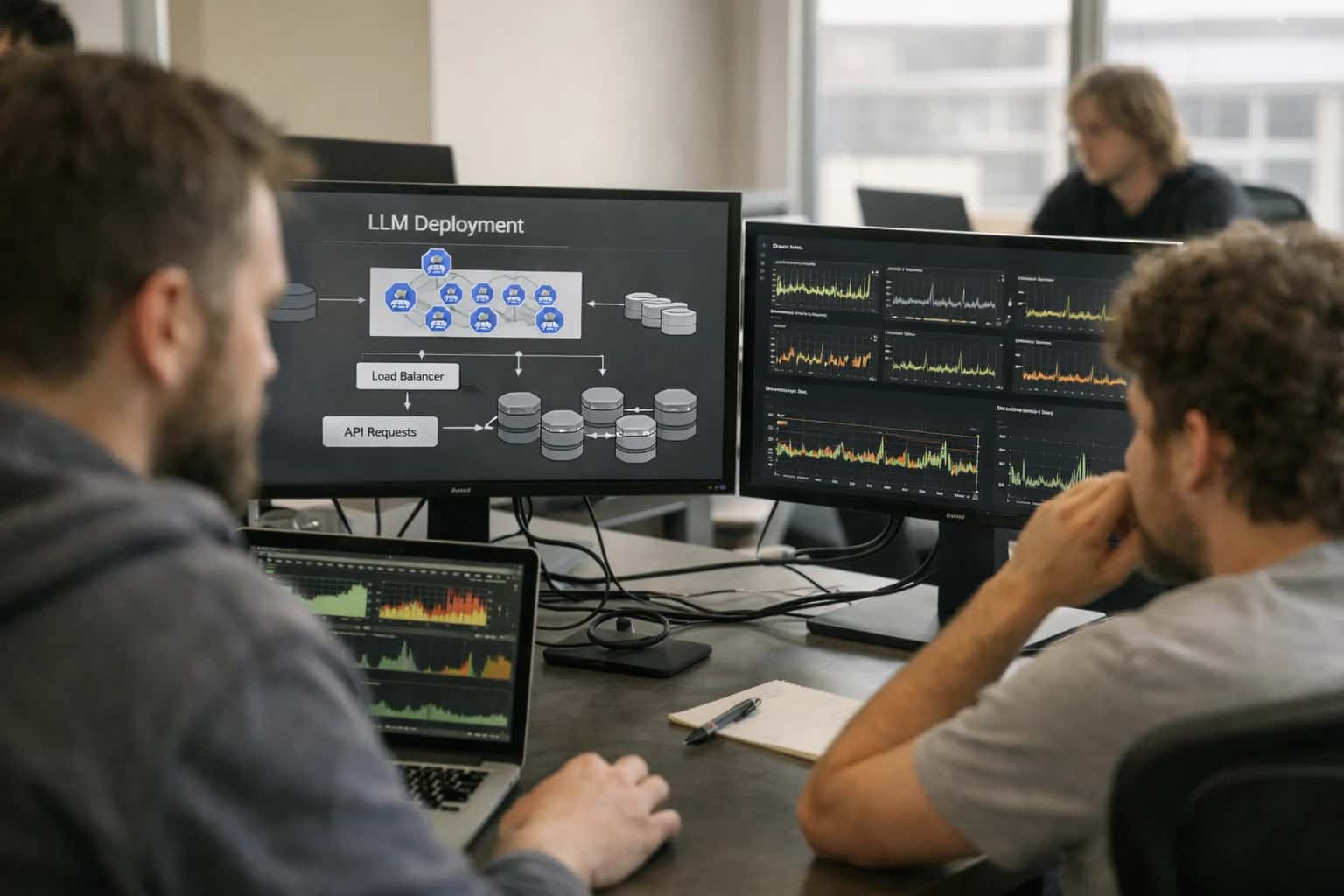
EDGE MODEL DEPLOYMENT
What is Continuous Deployment (CD Pipeline)?
A core practice in modern software and MLOps for automating the release of validated code and models to production.
The pipeline integrates with model versioning, containerization, and orchestration platforms like Kubernetes to manage deployments. Strategies such as canary deployments or rolling updates are used to minimize risk by gradually exposing new models to subsets of edge devices. The final goal is a closed-loop system where model monitoring triggers retraining and the CD pipeline redeploys improved models, creating a Continuous Model Learning cycle for adaptive edge intelligence.
EDGE MODEL DEPLOYMENT
Core Characteristics of Continuous Deployment
Continuous Deployment (CD) automates the release of validated code changes—including new machine learning models—directly to production. In edge AI, this practice is adapted to manage the unique challenges of distributed, resource-constrained hardware.
01
Fully Automated Release Pipeline
A Continuous Deployment pipeline automates every step from code commit to production release without manual intervention. For edge AI, this includes:
- Automated testing: Unit, integration, and model-specific validation (e.g., accuracy, latency).
- Automated building: Containerization of the model, runtime, and dependencies.
- Automated deployment: Pushing the validated artifact to the target edge environment. This eliminates human error and enables rapid, reliable updates to models running on remote devices.
02
Declarative Desired State
CD for edge systems relies on a declarative configuration that specifies the intended state of the entire fleet (e.g., model:v2.1 on all devices). An orchestrator (like Kubernetes) continuously reconciles the actual state of devices with this declared state. This is essential for managing thousands of heterogeneous edge nodes, ensuring they run the correct model version and configuration automatically, even after reboots or network partitions.
03
Advanced Deployment Strategies
To mitigate risk when updating models in production, CD pipelines implement sophisticated rollout strategies:
- Canary Deployment: Release a new model to a small, representative subset of edge devices first.
- Blue-Green Deployment: Maintain two identical environments; switch traffic from the old (blue) model to the new (green) model instantaneously.
- Rolling Update: Gradually replace model instances across the fleet to ensure zero downtime. These strategies allow for performance validation and fast rollback if the new model underperforms.
04
Comprehensive Model Monitoring & Drift Detection
True CD requires continuous validation that the deployed model is performing as expected. This involves:
- Performance Monitoring: Tracking inference latency, throughput, and hardware utilization on each device.
- Drift Detection: Automatically identifying data drift (changes in input data distribution) and concept drift (changes in the relationship between input and output).
- Shadow Deployment: Running a new model in parallel with the production model to compare predictions without affecting users. Alerts from this monitoring can automatically trigger pipeline stages for retraining or rollback.
05
Infrastructure as Code (IaC) & GitOps
The entire deployment environment—networking, security policies, and model specifications—is defined and version-controlled as code. GitOps applies this principle by using a Git repository as the single source of truth. Any change to the model or its deployment manifest in Git triggers the automated CD pipeline. This ensures:
- Auditability: Every change is tracked, reviewed, and reversible.
- Consistency: Identical, reproducible environments across development, staging, and production.
- Speed: Engineers can safely deploy updates by submitting a pull request.
06
Resilient Edge-Specific Operations
Deploying to the edge introduces unique constraints that CD pipelines must address:
- Over-the-Air (OTA) Updates: Secure, wireless distribution of model artifacts to remote devices.
- Delta Updates: Transmitting only the changed components of a model to conserve limited bandwidth.
- Offline Resilience: Pipelines must handle devices that are intermittently connected, using eventual consistency patterns.
- Rollback Mechanisms: Automated reversion to a previous stable model version must be possible even if a device cannot contact the central orchestrator, often managed through a device twin pattern.
DEPLOYMENT STRATEGIES
Continuous Deployment vs. Related Practices
A comparison of Continuous Deployment (CD) with adjacent software and model release methodologies, highlighting key operational differences for edge AI and MLOps.
| Feature / Metric | Continuous Deployment (CD) | Continuous Delivery | Manual Deployment |
|---|---|---|---|
Primary Goal | Every validated change is automatically released to production. | Every validated change is production-ready but requires manual approval for release. | Releases are planned, bundled, and executed manually by an operations team. |
Release Automation | |||
Human Approval Gate | |||
Release Cadence | Multiple times per day | Daily to weekly | Weekly to quarterly |
Rollback Mechanism | Automated, often via feature flags or blue-green switch. | Automated, but rollback decision may be manual. | Manual, often complex and time-consuming. |
Risk Profile | Low per-change risk; relies on extensive automated testing and monitoring. | Moderate risk; final human verification adds a safety check. | High risk; large, infrequent batches increase the impact of potential failures. |
Suitable for Edge AI Models | |||
Infrastructure Requirement | Full CI/CD pipeline, advanced monitoring, and automated rollback systems. | Full CI/CD pipeline with a manual approval stage. | Basic build scripts and manual orchestration tools. |
Team Culture | Requires high trust in automation and a 'you build it, you run it' DevOps mindset. | Requires collaboration between development and operations teams. | Traditional separation of development and operations (Dev vs. Ops). |
EDGE MODEL DEPLOYMENT
Continuous Deployment for Edge AI & Machine Learning
Continuous Deployment (CD) for Edge AI automates the release of validated machine learning models to a distributed fleet of remote devices, ensuring rapid, reliable, and consistent updates without manual intervention.
01
Core Pipeline Stages
A CD pipeline for Edge AI automates the sequence from code commit to live deployment. Key stages include:
- Build & Package: The trained model is converted into an optimized format (e.g., ONNX, TFLite) and packaged with its runtime dependencies into a container (e.g., Docker) or a device-specific artifact.
- Testing: The packaged model undergoes validation tests, including unit tests, integration tests, and performance benchmarks for target edge hardware.
- Deployment: The validated artifact is distributed to the edge device fleet via an orchestrator (e.g., Kubernetes). Strategies like canary deployment or rolling updates manage the rollout.
- Verification & Monitoring: Post-deployment, the model's performance and device health are monitored for data drift, latency spikes, or errors, triggering rollback if necessary.
02
Key Deployment Strategies
Different strategies manage risk and ensure availability during model updates on edge devices:
- Canary Deployment: The new model version is deployed to a small, representative subset of devices first. Its performance is monitored before a full fleet rollout, minimizing blast radius.
- Blue-Green Deployment: Two identical environments (blue = old version, green = new version) exist. Traffic is switched instantly from blue to green, enabling near-zero downtime and instant rollback by switching back.
- Rolling Update: The new version is incrementally deployed across the fleet, updating a few devices at a time while the rest serve traffic, ensuring continuous service availability.
- Shadow Deployment: The new model runs in parallel with the production model, processing real input data but not serving predictions. This validates performance under real load without user impact.
03
Edge-Specific Challenges & Solutions
Deploying to constrained, distributed devices introduces unique hurdles:
- Network Constraints: Limited or intermittent bandwidth requires efficient updates. Delta updates transmit only the changed bytes between model versions, and Over-the-Air (OTA) update managers handle resumeable transfers.
- Hardware Heterogeneity: A fleet may contain different chips (CPU, GPU, NPU). The pipeline must build and serve multiple optimized variants (e.g., quantized for ARM, compiled for NVIDIA Jetson) from a single model source.
- State Management & Rollback: Devices may be offline during an update. Orchestrators use a desired state declaration and device twins to reconcile state when devices reconnect. Automated model rollback procedures are critical for failed updates.
- Security: The update pipeline and artifacts must be cryptographically signed. Devices must verify integrity before installing to prevent malicious code execution.
04
Essential Enabling Technologies
CD for Edge AI relies on a stack of modern infrastructure tools:
- Orchestrators: Kubernetes (with K3s, KubeEdge, or MicroK8s for edge) or Docker Swarm automate deployment, scaling, and management of model containers across device fleets. DaemonSets ensure a pod (e.g., a monitoring agent) runs on every node.
- Infrastructure as Code (IaC) & GitOps: Tools like Terraform and Ansible define device infrastructure. GitOps (using tools like Flux or ArgoCD) makes a Git repository the source of truth, automatically syncing the live device state to the declared model version and configuration.
- Artifact & Configuration Management: Helm charts package Kubernetes manifests for complex model deployments. Container registries (e.g., Amazon ECR, Google Container Registry) store versioned model images. Feature flags allow dynamic enabling/disabling of model behavior without redeployment.
- Observability: Integrated monitoring stacks track model metrics (inference latency, throughput), device health, and detect concept drift. This telemetry is the feedback loop for the CD pipeline.
05
Integration with MLOps & CI
Edge CD is the final stage of a broader Machine Learning Operations (MLOps) lifecycle, tightly integrated with Continuous Integration (CI).
- CI Pipeline: Automatically trains and validates a model when new code or data is committed. It outputs a candidate model artifact and triggers the CD pipeline.
- Model Registry: Serves as a versioned repository (e.g., MLflow Model Registry, Sagemaker Model Registry) for trained models. The CD pipeline pulls a specific approved model version from the registry for deployment.
- Unified Experiment Tracking: Links the model version running on edge devices back to the exact training code, data snapshot, and hyperparameters used to create it, ensuring full reproducibility.
- Automated Retraining Triggers: Monitoring data from the CD phase (e.g., drift detection) can automatically trigger the CI pipeline to retrain a new model, creating a closed-loop, continuous learning system.
06
Best Practices for Production
To ensure reliable, large-scale Edge AI deployments:
- Declare Everything as Code: Model definitions, infrastructure, deployment manifests, and configuration should be version-controlled. This enables audit trails, collaboration, and disaster recovery.
- Implement Progressive Rollouts: Always use canary or rolling deployments. Start with 1-5% of devices, validate key metrics (accuracy, latency, memory), then gradually increase.
- Design for Resilience: Assume network and hardware failures. Use circuit breakers and exponential backoff in service calls. Ensure update transactions are idempotent to allow safe retries.
- Monitor Business & Operational Metrics: Beyond technical metrics (CPU usage), monitor business KPIs affected by the model (e.g., product defect rate, energy savings) to validate the update's real-world impact.
- Plan for Rollback: Automate rollback procedures. The ability to quickly revert to a previous known-good model version is more important than a fast rollout of a new, potentially broken one.
CONTINUOUS DEPLOYMENT (CD)
Frequently Asked Questions
Continuous Deployment (CD) automates the release of validated code changes—including new machine learning models—to production. This FAQ addresses its core mechanisms, benefits, and specific considerations for deploying AI to the edge.
Continuous Deployment (CD) is a software engineering practice where every code change that passes automated testing is automatically released to a production environment. For machine learning, this extends to automatically deploying new model versions. The core mechanism is an automated CD pipeline, a sequence of stages triggered by a code commit. A typical pipeline for an edge AI model includes: building a new model container, running unit and integration tests, deploying the container to a staging environment for validation, executing performance and drift detection checks, and finally, if all gates pass, automatically rolling out the update to production edge devices, often using strategies like canary deployment or rolling updates.
Enabling Efficiency, Speed & Accuracy
Intelligent Analysis, Decision & Execution
We build AI systems for teams that need search across company data, workflow automation across tools, or AI features inside products and internal software.
Talk to Us
Search across company data
Give teams answers from docs, tickets, runbooks, and product data with sources and permissions.
Useful when people spend too long searching or get different answers from different systems.
Enterprise searchRAGPermissions
Read more
Automate internal workflows
Use AI to route work, draft outputs, trigger actions, and keep approvals and logs in place.
Useful when repetitive work moves across multiple tools and teams.
AI agentsWorkflow automationGovernance
Read more
Add AI to products and internal tools
Build assistants, guided actions, or decision support into the software your team or customers already use.
Useful when AI needs to be part of the product, not a separate tool.
AI integrationDecision supportModel routing
Read more
About the author
Prasad Kumkar
CEO & MD, Inference Systems
Prasad Kumkar is the CEO & MD of Inference Systems and writes about AI systems architecture, LLM infrastructure, model serving, evaluation, and production deployment. Over 5+ years, he has worked across computer vision models, L5 autonomous vehicle systems, and LLM research, with a focus on taking complex AI ideas into real-world engineering systems.
His work and writing cover AI systems, large language models, AI agents, multimodal systems, autonomous systems, inference optimization, RAG, evaluation, and production AI engineering.
LinkedIn
Limited slotsGet a Free AI Consultation
Partnered with leading AI, data, and software stack.





How We Work
Custom AI workflows for your Business
One-fit-all AI don't work for modern businesses. At Inferensys, we aim to understand your business & custom requirements; which we use to define most efficient agentic workflows, the data, and the tools for your business.
01
Review the use case
We understand the task, the users, and where AI can actually help.
Read more02
Pick the right approach
We define what needs search, automation, or product integration.
Read more03
Build the first useful version
We implement the part that proves the value first.
Read more04
Improve from there
We add the checks and visibility needed to keep it useful.
Read moreThe first call is a practical review of your use case and the right next step.
Talk to Us