The Horizontal Pod Autoscaler (HPA) is a Kubernetes controller that automatically scales the number of Pod replicas in a deployment, replica set, or stateful set based on observed utilization of specified metrics. It operates by querying the Kubernetes Metrics API to monitor resource consumption like CPU and memory, or custom application metrics exposed via the Custom Metrics API. The HPA controller continuously compares the current metric values against the target values defined by the user, calculating the desired replica count to maintain the declared performance target.

Glossary
Horizontal Pod Autoscaler (HPA)
The Horizontal Pod Autoscaler (HPA) is a Kubernetes controller that automatically adjusts the number of Pod replicas in a deployment based on observed CPU utilization, memory consumption, or custom metrics to meet application demand.
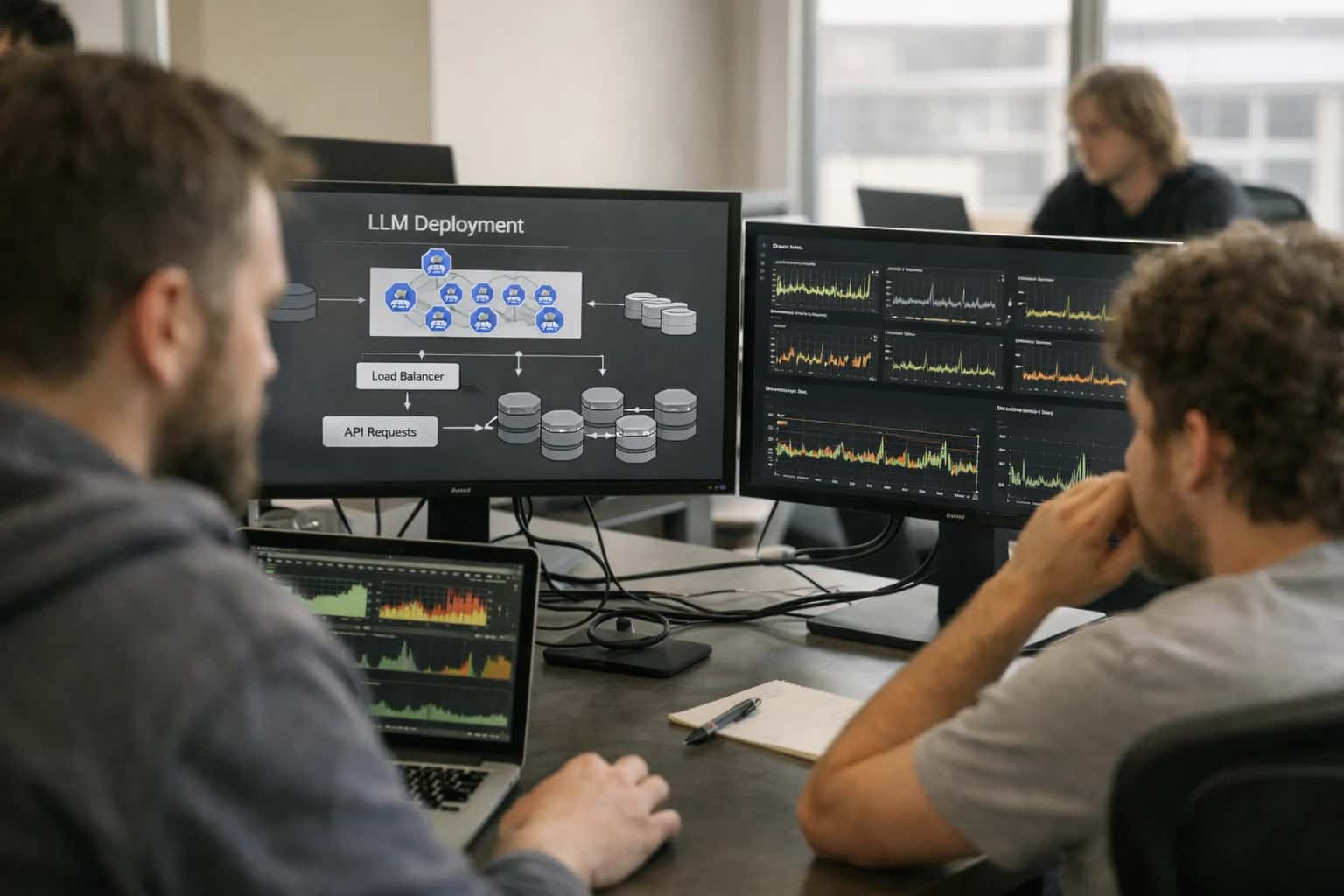
KUBERNETES AUTOSCALING
What is Horizontal Pod Autoscaler (HPA)?
The Horizontal Pod Autoscaler (HPA) is a core Kubernetes controller that automatically adjusts the number of Pod replicas in a workload to match observed demand.
For Edge AI Orchestration, HPA is critical for managing inference workloads on edge clusters, allowing services to scale out during peak demand and scale in to conserve resources. It integrates with the Kubernetes control plane to update the .spec.replicas field of the target workload, triggering the cluster's scheduler. Scaling decisions are governed by a control loop that prevents thrashing, and policies can be tuned with stabilization windows and scaling limits to suit the specific latency and resource constraints of distributed edge environments.
KUBERNETES ORCHESTRATION
Key Features of HPA
The Horizontal Pod Autoscaler (HPA) is a core Kubernetes controller that automatically adjusts the number of Pod replicas in a workload to match observed demand. Its design is built on several foundational principles for reliable, automated scaling.
01
Declarative Scaling Policy
HPA operates on a declarative model. You define a scaling policy by specifying a target metric (e.g., CPU utilization at 70%) and the HPA controller's job is to continuously reconcile the actual state (current Pod count) with that declared desired state. This is a core Kubernetes pattern, separating the 'what' (the policy) from the 'how' (the control loop logic).
- Policy Definition: Configured via a
HorizontalPodAutoscalerresource YAML. - Separation of Concerns: Developers/operators define the goal; the system handles the execution.
02
Metric-Driven Control Loop
At its heart, HPA runs a continuous control loop, typically every 15-30 seconds. In each iteration, it:
- Queries Metrics: Pulls current utilization values from the Metrics API (for core resources) or the Custom Metrics API.
- Calculates Desired Replicas: Uses the formula
desiredReplicas = ceil[currentReplicas * (currentMetricValue / desiredMetricValue)]. - Acts on Discrepancy: If the calculated desired replica count differs from the current count, it updates the target Deployment or ReplicaSet.
This loop embodies the observe-orient-decide-act (OODA) pattern for autonomous systems.
03
Multi-Metric Support
Modern HPA supports scaling based on multiple metric types, enabling sophisticated scaling logic:
- Resource Metrics: Core CPU and memory usage, sourced from the resource metrics pipeline (e.g.,
metrics-server). - Custom Metrics: Application-specific metrics like HTTP requests per second, queue length, or business logic KPIs, exposed via the Custom Metrics API (often backed by Prometheus Adapter).
- External Metrics: Metrics from outside the Kubernetes cluster, such as cloud provider queue depths (e.g., AWS SQS).
Metrics can be combined using logic (e.g., scale up if CPU > 70% OR requests per second > 1000).
04
Stability Controls: Cooldown/Delay
To prevent rapid, flapping scaling actions due to metric noise, HPA implements stabilization windows (cooldown/delay periods).
- Scale-Up Stabilization Window: Default 0 minutes (can scale up immediately). Can be configured to wait, allowing metrics to stabilize before adding more Pods.
- Scale-Down Stabilization Window: Default 5 minutes. The controller must observe a scaling recommendation for this full window before it will remove a Pod. This is a critical safety mechanism to protect against prematurely scaling down during short-lived traffic dips.
These windows are configurable per HPA resource.
05
Integration with Cluster Autoscaler
HPA scales Pods within the constraints of available node resources. For true elasticity, it is designed to work in tandem with the Cluster Autoscaler.
- HPA's Role: Scales the application layer (Pods).
- Cluster Autoscaler's Role: Scales the infrastructure layer (Nodes).
If HPA attempts to scale out Pods but there are insufficient node resources (a pending Pod), the Cluster Autoscaler detects this and provisions a new node in the cloud. This creates a full-stack, reactive scaling pipeline from application load to cloud infrastructure.
06
Custom Resource Definition (CRD) Based
The HorizontalPodAutoscaler resource itself is defined via a Custom Resource Definition (CRD), specifically autoscaling/v2. This makes HPA an extensible part of the Kubernetes API.
- API Versioning:
autoscaling/v2beta2introduced multi-metric and external metric support, which became stable inautoscaling/v2. - Operator Pattern Enabler: The HPA controller is a perfect example of the Operator Pattern—a custom controller watching a custom resource type and taking action to reconcile state. This model allows for the creation of third-party, application-specific autoscalers that extend or replace HPA's logic.
SCALING COMPARISON
HPA vs. Other Kubernetes Scaling Methods
A comparison of the Horizontal Pod Autoscaler with other primary scaling mechanisms available within Kubernetes, highlighting their operational triggers, resource targets, and suitability for different workload types, particularly in edge AI contexts.
| Feature / Metric | Horizontal Pod Autoscaler (HPA) | Vertical Pod Autoscaler (VPA) | Cluster Autoscaler (CA) | Manual Scaling (kubectl scale) |
|---|---|---|---|---|
Primary Scaling Dimension | Number of Pod replicas (horizontal) | CPU/Memory resources per Pod (vertical) | Number of cluster Nodes | Number of Pod replicas (horizontal) |
Core Trigger Mechanism | Observed metric (CPU, memory, custom) vs. target | Observed resource request vs. usage recommendation | Unschedulable Pods due to resource constraints | Human operator command |
Typical Target Metric | CPU utilization, memory usage, custom Prometheus metrics | Container CPU & memory request/limit recommendations | Cluster-wide allocatable CPU & memory | N/A |
Automation Level | ||||
Requires Pod Restart for Resource Change | ||||
Edge AI Suitability (Low/Medium/High) | High (stateless inference, batch processing) | Low (requires restart, disruptive) | Medium (adds nodes, slower response) | Low (manual, not reactive) |
Response Latency to Load Spike | 15-30 seconds (default metrics poll interval) | Minutes (analysis & recommendation cycle) | 1-5 minutes (node provisioning time) | Seconds to minutes (human-dependent) |
Stateful Workload Support | Limited (requires careful design for state) | Possible (but restart is disruptive) | Yes (node addition) | Yes (manual control) |
Declarative Configuration | ||||
Integration with Custom Metrics |
KUBERNETES SCALING
HPA in Edge AI Orchestration
The Horizontal Pod Autoscaler (HPA) is a critical Kubernetes controller for Edge AI, automatically adjusting the number of application Pod replicas based on real-time resource demand to ensure low-latency inference and efficient resource utilization across distributed edge nodes.
01
Core Scaling Mechanism
The HPA operates a continuous control loop that queries the Kubernetes Metrics Server or a custom metrics API to monitor resource consumption for a specified Deployment, ReplicaSet, or StatefulSet. It compares the observed metrics (e.g., average CPU utilization, memory usage, or custom application metrics) against user-defined target values. Based on this calculation, it automatically issues scaling instructions to the Kubernetes API to increase or decrease the number of Pod replicas. The formula is: desiredReplicas = ceil[currentReplicas * (currentMetricValue / desiredMetricValue)]. This ensures the application workload has sufficient compute resources to handle fluctuating inference requests at the edge without manual intervention.
02
Metrics for Edge AI Workloads
While CPU is a common default, Edge AI workloads often require more nuanced scaling triggers:
- Custom Metrics: Scale based on application-level metrics like queries per second (QPS), inference latency p99, or GPU memory utilization piped from a tool like Prometheus.
- External Metrics: Scale based on metrics from outside the cluster, such as queue depth in Apache Kafka or AWS SQS, signaling batch processing demand.
- Object Metrics: Scale based on a metric describing a single Kubernetes object, like the value of an Ingress object's
requests-per-second. For AI inference, targeting a metric like average request latency is often more effective than raw CPU, as it directly correlates with user experience and can trigger scaling before resource exhaustion causes slowdowns.
03
Configuration & Stability Controls
HPA behavior is finely tuned via its specification to prevent rapid, costly oscillation (thrashing):
minReplicas/maxReplicas: Define the absolute bounds for scaling, crucial for cost control on potentially expensive edge GPU nodes.targetAverageUtilizationortargetAverageValue: The desired value for the chosen metric (e.g.,targetAverageUtilization: 70for 70% CPU use).behavior: A critical stanza for Edge AI, allowing control over scaling speed.scaleUp/scaleDown: Policies define how many Pods can be added/removed per period and the stabilization window.stabilizationWindowSeconds: Prevents scaling based on brief metric spikes, using a historical window to determine the desired replica count. A longer downscale window protects against removing Pods during temporary traffic dips.
04
Challenges in Edge Environments
Deploying HPA in distributed edge clusters introduces unique constraints:
- Resource Fragmentation: Edge nodes are often heterogeneous and resource-constrained. HPA may scale a Deployment, but if nodes lack available CPU/memory/GPU, the new Pods will enter a Pending state, waiting for the Kubernetes Scheduler to find a suitable node.
- Network Latency & Metrics Delay: Metrics collection across high-latency, low-bandwidth edge links can be delayed, causing lag in scaling decisions.
- Cold Start Penalty: Scaling from zero replicas for serverless-style inference functions incurs a cold start delay as the model loads into memory, impacting the first requests.
- Stateful Workloads: Scaling StatefulSets (e.g., for distributed model training) is more complex than stateless Deployments and requires careful coordination.
05
Integration with Cluster Autoscaler
For comprehensive elasticity, HPA is paired with the Cluster Autoscaler (CA). The HPA scales Pods horizontally within the existing node pool. If scaling causes Pods to be unschedulable due to insufficient resources, the Cluster Autoscaler detects these Pending Pods and provisions new Nodes in the cloud or edge cluster (where supported). Conversely, when nodes are underutilized and Pods can be consolidated, the CA can remove nodes. This combination enables true auto-scaling of both application and infrastructure layers, though node provisioning at the physical edge is often slower than in the cloud.
06
Vertical Pod Autoscaler (VPA) vs. HPA
VPA is a complementary autoscaling approach. While HPA adjusts the number of Pod replicas, VPA adjusts the resource requests and limits (CPU, memory) of individual Pods. Their use cases differ:
- HPA: Best for stateless, scalable microservices where traffic load varies. Ideal for inference endpoints.
- VPA: Best for stateful or singleton workloads where horizontal scaling isn't feasible. It rightsizes resource allocations based on actual usage, preventing over-provisioning. Important: Running HPA and VPA on the same resource for the same metrics is not recommended without careful configuration, as they can conflict. For memory-bound applications, VPA can prevent OOM kills, while HPA handles traffic-based scaling.
HORIZONTAL POD AUTOSCALER
Frequently Asked Questions
Essential questions about the Kubernetes Horizontal Pod Autoscaler (HPA), the core controller for automatically scaling application replicas based on resource demand in edge and cloud-native environments.
The Horizontal Pod Autoscaler (HPA) is a Kubernetes controller that automatically increases or decreases the number of Pod replicas in a Deployment, ReplicaSet, or StatefulSet based on observed utilization of specified metrics, such as CPU or memory. It operates through a continuous control loop:
- Metrics Collection: The HPA queries the Metrics Server (for core resource metrics) or a custom metrics API (for application-specific metrics) to gather current utilization data for the target Pods.
- Desired Replica Calculation: It compares the current metric values against the target values defined in its specification. Using the formula
desiredReplicas = ceil[currentReplicas * (currentMetricValue / desiredMetricValue)], it calculates the ideal number of Pods. - Scaling Decision & Action: The HPA sends an update to the target workload's scale subresource, instructing the workload controller (e.g., the Deployment controller) to reconcile the actual Pod count to match the newly calculated desired state. This triggers the control plane to schedule or terminate Pods on available nodes in the data plane.
Enabling Efficiency, Speed & Accuracy
Intelligent Analysis, Decision & Execution
We build AI systems for teams that need search across company data, workflow automation across tools, or AI features inside products and internal software.
Talk to Us
Search across company data
Give teams answers from docs, tickets, runbooks, and product data with sources and permissions.
Useful when people spend too long searching or get different answers from different systems.
Enterprise searchRAGPermissions
Read more
Automate internal workflows
Use AI to route work, draft outputs, trigger actions, and keep approvals and logs in place.
Useful when repetitive work moves across multiple tools and teams.
AI agentsWorkflow automationGovernance
Read more
Add AI to products and internal tools
Build assistants, guided actions, or decision support into the software your team or customers already use.
Useful when AI needs to be part of the product, not a separate tool.
AI integrationDecision supportModel routing
Read more
About the author
Prasad Kumkar
CEO & MD, Inference Systems
Prasad Kumkar is the CEO & MD of Inference Systems and writes about AI systems architecture, LLM infrastructure, model serving, evaluation, and production deployment. Over 5+ years, he has worked across computer vision models, L5 autonomous vehicle systems, and LLM research, with a focus on taking complex AI ideas into real-world engineering systems.
His work and writing cover AI systems, large language models, AI agents, multimodal systems, autonomous systems, inference optimization, RAG, evaluation, and production AI engineering.
LinkedIn
Limited slotsGet a Free AI Consultation
Partnered with leading AI, data, and software stack.





How We Work
Custom AI workflows for your Business
One-fit-all AI don't work for modern businesses. At Inferensys, we aim to understand your business & custom requirements; which we use to define most efficient agentic workflows, the data, and the tools for your business.
01
Review the use case
We understand the task, the users, and where AI can actually help.
Read more02
Pick the right approach
We define what needs search, automation, or product integration.
Read more03
Build the first useful version
We implement the part that proves the value first.
Read more04
Improve from there
We add the checks and visibility needed to keep it useful.
Read moreThe first call is a practical review of your use case and the right next step.
Talk to Us