TensorFlow Lite (TFLite) is an open-source deep learning framework and compiler toolchain for deploying trained TensorFlow models on resource-constrained devices like mobile phones, microcontrollers, and edge hardware. Its core function is to convert standard models into an efficient, compact format via its TFLite Converter, applying optimizations like post-training quantization and pruning to reduce model size and latency. The framework includes a lean interpreter for executing models and a modular delegate system to offload computations to specialized hardware accelerators like NPUs, GPUs, or DSPs.

Glossary
TFLite (TensorFlow Lite)
TensorFlow Lite (TFLite) is a lightweight open-source machine learning library and compiler toolchain designed for deploying models on mobile, embedded, and edge devices with limited compute resources.
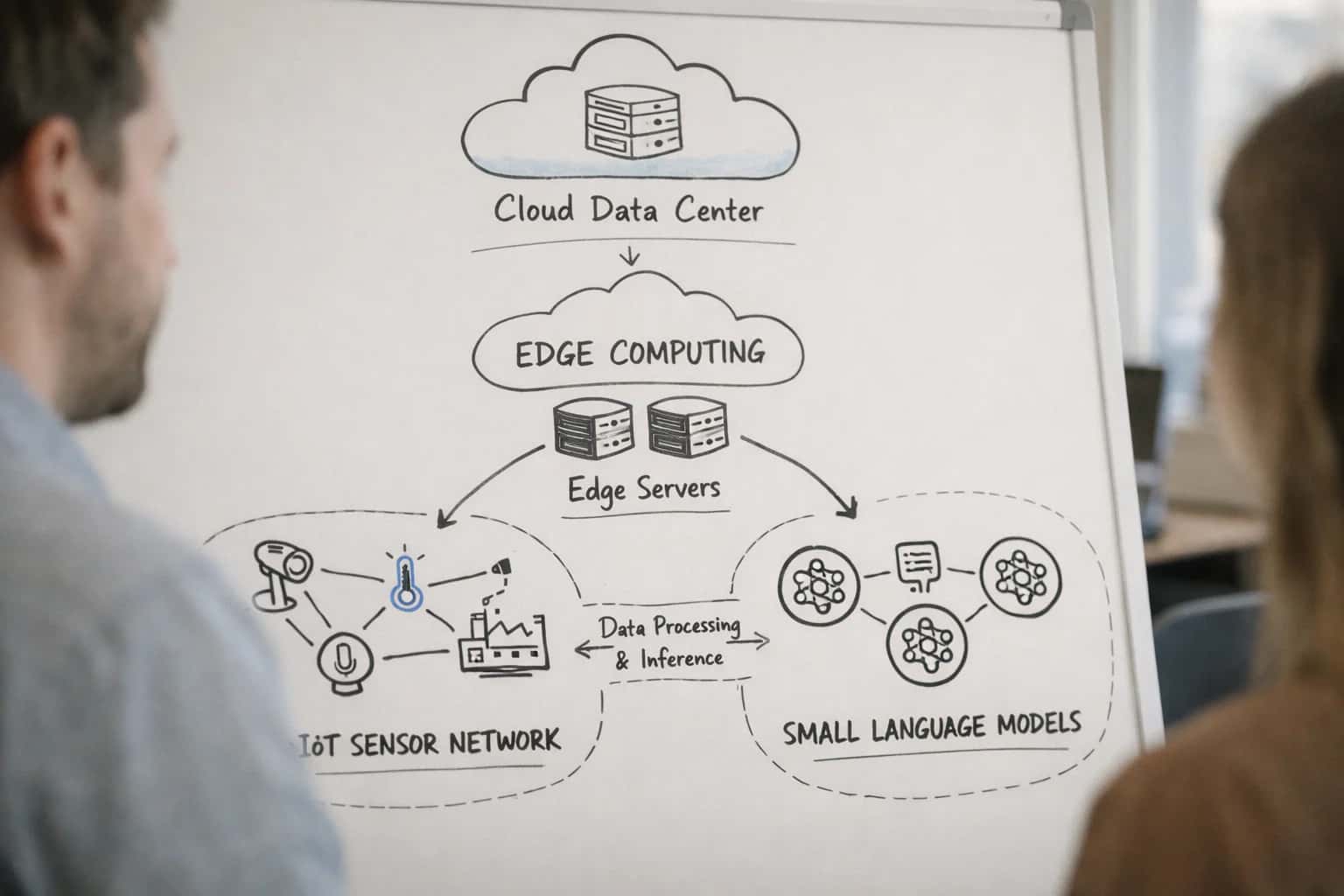
EDGE AI COMPILER
What is TFLite (TensorFlow Lite)?
A lightweight machine learning library and compiler toolchain for deploying models on mobile, embedded, and edge devices.
As a key edge AI compiler, TFLite performs ahead-of-time (AOT) graph optimizations such as operator fusion and constant folding to minimize runtime overhead. It supports both float32 and int8 precision models, enabling a balance between accuracy and performance. The toolchain is integral to the TinyML ecosystem, allowing developers to achieve low-latency, offline inference for applications requiring data sovereignty and operational resilience without cloud connectivity. Its design prioritizes minimal binary size and efficient memory usage for embedded systems.
TFLITE ARCHITECTURE
Core Components of the TFLite Stack
TensorFlow Lite is a lightweight, modular stack for deploying machine learning models on edge devices. Its architecture is built around a core interpreter that is extended by a suite of specialized components for optimization and hardware acceleration.
COMPILER WORKFLOW
How the TFLite Toolchain Works: From Model to Edge
The TensorFlow Lite (TFLite) toolchain is a specialized compiler pipeline that transforms a trained TensorFlow model into an optimized format for efficient execution on mobile, embedded, and edge devices.
The workflow begins with model conversion using the TFLiteConverter. This tool takes a model from a standard format like a TensorFlow SavedModel or Keras .h5 file and translates it into a FlatBuffer-based .tflite file. During conversion, the toolchain applies critical graph optimizations such as operator fusion, constant folding, and quantization to reduce model size and computational demands. This creates a portable, efficient representation ready for deployment.
For execution, the TFLite Interpreter loads the .tflite file on the target device. It performs static memory planning to allocate all necessary tensor buffers upfront, minimizing runtime overhead. To leverage specialized hardware like NPUs or DSPs, the interpreter uses a delegate mechanism, which offloads supported subgraphs to accelerated backends. This entire toolchain—conversion, optimization, and efficient runtime execution—enables high-performance, low-latency inference directly on resource-constrained edge hardware.
TFLITE DEPLOYMENT
Primary Use Cases for TFLite Deployment
TensorFlow Lite is designed for scenarios where models must run locally on devices with constrained resources, prioritizing low latency, privacy, and operational resilience without cloud dependency.
COMPARISON
TFLite vs. Other Edge Inference Frameworks
A feature and capability comparison of TensorFlow Lite against other prominent frameworks for deploying machine learning models on edge devices.
| Feature / Metric | TensorFlow Lite (TFLite) | ONNX Runtime | TVM | Core ML |
|---|---|---|---|---|
Primary Maintainer | Microsoft | Apache Software Foundation | Apple | |
Primary Model Format | TensorFlow SavedModel, Keras, TFLite FlatBuffer | ONNX | TVM Relay, ONNX, TensorFlow, PyTorch | Core ML Model (.mlmodel) |
Ahead-of-Time (AOT) Compilation | ||||
Just-in-Time (JIT) Compilation | ||||
Cross-Platform Support | Android, iOS, Linux, MCUs | Windows, Linux, Android, iOS | Windows, Linux, Android, iOS, WebAssembly | iOS, macOS, watchOS, tvOS |
Hardware Delegation API | ||||
Built-in Quantization Support (Post-Training) | INT8, FP16 | INT8, FP16 (via providers) | INT8, FP16 (via AutoTVM/Ansor) | INT8, FP16 |
Microcontroller Support (TinyML) | ||||
Static Memory Planning | ||||
Model Optimization Toolkit (e.g., Pruning, Clustering) | ||||
Native Support for Selective Build | ||||
Primary Optimization Focus | Deployment ease, binary size | Cross-framework compatibility, performance | Extreme performance portability | Tight Apple hardware integration |
TENSORFLOW LITE
Frequently Asked Questions
Essential questions and answers about TensorFlow Lite, the open-source deep learning framework for deploying models on mobile, microcontrollers, and edge devices.
TensorFlow Lite (TFLite) is a lightweight, open-source machine learning library and compiler toolchain designed to deploy TensorFlow models on resource-constrained devices like mobile phones, microcontrollers, and edge hardware. It works through a three-stage pipeline: model conversion, optimization, and interpreter-based execution. First, a model trained in TensorFlow is converted to the compact TFLite FlatBuffer format (.tflite) using the TFLite Converter. This converter applies optimizations like quantization and pruning. The resulting model is then executed on the target device by the TFLite Interpreter, which loads the model and runs inference using optimized kernel libraries and optional hardware delegates (e.g., for GPU, NPU, or DSP).
Enabling Efficiency, Speed & Accuracy
Intelligent Analysis, Decision & Execution
We build AI systems for teams that need search across company data, workflow automation across tools, or AI features inside products and internal software.
Talk to Us
Search across company data
Give teams answers from docs, tickets, runbooks, and product data with sources and permissions.
Useful when people spend too long searching or get different answers from different systems.
Enterprise searchRAGPermissions
Read more
Automate internal workflows
Use AI to route work, draft outputs, trigger actions, and keep approvals and logs in place.
Useful when repetitive work moves across multiple tools and teams.
AI agentsWorkflow automationGovernance
Read more
Add AI to products and internal tools
Build assistants, guided actions, or decision support into the software your team or customers already use.
Useful when AI needs to be part of the product, not a separate tool.
AI integrationDecision supportModel routing
Read more
About the author
Prasad Kumkar
CEO & MD, Inference Systems
Prasad Kumkar is the CEO & MD of Inference Systems and writes about AI systems architecture, LLM infrastructure, model serving, evaluation, and production deployment. Over 5+ years, he has worked across computer vision models, L5 autonomous vehicle systems, and LLM research, with a focus on taking complex AI ideas into real-world engineering systems.
His work and writing cover AI systems, large language models, AI agents, multimodal systems, autonomous systems, inference optimization, RAG, evaluation, and production AI engineering.
LinkedIn
Limited slotsGet a Free AI Consultation
Partnered with leading AI, data, and software stack.





How We Work
Custom AI workflows for your Business
One-fit-all AI don't work for modern businesses. At Inferensys, we aim to understand your business & custom requirements; which we use to define most efficient agentic workflows, the data, and the tools for your business.
01
Review the use case
We understand the task, the users, and where AI can actually help.
Read more02
Pick the right approach
We define what needs search, automation, or product integration.
Read more03
Build the first useful version
We implement the part that proves the value first.
Read more04
Improve from there
We add the checks and visibility needed to keep it useful.
Read moreThe first call is a practical review of your use case and the right next step.
Talk to Us