Visual inspection is an industrial edge AI application that uses computer vision and deep learning models to automatically detect defects, measure components, and verify assembly in manufacturing and quality control processes. By executing on-device inference, these systems analyze images or video streams in real-time without cloud connectivity, minimizing latency for immediate feedback and ensuring operational continuity. This deployment directly addresses the need for highly resilient, automated systems in production environments.

Glossary
Visual Inspection
Visual inspection is an industrial edge AI application that uses computer vision to automatically detect defects, measure components, or verify assembly in manufacturing and quality control processes.
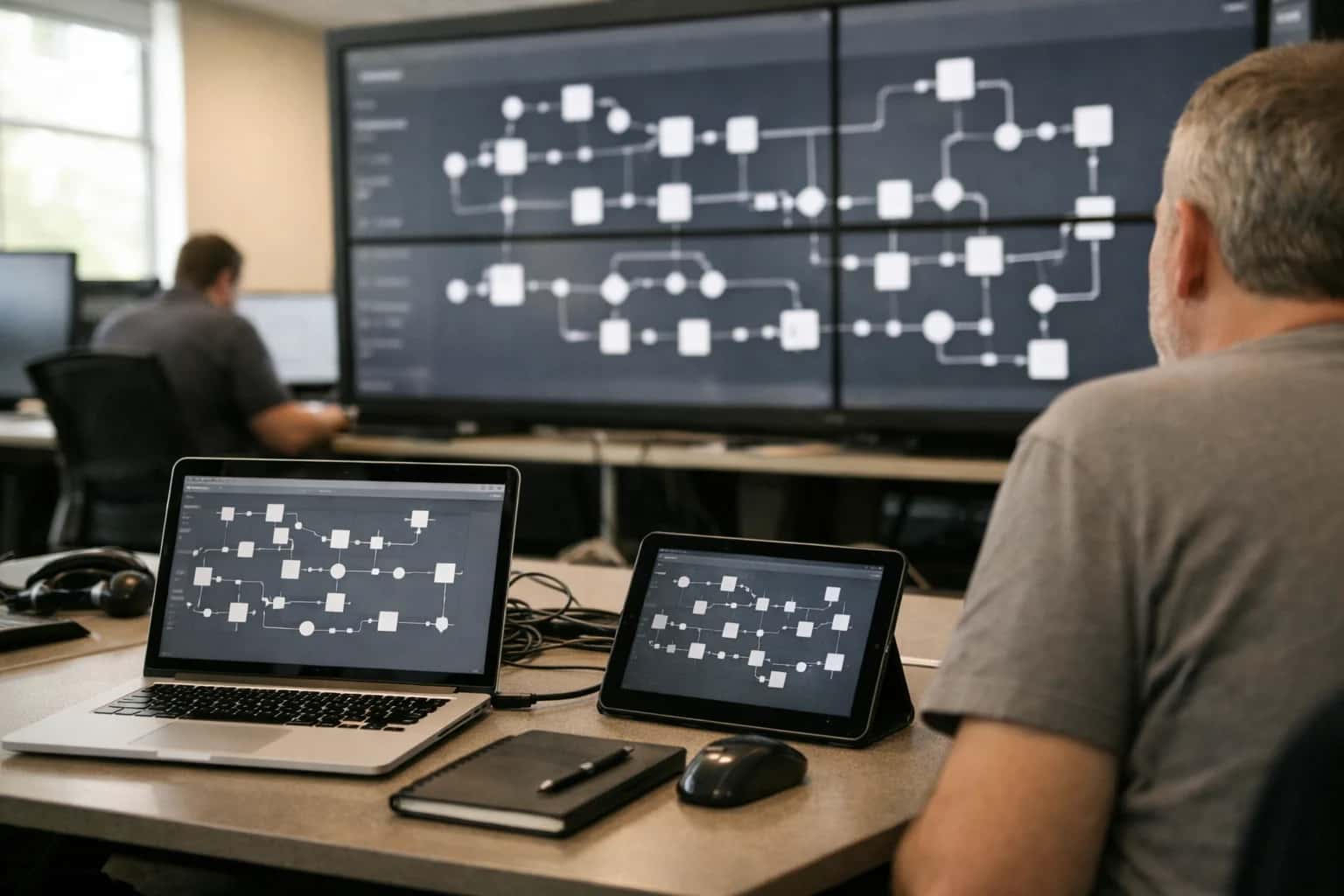
EDGE AI APPLICATION
What is Visual Inspection?
Visual inspection is a core industrial application of edge artificial intelligence that automates quality control and defect detection directly on manufacturing lines.
The technology relies on models trained for tasks like object detection, semantic segmentation, and anomaly detection to identify scratches, misalignments, or missing parts. Deploying these models at the edge—on cameras, gateways, or robotic arms—reduces bandwidth costs, enhances data privacy by keeping sensitive imagery local, and enables deterministic, low-latency responses critical for high-speed production lines. It is a foundational use case within Edge AI Architectures, demonstrating the shift from manual checks or centralized cloud analysis to distributed, intelligent automation.
EDGE AI APPLICATIONS
Core Components of an AI Visual Inspection System
An industrial AI visual inspection system is a multi-stage pipeline that integrates hardware, software, and machine learning models to automate quality control. These components work together to capture, process, analyze, and act on visual data directly at the point of production.
01
Imaging Hardware & Sensors
The physical layer responsible for capturing high-quality visual data under controlled conditions. This includes:
- Industrial Cameras: High-resolution, high-frame-rate sensors (e.g., CMOS, CCD) often with global shutters to prevent motion blur.
- Optics: Specialized lenses (telecentric, macro) and filters (polarizing, bandpass) to highlight specific features or defects.
- Lighting Systems: Structured, coaxial, or dark-field illumination engineered to create consistent contrast for the features of interest, critical for reliable model performance.
02
Edge Inference Engine
The software and hardware stack that executes the trained machine learning model on the local device. Key elements are:
- Optimized Model: A neural network (e.g., CNN, Vision Transformer) compressed via quantization and pruning for fast, efficient execution.
- Inference Runtime: Frameworks like TensorFlow Lite, ONNX Runtime, or hardware-specific SDKs (NVIDIA TensorRT, Intel OpenVINO) that compile the model for the target accelerator.
- Hardware Accelerator: A dedicated processor such as a Neural Processing Unit (NPU), GPU, or VPU that performs the matrix computations required for inference with high throughput and low power consumption.
03
Defect Detection & Classification Model
The core machine learning algorithm that analyzes the image to identify anomalies. Common architectures and tasks include:
- Object Detection Models (e.g., YOLO, EfficientDet): Locate and classify defects within an image, outputting bounding boxes.
- Semantic Segmentation Models (e.g., U-Net, DeepLab): Perform pixel-wise classification to precisely outline defect boundaries, useful for measuring crack length or stain area.
- Anomaly Detection Models: Used when defective samples are rare; these learn the distribution of "good" parts and flag significant deviations, often using autoencoders or One-Class SVMs.
04
Pre-Processing & Augmentation Pipeline
Software routines that prepare raw image data for the model to ensure consistency and robustness. This involves:
- Image Normalization: Scaling pixel values to a standard range (e.g., 0-1).
- Spatial Transformations: Cropping, resizing, and deskewing to align the object of interest.
- Noise Reduction: Applying filters (Gaussian, median) to remove sensor noise.
- Synthetic Data Augmentation: Generating training variations (rotations, contrast changes, simulated defects) to improve model generalization and compensate for limited real defect data.
05
Decision Logic & Integration Layer
The system component that translates model predictions into actionable outcomes and connects to broader industrial systems.
- Business Rules Engine: Applies thresholds and logic (e.g., "if crack length > 2mm, reject") to raw model confidence scores.
- Industrial Communication Protocols: Interfaces like OPC UA, MQTT, or PROFINET to send pass/fail signals to Programmable Logic Controllers (PLCs) that control conveyor belts or robotic arms.
- Human-Machine Interface (HMI): Displays results, defect overlays, and system status for operator review and override.
06
Model Management & Observability
The operational software responsible for the lifecycle and monitoring of inspection models in production.
- Model Versioning & A/B Testing: Rolling out new model versions to a subset of lines for performance comparison.
- Performance Monitoring: Tracking key metrics like inference latency, throughput (FPS), and model accuracy drift over time.
- Data Logging & Feedback Loop: Storing images of flagged defects for human review, creating a labeled dataset for continuous model retraining and improvement.
EDGE AI APPLICATION
How AI-Powered Visual Inspection Works
AI-powered visual inspection is an industrial application of computer vision where deep learning models, deployed directly on manufacturing hardware, automatically analyze images or video streams to identify defects, verify assembly, and ensure quality.
The process begins with image acquisition using industrial cameras or sensors. A trained convolutional neural network (CNN) then performs inference directly on the edge device, analyzing the visual data. The model executes tasks like object detection to locate components or semantic segmentation to classify every pixel, identifying anomalies such as scratches, misalignments, or missing parts against a learned standard of quality. This on-device execution eliminates cloud latency, enabling real-time, sub-second decision-making crucial for high-speed production lines.
For deployment, models are heavily optimized via techniques like quantization and pruning to run efficiently on constrained edge hardware, such as neural processing units (NPUs). The system outputs a pass/fail determination or detailed defect map, often triggering an automated reject mechanism. Continuous operation is enabled by federated learning frameworks, which allow the model to improve over time by aggregating learnings from multiple factory-floor devices without centralizing sensitive production image data.
EDGE AI APPLICATIONS
Industrial Applications and Examples
Visual inspection powered by edge AI automates quality control by deploying computer vision models directly onto cameras and industrial devices. This enables real-time defect detection, measurement, and verification without reliance on cloud connectivity.
01
Automotive Manufacturing
Edge AI performs real-time inspection of welds, paint finishes, and component assembly on the production line. Models detect micro-cracks, surface imperfections, and missing parts with sub-millimeter precision. This prevents defective units from progressing, reducing scrap and rework costs. Systems often use high-resolution line-scan cameras and structured light for 3D measurement.
< 100ms
Typical Latency
> 99.9%
Detection Accuracy
02
Electronics & Semiconductor
Inspects printed circuit boards (PCBs) and microchip packaging for defects like soldering bridges, missing components, or misaligned ball grid arrays. Edge models analyze imagery from microscopes and automated optical inspection (AOI) systems. Key challenges include handling reflective surfaces and detecting anomalies at micron-scale resolutions. Deployment prevents catastrophic failures in downstream products.
03
Pharmaceutical Packaging
Ensures label accuracy, blister pack integrity, and vial fill levels. Edge vision systems verify:
- Correct drug name and dosage on labels.
- Presence of safety seals and tamper evidence.
- Absence of foreign particles in liquid solutions.
Execution on local hardware maintains Good Manufacturing Practice (GMP) compliance by keeping sensitive production data on-premise.
04
Food & Beverage Quality Control
Monitors product consistency and safety on high-speed packaging lines. Applications include:
- Detecting contaminants (e.g., plastic, metal, organic matter).
- Sorting by color, size, and shape (e.g., fruits, vegetables).
- Verifying seal integrity on pouches and trays.
- Checking fill levels in bottles and cans.
Edge deployment is critical due to harsh, wash-down environments and the need for continuous operation without network dependency.
05
Aerospace & Composite Materials
Inspects carbon fiber layups, drill holes, and surface coatings on aircraft components. Edge AI analyzes thermographic and ultrasonic imagery to identify delamination, porosity, and impact damage invisible to the naked eye. The models must be robust to varying material textures and lighting conditions. On-device processing is mandated in secure, network-limited manufacturing facilities.
06
Textile & Apparel
Automates the detection of fabric defects like holes, stains, color inconsistencies, and weaving errors. High-speed line-scan cameras capture continuous material rolls, and edge models classify flaws in real-time, triggering automatic marking or cutting. This replaces manual inspection, increasing throughput and consistency. Models are trained on diverse fabric types and patterns to generalize across product lines.
COMPARISON
Traditional vs. AI-Powered Visual Inspection
A comparison of core technical and operational characteristics between rule-based automated optical inspection (AOI) systems and modern, AI-driven computer vision solutions for industrial quality control.
| Feature / Metric | Traditional Automated Optical Inspection (AOI) | AI-Powered Visual Inspection |
|---|---|---|
Core Methodology | Rule-based algorithms and template matching | Deep learning models (e.g., CNNs) trained on defect examples |
Defect Detection Capability | Predefined, known defects with simple geometries | Novel and complex defects, including subtle anomalies and variations |
Setup & Programming | Manual, labor-intensive; requires precise lighting/jig setup | Data-driven; trained on annotated image datasets of defects |
Adaptability to New Defects/Products | Requires complete reprogramming for new defect types or product lines | Adapts via incremental learning or retraining on new data; high flexibility |
False Positive/Negative Rate | High; sensitive to environmental changes (lighting, positioning) | Low; robust to environmental variances and minor product variations |
Inference Latency | < 100 ms (deterministic, simple logic) | 50-500 ms (varies with model complexity and hardware acceleration) |
Hardware Dependency | High; requires controlled, consistent environments | Low; can operate in variable conditions with appropriate sensor fusion |
Data & Connectivity Requirement | Minimal; standalone operation | Initial cloud/edge training pipeline; can run inference fully on-device |
Scalability Across Product Lines | Low; system is tightly coupled to specific product SKUs | High; a single model architecture can often be adapted for multiple SKUs |
Total Cost of Ownership (TCO) | High maintenance and reprogramming costs over time | Higher initial data/development cost, lower long-term operational cost |
Explainability of Reject Decisions | High; reject logic is explicitly programmed and traceable | Variable; requires XAI techniques (e.g., saliency maps) for interpretability |
VISUAL INSPECTION
Frequently Asked Questions
Essential questions about deploying computer vision for automated quality control and defect detection directly on manufacturing lines and edge devices.
Visual inspection in edge AI is an industrial application of computer vision where machine learning models are deployed directly onto cameras or local gateways to automatically detect defects, measure components, and verify assembly in real-time without requiring a cloud connection.
This process involves capturing images or video streams from production lines, running inference on an edge-optimized model (like a pruned and quantized convolutional neural network), and making immediate pass/fail decisions. Key advantages include sub-second latency for high-speed production, operational continuity during network outages, and data privacy as sensitive images never leave the factory floor. It is a core component of Industry 4.0 and smart manufacturing initiatives.
Enabling Efficiency, Speed & Accuracy
Intelligent Analysis, Decision & Execution
We build AI systems for teams that need search across company data, workflow automation across tools, or AI features inside products and internal software.
Talk to Us
Search across company data
Give teams answers from docs, tickets, runbooks, and product data with sources and permissions.
Useful when people spend too long searching or get different answers from different systems.
Enterprise searchRAGPermissions
Read more
Automate internal workflows
Use AI to route work, draft outputs, trigger actions, and keep approvals and logs in place.
Useful when repetitive work moves across multiple tools and teams.
AI agentsWorkflow automationGovernance
Read more
Add AI to products and internal tools
Build assistants, guided actions, or decision support into the software your team or customers already use.
Useful when AI needs to be part of the product, not a separate tool.
AI integrationDecision supportModel routing
Read more
About the author
Prasad Kumkar
CEO & MD, Inference Systems
Prasad Kumkar is the CEO & MD of Inference Systems and writes about AI systems architecture, LLM infrastructure, model serving, evaluation, and production deployment. Over 5+ years, he has worked across computer vision models, L5 autonomous vehicle systems, and LLM research, with a focus on taking complex AI ideas into real-world engineering systems.
His work and writing cover AI systems, large language models, AI agents, multimodal systems, autonomous systems, inference optimization, RAG, evaluation, and production AI engineering.
LinkedIn
Limited slotsGet a Free AI Consultation
Partnered with leading AI, data, and software stack.





How We Work
Custom AI workflows for your Business
One-fit-all AI don't work for modern businesses. At Inferensys, we aim to understand your business & custom requirements; which we use to define most efficient agentic workflows, the data, and the tools for your business.
01
Review the use case
We understand the task, the users, and where AI can actually help.
Read more02
Pick the right approach
We define what needs search, automation, or product integration.
Read more03
Build the first useful version
We implement the part that proves the value first.
Read more04
Improve from there
We add the checks and visibility needed to keep it useful.
Read moreThe first call is a practical review of your use case and the right next step.
Talk to Us