On-device inference is the process where a pre-trained machine learning model performs prediction or classification tasks directly on local hardware. This architectural shift moves computation from centralized cloud servers to the network edge, enabling real-time decision-making. The core technical challenge involves optimizing models to run within the strict memory, power, and compute constraints of embedded systems and mobile processors while maintaining accuracy.

Glossary
On-Device Inference
On-device inference is the process of executing a trained machine learning model locally on an edge device, such as a smartphone or sensor, without requiring a network connection to a cloud server.
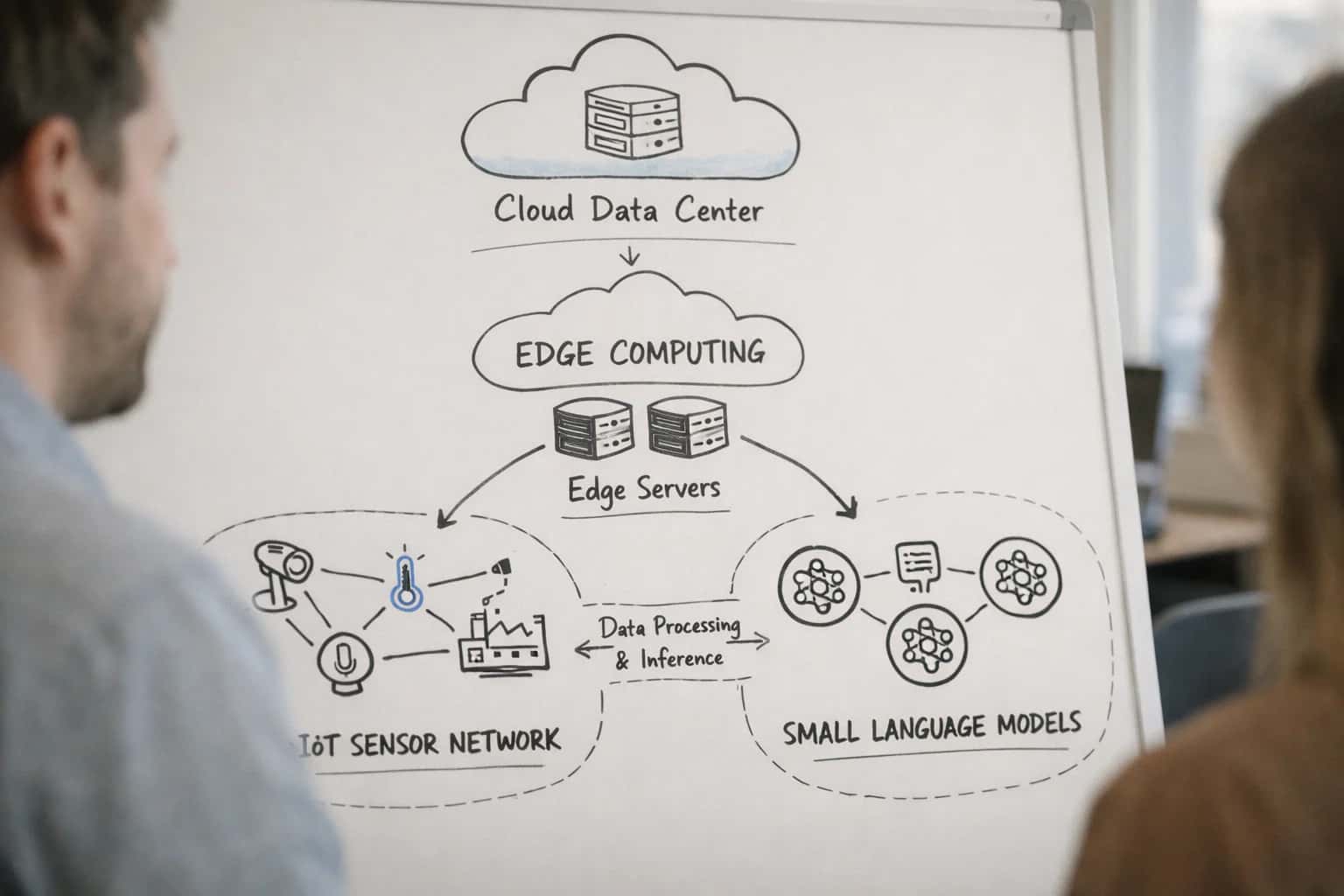
EDGE AI APPLICATIONS
What is On-Device Inference?
On-device inference is the execution of a trained machine learning model locally on an edge device, such as a smartphone, sensor, or industrial controller, without requiring a network connection to a cloud server.
This paradigm is foundational to applications requiring low-latency response, operational continuity without internet connectivity, and enhanced data privacy by keeping sensitive information local. It is enabled by techniques like model compression, quantization, and hardware-specific acceleration using NPUs or GPUs. Key use cases include autonomous navigation, industrial predictive maintenance, real-time video analytics, and keyword spotting on smart devices.
DEFINING FEATURES
Core Characteristics of On-Device Inference
On-device inference is defined by a set of interrelated technical and operational attributes that distinguish it from cloud-based execution. These characteristics collectively enable a new class of resilient, private, and responsive applications.
01
Latency Determinism
On-device inference provides predictable, low-latency responses by eliminating network round-trip time to a cloud server. Execution time is bounded by local hardware capabilities, not variable internet connectivity. This is critical for real-time applications where sub-second decisions are mandatory, such as:
- Autonomous vehicle obstacle avoidance.
- Industrial robotics for precise control loops.
- Interactive augmented reality overlays. Latency is typically measured in milliseconds, with performance governed by the device's Neural Processing Unit (NPU) or GPU.
02
Data Privacy & Sovereignty
Sensitive data, such as personally identifiable information (PII), biometric data, or proprietary operational telemetry, never leaves the physical device. This local processing model is a foundational requirement for:
- Compliance with regulations like GDPR and HIPAA.
- Offline operation in secure or remote environments.
- Mitigating risks associated with data breaches during transmission. The model and its outputs reside entirely within the user's or organization's controlled hardware, ensuring data sovereignty and reducing attack surfaces.
03
Operational Resilience
Systems remain fully functional without a persistent network connection. This offline capability guarantees service continuity in scenarios with intermittent connectivity or deliberate air-gapping, such as:
- Remote field equipment in mining or agriculture.
- Disaster response operations where networks are compromised.
- Consumer devices like smartphones in airplane mode. Resilience is achieved through complete software encapsulation of the model, runtime, and necessary data on the edge device.
04
Bandwidth & Cost Efficiency
By processing data locally, on-device inference eliminates the need to continuously stream high-volume sensor data (e.g., video, audio, LiDAR) to the cloud. This results in:
- Drastic reduction in cellular or satellite data transfer costs.
- Conservation of network bandwidth in congested environments.
- Elimination of recurring cloud inference API costs. Only lightweight results or aggregated metadata (e.g., "anomaly detected") are transmitted if needed, optimizing total cost of ownership.
05
Hardware-Software Co-Design
Effective on-device inference requires deep optimization for specific edge silicon. This involves:
- Model Compression: Techniques like quantization (e.g., INT8), pruning, and knowledge distillation to reduce model size and compute needs.
- Compiler Optimization: Using frameworks like TensorFlow Lite, ONNX Runtime, or Apache TVM to compile models for efficient execution on target accelerators (NPUs, GPUs, DSPs).
- Power Management: Algorithms must operate within strict thermal design power (TDP) and battery life constraints, often leveraging heterogeneous computing (big.LITTLE cores).
06
Scalable Fleet Management
Deploying and maintaining models across thousands or millions of devices introduces unique MLOps challenges. Key capabilities include:
- Over-the-Air (OTA) Updates: Secure, differential updates for model versions and firmware.
- Health Monitoring: Remote telemetry for model performance, drift detection, and hardware status.
- A/B Testing & Canary Releases: Rolling out new models to device subsets to validate performance.
- Federated Learning: Enabling collaborative model improvement from decentralized edge data without central raw data collection. This transforms the fleet from a static deployment into a dynamic, adaptive system.
EDGE AI APPLICATIONS
How On-Device Inference Works: A Technical Workflow
On-device inference is the process of executing a trained machine learning model locally on an edge device, such as a smartphone or sensor, without requiring a network connection to a cloud server.
The workflow begins with a pre-trained model that has undergone model compression techniques like quantization and pruning to reduce its size and computational demands. This optimized model is then compiled by a specialized edge AI compiler, such as TensorFlow Lite or ONNX Runtime, which translates the model's operations into efficient instructions for the target hardware, whether a CPU, GPU, or a dedicated Neural Processing Unit (NPU). The compiled model binary is deployed to the device's storage, ready for execution.
During runtime, the device's inference engine loads the model into memory. Raw input data from local sensors—like camera pixels or audio samples—is preprocessed into the model's expected tensor format. The engine then executes the model's computational graph layer-by-layer on the local accelerator. The resulting output—a classification, bounding box, or forecast—is generated with minimal latency. This closed-loop execution ensures data privacy, operational resilience without connectivity, and deterministic power efficiency by eliminating network transmission overhead.
INDUSTRY USE CASES
Real-World Applications of On-Device Inference
On-device inference enables intelligent, real-time decision-making across industries by executing machine learning models locally on smartphones, sensors, cameras, and embedded systems. These applications prioritize low latency, data privacy, and operational resilience.
01
Smartphone Photography & Augmented Reality
Modern smartphones use on-device neural networks for computational photography and real-time AR. Key functions include:
- Portrait mode and night mode processing using semantic segmentation and multi-frame fusion.
- Real-time object occlusion in AR apps, where virtual objects interact believably with the physical scene.
- Live translation through the camera viewfinder, overlaying text in a different language. These features require sub-100ms latency, which is only achievable by processing frames directly on the device's Neural Processing Unit (NPU) or GPU, avoiding the round-trip delay of cloud offloading.
02
Industrial Predictive Maintenance
Factories deploy vibration analysis and acoustic anomaly detection models directly on sensors attached to critical machinery like motors, pumps, and turbines.
- Models analyze sensor telemetry in real-time to detect patterns indicative of impending failure, such as bearing wear or imbalance.
- By triggering alerts locally, maintenance can be scheduled proactively, preventing costly unplanned downtime.
- This approach is essential in environments with poor or non-existent network connectivity, ensuring continuous monitoring. It also keeps sensitive operational data on-premises.
03
Autonomous Mobile Robots & Drones
Warehouse robots and delivery drones rely on on-device sensor fusion and path planning for safe navigation.
- Simultaneous Localization and Mapping (SLAM) algorithms run locally to build a map and locate the robot within it using LiDAR, cameras, and inertial sensors.
- Real-time obstacle detection and avoidance models process camera feeds to identify people, pallets, and other hazards, enabling immediate evasive maneuvers.
- This local processing is non-negotiable for safety; a network lag could result in a collision. It also allows operation in GPS-denied environments like indoor warehouses.
04
Healthcare & Medical Devices
Patient-facing medical devices use on-device AI for immediate diagnostics and monitoring while protecting Protected Health Information (PHI).
- Portable ultrasound devices use image enhancement models to provide clearer imaging for point-of-care diagnostics.
- Continuous glucose monitors and smart inhalers use predictive algorithms to forecast trends and provide personalized alerts.
- ECG analysis on smartwatches detects atrial fibrillation by processing heart rhythm data locally, ensuring privacy and enabling life-critical, instantaneous alerts without relying on a cellular connection.
05
Automotive Advanced Driver Assistance Systems (ADAS)
Modern vehicles are networks of Electronic Control Units (ECUs) running specialized on-device models for split-second decisions.
- Camera-based systems perform lane detection, traffic sign recognition, and pedestrian detection.
- Radar and LiDAR processing units fuse data to create a robust model of the vehicle's surroundings for adaptive cruise control and automatic emergency braking.
- These systems are architected for functional safety (ISO 26262 ASIL-D), meaning they must operate deterministically with zero network dependency, as a cloud round-trip delay of even 100ms is unacceptable at highway speeds.
06
Smart Retail & Checkout-Free Stores
Checkout-free stores like Amazon Go use dense networks of ceiling-mounted cameras and weight sensors.
- On-edge compute units run sophisticated computer vision models that track individual shoppers, identify products they pick up, and maintain a virtual cart in real-time.
- This generates terabytes of video data daily; processing it locally is the only viable economic model, as transmitting it to the cloud would be prohibitively expensive in bandwidth costs.
- It also addresses major privacy concerns by ensuring raw video streams never leave the store's local network, with only transaction metadata being sent to central systems.
ARCHITECTURAL DECISION
On-Device vs. Cloud Inference: A Technical Comparison
A feature-by-feature comparison of executing machine learning model inference locally on an edge device versus sending data to a remote cloud server.
| Feature / Metric | On-Device Inference | Cloud Inference |
|---|---|---|
Latency | < 10-100 ms | 100-1000+ ms |
Network Dependency | ||
Data Privacy | ||
Operational Cost (per inference) | $0.0001 - $0.001 | $0.001 - $0.01 |
Upfront Hardware Cost | $10 - $500 | $0 (client-side) |
Scalability (Concurrent Users) | Limited by device | Effectively unlimited |
Model Update Frequency | Weeks/Months (OTA) | Minutes/Hours |
Maximum Model Complexity | Small/Medium (e.g., < 100M params) | Very Large (e.g., > 10B params) |
Power Consumption Profile | Milliwatts - Watts (battery) | Kilowatts (data center) |
Deterministic Execution |
ON-DEVICE INFERENCE
Frequently Asked Questions
On-device inference is the execution of a trained machine learning model locally on an edge device, such as a smartphone, IoT sensor, or embedded system, without requiring a network connection to a cloud server. This glossary answers common technical questions about its implementation, benefits, and trade-offs.
On-device inference is the process of executing a trained machine learning model locally on an edge device's hardware, such as a CPU, GPU, or specialized Neural Processing Unit (NPU), without sending data to a remote server. The workflow involves:
- Model Deployment: A pre-trained model (e.g., a TensorFlow Lite or ONNX Runtime model) is compiled and optimized for the target device's architecture.
- Input Processing: Raw sensor data (images, audio, time-series) is captured and preprocessed (normalized, resized) on the device.
- Forward Pass: The processed data is fed through the model's computational graph. The device's compute cores perform the matrix multiplications and activation functions defined by the model's weights.
- Output Generation: The model produces a prediction (e.g., a classification label, bounding boxes, a forecast) which is then used by the local application.
This entire pipeline operates within the device's memory and compute constraints, enabled by techniques like quantization and pruning.
Enabling Efficiency, Speed & Accuracy
Intelligent Analysis, Decision & Execution
We build AI systems for teams that need search across company data, workflow automation across tools, or AI features inside products and internal software.
Talk to Us
Search across company data
Give teams answers from docs, tickets, runbooks, and product data with sources and permissions.
Useful when people spend too long searching or get different answers from different systems.
Enterprise searchRAGPermissions
Read more
Automate internal workflows
Use AI to route work, draft outputs, trigger actions, and keep approvals and logs in place.
Useful when repetitive work moves across multiple tools and teams.
AI agentsWorkflow automationGovernance
Read more
Add AI to products and internal tools
Build assistants, guided actions, or decision support into the software your team or customers already use.
Useful when AI needs to be part of the product, not a separate tool.
AI integrationDecision supportModel routing
Read more
About the author
Prasad Kumkar
CEO & MD, Inference Systems
Prasad Kumkar is the CEO & MD of Inference Systems and writes about AI systems architecture, LLM infrastructure, model serving, evaluation, and production deployment. Over 5+ years, he has worked across computer vision models, L5 autonomous vehicle systems, and LLM research, with a focus on taking complex AI ideas into real-world engineering systems.
His work and writing cover AI systems, large language models, AI agents, multimodal systems, autonomous systems, inference optimization, RAG, evaluation, and production AI engineering.
LinkedIn
Limited slotsGet a Free AI Consultation
Partnered with leading AI, data, and software stack.





How We Work
Custom AI workflows for your Business
One-fit-all AI don't work for modern businesses. At Inferensys, we aim to understand your business & custom requirements; which we use to define most efficient agentic workflows, the data, and the tools for your business.
01
Review the use case
We understand the task, the users, and where AI can actually help.
Read more02
Pick the right approach
We define what needs search, automation, or product integration.
Read more03
Build the first useful version
We implement the part that proves the value first.
Read more04
Improve from there
We add the checks and visibility needed to keep it useful.
Read moreThe first call is a practical review of your use case and the right next step.
Talk to Us