Federated inference is a distributed computing paradigm where multiple edge devices collaboratively perform inference using a shared machine learning model without centralizing raw data. Unlike federated learning, which focuses on decentralized model training, this architecture is optimized for decentralized model execution. It enables devices like smartphones, sensors, or IoT gateways to process data locally and then share only aggregated insights or partial results, preserving privacy and reducing latency by minimizing cloud dependency.

Glossary
Federated Inference
Federated inference is a distributed computing paradigm where multiple edge devices collaboratively perform inference using a shared model, often aggregating results without exposing raw local data.
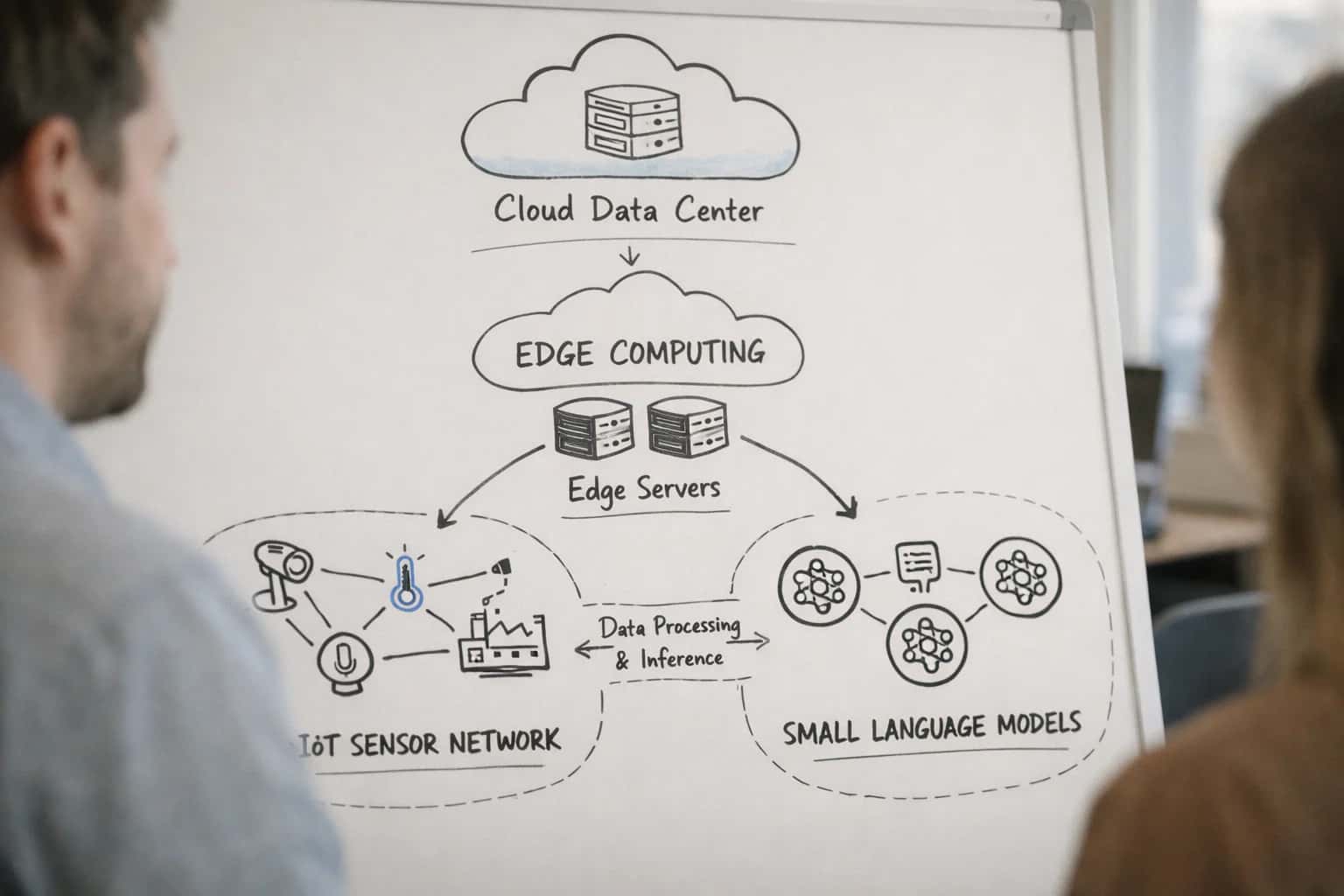
EDGE AI APPLICATIONS
What is Federated Inference?
Federated inference is a distributed computing paradigm where multiple edge devices collaboratively perform inference on a shared model, potentially aggregating results without exposing raw local data.
This approach is critical for applications requiring real-time responsiveness and data sovereignty, such as collaborative sensor networks for predictive maintenance or privacy-sensitive smart surveillance. The system often involves an orchestration layer that coordinates devices, manages model versions, and securely aggregates inferences. By keeping sensitive data on-premises and distributing the computational load, federated inference enhances resilience against network failures and supports scalable, privacy-preserving edge AI deployments across regulated industries.
ARCHITECTURAL PRINCIPLES
Key Characteristics of Federated Inference
Federated inference is a distributed computing paradigm where multiple edge devices collaboratively perform inference using a shared model, often aggregating results without exposing raw local data. Its core characteristics define its unique advantages and constraints.
01
Decentralized Execution
Inference is performed locally on each participating edge device (e.g., smartphone, sensor, IoT gateway) using a shared model. This eliminates the need to transmit raw sensor data (images, audio, telemetry) to a central cloud server, reducing bandwidth consumption and transmission latency. The system's intelligence is distributed across the network perimeter.
02
Privacy-Preserving Aggregation
A defining feature is the aggregation of local inference results or embeddings instead of raw data. Techniques include:
- Secure Aggregation: Cryptographic protocols that combine model outputs (e.g., averaged predictions) without revealing any single device's contribution.
- Differential Privacy: Adding calibrated noise to shared outputs to mathematically guarantee individual data points cannot be re-identified. This enables collaborative intelligence while maintaining data sovereignty and complying with regulations like GDPR.
03
Heterogeneous Device Orchestration
Federated inference must manage a heterogeneous fleet of devices with varying compute power (CPU, GPU, NPU), memory, network connectivity, and power profiles. The orchestration layer must:
- Schedule inference tasks based on device capability and availability.
- Handle partial participation, where only a subset of devices are online or willing to contribute at any given time.
- Manage model versions and updates across diverse hardware.
04
Resilience to Network Disruption
The architecture is inherently resilient because core inference logic runs on-device. Devices can continue to operate and provide intelligent functionality during network outages or in low-connectivity environments (e.g., remote industrial sites, moving vehicles). Final aggregated insights can be computed asynchronously once connectivity is restored, making it ideal for mission-critical applications requiring operational continuity.
05
Latency-Optimized Workflows
By performing inference at the source of data generation, federated inference minimizes end-to-end latency. This is critical for real-time applications such as:
- Industrial robotics requiring millisecond response times.
- Augmented reality overlays that must track user movement instantly.
- Autonomous vehicle perception systems. Latency is determined by local hardware speed, not by round-trip communication to a distant data center.
06
Collaborative Context Enrichment
Federated inference enables a form of collective intelligence. By aggregating insights from many devices observing related phenomena in different locations or contexts, the system can build a richer, more robust understanding than any single device could. Examples include:
- Traffic monitoring: Aggregating anonymized object detection results from hundreds of vehicles to map congestion.
- Environmental sensing: Combining local air quality inferences from a network of sensors to model pollution dispersion.
- Federated retrieval: Building a distributed search index from on-device document embeddings without centralizing the documents themselves.
COMPARISON
Federated Inference vs. Related Paradigms
This table contrasts federated inference with other distributed and edge computing paradigms, highlighting key architectural and operational differences.
| Feature / Metric | Federated Inference | On-Device Inference | Edge Computing | Cloud Inference |
|---|---|---|---|---|
Primary Execution Location | Distributed across multiple edge devices | Single, local edge device | Local edge server or gateway | Centralized cloud data center |
Data Privacy Posture | Raw data never leaves the device; only aggregated results or model updates are shared. | Raw data processed and remains entirely on the device. | Data is processed on a local network node, potentially outside the originating device. | Raw data is transmitted to and processed in a remote, third-party cloud environment. |
Network Dependency | Required for result/model aggregation, but not for local inference execution. | Typically required for initial model deployment and data ingestion, but not for core inference. | ||
Typical Latency | < 100 ms (aggregation + local inference) | < 10 ms (local inference only) | 10-50 ms (local network hop) | 200-1000 ms (round-trip to cloud) |
Bandwidth Consumption | Low (kilobits per second for model updates/aggregated results) | None for inference execution. | Moderate (megabits per second for sensor data to gateway) | High (megabits to gigabits per second for raw data upload) |
Scalability Model | Horizontally scalable by adding more devices to the federation. | Limited by the computational capacity of the single device. | Vertically scalable by upgrading the edge server; limited by local cluster size. | Effectively infinite, scaled by cloud provider's infrastructure. |
Resilience to Network Outage | Local devices can continue independent inference; aggregation pauses. | Local server can continue processing; upstream/downstream sync pauses. | ||
Model Update Mechanism | Aggregated learning or coordinated model pushes via federated learning techniques. | Requires full model OTA update or on-device personalization. | Model deployed via orchestration to the edge server. | Model deployed centrally to cloud endpoints; instant global update. |
Primary Use Case Driver | Collaborative intelligence without data centralization (e.g., swarm sensing, privacy-first analytics). | Ultra-low latency, always-available functionality (e.g., wake-word detection, real-time control). | Local data processing and reduction before cloud upload (e.g., factory floor analytics, smart city hubs). | Heavyweight model execution, batch processing, and centralized data lakes. |
FEDERATED INFERENCE
Frequently Asked Questions
Federated inference is a distributed computing paradigm where multiple edge devices collaboratively perform inference on a shared model, potentially aggregating results without exposing raw local data. This FAQ addresses key technical questions about its mechanisms, benefits, and implementation.
Federated inference is a distributed computing paradigm where a cohort of edge devices collaboratively executes inference using a shared machine learning model, often aggregating their local predictions to form a consolidated result without transmitting raw data to a central server. It works by deploying a pre-trained model to participating devices. Each device runs inference locally on its private data, generating a prediction or an intermediate result (like a logit vector or embedding). These local outputs are then transmitted—not the raw input data—to a designated aggregator (which could be a server or a peer device). The aggregator applies a fusion function, such as a weighted average, majority vote, or a more sophisticated ensemble method, to produce a final, often more robust and accurate, collective inference. This architecture decouples model execution from data centralization, enabling privacy-preserving, low-latency, and bandwidth-efficient distributed intelligence.
Enabling Efficiency, Speed & Accuracy
Intelligent Analysis, Decision & Execution
We build AI systems for teams that need search across company data, workflow automation across tools, or AI features inside products and internal software.
Talk to Us
Search across company data
Give teams answers from docs, tickets, runbooks, and product data with sources and permissions.
Useful when people spend too long searching or get different answers from different systems.
Enterprise searchRAGPermissions
Read more
Automate internal workflows
Use AI to route work, draft outputs, trigger actions, and keep approvals and logs in place.
Useful when repetitive work moves across multiple tools and teams.
AI agentsWorkflow automationGovernance
Read more
Add AI to products and internal tools
Build assistants, guided actions, or decision support into the software your team or customers already use.
Useful when AI needs to be part of the product, not a separate tool.
AI integrationDecision supportModel routing
Read more
About the author
Prasad Kumkar
CEO & MD, Inference Systems
Prasad Kumkar is the CEO & MD of Inference Systems and writes about AI systems architecture, LLM infrastructure, model serving, evaluation, and production deployment. Over 5+ years, he has worked across computer vision models, L5 autonomous vehicle systems, and LLM research, with a focus on taking complex AI ideas into real-world engineering systems.
His work and writing cover AI systems, large language models, AI agents, multimodal systems, autonomous systems, inference optimization, RAG, evaluation, and production AI engineering.
LinkedIn
Limited slotsGet a Free AI Consultation
Partnered with leading AI, data, and software stack.





How We Work
Custom AI workflows for your Business
One-fit-all AI don't work for modern businesses. At Inferensys, we aim to understand your business & custom requirements; which we use to define most efficient agentic workflows, the data, and the tools for your business.
01
Review the use case
We understand the task, the users, and where AI can actually help.
Read more02
Pick the right approach
We define what needs search, automation, or product integration.
Read more03
Build the first useful version
We implement the part that proves the value first.
Read more04
Improve from there
We add the checks and visibility needed to keep it useful.
Read moreThe first call is a practical review of your use case and the right next step.
Talk to Us