An Edge Digital Twin is a real-time, virtual representation of a physical asset, process, or system that is hosted and executed on local edge hardware. Unlike cloud-based digital twins, it is updated directly by local sensor data and runs local simulations for predictive analytics, control, and decision-making without requiring constant cloud connectivity. This architecture minimizes latency, ensures operational continuity, and enhances data privacy for critical systems like industrial machinery, smart grids, and autonomous vehicles.

Glossary
Edge Digital Twins
An edge digital twin is a real-time virtual model of a physical asset or system, updated by local sensor data and running predictive simulations directly on edge hardware for low-latency control.
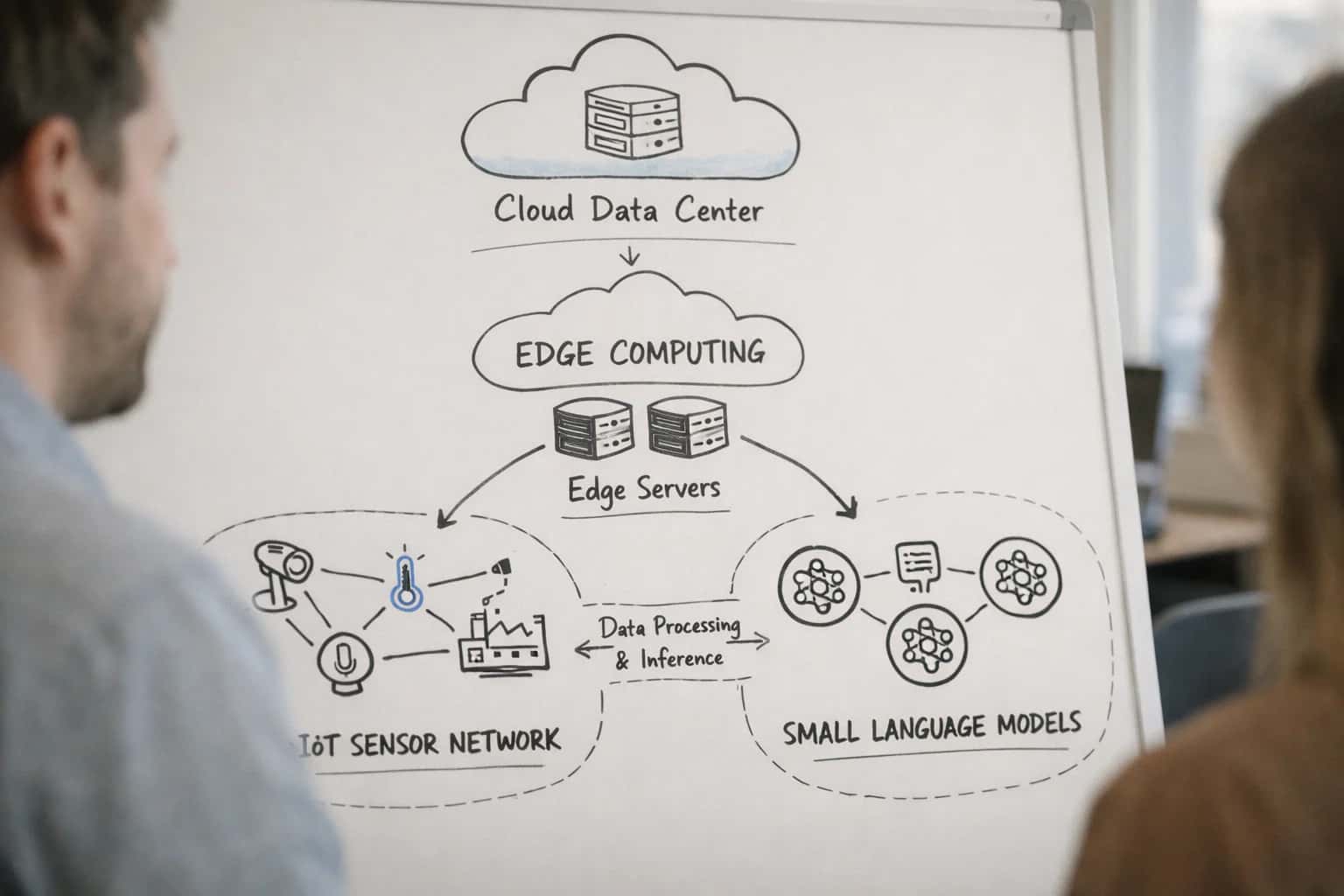
EDGE AI APPLICATIONS
What is Edge Digital Twins?
An edge digital twin is a real-time virtual model of a physical entity that runs and updates locally using edge sensor data, enabling autonomous simulation and control.
The core function is to create a closed-loop system where the virtual model receives live telemetry, executes predictive models or physics-based simulations, and outputs commands back to the physical asset. This enables applications like predictive maintenance, real-time operational optimization, and what-if scenario testing directly at the source of data generation. By decentralizing intelligence, edge digital twins provide highly resilient, responsive, and private control systems essential for modern Industry 4.0 and embodied intelligence applications.
EDGE DIGITAL TWINS
Core Architectural Characteristics
An edge digital twin is a real-time, virtual representation of a physical asset, process, or system that is updated by edge sensor data and runs local simulations for predictive analytics and control. Its architecture is defined by several core characteristics that distinguish it from cloud-centric digital twins.
01
Real-Time Synchronization
Edge digital twins maintain a low-latency, bidirectional data flow with their physical counterparts. This is achieved through:
- High-frequency sensor ingestion from IoT devices (e.g., accelerometers, temperature sensors, cameras).
- Local data preprocessing to filter noise and extract relevant features before updating the twin's state.
- Sub-second update cycles that enable the virtual model to reflect the physical world's current state, which is critical for closed-loop control systems in manufacturing or autonomous vehicles.
02
Localized Intelligence & Simulation
The core computational workload—inference and simulation—occurs on the edge device or a nearby gateway. This characteristic enables:
- Offline operational continuity; the twin can run predictive maintenance models or finite element analysis simulations without cloud connectivity.
- Deterministic latency for time-sensitive decisions, such as adjusting a robotic arm's trajectory or rerouting energy in a microgrid.
- Privacy-by-design, as sensitive operational data (e.g., proprietary manufacturing parameters) is processed locally and never leaves the premises.
03
Resource-Constrained Optimization
Edge digital twins are engineered for high efficiency on limited hardware. This involves:
- Model compression techniques like quantization and pruning to shrink neural networks for local execution.
- Computational graph optimization via compilers (e.g., Apache TVM, TensorFlow Lite) to maximize performance on specific NPUs or GPUs.
- Selective fidelity, where the twin's simulation granularity adapts based on available compute power and the criticality of the task, balancing accuracy with resource consumption.
04
Autonomous Closed-Loop Control
A defining capability is the direct actuation feedback loop. The edge twin doesn't just monitor; it can command physical systems.
- The twin runs a local predictive model (e.g., forecasting a motor's failure within 48 hours).
- Based on the simulation outcome, it can autonomously execute a pre-programmed action via PLCs or actuators, such as throttling power or scheduling a maintenance ticket.
- This creates a self-optimizing system that reduces human intervention, crucial for remote infrastructure like wind farms or underwater pipelines.
05
Hierarchical Federation
Edge digital twins often exist within a multi-tiered architecture.
- A local edge twin handles real-time control on a single asset (e.g., one CNC machine).
- Multiple edge twins federate data to a facility-level twin on a local server for line-wide optimization.
- Aggregated insights may then be summarized and sent to a cloud-based strategic twin for enterprise-wide analytics and long-term planning. This structure balances local autonomy with global oversight.
06
Physics-Informed Modeling
Beyond pure data-driven AI, edge digital twins frequently integrate domain-specific physical laws.
- The virtual model combines sensor data streams with first-principles equations (e.g., thermodynamics, fluid dynamics, mechanical stress models).
- This hybrid approach improves prediction accuracy, especially in edge cases with sparse training data, and enhances the explainability of the twin's recommendations to human operators.
- It is fundamental in engineering domains like structural health monitoring and chemical process control.
OPERATIONAL CYCLE
How Edge Digital Twins Work: The Technical Loop
An Edge Digital Twin operates through a continuous, closed-loop process that synchronizes a physical asset with its virtual counterpart at the network edge. This technical loop enables autonomous, real-time analytics and control.
The loop begins with sensor ingestion, where edge devices collect high-frequency telemetry—temperature, vibration, video—from the physical asset. This raw data is pre-processed locally using edge AI models for filtering and feature extraction before being streamed to update the virtual representation. This real-time synchronization creates a living digital model that mirrors the asset's exact state, forming the basis for predictive simulation.
The core intelligence occurs within the twin's local simulation engine, which runs physics-based or data-driven models to forecast future states, such as predicting mechanical failure. Based on these insights, the system can trigger prescriptive actions, sending control signals back to the physical asset's actuators or issuing alerts to operators. This closed-loop autonomy minimizes latency, ensures operational continuity without cloud dependency, and enables proactive system optimization.
EDGE DIGITAL TWINS
Primary Use Cases and Applications
Edge digital twins enable real-time simulation and control by processing sensor data locally. Their primary applications focus on predictive analytics, autonomous decision-making, and operational optimization in latency-sensitive and disconnected environments.
01
Predictive Maintenance
Edge digital twins continuously simulate the physical state and wear of industrial assets like turbines, pumps, or manufacturing robots. By comparing real-time sensor data (vibration, temperature, pressure) against the virtual model's predictions, the system can forecast component failures with high accuracy. This enables condition-based maintenance, where repairs are scheduled just before a predicted failure, maximizing asset uptime and eliminating unplanned downtime. Unlike cloud-based analytics, edge execution provides immediate alerts for critical anomalies, even during network outages.
02
Autonomous System Control
In robotics and autonomous vehicles, an edge digital twin acts as a high-fidelity simulation sandbox for real-time decision-making. The twin ingests data from LiDAR, cameras, and IMUs to maintain a live model of the environment. Before executing a physical action—like a robotic arm movement or an emergency vehicle maneuver—the system can run thousands of micro-simulations in the virtual model to evaluate potential outcomes and select the optimal, safest path. This closed-loop control enables deterministic execution and safe operation in dynamic, unstructured environments without cloud dependency.
03
Smart City Infrastructure Management
Edge digital twins manage complex, distributed urban systems such as traffic networks, power grids, and water distribution. A city-scale twin aggregates data from thousands of edge sensors (traffic cameras, smart meters, flow sensors) to create a living model of city operations. Key applications include:
- Dynamic traffic light optimization to reduce congestion based on real-time vehicle flow.
- Predictive load balancing in electrical grids to integrate renewable energy sources.
- Leak detection and pressure management in water utilities. By processing and acting on data locally at district gateways, these systems ensure resilience and sub-second response times critical for public infrastructure.
04
Industrial Process Optimization
Within a factory or plant, edge digital twins create virtual replicas of entire production lines or chemical processes. The twin ingests data from Programmable Logic Controllers (PLCs), vision systems, and quality control sensors. It runs continuous what-if simulations to optimize for key performance indicators like yield, throughput, and energy consumption. For example, the system can autonomously adjust machine setpoints, conveyor speeds, or mixing ratios in real-time to maintain optimal quality while minimizing waste. This application is foundational for Industry 4.0 and software-defined manufacturing, moving control logic from rigid hardware to adaptive, AI-driven software.
05
Healthcare and Medical Device Monitoring
Edge digital twins are deployed for patient-specific modeling and critical medical equipment oversight. For a patient, a twin can integrate real-time data from wearable sensors (ECG, SpO2, glucose monitors) with a physiological model to predict adverse events like hypoglycemia or cardiac arrhythmia, triggering local alerts. For hospital equipment like MRI machines or ventilators, the twin monitors operational telemetry to predict mechanical failures before they impact patient care. This use case emphasizes data privacy (sensitive health data never leaves the device) and ultra-reliable operation where cloud connectivity cannot be guaranteed.
06
Energy Grid and Renewable Integration
Edge digital twins are critical for managing the stability of modern, decentralized power grids. A twin deployed at a substation or wind farm models local grid conditions, integrating data from smart inverters, phasor measurement units, and weather forecasts. It performs local stability analysis and can autonomously execute commands—like curtailment of renewable generation or switching in capacitor banks—to maintain voltage and frequency within safe limits. This real-time, distributed control is essential for integrating volatile renewable energy sources and preventing cascading blackouts, forming a core component of the smart grid.
ARCHITECTURAL COMPARISON
Edge Digital Twin vs. Cloud Digital Twin
A feature-by-feature comparison of digital twin implementations based on their primary computational locus, highlighting trade-offs in latency, autonomy, and data management.
| Feature / Metric | Edge Digital Twin | Cloud Digital Twin | Hybrid Digital Twin |
|---|---|---|---|
Primary Compute Locus | Local device (e.g., industrial PC, gateway) | Remote data center | Distributed across edge and cloud |
Latency for Control Actions | < 10 milliseconds | 100-500 milliseconds | Variable (<10ms edge; >100ms cloud) |
Operational Autonomy | |||
Bandwidth Consumption | < 1 Mbps (aggregated metadata) | 10-100 Mbps (raw data streams) | 1-10 Mbps (optimized data) |
Data Privacy & Sovereignty | Data processed and retained locally | Data transmitted to third-party infrastructure | Sensitive data kept local; analytics in cloud |
Real-Time Simulation Fidelity | High-fidelity for local physics | Extremely high-fidelity for system-wide models | Local high-fidelity; global high-fidelity in cloud |
Uptime During Network Outage | |||
Scalability for Fleet-Wide Analytics | |||
Initial Deployment Complexity | High (per-device provisioning) | Low (centralized deployment) | High (orchestration required) |
Model Update & Management | Challenging (requires OTA to fleet) | Centralized and immediate | Orchestrated (staged rollouts) |
Typical Hardware Cost per Node | $500 - $5,000 | $0 (infrastructure as a service) | $500 - $5,000 + cloud fees |
Use Case Example | Real-time robotic arm control for collision avoidance | Plant-wide production simulation and optimization | Predictive maintenance with local anomaly detection and global trend analysis |
EDGE DIGITAL TWINS
Frequently Asked Questions
Edge digital twins are dynamic virtual models of physical systems that operate locally on edge hardware, enabling real-time simulation and autonomous control without cloud dependency.
An edge digital twin is a real-time, virtual representation of a physical asset, process, or system that is hosted and executed locally on edge hardware, updated continuously by local sensor data, and used for autonomous simulation, predictive analytics, and closed-loop control. It works by creating a physics-based or data-driven model of the physical entity. This model ingests a live stream of sensor data (e.g., temperature, vibration, video) from the asset via local networks. The twin runs local simulations to predict future states, diagnose issues, or test control strategies in a virtual sandbox. Based on these simulations, it can send commands directly back to the physical asset's actuators, enabling autonomous, low-latency responses. This closed-loop operation is distinct from cloud-based digital twins, which introduce network latency and rely on continuous connectivity.
Enabling Efficiency, Speed & Accuracy
Intelligent Analysis, Decision & Execution
We build AI systems for teams that need search across company data, workflow automation across tools, or AI features inside products and internal software.
Talk to Us
Search across company data
Give teams answers from docs, tickets, runbooks, and product data with sources and permissions.
Useful when people spend too long searching or get different answers from different systems.
Enterprise searchRAGPermissions
Read more
Automate internal workflows
Use AI to route work, draft outputs, trigger actions, and keep approvals and logs in place.
Useful when repetitive work moves across multiple tools and teams.
AI agentsWorkflow automationGovernance
Read more
Add AI to products and internal tools
Build assistants, guided actions, or decision support into the software your team or customers already use.
Useful when AI needs to be part of the product, not a separate tool.
AI integrationDecision supportModel routing
Read more
About the author
Prasad Kumkar
CEO & MD, Inference Systems
Prasad Kumkar is the CEO & MD of Inference Systems and writes about AI systems architecture, LLM infrastructure, model serving, evaluation, and production deployment. Over 5+ years, he has worked across computer vision models, L5 autonomous vehicle systems, and LLM research, with a focus on taking complex AI ideas into real-world engineering systems.
His work and writing cover AI systems, large language models, AI agents, multimodal systems, autonomous systems, inference optimization, RAG, evaluation, and production AI engineering.
LinkedIn
Limited slotsGet a Free AI Consultation
Partnered with leading AI, data, and software stack.





How We Work
Custom AI workflows for your Business
One-fit-all AI don't work for modern businesses. At Inferensys, we aim to understand your business & custom requirements; which we use to define most efficient agentic workflows, the data, and the tools for your business.
01
Review the use case
We understand the task, the users, and where AI can actually help.
Read more02
Pick the right approach
We define what needs search, automation, or product integration.
Read more03
Build the first useful version
We implement the part that proves the value first.
Read more04
Improve from there
We add the checks and visibility needed to keep it useful.
Read moreThe first call is a practical review of your use case and the right next step.
Talk to Us