Condition monitoring is the continuous or periodic measurement of operational parameters—such as vibration, temperature, pressure, or acoustic emissions—from machinery, infrastructure, or industrial systems. By deploying edge sensors and on-device inference, this process assesses an asset's real-time state to detect anomalies, diagnose faults, and predict impending failures. The core objective is to transition from reactive or scheduled maintenance to a predictive maintenance paradigm, minimizing unplanned downtime and extending asset lifespan.

Glossary
Condition Monitoring
Condition monitoring is the continuous measurement of machinery parameters using edge sensors and AI to assess operational state and predict maintenance needs.
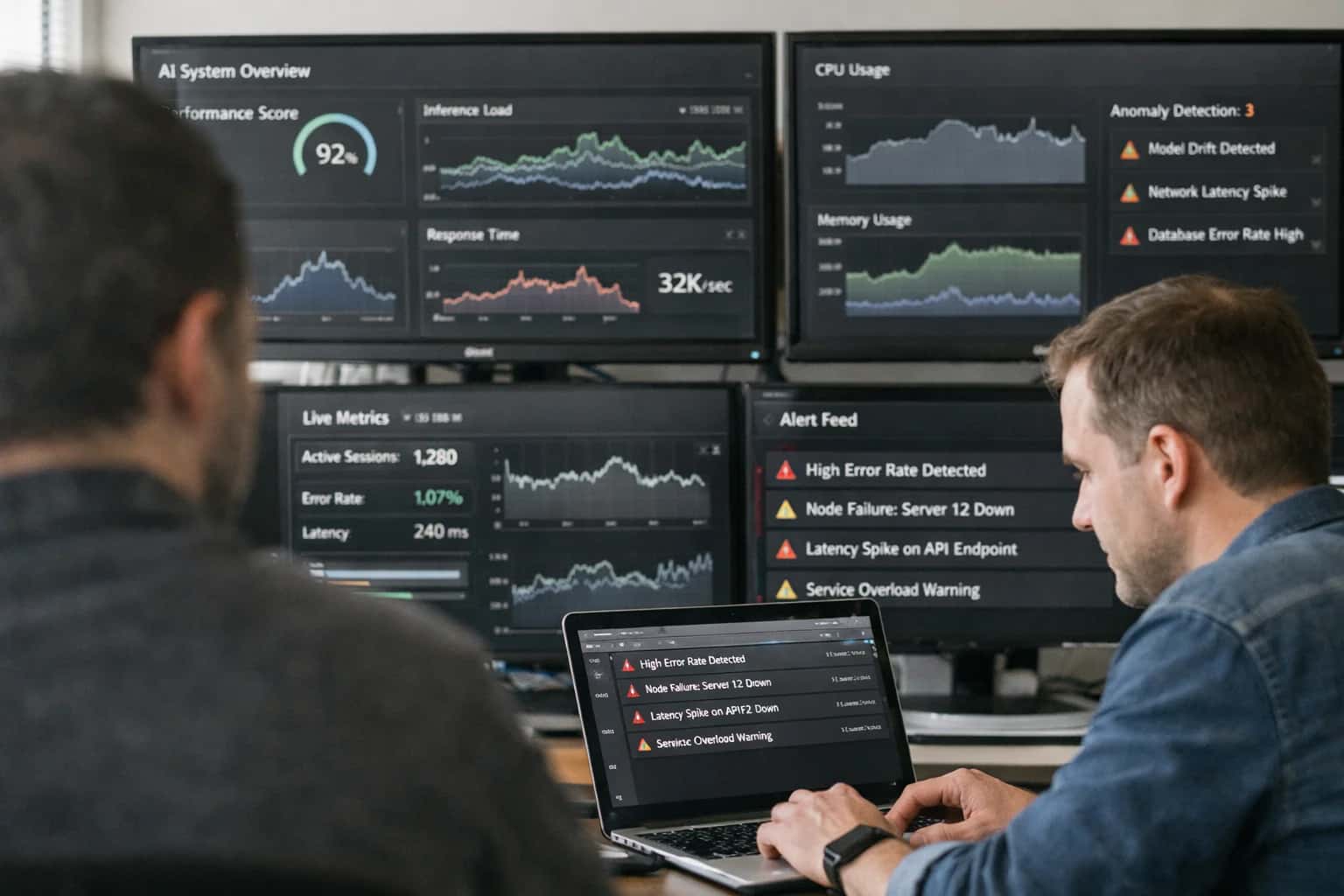
EDGE AI APPLICATION
What is Condition Monitoring?
Condition monitoring is a predictive maintenance technique that uses sensors and edge AI to continuously assess the operational health of physical assets.
In an Edge AI architecture, condition monitoring models, often lightweight time-series forecasting or anomaly detection algorithms, run directly on local gateways or embedded processors. This enables low-latency analysis without constant cloud connectivity, crucial for remote or safety-critical operations. The system generates actionable alerts and can trigger automated responses, forming a key component of industrial IoT and Industry 4.0 strategies. It is foundational for applications in manufacturing, energy, transportation, and utilities.
ARCHITECTURE
Core Components of an AI-Powered Condition Monitoring System
A modern condition monitoring system is a multi-layered architecture that integrates physical sensors, edge computing, and cloud analytics to transform raw telemetry into actionable maintenance intelligence.
01
Edge Sensors & Data Acquisition
The physical layer consists of vibration sensors, acoustic emission sensors, thermocouples, and current clamps that continuously sample physical parameters from machinery. These sensors convert analog phenomena into digital time-series data. Key considerations include:
- Sampling Rate: Must be high enough to capture critical failure signatures (e.g., >10 kHz for vibration analysis).
- Signal Conditioning: On-sensor filtering and amplification to ensure data quality before transmission.
- Industrial Protocols: Use of standards like IO-Link, Modbus, or OPC UA for reliable data ingestion from legacy PLCs.
02
Edge Inference Engine
This is the on-device AI model that performs real-time analysis. Deployed directly on an edge gateway or industrial PC, it executes lightweight neural networks (e.g., CNNs for vibration spectrograms, LSTMs for temporal sequences) to detect anomalies and classify failure modes. Core functions are:
- Feature Extraction: Calculating statistical features (RMS, kurtosis, crest factor) from raw signals.
- Model Inference: Running quantized models (e.g., TensorFlow Lite, ONNX Runtime) to generate health scores.
- Local Alerting: Triggering immediate alarms or shutdown commands if a critical threshold is breached, enabling sub-second response.
03
Feature Store & Time-Series Database
A specialized database layer that stores and manages the high-volume, time-stamped sensor data. InfluxDB, TimescaleDB, or cloud services like AWS Timestream are commonly used. This component handles:
- High-Write Throughput: Ingesting millions of data points per second from sensor fleets.
- Efficient Compression: Using algorithms like Gorilla or Facebook's Gorilla compression for long-term retention.
- Downsampling & Retention Policies: Automatically aggregating raw data to lower resolutions (e.g., from 1-second to 1-hour intervals) to manage storage costs while preserving trends.
04
Cloud Analytics & Model Management
The centralized brain of the system, typically hosted on cloud infrastructure (AWS, Azure, GCP). It performs heavy computational tasks that are infeasible at the edge:
- Model Training & Retraining: Using historical data to develop new anomaly detection models or fine-tune existing ones.
- Fleet-Wide Analytics: Correlating data across thousands of assets to identify systemic issues or performance degradation patterns.
- Model Lifecycle Management: Orchestrating the continuous deployment of updated models to the edge fleet via an MLOps pipeline (e.g., using Kubeflow or MLflow).
05
Health Dashboard & Visualization
The user interface that presents complex telemetry as actionable insights for maintenance engineers and plant managers. It transforms model outputs into:
- Asset Health Scores: A single, normalized metric (e.g., 0-100%) representing the overall condition of each machine.
- Trend Analysis: Interactive charts showing vibration spectra, temperature trends, and predicted Remaining Useful Life (RUL).
- Root Cause Analysis Tools: Drill-down capabilities to inspect raw sensor data aligned with model predictions, facilitating diagnosis.
- Integration with CMMS (Computerized Maintenance Management Systems) like IBM Maximo to automatically generate work orders.
06
Orchestration & Communication Layer
The software middleware that ensures reliable, secure, and efficient data flow between all components. This layer is critical for system resilience and includes:
- Message Brokers: MQTT or Apache Kafka for handling publish/subscribe data streams from edge devices to the cloud.
- Edge Management Platform: Tools like AWS IoT Greengrass or Azure IoT Edge for remotely deploying code, managing configurations, and monitoring the health of the edge fleet.
- Secure Communication: Enforcing mutual TLS authentication and data encryption in transit to protect critical infrastructure data from cyber threats.
EDGE AI APPLICATIONS
How AI-Powered Condition Monitoring Works
AI-powered condition monitoring is a predictive maintenance technique that uses machine learning models deployed at the edge to analyze sensor data from machinery in real-time, detecting anomalies and forecasting failures before they cause downtime.
The process begins with edge sensors continuously collecting high-frequency operational data—such as vibration, temperature, pressure, and acoustic emissions—from industrial assets. This raw telemetry is processed locally by an edge inference engine running a trained model, which performs feature extraction and anomaly detection to assess the asset's health state without requiring a cloud connection. This on-device inference minimizes latency, preserves bandwidth, and ensures operational continuity even in network-disrupted environments.
The core AI models, often autoencoders, isolation forests, or recurrent neural networks, learn the normal operational baseline from historical data. They flag deviations as potential faults. For predictive maintenance, time-series forecasting models like LSTMs predict remaining useful life. Insights are aggregated by an edge orchestration layer, triggering local alerts or scheduling maintenance. This closed-loop system transforms raw sensor data into actionable intelligence, preventing unplanned downtime and optimizing asset lifespan.
CONDITION MONITORING
Industry Applications and Use Cases
Condition monitoring leverages edge AI to continuously assess the health of physical assets by analyzing sensor data locally. This enables predictive maintenance, reduces unplanned downtime, and optimizes operational efficiency across industries.
01
Industrial Machinery & Manufacturing
Edge AI monitors critical parameters like vibration, temperature, and acoustic emissions from motors, pumps, and gearboxes. By detecting subtle anomalies indicative of wear—such as imbalanced rotors or bearing faults—maintenance can be scheduled proactively, preventing catastrophic failure and production line stoppages. This is foundational to predictive maintenance strategies in Industry 4.0.
02
Energy & Utilities
Condition monitoring is vital for infrastructure integrity in power generation and distribution.
- Wind Turbines: Analyzes vibration and lubrication data from gearboxes and blades to predict mechanical stress and optimize maintenance schedules, reducing costly crane deployments.
- Electrical Substations: Monitors partial discharge in transformers and switchgear using ultrasonic and thermal imaging sensors to prevent fires and grid failures.
- Pipeline Networks: Uses acoustic emission sensors to detect leaks or corrosion in real-time across vast, remote networks.
03
Transportation & Aerospace
Ensures safety and reliability in mobile and high-stakes environments.
- Rail & Mass Transit: Monitors wheel-rail interaction, bogie health, and track geometry from onboard sensors to prevent derailments.
- Aviation: Performs engine health monitoring (EHM) by analyzing real-time data from aircraft engines during flight, predicting component lifespan.
- Fleet Management: Tracks vehicle health (engine load, brake wear) via telematics units, enabling just-in-time part replacement and reducing roadside breakdowns.
04
Building Management & HVAC
Edge AI optimizes energy consumption and prevents equipment failure in commercial and industrial facilities. Systems monitor chillers, boilers, and air handling units for inefficiencies like refrigerant leaks, clogged filters, or failing compressors. By correlating performance data with setpoints, the system can identify suboptimal operation and trigger adjustments or alerts, significantly reducing energy costs and extending equipment life.
05
Data Center Infrastructure
Critical for uptime and efficiency, condition monitoring safeguards IT hardware.
- Server Health: Tracks fan speeds, power supply unit (PSU) voltages, and CPU/GPU temperatures to predict hardware failure.
- Uninterruptible Power Supply (UPS): Monitors battery cell impedance and temperature to ensure backup power reliability.
- Cooling Systems: Analyzes performance of computer room air handlers (CRAHs) and coolant flow to prevent thermal overload. This application directly supports data observability by ensuring the physical layer does not disrupt computational workloads.
06
Edge-Specific Advantages
Deploying condition monitoring at the edge provides distinct operational benefits:
- Low Latency Response: Enables real-time anomaly detection and immediate shutdown commands for safety-critical systems (<100ms).
- Bandwidth & Cost Reduction: Processes high-frequency sensor data (e.g., vibration at 10kHz) locally, sending only alerts or aggregated insights to the cloud.
- Operational Resilience: Functions independently of network connectivity, crucial for remote or mobile assets like ships or mining equipment.
- Data Privacy: Sensitive operational data never leaves the facility, addressing security and sovereign AI concerns.
MAINTENANCE STRATEGY COMPARISON
Condition Monitoring vs. Related Maintenance Strategies
A feature comparison of condition monitoring against other common industrial maintenance approaches, highlighting the role of edge AI and predictive analytics.
| Core Feature / Metric | Reactive (Run-to-Failure) | Preventive (Scheduled) | Predictive (Condition-Based) | Prescriptive (AI-Driven) |
|---|---|---|---|---|
Primary Trigger for Action | Complete equipment failure | Fixed calendar or usage intervals | Measured deviation from normal operating condition | AI-prescribed action based on predicted failure mode and business impact |
Data Utilization | Post-failure incident logs | Simple runtime counters | Continuous real-time sensor telemetry (vibration, temperature, acoustics) | Multimodal sensor data fused with operational context, maintenance records, and digital twin simulations |
Edge AI & Analytics Role | On-device anomaly detection and feature extraction | On-edge prognostic models, root-cause analysis, and optimization of repair schedules | ||
Typical Maintenance Cost Reduction | 0% baseline | 10-30% | 30-50% |
|
Unplanned Downtime Reduction | 0% baseline | 10-25% | 40-70% | 70-90% |
Spare Parts Inventory Efficiency | ||||
Implementation Complexity & Cost | Low | Medium | High | Very High |
Ability to Prevent Catastrophic Failure |
CONDITION MONITORING
Frequently Asked Questions
Condition monitoring is a core application of Edge AI, using local sensors and on-device intelligence to assess the health of machinery and infrastructure. This FAQ addresses common technical questions about its implementation, benefits, and integration within modern industrial systems.
Condition monitoring is the continuous or periodic measurement of operational parameters from physical assets using sensors and edge-based artificial intelligence to assess their health and predict maintenance needs. It works by deploying IoT sensors (e.g., accelerometers, thermocouples, acoustic emission sensors) directly on machinery to collect real-time data streams like vibration, temperature, and pressure. This raw telemetry is processed locally by an edge inference engine running a trained machine learning model—often an anomaly detection or regression model—to transform sensor readings into a health score or a remaining useful life (RUL) estimate. By performing analysis at the edge, the system minimizes latency, operates without constant cloud connectivity, and triggers immediate alerts or automated control actions when a predefined threshold is exceeded, enabling a shift from scheduled to predictive maintenance.
Enabling Efficiency, Speed & Accuracy
Intelligent Analysis, Decision & Execution
We build AI systems for teams that need search across company data, workflow automation across tools, or AI features inside products and internal software.
Talk to Us
Search across company data
Give teams answers from docs, tickets, runbooks, and product data with sources and permissions.
Useful when people spend too long searching or get different answers from different systems.
Enterprise searchRAGPermissions
Read more
Automate internal workflows
Use AI to route work, draft outputs, trigger actions, and keep approvals and logs in place.
Useful when repetitive work moves across multiple tools and teams.
AI agentsWorkflow automationGovernance
Read more
Add AI to products and internal tools
Build assistants, guided actions, or decision support into the software your team or customers already use.
Useful when AI needs to be part of the product, not a separate tool.
AI integrationDecision supportModel routing
Read more
About the author
Prasad Kumkar
CEO & MD, Inference Systems
Prasad Kumkar is the CEO & MD of Inference Systems and writes about AI systems architecture, LLM infrastructure, model serving, evaluation, and production deployment. Over 5+ years, he has worked across computer vision models, L5 autonomous vehicle systems, and LLM research, with a focus on taking complex AI ideas into real-world engineering systems.
His work and writing cover AI systems, large language models, AI agents, multimodal systems, autonomous systems, inference optimization, RAG, evaluation, and production AI engineering.
LinkedIn
Limited slotsGet a Free AI Consultation
Partnered with leading AI, data, and software stack.





How We Work
Custom AI workflows for your Business
One-fit-all AI don't work for modern businesses. At Inferensys, we aim to understand your business & custom requirements; which we use to define most efficient agentic workflows, the data, and the tools for your business.
01
Review the use case
We understand the task, the users, and where AI can actually help.
Read more02
Pick the right approach
We define what needs search, automation, or product integration.
Read more03
Build the first useful version
We implement the part that proves the value first.
Read more04
Improve from there
We add the checks and visibility needed to keep it useful.
Read moreThe first call is a practical review of your use case and the right next step.
Talk to Us