Spectrum handoff is a mandatory mobility management protocol in interweave cognitive radio networks where secondary users must immediately cease transmission and relocate to a backup channel when a licensed primary user reclaims the frequency. Unlike traditional cellular handoffs triggered by signal degradation, this process is initiated by spectrum sensing detection of incumbent activity, requiring pre-negotiated target channels and low-latency switching to prevent harmful interference.

Glossary
Spectrum Handoff
Spectrum handoff is the process by which a cognitive radio user vacates its current frequency channel upon detecting a returning primary user and seamlessly transitions its communication to another available channel.
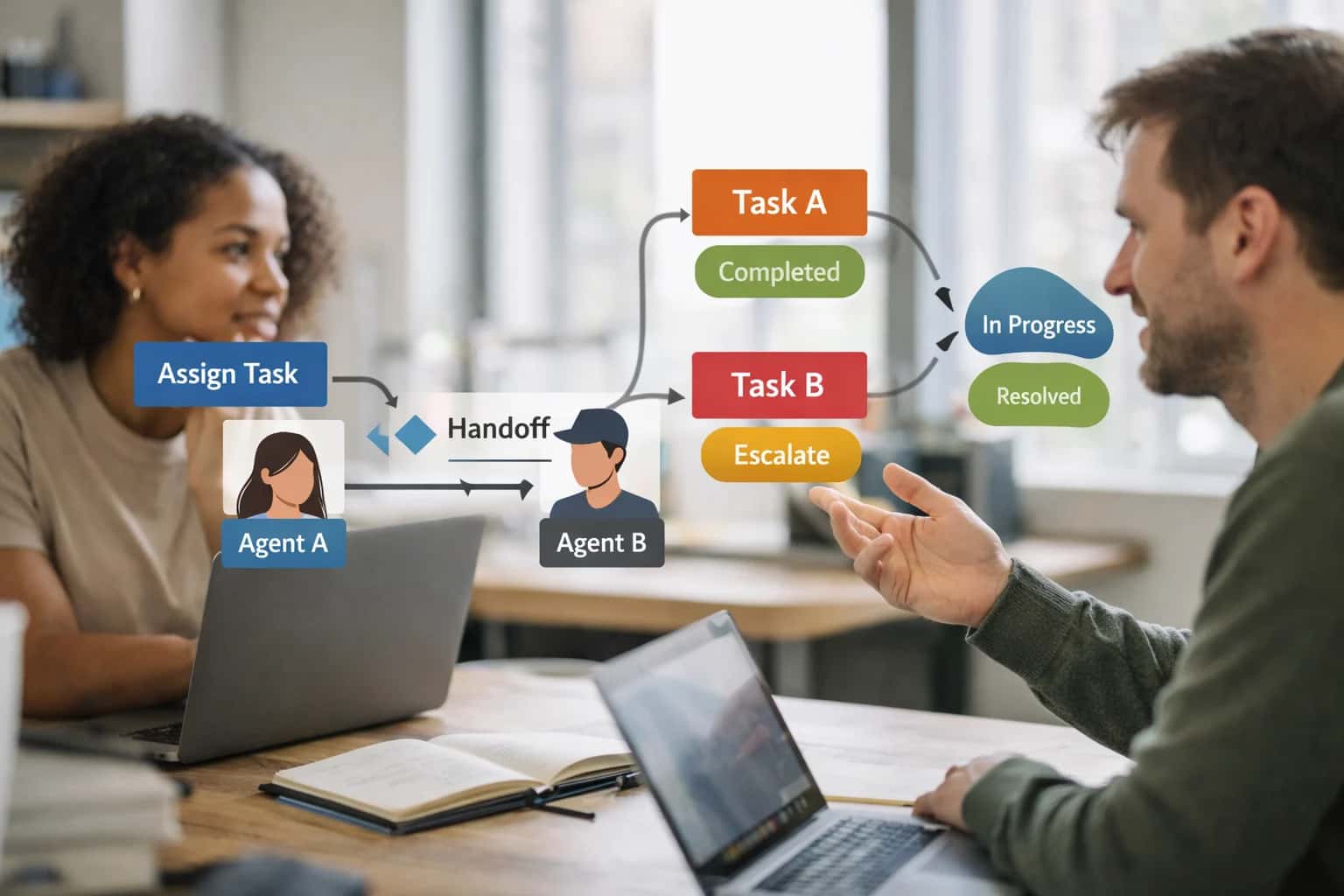
COGNITIVE RADIO MOBILITY MANAGEMENT
What is Spectrum Handoff?
Spectrum handoff is the process by which a cognitive radio user vacates its current frequency channel upon detecting a returning primary user and seamlessly transitions its communication to another available channel, maintaining service continuity.
The handoff mechanism relies on spectrum mobility prediction models and a maintained list of candidate backup channels to minimize disruption. Proactive approaches use historical occupancy data to forecast channel availability before a primary user appears, while reactive strategies execute emergency switching upon detection. Effective execution depends on spectrum sharing coordination protocols to avoid collisions when multiple secondary users simultaneously migrate to the same vacant channel.
SEAMLESS TRANSITION MECHANISMS
Key Characteristics of Spectrum Handoff
Spectrum handoff is the critical process enabling cognitive radio networks to maintain uninterrupted communication while respecting primary user rights. The following characteristics define the performance and reliability of this dynamic frequency migration.
01
Proactive vs. Reactive Handoff
The fundamental classification of handoff strategies based on initiation timing. Proactive handoff uses predictive models like Spectrum Mobility Prediction to identify and reserve a target channel before the primary user arrives, minimizing latency. Reactive handoff triggers only upon primary user detection, requiring an immediate, on-demand search for an available channel, which increases link disruption time but requires no predictive infrastructure.
< 1 ms
Proactive Switching Latency
10-50 ms
Reactive Sensing Delay
02
Hard vs. Soft Handoff
Describes the physical layer transition strategy. Hard handoff follows a 'break-before-make' approach, where the cognitive radio severs the current link before establishing the new one, risking packet loss. Soft handoff uses a 'make-before-break' approach, maintaining simultaneous connections on both the old and new channels during transition, ensuring zero data loss but requiring more complex, multi-radio hardware.
03
Link Maintenance and Target Selection
The decision logic governing the selection of the optimal target channel. Algorithms must evaluate candidate frequencies based on multiple criteria:
- Estimated idle time: How long before another primary user appears?
- Channel quality: Signal-to-noise ratio and capacity.
- Power constraints: Required transmission power for the new frequency.
- Handoff latency: Time required to switch and resynchronize. This process often leverages Radio Environment Maps (REM) for geolocated channel availability data.
04
Multi-User Spectrum Handoff Coordination
In dense cognitive radio networks, a single primary user return can trigger a cascading handoff for multiple secondary users. Without coordination, this causes a spectrum handoff storm, leading to collisions and service degradation. Multi-Agent Reinforcement Learning (MARL) and Distributed Constraint Optimization (DCOP) are employed to orchestrate group migrations, ensuring fair distribution of the remaining spectral resources and preventing network-wide disruption.
05
Handoff Latency Budgeting
A strict engineering constraint defining the maximum permissible time for the entire handoff process. The budget includes:
- Detection time: Sensing the primary user.
- Decision time: Running the target selection algorithm.
- Execution time: Radio reconfiguration and resynchronization. For ultra-reliable low-latency communication (URLLC) applications, this total budget must often remain under 1 millisecond to prevent application-layer timeouts.
SPECTRUM HANDOFF
Frequently Asked Questions
Explore the critical mechanisms and protocols that enable cognitive radios to vacate channels and maintain seamless communication when primary users appear.
Spectrum handoff is the process by which a cognitive radio (CR) user immediately vacates its current frequency channel upon detecting a returning licensed primary user and seamlessly transitions its ongoing communication to another vacant channel. The mechanism works through a three-phase cycle: channel sensing to detect the primary user's reappearance, link maintenance to pause and buffer data during the switch, and target channel selection to identify and move to the best available backup frequency. Unlike traditional cellular handoffs triggered by signal degradation, spectrum handoffs are reactive to incumbent activity and must occur within a strict time boundary to avoid harmful interference. Advanced implementations use proactive spectrum mobility prediction to pre-calculate backup channels before the primary user arrives, reducing the total handoff latency to under 40 milliseconds in modern 5G dynamic spectrum access systems.
Enabling Efficiency, Speed & Accuracy
Intelligent Analysis, Decision & Execution
We build AI systems for teams that need search across company data, workflow automation across tools, or AI features inside products and internal software.
Talk to Us
Search across company data
Give teams answers from docs, tickets, runbooks, and product data with sources and permissions.
Useful when people spend too long searching or get different answers from different systems.
Enterprise searchRAGPermissions
Read more
Automate internal workflows
Use AI to route work, draft outputs, trigger actions, and keep approvals and logs in place.
Useful when repetitive work moves across multiple tools and teams.
AI agentsWorkflow automationGovernance
Read more
Add AI to products and internal tools
Build assistants, guided actions, or decision support into the software your team or customers already use.
Useful when AI needs to be part of the product, not a separate tool.
AI integrationDecision supportModel routing
Read more
About the author
Prasad Kumkar
CEO & MD, Inference Systems
Prasad Kumkar is the CEO & MD of Inference Systems and writes about AI systems architecture, LLM infrastructure, model serving, evaluation, and production deployment. Over 5+ years, he has worked across computer vision models, L5 autonomous vehicle systems, and LLM research, with a focus on taking complex AI ideas into real-world engineering systems.
His work and writing cover AI systems, large language models, AI agents, multimodal systems, autonomous systems, inference optimization, RAG, evaluation, and production AI engineering.
LinkedIn
Limited slotsGet a Free AI Consultation
Partnered with leading AI, data, and software stack.





How We Work
Custom AI workflows for your Business
One-fit-all AI don't work for modern businesses. At Inferensys, we aim to understand your business & custom requirements; which we use to define most efficient agentic workflows, the data, and the tools for your business.
01
Review the use case
We understand the task, the users, and where AI can actually help.
Read more02
Pick the right approach
We define what needs search, automation, or product integration.
Read more03
Build the first useful version
We implement the part that proves the value first.
Read more04
Improve from there
We add the checks and visibility needed to keep it useful.
Read moreThe first call is a practical review of your use case and the right next step.
Talk to Us