Spot jamming is an electronic attack technique where a jammer focuses its entire transmit power onto a single, narrow bandwidth, typically matching the exact frequency of a target communication channel. This concentrated approach maximizes the jamming-to-signal ratio (JSR) at the receiver, effectively overwhelming the intended signal with noise or deceptive energy on that specific frequency.

Glossary
Spot Jamming
A precision electronic attack that concentrates all available jamming power onto a single, narrow frequency channel or specific subcarrier of a target signal to maximize disruption.
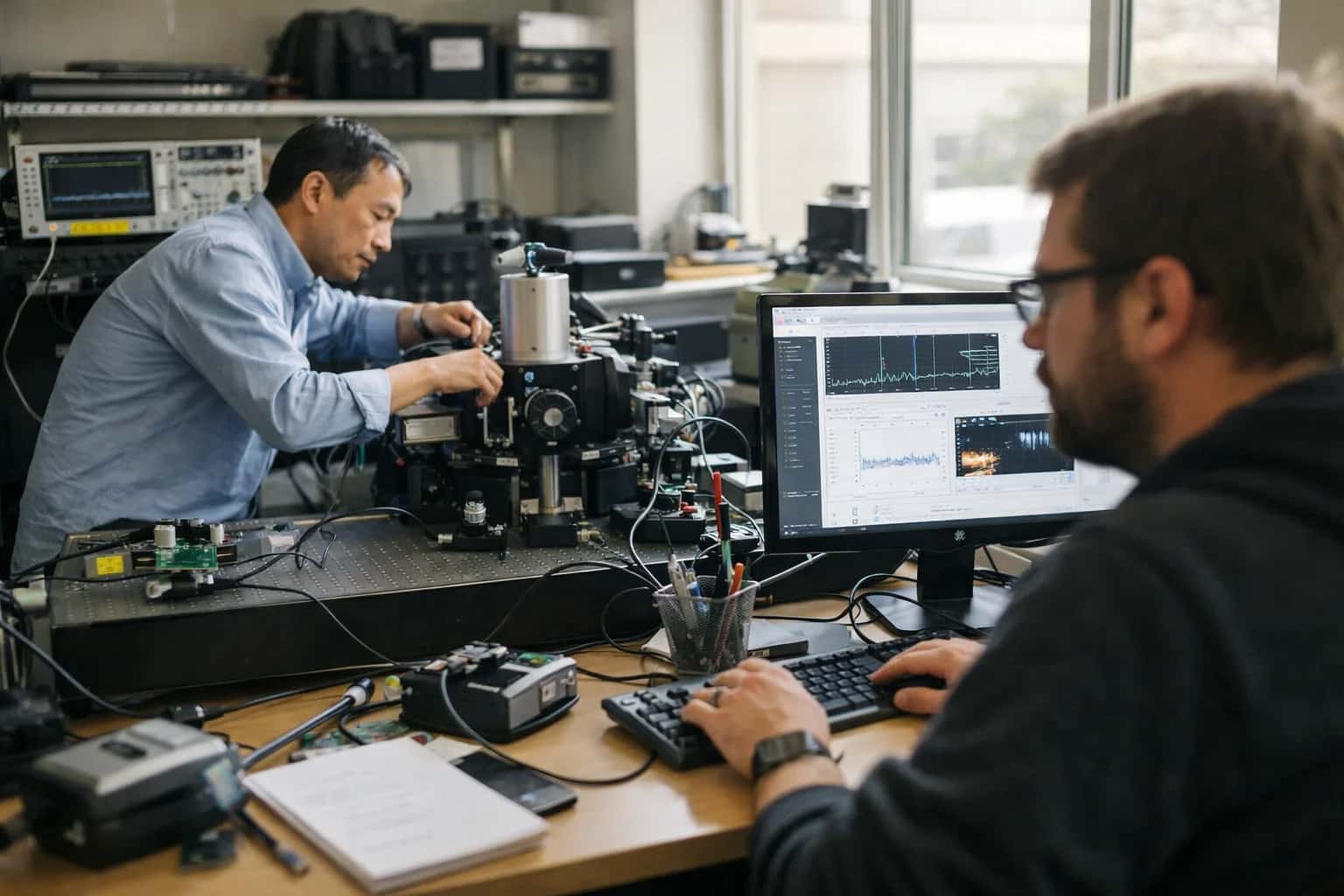
ELECTRONIC ATTACK TECHNIQUE
What is Spot Jamming?
A precision electronic attack that concentrates all available jamming power onto a single, narrow frequency channel or specific subcarrier of a target signal.
The primary advantage of spot jamming is its power efficiency—by not dispersing energy across a wide spectrum, it achieves a higher effective radiated power on the target frequency. However, this precision requires accurate prior knowledge or real-time estimation of the target's operating frequency, making it vulnerable to adaptive frequency hopping (AFH) and other electronic counter-countermeasures (ECCM) that rapidly shift the communication channel.
PRECISION ELECTRONIC ATTACK
Key Characteristics of Spot Jamming
Spot jamming represents a focused electronic warfare technique where all available transmitter power is concentrated into a single, narrow bandwidth matching the target's specific frequency channel. This surgical approach maximizes power spectral density against the victim receiver.
01
Concentrated Power Spectral Density
The defining characteristic of spot jamming is the concentration of effective radiated power (ERP) into a bandwidth precisely matching a single communication channel. Unlike barrage jamming, which dilutes power across a wide spectrum, spot jamming achieves a significantly higher jamming-to-signal ratio (JSR) at the target receiver. This makes it highly effective against narrowband signals such as FM voice, single-frequency data links, or specific orthogonal frequency-division multiplexing (OFDM) subcarriers. The jammer's power amplifier operates at peak efficiency within a narrow instantaneous bandwidth, often achieving JSR values exceeding 30 dB at the victim receiver's front end.
>30 dB
Achievable JSR at Receiver
02
Frequency Agility and Look-Through Capability
Modern spot jamming systems incorporate look-through architectures that periodically mute the jammer transmitter to sample the electromagnetic environment. This enables the system to verify whether the target signal is still active on the jammed frequency and to detect if the target has executed a frequency hop. Advanced digital radio frequency memory (DRFM)-based spot jammers can achieve look-through windows of less than 1 microsecond, making them nearly imperceptible to the target. The system's reaction time—the interval between detecting a frequency change and re-establishing the jam—is a critical performance parameter, often measured in tens of microseconds.
<1 µs
Look-Through Window
<50 µs
Typical Reaction Time
03
Spectral Containment and Collateral Mitigation
A well-designed spot jammer must maintain strict spectral containment to avoid unintentionally interfering with friendly or neutral communications on adjacent channels. This requires high-performance bandpass filtering and linear power amplification to minimize spectral regrowth and out-of-band emissions. The occupied bandwidth of the jamming signal should ideally match the target signal's bandwidth with minimal spillover. Modern systems employ digital pre-distortion techniques to linearize the power amplifier, ensuring that adjacent channel power ratio (ACPR) remains below -60 dBc, preserving spectrum for cooperative users.
<-60 dBc
Adjacent Channel Power Ratio
04
Waveform Matching for Coherent Jamming
The most sophisticated spot jamming techniques employ coherent waveform matching, where the jammer analyzes the target signal's modulation parameters—such as symbol rate, pulse shape, and framing structure—and synthesizes a correlated jamming waveform. This deceptive jamming approach inserts false symbols or corrupted frames that pass through the receiver's front-end filters but cause bit errors at the demodulator. By matching the root-raised-cosine pulse shape of a QPSK signal, for example, the jammer maximizes energy within the receiver's matched filter while minimizing the power required to achieve a given bit error rate.
05
Vulnerability to Frequency Hopping Countermeasures
The primary limitation of spot jamming is its susceptibility to frequency hop spreading (FHSS) countermeasures. A spot jammer can only disrupt one channel at a time, so a fast-hopping transceiver that changes frequencies hundreds or thousands of times per second forces the jammer into a reactive chase. The dwell time of the target—the period it remains on a single channel—must exceed the jammer's reaction time for effective disruption. Modern adaptive frequency hopping (AFH) systems further compound this by dynamically excluding jammed channels from the hop set, rendering the spot jammer ineffective unless it can predict and preempt the hopping sequence.
100+ hops/s
Fast FHSS Evasion Rate
06
Integration with Cognitive Electronic Warfare Loops
Next-generation spot jamming is evolving into a cognitive electronic warfare (CEW) function, where machine learning models autonomously execute the observe-orient-decide-act (OODA) loop. A deep neural network classifier analyzes the spectral environment in real-time, identifies target signals by their cyclostationary features, and selects the optimal jamming waveform from a library of techniques. This closed-loop system continuously evaluates the effectiveness of the jamming by monitoring changes in the target's behavior—such as power increases or modulation changes—and adapts its strategy without operator intervention, achieving reaction times that exceed human capability.
ELECTRONIC ATTACK COMPARISON
Spot Jamming vs. Other Jamming Techniques
A comparison of spot jamming against other common electronic attack strategies based on power efficiency, target coverage, and operational complexity.
| Feature | Spot Jamming | Barrage Jamming | Sweep Jamming |
|---|---|---|---|
Target Bandwidth | Single narrow channel | Entire operational band | Sequential narrow channels |
Power Efficiency | High | Low | Medium |
Power Density on Target | Maximum | Minimal | High (instantaneous) |
Simultaneous Channel Disruption | |||
Detection Probability by ESM | Low | High | Medium |
Effective Against FHSS | |||
Complexity of Implementation | Low | Low | Medium |
Optimal JSR per Channel | < 0 dB |
| 0-3 dB |
SPOT JAMMING INSIGHTS
Frequently Asked Questions
Explore the technical nuances of spot jamming, a precision electronic attack that focuses maximum power on a single frequency to disrupt specific communication channels.
Spot jamming is a precision electronic attack technique where all available jamming power is concentrated onto a single, narrow frequency channel or specific subcarrier of a target signal. Unlike barrage jamming, which disperses energy across a wide spectrum, spot jamming maximizes the Jamming-to-Signal Ratio (JSR) at the victim receiver for that specific frequency. The jammer generates a high-power noise or deceptive signal precisely centered on the target's carrier frequency, effectively overwhelming the legitimate communication. This technique requires accurate prior knowledge or real-time measurement of the target's operating frequency, making it highly effective against fixed-frequency or slowly hopping systems but vulnerable to Adaptive Frequency Hopping (AFH) countermeasures.
Enabling Efficiency, Speed & Accuracy
Intelligent Analysis, Decision & Execution
We build AI systems for teams that need search across company data, workflow automation across tools, or AI features inside products and internal software.
Talk to Us
Search across company data
Give teams answers from docs, tickets, runbooks, and product data with sources and permissions.
Useful when people spend too long searching or get different answers from different systems.
Enterprise searchRAGPermissions
Read more
Automate internal workflows
Use AI to route work, draft outputs, trigger actions, and keep approvals and logs in place.
Useful when repetitive work moves across multiple tools and teams.
AI agentsWorkflow automationGovernance
Read more
Add AI to products and internal tools
Build assistants, guided actions, or decision support into the software your team or customers already use.
Useful when AI needs to be part of the product, not a separate tool.
AI integrationDecision supportModel routing
Read more
About the author
Prasad Kumkar
CEO & MD, Inference Systems
Prasad Kumkar is the CEO & MD of Inference Systems and writes about AI systems architecture, LLM infrastructure, model serving, evaluation, and production deployment. Over 5+ years, he has worked across computer vision models, L5 autonomous vehicle systems, and LLM research, with a focus on taking complex AI ideas into real-world engineering systems.
His work and writing cover AI systems, large language models, AI agents, multimodal systems, autonomous systems, inference optimization, RAG, evaluation, and production AI engineering.
LinkedIn
Limited slotsGet a Free AI Consultation
Partnered with leading AI, data, and software stack.





How We Work
Custom AI workflows for your Business
One-fit-all AI don't work for modern businesses. At Inferensys, we aim to understand your business & custom requirements; which we use to define most efficient agentic workflows, the data, and the tools for your business.
01
Review the use case
We understand the task, the users, and where AI can actually help.
Read more02
Pick the right approach
We define what needs search, automation, or product integration.
Read more03
Build the first useful version
We implement the part that proves the value first.
Read more04
Improve from there
We add the checks and visibility needed to keep it useful.
Read moreThe first call is a practical review of your use case and the right next step.
Talk to Us