Model monitoring is the systematic practice of tracking a production model's input data distributions, prediction outputs, and system-level metrics against a known baseline. It operationalizes drift detection by applying statistical tests like the Population Stability Index (PSI) to identify when the real-world environment has diverged from the training context, directly alerting MLOps engineers to silent performance degradation.

Glossary
Model Monitoring
Model monitoring is the continuous observation of a deployed machine learning model's operational health, data quality, and predictive performance to ensure it functions as expected and to detect drift or anomalies.
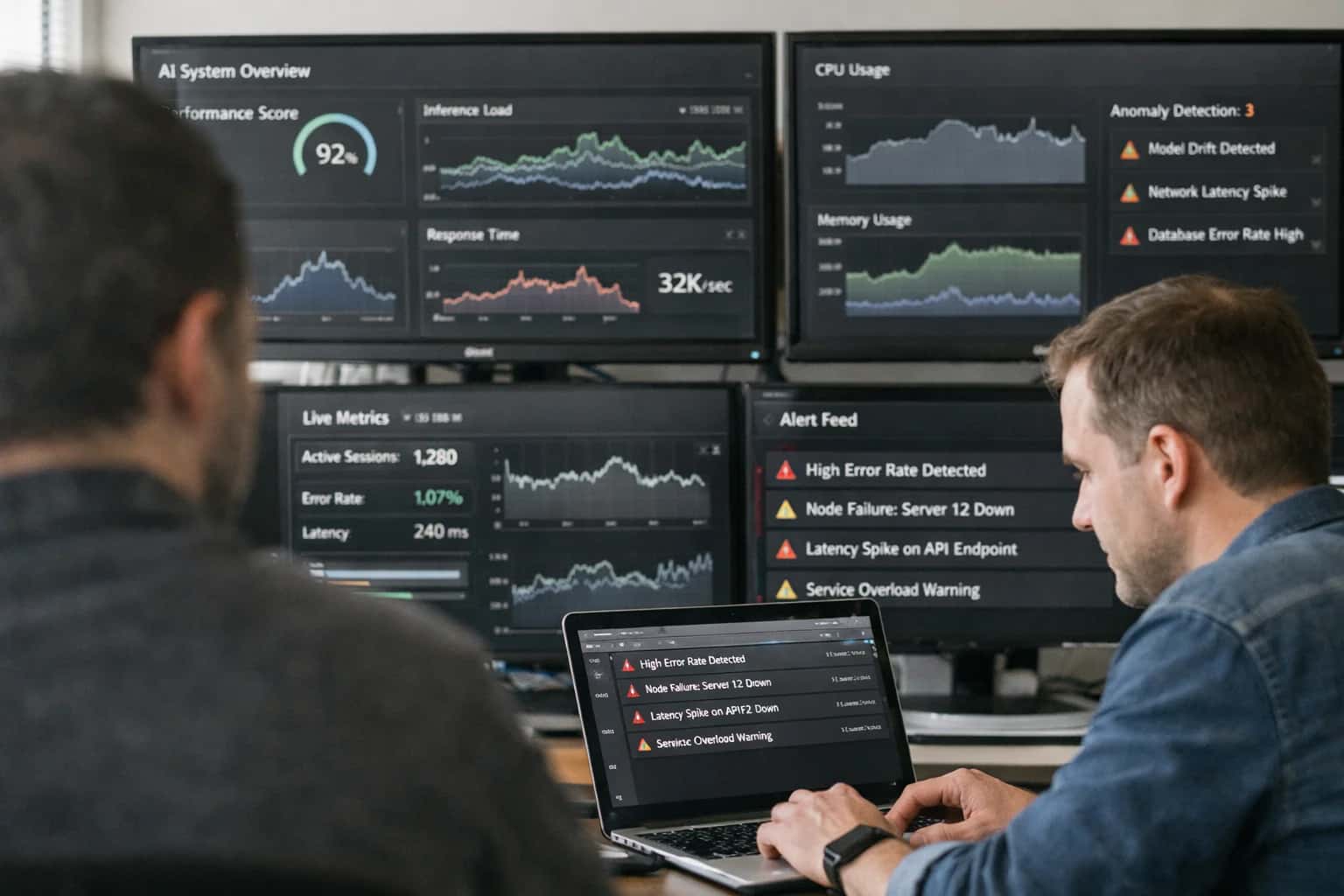
MLOps Observability
What is Model Monitoring?
Model monitoring is the continuous, automated observation of a deployed machine learning model's operational health, data quality, and predictive performance to ensure it functions as expected and to detect drift or anomalies.
An effective monitoring stack extends beyond accuracy to measure feature freshness, prediction latency, and throughput. By establishing a performance degradation threshold, teams automate the transition from passive observation to active remediation, triggering a continuous training pipeline or a model rollback to prevent business impact from model decay.
OBSERVABILITY
Key Pillars of Model Monitoring
Effective model monitoring is a multi-faceted discipline that extends beyond simple accuracy checks. It requires a holistic view of operational health, data integrity, and predictive consistency to ensure AI systems remain reliable in production.
01
Data Drift Detection
The continuous statistical analysis of production input features against a baseline training distribution. Data drift occurs when the underlying data a model encounters in the real world diverges from what it was trained on, often silently degrading performance.
- Population Stability Index (PSI) is the standard metric for quantifying distributional shift.
- Monitors for covariate shift, where the distribution of independent variables changes.
- A high PSI score triggers an alert, often initiating an automated retraining pipeline.
PSI > 0.25
Significant Drift Threshold
02
Concept Drift Monitoring
Tracks changes in the statistical relationship between input features and the target variable. Unlike data drift, concept drift means the fundamental rules the model learned are no longer valid. For example, a user's historical purchase pattern may no longer predict future behavior after a major economic shift.
- Requires access to delayed ground truth labels for measurement.
- Detected via a sustained drop in performance metrics like log loss or AUC.
- Often necessitates a full model retraining or architectural redesign.
Accuracy Drop
Primary Indicator
03
Prediction & Performance Logging
The foundational practice of capturing every inference request and its context. Comprehensive prediction logging creates an auditable, queryable dataset that is the single source of truth for all monitoring activities.
- Logs must include the input features, raw model output, final prediction, and model version.
- Enables offline analysis of model fairness, bias, and edge-case failures.
- This data serves as the training set for future challenger models in a champion/challenger deployment pattern.
04
Operational & Latency Metrics
Monitors the serving infrastructure's health, which is distinct from the model's statistical health. Operational monitoring ensures the model is available and responsive, directly impacting user experience.
- Tracks p95 and p99 latency, requests per second, and error rates.
- A spike in latency can indicate a memory leak or hardware contention, not a model problem.
- Essential for maintaining Service Level Agreements (SLAs) for real-time personalization engines.
p99 < 100ms
Common Real-Time SLA
05
Training-Serving Skew Prevention
An architectural discipline to guarantee offline/online consistency. Training-serving skew is a silent killer of model performance, occurring when the feature engineering code path during training differs from the one used during inference.
- Mandates the use of a shared Feature Store for both training and serving.
- Automated data validation checks for schema violations and feature freshness before inference.
- A primary cause is stale features, where a value computed hours ago is used for a real-time prediction.
06
Automated Alerting & Retraining Triggers
The closed-loop system that moves monitoring from passive observation to active remediation. A performance degradation threshold is a predefined boundary that, when breached, automatically fires an alert or triggers a pipeline.
- Integrates drift detection statistics with CI/CD orchestration tools.
- A drop in a key metric below a threshold can initiate a canary deployment of a newly trained model.
- Enables a fully autonomous continuous training lifecycle, minimizing the time to recover from model decay.
MODEL MONITORING
Frequently Asked Questions
Essential questions and answers about the continuous observation of deployed machine learning models to ensure operational health, data quality, and sustained predictive performance in production environments.
Model monitoring is the continuous, automated process of observing a deployed machine learning model's operational health, input data quality, and predictive performance to ensure it functions as expected and to detect drift or anomalies. It is critical because a model's performance is not static; the real-world data it encounters in production inevitably changes over time due to shifting consumer behavior, seasonality, or economic factors. Without monitoring, a model can silently degrade—a phenomenon known as model decay—leading to incorrect predictions that directly impact revenue, customer experience, or operational safety. Effective monitoring provides the observability layer required to trigger automated retraining pipelines, alert MLOps engineers, and maintain trust in AI systems. It bridges the gap between a successful offline evaluation and the chaotic reality of a live production environment.
Enabling Efficiency, Speed & Accuracy
Intelligent Analysis, Decision & Execution
We build AI systems for teams that need search across company data, workflow automation across tools, or AI features inside products and internal software.
Talk to Us
Search across company data
Give teams answers from docs, tickets, runbooks, and product data with sources and permissions.
Useful when people spend too long searching or get different answers from different systems.
Enterprise searchRAGPermissions
Read more
Automate internal workflows
Use AI to route work, draft outputs, trigger actions, and keep approvals and logs in place.
Useful when repetitive work moves across multiple tools and teams.
AI agentsWorkflow automationGovernance
Read more
Add AI to products and internal tools
Build assistants, guided actions, or decision support into the software your team or customers already use.
Useful when AI needs to be part of the product, not a separate tool.
AI integrationDecision supportModel routing
Read more
About the author
Prasad Kumkar
CEO & MD, Inference Systems
Prasad Kumkar is the CEO & MD of Inference Systems and writes about AI systems architecture, LLM infrastructure, model serving, evaluation, and production deployment. Over 5+ years, he has worked across computer vision models, L5 autonomous vehicle systems, and LLM research, with a focus on taking complex AI ideas into real-world engineering systems.
His work and writing cover AI systems, large language models, AI agents, multimodal systems, autonomous systems, inference optimization, RAG, evaluation, and production AI engineering.
LinkedIn
Limited slotsGet a Free AI Consultation
Partnered with leading AI, data, and software stack.





How We Work
Custom AI workflows for your Business
One-fit-all AI don't work for modern businesses. At Inferensys, we aim to understand your business & custom requirements; which we use to define most efficient agentic workflows, the data, and the tools for your business.
01
Review the use case
We understand the task, the users, and where AI can actually help.
Read more02
Pick the right approach
We define what needs search, automation, or product integration.
Read more03
Build the first useful version
We implement the part that proves the value first.
Read more04
Improve from there
We add the checks and visibility needed to keep it useful.
Read moreThe first call is a practical review of your use case and the right next step.
Talk to Us