A supply chain digital twin is a dynamic, real-time virtual representation of a physical end-to-end supply chain. It ingests live data from IoT sensors, ERP systems, and transportation management platforms to mirror the current state of inventory, assets, and logistics flows, enabling continuous simulation and analysis.

Glossary
Supply Chain Digital Twin
A dynamic, virtual simulation model of a physical supply chain that uses real-time data to mirror its state, enabling what-if analysis, bottleneck prediction, and optimized decision-making.
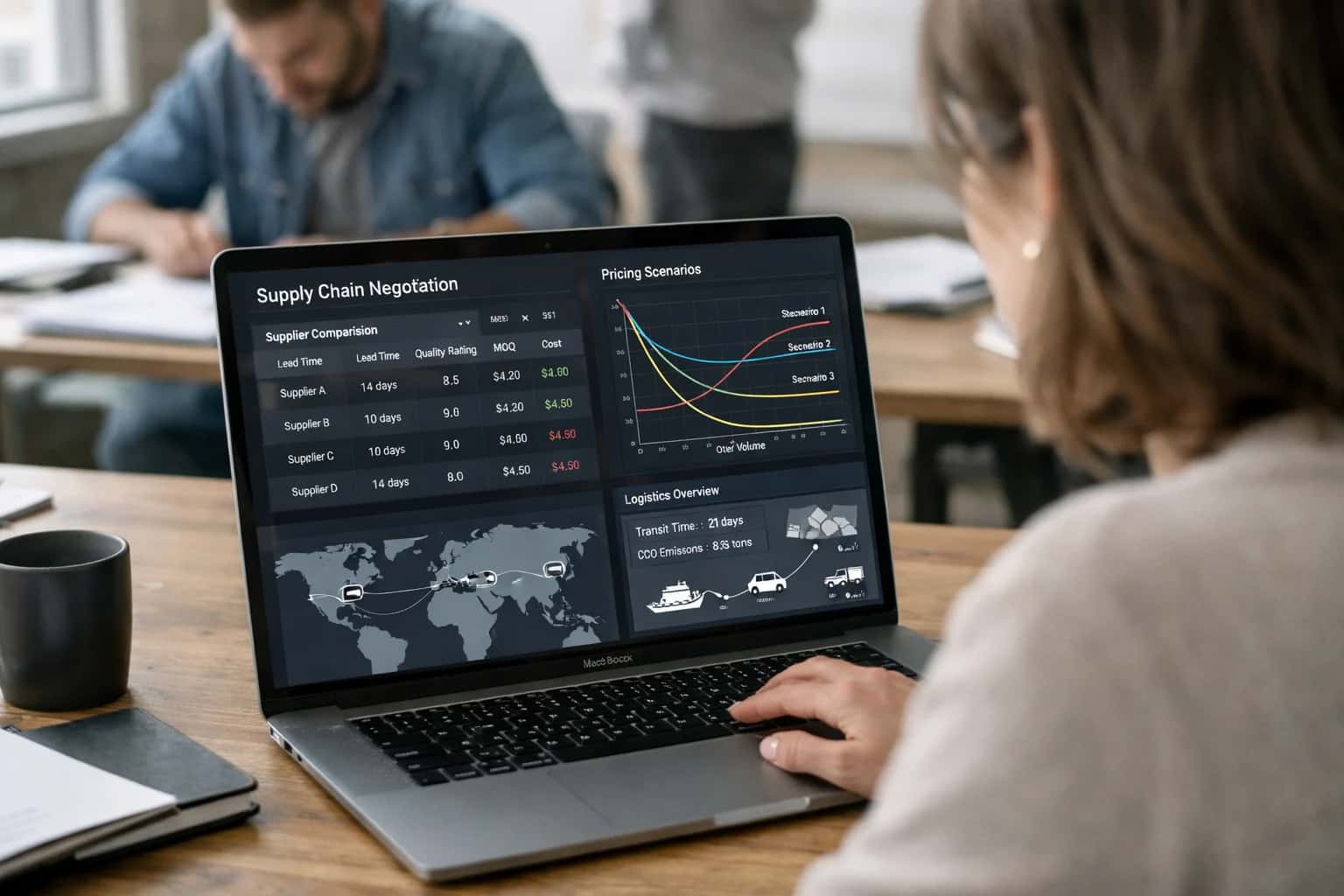
VIRTUAL SUPPLY CHAIN MIRROR
What is Supply Chain Digital Twin?
A dynamic, virtual simulation model of a physical supply chain that uses real-time data to mirror its state, enabling what-if analysis, bottleneck prediction, and optimized decision-making.
Unlike static models, a digital twin allows supply chain directors to conduct probabilistic what-if analysis and stress-test scenarios without disrupting live operations. By applying machine learning to this synchronized data, the system predicts future bottlenecks, models the bullwhip effect, and prescribes optimal inventory rebalancing actions to mitigate risk.
VIRTUAL MIRROR CAPABILITIES
Key Features of a Supply Chain Digital Twin
A supply chain digital twin is defined by its ability to create a living, breathing simulation. These core features transform a static model into a dynamic decision-support system.
01
Real-Time Data Synchronization
The foundational capability that distinguishes a digital twin from a static model. It ingests streaming data from IoT sensors, ERP systems, transportation management systems (TMS) , and warehouse management systems (WMS) to maintain a current-state mirror of the physical network. This includes inventory levels, shipment GPS coordinates, production line throughput, and supplier status. Without real-time connectivity, the twin becomes a historical snapshot rather than an operational tool.
02
Multi-Echelon Network Modeling
Represents the entire supply chain as a connected graph of nodes and links, not isolated silos. The twin models the interdependencies between tier-n suppliers, manufacturing plants, distribution centers, cross-docks, and last-mile delivery routes. This holistic view captures the ripple effects of disruptions—showing how a supplier delay in one region cascades into a stockout at a specific retail location—enabling true end-to-end visibility.
03
Stochastic Simulation Engine
Moves beyond deterministic planning by incorporating probability distributions for key variables like lead time, demand, and yield. The engine runs thousands of Monte Carlo simulations to model a range of possible futures. This allows planners to quantify risk and answer questions like 'What is the probability of a stockout if Supplier A is 3 days late?' rather than relying on a single, fragile point estimate.
04
What-If Scenario Analysis
A controlled environment for stress-testing the supply chain without real-world consequences. Planners can inject hypothetical disruptions—such as a port closure, a 20% demand surge, or a factory fire—and observe the simulated impact on service levels, cost, and inventory. This capability supports proactive contingency planning and capital investment decisions, such as evaluating the resilience benefit of adding a new distribution center.
05
AI-Powered Prescriptive Analytics
Integrates machine learning models to not just predict outcomes but recommend optimal actions. The twin uses reinforcement learning and mathematical optimization to evaluate millions of potential decisions and surface the best course of action. For example, it can prescribe the lowest-cost expedited shipping route that meets a 98% service level target or dynamically reallocate inventory across a network to preempt a predicted regional shortage.
06
Control Tower Visualization Layer
Provides an intuitive, geospatial 3D interface that overlays real-time alerts and KPIs onto a visual model of the supply chain. Users drill down from a global heat map of On-Time In-Full (OTIF) performance to a specific delayed shipment. The layer surfaces exceptions—not noise—highlighting nodes that are drifting out of tolerance and require human intervention, effectively serving as the user interface for the complex simulation running underneath.
VIRTUAL MIRRORING
How a Supply Chain Digital Twin Works
A supply chain digital twin is a dynamic, real-time virtual simulation of a physical supply chain, enabling what-if analysis and optimized decision-making.
A supply chain digital twin ingests real-time data streams from IoT sensors, ERP systems, and transportation management platforms to create a synchronized virtual replica of the entire physical network. This mirroring allows the model to reflect the current state of inventory, assets, and shipments with high fidelity, serving as a sandbox for testing disruptions without operational risk.
By applying what-if simulations and predictive algorithms to this live model, organizations can identify bottlenecks, forecast inventory shortfalls, and optimize logistics routes before executing changes in the real world. The continuous feedback loop between the physical and virtual environments enables autonomous, closed-loop decision-making that dynamically adapts to shifting supply and demand signals.
SUPPLY CHAIN DIGITAL TWIN
Frequently Asked Questions
Explore the core concepts behind supply chain digital twins, from their foundational architecture to their role in risk mitigation and autonomous decision-making.
A supply chain digital twin is a dynamic, virtual simulation model of a physical supply chain that uses real-time data to mirror its state, enabling what-if analysis, bottleneck prediction, and optimized decision-making. It works by ingesting live data streams from Enterprise Resource Planning (ERP) systems, Internet of Things (IoT) sensors, and transportation management platforms to create a synchronized digital counterpart. Unlike a static model, the twin continuously updates to reflect current inventory levels, shipment locations, and demand signals. Advanced twins incorporate agent-based modeling and discrete-event simulation to test scenarios—such as a port closure or a demand spike—and prescribe optimal responses without disrupting actual operations.
Enabling Efficiency, Speed & Accuracy
Intelligent Analysis, Decision & Execution
We build AI systems for teams that need search across company data, workflow automation across tools, or AI features inside products and internal software.
Talk to Us
Search across company data
Give teams answers from docs, tickets, runbooks, and product data with sources and permissions.
Useful when people spend too long searching or get different answers from different systems.
Enterprise searchRAGPermissions
Read more
Automate internal workflows
Use AI to route work, draft outputs, trigger actions, and keep approvals and logs in place.
Useful when repetitive work moves across multiple tools and teams.
AI agentsWorkflow automationGovernance
Read more
Add AI to products and internal tools
Build assistants, guided actions, or decision support into the software your team or customers already use.
Useful when AI needs to be part of the product, not a separate tool.
AI integrationDecision supportModel routing
Read more
About the author
Prasad Kumkar
CEO & MD, Inference Systems
Prasad Kumkar is the CEO & MD of Inference Systems and writes about AI systems architecture, LLM infrastructure, model serving, evaluation, and production deployment. Over 5+ years, he has worked across computer vision models, L5 autonomous vehicle systems, and LLM research, with a focus on taking complex AI ideas into real-world engineering systems.
His work and writing cover AI systems, large language models, AI agents, multimodal systems, autonomous systems, inference optimization, RAG, evaluation, and production AI engineering.
LinkedIn
Limited slotsGet a Free AI Consultation
Partnered with leading AI, data, and software stack.





How We Work
Custom AI workflows for your Business
One-fit-all AI don't work for modern businesses. At Inferensys, we aim to understand your business & custom requirements; which we use to define most efficient agentic workflows, the data, and the tools for your business.
01
Review the use case
We understand the task, the users, and where AI can actually help.
Read more02
Pick the right approach
We define what needs search, automation, or product integration.
Read more03
Build the first useful version
We implement the part that proves the value first.
Read more04
Improve from there
We add the checks and visibility needed to keep it useful.
Read moreThe first call is a practical review of your use case and the right next step.
Talk to Us