A dark launch is a deployment strategy where new software functionality, such as an updated machine learning model, is released to the production environment but is not activated for end-users. Instead, the new code runs silently in the background, often processing shadow traffic—real user requests that are duplicated and sent to the new version—while the primary system continues to serve live responses from the stable version. This allows engineers to validate performance, monitor resource consumption, and detect errors under actual load without any user-facing impact.

Glossary
Dark Launch
Dark launch is a deployment technique where new code or a model is released to production but kept hidden from users, often used to test infrastructure under real load or gather performance data in shadow mode.
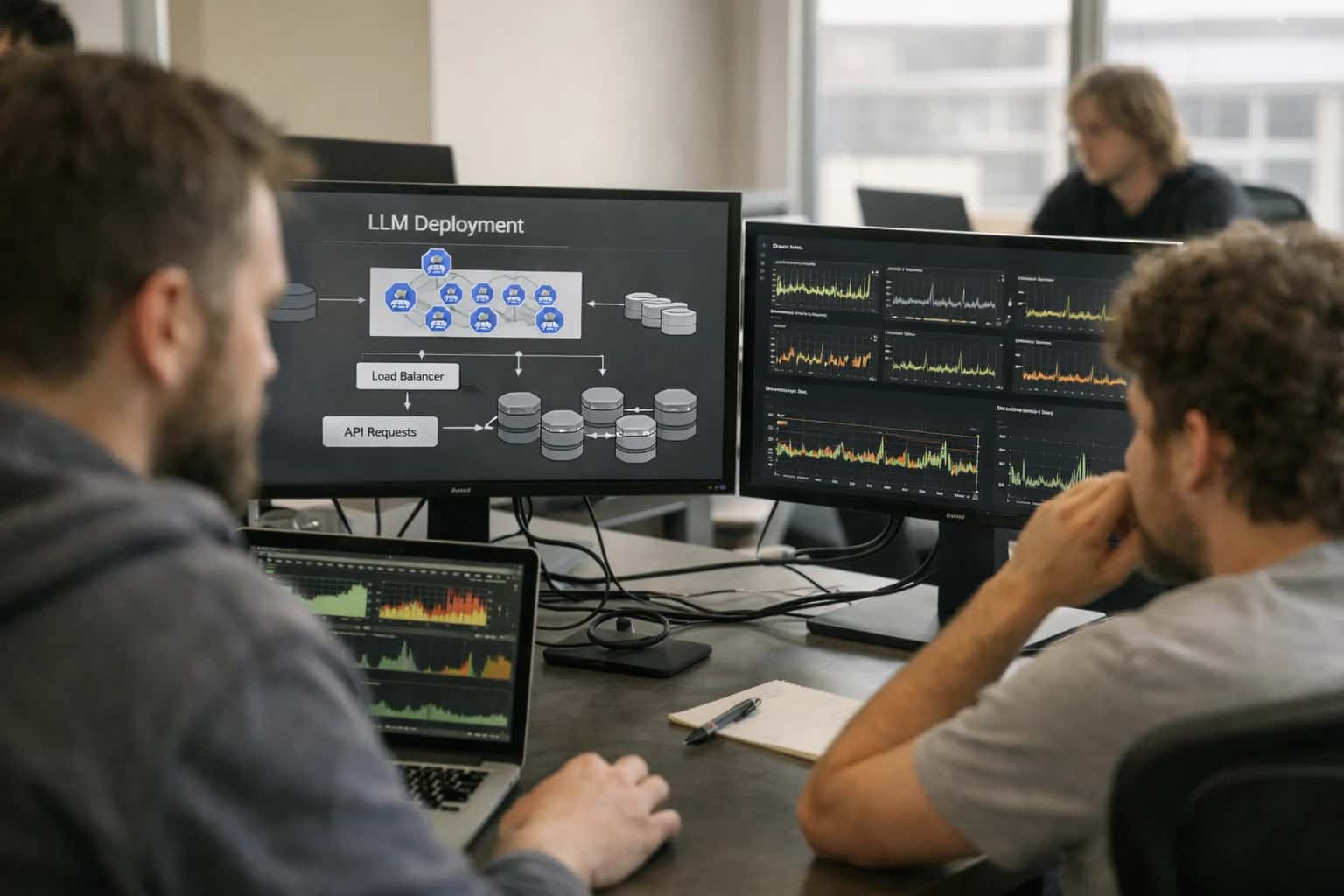
SAFE MODEL DEPLOYMENT
What is Dark Launch?
Dark launch is a deployment technique where new code or a model is released to production but kept hidden from users, often used to test infrastructure under real load or gather performance data in shadow mode.
This technique is a cornerstone of safe model deployment and progressive delivery, enabling rigorous validation before a full rollout. It is closely related to shadow mode and often precedes a canary release or A/B test. By executing in production but remaining 'dark,' teams can gather critical observability data, verify Service Level Objectives (SLOs) like latency, and ensure infrastructure scalability, thereby de-risking the launch of complex AI systems.
SAFE MODEL DEPLOYMENT
Key Characteristics of Dark Launch
Dark launch is a deployment technique where new code or a model is released to production but kept hidden from users, often used to test infrastructure under real load or gather performance data in shadow mode. The following characteristics define its implementation and purpose.
01
User-Invisible Execution
The core principle of a dark launch is that the new functionality executes silently within the production environment without affecting the user experience or visible output. User requests are processed by both the old and new systems, but only the results from the old, stable system are returned to the end-user. This allows for zero-impact testing on real user traffic.
02
Infrastructure & Load Testing
A primary use case is to validate new infrastructure under real-world load conditions before a user-facing launch. This involves:
- Testing database queries, caching layers, and external API calls at production scale.
- Identifying bottlenecks in network I/O, memory usage, or GPU utilization for new models.
- Verifying autoscaling policies and resource provisioning under peak traffic. This prevents performance degradation when the feature is officially enabled.
03
Shadow Mode for Models
In machine learning, dark launch is synonymous with shadow mode or shadow deployment. A new model version processes live inference requests in parallel with the champion model. Its predictions are logged and compared offline against the live model's outputs and ground truth (when available). Key metrics evaluated include:
- Prediction latency and throughput.
- Statistical differences in output distributions.
- Business metric performance (e.g., click-through rate, conversion) via offline replay.
04
Data Collection & Validation
Dark launches facilitate the collection of production-grade telemetry and validation data for the new system. This includes:
- Logging inputs, outputs, and internal state for analysis.
- Gathering a labeled dataset by recording model predictions and subsequent user actions (e.g., whether a recommended item was purchased).
- Validating assumptions about data schemas and distributions that may differ from staging environments.
05
Progressive Activation via Feature Flags
Dark launch is typically controlled by feature flags or toggles. This allows for:
- Granular control: Enabling the dark launch for specific user segments, geographic regions, or percentages of traffic.
- Instant rollback: Disabling the new code path immediately if critical issues are detected, without a full deployment rollback.
- Phased graduation: Seamlessly transitioning from dark launch (0% user-facing) to a canary release (1% of users) to a full rollout.
06
Separation of Deployment from Release
This technique decouples the deployment of code from the release of functionality. The new code is shipped and runs in production, but its business logic is dormant. This allows:
- Reduced risk during deployment events, as the system's behavior does not change.
- The operations team to validate deployment health (e.g., smoke tests) before the product team 'flips the switch' to release.
- Compliance with strict release windows, as code can be deployed ahead of time and activated at a scheduled moment.
SAFE MODEL DEPLOYMENT
How Dark Launch Works
Dark launch is a deployment technique where new code or a model is released to production but kept hidden from users, often used to test infrastructure under real load or gather performance data in shadow mode.
A dark launch is a deployment strategy where new software, such as a machine learning model, is released to the live production environment but its functionality is kept hidden from end-users. This is typically achieved using feature flags or configuration toggles. The primary goal is to test the new component under real-world load and infrastructure conditions without affecting the user experience or business metrics, allowing engineers to validate stability, performance, and resource consumption.
In machine learning, a common application is shadow mode, where the new model processes live inference requests in parallel with the champion model. Its predictions are logged and compared for accuracy and latency but are not served to users. This provides a risk-free method for gathering performance data and detecting concept drift or integration issues before a gradual rollout or A/B test begins, forming a critical part of a progressive delivery pipeline.
SAFE MODEL DEPLOYMENT
Common Use Cases for Dark Launch
Dark launch is a foundational technique for mitigating risk in production AI systems. Its primary applications involve validating infrastructure, gathering unbiased performance data, and testing new capabilities without user-facing impact.
02
Shadow Mode Performance Validation
The new model runs in parallel with the current champion model, processing identical inputs. Its outputs are logged and compared offline against the live model's results and ground truth (when available). This generates a completely unbiased performance benchmark using live data, free from the selection bias that can affect offline testing datasets. Key metrics evaluated include:
- Prediction accuracy and business KPIs
- Output distribution shifts
- Latency profiles and P99 tail latency
- Resource efficiency (cost per inference) This data is essential for a confident go/no-go decision on a full rollout.
03
Testing New Feature Integrations
Dark launch is used to test complex new features or data pipelines that feed into the model, where failures could be catastrophic. For example, a new retrieval-augmented generation (RAG) system can be dark-launched: live user queries trigger the full RAG pipeline (query vectorization, semantic search, context augmentation, and generation), but the final answer is discarded. This validates the entire integration—including the vector database, context window management, and prompt formatting—ensuring no runtime errors or performance cliffs exist before the feature is user-visible.
04
Gathering Real-World Inference Data
Before a model can be improved, it needs data from its target domain. A dark launch allows the collection of a high-fidelity inference dataset from the exact production environment. This dataset includes:
- Raw input features as seen in production (post-any upstream transformations)
- The model's predictions
- Subsequent ground truth labels (collected via user feedback or system outcomes) This dataset is invaluable for diagnosing future concept drift, creating representative test sets, and performing targeted fine-tuning or model editing based on real-world edge cases.
05
Validating Observability & Monitoring
Deploying the observability stack for a new model is as critical as deploying the model itself. A dark launch provides a safe period to verify that telemetry, logging, metrics, and alerting are functioning correctly. Teams can confirm:
- Latency histograms are being populated accurately
- Prediction drift detectors are receiving data
- Business metric calculations are correct
- Error tracking captures failed inferences This ensures that when the model goes live, the engineering team has a verified, operational dashboard to monitor its health, rather than discovering monitoring gaps during an incident.
06
Chaos Engineering & Resilience Testing
Dark launch provides a controlled environment to inject failures and test the resilience of the new model serving system. Engineers can safely test the integration of circuit breakers, fallback models, and graceful degradation pathways. For instance, by artificially throttling the new model's dependencies (e.g., a feature store), teams can verify that the system correctly fails over to a cached value or a default, rather than crashing or timing out. This proactive validation of failure modes is a core practice in building reliable ML-powered services.
COMPARISON MATRIX
Dark Launch vs. Related Deployment Strategies
A technical comparison of Dark Launch against other core strategies for safely deploying machine learning models, highlighting their primary mechanisms, risk profiles, and operational characteristics.
| Feature / Characteristic | Dark Launch | Canary Release | A/B Testing | Shadow Mode |
|---|---|---|---|---|
Primary Mechanism | Code is live but user-facing output is hidden | Gradual traffic shift to a new version | Randomized traffic split for statistical comparison | Parallel inference with primary model; outputs are logged but not acted upon |
User Exposure | Zero (users unaware) | Limited, incremental percentage of users | Controlled percentage(s) of users | 100% of traffic, but zero user impact |
Primary Objective | Test infrastructure under real load; gather performance telemetry | Validate stability and performance with real users before full rollout | Measure causal impact on a business or performance metric | Compare prediction quality/logs against a baseline without risk |
Risk to User Experience | None (if implemented correctly) | Low to Medium (limited blast radius) | Low (controlled, measurable impact) | None |
Rollback Capability | Instant (toggle off) | Instant (reroute traffic) | Instant (reroute traffic) | Not applicable (no live traffic served) |
Data Collected | System performance (latency, throughput, errors), model outputs (logs) | Real-user performance, errors, business metrics for exposed group | Business/performance metrics for statistical significance | Prediction logs for detailed offline evaluation against ground truth or champion model |
Typical Use Case in ML | Load testing a new model architecture; validating GPU memory usage | Safely rolling out a new model version to a subset of users | Determining if Model B increases click-through rate over Model A | Validating a new model's accuracy and behavior against the current champion on live data |
Requires Traffic Routing Logic | Yes (to activate/deactivate) | Yes (for percentage-based routing) | Yes (for randomized cohort assignment) | Yes (for request duplication/fan-out) |
Implementation Complexity | Medium (requires feature flagging/hiding logic) | Low to Medium (requires routing orchestration) | Medium (requires cohort management & statistical analysis) | High (requires non-blocking parallel inference & log aggregation) |
DARK LAUNCH
Frequently Asked Questions
Dark launch is a critical technique in the safe deployment of machine learning models. These FAQs address its core mechanisms, use cases, and how it differs from related deployment strategies.
A dark launch is a deployment technique where new code or a machine learning model is released to a production environment but is kept hidden from end-users, with its outputs not affecting live decisions. The primary purpose is to test infrastructure under real load, validate integration points, and gather performance data in a shadow mode without exposing users to potential failures. It is a foundational practice within safe model deployment strategies, allowing teams to de-risk releases by observing system behavior with actual traffic before enabling user-facing functionality.
Enabling Efficiency, Speed & Accuracy
Intelligent Analysis, Decision & Execution
We build AI systems for teams that need search across company data, workflow automation across tools, or AI features inside products and internal software.
Talk to Us
Search across company data
Give teams answers from docs, tickets, runbooks, and product data with sources and permissions.
Useful when people spend too long searching or get different answers from different systems.
Enterprise searchRAGPermissions
Read more
Automate internal workflows
Use AI to route work, draft outputs, trigger actions, and keep approvals and logs in place.
Useful when repetitive work moves across multiple tools and teams.
AI agentsWorkflow automationGovernance
Read more
Add AI to products and internal tools
Build assistants, guided actions, or decision support into the software your team or customers already use.
Useful when AI needs to be part of the product, not a separate tool.
AI integrationDecision supportModel routing
Read more
About the author
Prasad Kumkar
CEO & MD, Inference Systems
Prasad Kumkar is the CEO & MD of Inference Systems and writes about AI systems architecture, LLM infrastructure, model serving, evaluation, and production deployment. Over 5+ years, he has worked across computer vision models, L5 autonomous vehicle systems, and LLM research, with a focus on taking complex AI ideas into real-world engineering systems.
His work and writing cover AI systems, large language models, AI agents, multimodal systems, autonomous systems, inference optimization, RAG, evaluation, and production AI engineering.
LinkedIn
Limited slotsGet a Free AI Consultation
Partnered with leading AI, data, and software stack.





How We Work
Custom AI workflows for your Business
One-fit-all AI don't work for modern businesses. At Inferensys, we aim to understand your business & custom requirements; which we use to define most efficient agentic workflows, the data, and the tools for your business.
01
Review the use case
We understand the task, the users, and where AI can actually help.
Read more02
Pick the right approach
We define what needs search, automation, or product integration.
Read more03
Build the first useful version
We implement the part that proves the value first.
Read more04
Improve from there
We add the checks and visibility needed to keep it useful.
Read moreThe first call is a practical review of your use case and the right next step.
Talk to Us