Context window optimization refers to the strategic management of a language model's finite input token limit to maximize the relevance and utility of retained information during extended, multi-step reasoning. In agentic frameworks like ReAct, where models interleave thought-action-observation cycles, this involves techniques such as selective summarization of past interactions, priority-based retention of critical task state, and lossy compression of older context to preserve space for new observations and planned actions.

Glossary
Context Window Optimization
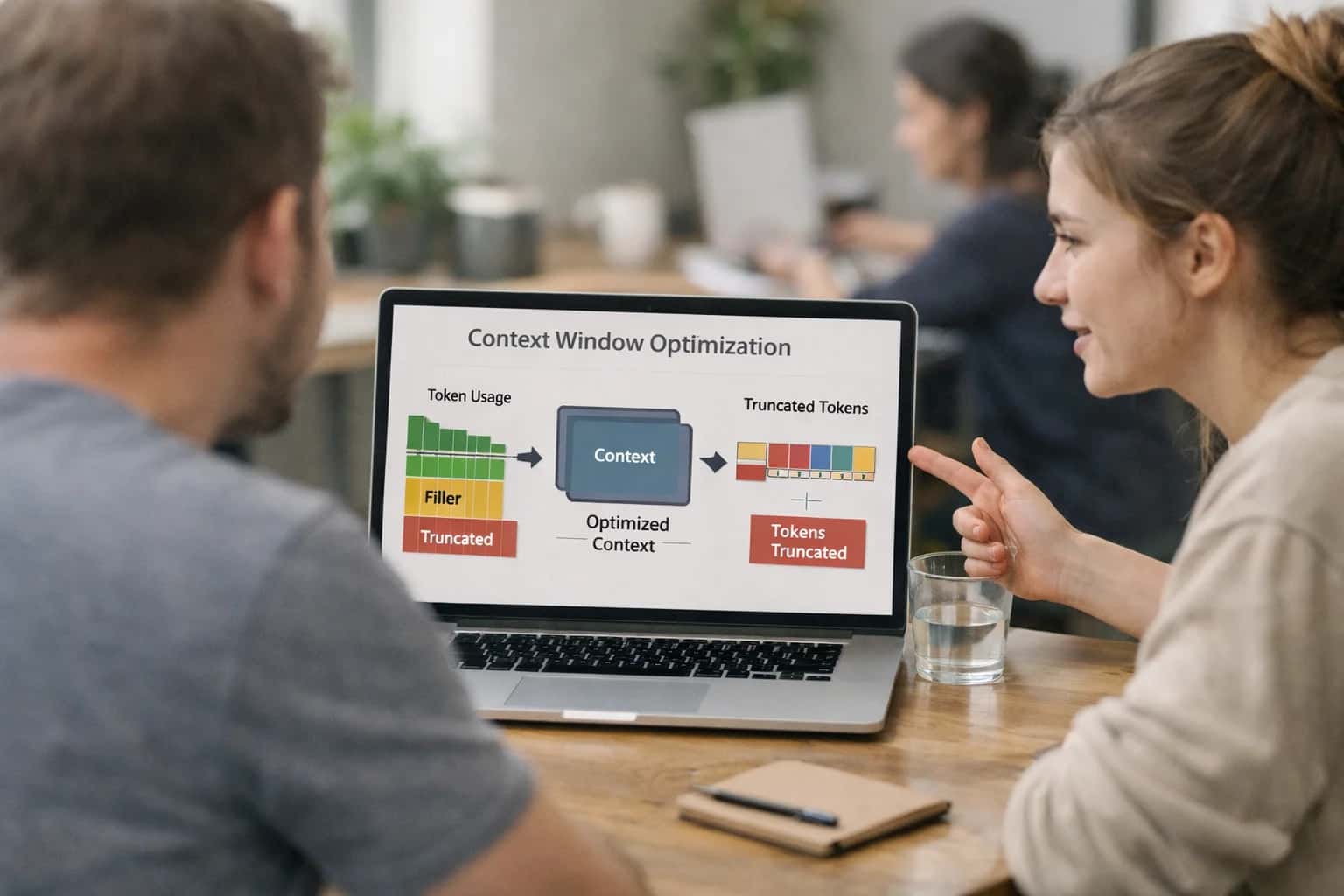
Context window optimization is the engineering discipline of strategically managing a language model's finite token context to maintain state, coherence, and performance in long-running, multi-step agentic systems.
REACT FRAMEWORKS
What is Context Window Optimization?
Context window optimization is a set of techniques for managing the limited token capacity of a language model within an autonomous agent's operational loop.
Core strategies include in-context compression, which distills previous agent outputs into concise summaries, and external memory offloading, which moves historical context to a vector database or episodic buffer for retrieval when needed. This optimization is critical for maintaining coherent long-horizon reasoning, preventing performance degradation from context overflow, and ensuring the agent has access to the most pertinent information for dynamic re-planning and tool-augmented reasoning without exceeding architectural constraints.
CONTEXT WINDOW OPTIMIZATION
Core Optimization Techniques
Context window optimization refers to strategies for managing the limited token context of a language model within an agentic loop, such as compressing past interactions or selectively retaining relevant information.
01
Context Summarization
A technique where the agent periodically compresses the history of a conversation or task execution into a concise summary. This frees up tokens for new reasoning steps while preserving the essential narrative and state. Common methods include:
- Extractive summarization: Selecting and concatenating key sentences or observations.
- Abstractive summarization: Generating a new, shorter narrative that captures the core meaning.
- State vector distillation: Creating a dense, structured representation (e.g., a JSON object) of the current situation, goals, and constraints.
02
Selective Memory
The strategic decision-making process for what information to retain, discard, or store externally. Instead of keeping the full interaction history, the agent identifies and caches only salient information critical for future steps. This involves:
- Relevance scoring: Assigning importance to facts, observations, or decisions based on the current task.
- Episodic buffering: Moving detailed step-by-step logs to long-term storage (e.g., a vector database) once a sub-task is complete.
- Forgetting policies: Explicit rules for discarding intermediate calculations or failed attempts that are no longer needed.
03
Sliding Window Attention
An architectural or prompting approach that mimics the fixed-context attention mechanism of transformers. The agent operates with a moving focus on the most recent N tokens or interactions, treating older context as outside its immediate working memory. This is implemented by:
- Truncation: Systematically removing the oldest tokens from the prompt once a threshold is reached.
- Hierarchical context: Maintaining a high-level summary of the distant past while keeping granular detail for the recent past.
- Windowed retrieval: Querying an external memory system only for information relevant to the current window's focus.
04
Tool Call Compression
Optimizing the representation of tool interactions within the context. Raw tool outputs (e.g., large API responses, database query results) can consume excessive tokens. Compression strategies include:
- Structured extraction: Parsing the output to extract only the specific data fields needed for the next reasoning step.
- Result summarization: Having the agent or a secondary model generate a one-sentence summary of a tool's result.
- Reference by pointer: Replacing bulky outputs with a short unique identifier, with the full data stored externally and retrieved only if explicitly needed later.
05
Dynamic Context Pruning
The real-time, algorithmic removal of context deemed low-value for the immediate next step. This goes beyond simple truncation by using the model's own meta-reasoning to evaluate context utility. Techniques involve:
- Token-level importance scoring: Using attention weights or a separate classifier to identify less impactful tokens.
- Turn-level compression: Aggressively summarizing or removing entire past Q&A pairs that are tangential to the current objective.
- Goal-conditioned filtering: Continuously filtering the retained context against the active subgoal, discarding information related to completed or abandoned subgoals.
06
External State Management
Offloading context from the model's working memory to specialized external systems. This transforms the finite context window into a gateway to a theoretically infinite state. Key systems include:
- Vector databases: Storing past observations, facts, and reasoning steps as embeddings for semantic retrieval.
- Knowledge graphs: Maintaining structured relationships between entities and events encountered during task execution.
- Episodic memory stores: Logging complete execution trajectories with timestamps and metadata for later recall by summary or reference. This approach is foundational for Memory-Augmented ReAct architectures.
CONTEXT WINDOW OPTIMIZATION
How It Works in a ReAct Loop
Within a ReAct (Reasoning and Acting) loop, context window optimization is the strategic management of the agent's working memory to maintain task coherence without exceeding the model's token limit.
The Thought-Action-Observation cycle continuously appends new tokens to the context. To prevent overflow, selective summarization compresses past reasoning steps, while relevance filtering discards obsolete observations. This ensures the most critical information—current subgoals, recent tool outputs, and key constraints—remains within the context window to guide the next iteration. Without optimization, the agent loses coherence as earlier steps are truncated.
Techniques include token budgeting, which allocates slots for different context types (e.g., system prompt vs. trajectory history), and stateful compression, where a vector database stores episodic memories retrieved on-demand. This allows the agent to operate over extended reasoning trajectories by maintaining a distilled, actionable state rather than a raw log, directly impacting the loop's ability to perform iterative task decomposition and dynamic re-planning effectively.
CONTEXT WINDOW MANAGEMENT
Optimization Strategy Comparison
Comparison of core strategies for managing the limited token context within an agentic ReAct loop, balancing information retention against computational overhead.
| Strategy | Summarization & Compression | Selective Retention (Relevance Filtering) | Hierarchical Chunking | External Memory (Vector Store) |
|---|---|---|---|---|
Primary Mechanism | Generates a condensed textual summary of past interactions | Scores and filters past turns based on relevance to current goal | Organizes context into a tree of summaries and details | Offloads full interaction history to a queryable database |
Token Efficiency | High (reduces context to a fixed summary length) | Medium-High (retains only a subset of tokens) | Medium (maintains structure with some redundancy) | Very High (stores history externally, queries bring in minimal tokens) |
Information Fidelity | Low-Medium (risk of information loss in summarization) | High for retained items, zero for filtered (depends on scoring accuracy) | Medium-High (details preserved in leaf nodes, accessible via hierarchy) | Very High (raw data is preserved verbatim in storage) |
Implementation Complexity | Medium (requires a reliable summarization model or heuristic) | High (requires a robust relevance scoring model/embedder) | High (requires logic to build and traverse the hierarchy) | Very High (requires integration with a separate database system) |
Best For | Long-running dialogues where only recent gist is needed | Tasks with clear, shifting subgoals where past context has variable relevance | Complex, multi-faceted tasks with nested information (e.g., document analysis) | Extremely long-horizon tasks requiring perfect recall of fine details |
Latency Impact | Medium (time cost for generating summary) | Low-Medium (time cost for scoring relevance) | Low (fast traversal of pre-built hierarchy) | High (network latency for database queries added to loop) |
Common Use Case | Chatbot memory over very long conversations | ReAct agents where only relevant tool outputs are kept | Code generation with large codebases | Research agents that need to correlate information across thousands of documents |
Key Risk | Hallucination or omission in the summary | Accidentally filtering out critical context (false negative) | Inefficient hierarchy leading to poor information access | Stale or irrelevant retrieval results polluting the context |
CONTEXT WINDOW OPTIMIZATION
Implementation Examples & Frameworks
Practical techniques and system designs for managing the finite token context of language models within autonomous agent loops, ensuring efficient information retention and task execution.
01
Context Summarization & Compression
This technique reduces the token footprint of past interactions by generating concise summaries. A common pattern is the Summarize-Then-Query loop, where after a set number of turns, the agent's previous Thought-Action-Observation cycles are condensed into a brief narrative. This preserves the high-level trajectory while freeing tokens for new reasoning. For example, a customer service agent might summarize a long troubleshooting history into "User attempted X and Y, error Z persists," before proceeding. Advanced methods use smaller, dedicated summarizer models or prompt the main agent to produce its own summary.
02
Sliding Window with Priority Cache
This architecture treats the context window as a fixed-size buffer that slides over the interaction history. The most recent N tokens are kept in full detail, while older interactions are either dropped or stored in a compressed form. A priority cache can retain critical information—like the original user goal, system instructions, or key facts—outside the sliding window, re-injecting them as needed. This mimics computer memory hierarchies (L1/L2 cache vs. RAM). It's fundamental for long-running stateful reasoning agents that must remember core objectives across hundreds of turns.
03
Vector-Based Relevance Retrieval
Instead of keeping the entire history, this method stores past interactions in a vector database. At each step, the agent's current state is used to query this memory for the K most semantically relevant past observations or facts. These are dynamically retrieved and inserted into the context. This transforms the context window from a simple FIFO buffer into a content-addressable memory, enabling the agent to "recall" pertinent information on-demand. It's a core component of memory-augmented ReAct and retrieval-augmented reasoning architectures.
04
Structured State Representation
This approach replaces verbose natural language history with structured data formats (JSON, YAML) to minimize token usage. The agent maintains a compact state object tracking entities, facts, and task progress. For instance, a booking agent's state might be {"user_intent": "flight_booking", "extracted_params": {"destination": "NYC", "date": "2024-10-01"}} instead of a paragraph of dialogue. This requires robust structured output generation from the model. Frameworks like LangChain's AgentState or custom Pydantic models enforce this, ensuring the context contains maximally dense, parseable information.
05
Tool-Centric Context Pruning
Optimization focused on the Tool Calling and API Execution phase. After a tool is called and its result (Observation) is integrated, the verbose intermediate reasoning (Thought) and the raw API request details can often be pruned or summarized. The context retains only the essential outcome. For example, after a calculator tool returns "42", the prompt "I need to compute 6*7..." can be removed. This requires careful design of the observation integration step to distill the tool's output into its canonical form, keeping the context lean for the next iterative task decomposition step.
06
Hierarchical Chunking with LLM Judges
A multi-stage method where long context is broken into chunks (e.g., by topic or time). A lightweight LLM judge (or a scoring heuristic) evaluates each chunk's relevance to the current subgoal. Only the highest-scoring chunks are loaded into the primary model's context. This is analogous to a planner-actor architecture for memory management. The judge can use embeddings or simple keyword matching. This is particularly effective for multi-document legal reasoning or clinical workflow automation agents that must sift through vast document sets but only need specific sections at a time.
CONTEXT WINDOW OPTIMIZATION
Frequently Asked Questions
Context window optimization refers to the critical engineering strategies for managing the limited token capacity of a language model within an agentic loop, such as compressing past interactions or selectively retaining relevant information to maintain performance and coherence.
A context window is the fixed maximum number of tokens (words or sub-words) a language model can process in a single input-output sequence. It is a fundamental architectural constraint determined by the model's design and the underlying Transformer architecture's attention mechanism, which has quadratic computational complexity relative to sequence length. This creates a bottleneck because an agent's entire history—its initial instructions, past reasoning steps (Thought), actions, tool outputs (Observations), and the current task state—must fit within this limit. Exceeding it typically results in truncation of the earliest parts of the conversation, causing the agent to lose critical task context and state, leading to incoherent or repetitive behavior.
Enabling Efficiency, Speed & Accuracy
Intelligent Analysis, Decision & Execution
We build AI systems for teams that need search across company data, workflow automation across tools, or AI features inside products and internal software.
Talk to Us
Search across company data
Give teams answers from docs, tickets, runbooks, and product data with sources and permissions.
Useful when people spend too long searching or get different answers from different systems.
Enterprise searchRAGPermissions
Read more
Automate internal workflows
Use AI to route work, draft outputs, trigger actions, and keep approvals and logs in place.
Useful when repetitive work moves across multiple tools and teams.
AI agentsWorkflow automationGovernance
Read more
Add AI to products and internal tools
Build assistants, guided actions, or decision support into the software your team or customers already use.
Useful when AI needs to be part of the product, not a separate tool.
AI integrationDecision supportModel routing
Read more
About the author
Prasad Kumkar
CEO & MD, Inference Systems
Prasad Kumkar is the CEO & MD of Inference Systems and writes about AI systems architecture, LLM infrastructure, model serving, evaluation, and production deployment. Over 5+ years, he has worked across computer vision models, L5 autonomous vehicle systems, and LLM research, with a focus on taking complex AI ideas into real-world engineering systems.
His work and writing cover AI systems, large language models, AI agents, multimodal systems, autonomous systems, inference optimization, RAG, evaluation, and production AI engineering.
LinkedIn
Limited slotsGet a Free AI Consultation
Partnered with leading AI, data, and software stack.





How We Work
Custom AI workflows for your Business
One-fit-all AI don't work for modern businesses. At Inferensys, we aim to understand your business & custom requirements; which we use to define most efficient agentic workflows, the data, and the tools for your business.
01
Review the use case
We understand the task, the users, and where AI can actually help.
Read more02
Pick the right approach
We define what needs search, automation, or product integration.
Read more03
Build the first useful version
We implement the part that proves the value first.
Read more04
Improve from there
We add the checks and visibility needed to keep it useful.
Read moreThe first call is a practical review of your use case and the right next step.
Talk to Us