Tool-use chaining is a prompt orchestration pattern that interleaves a language model's reasoning with sequential calls to external tools, APIs, or functions within a single, automated workflow. It decomposes a complex task into a series of discrete Reason and Act steps, where the model's output from one step dictates the next tool call or reasoning phase. This creates a deterministic, stateful loop, enabling the system to perform multi-step operations like data analysis, content generation with fact-checking, or dynamic API-based computations.

Glossary
Tool-Use Chaining
Tool-use chaining is a prompt orchestration pattern that interleaves model-generated reasoning with calls to external tools, APIs, or functions within a sequential workflow.
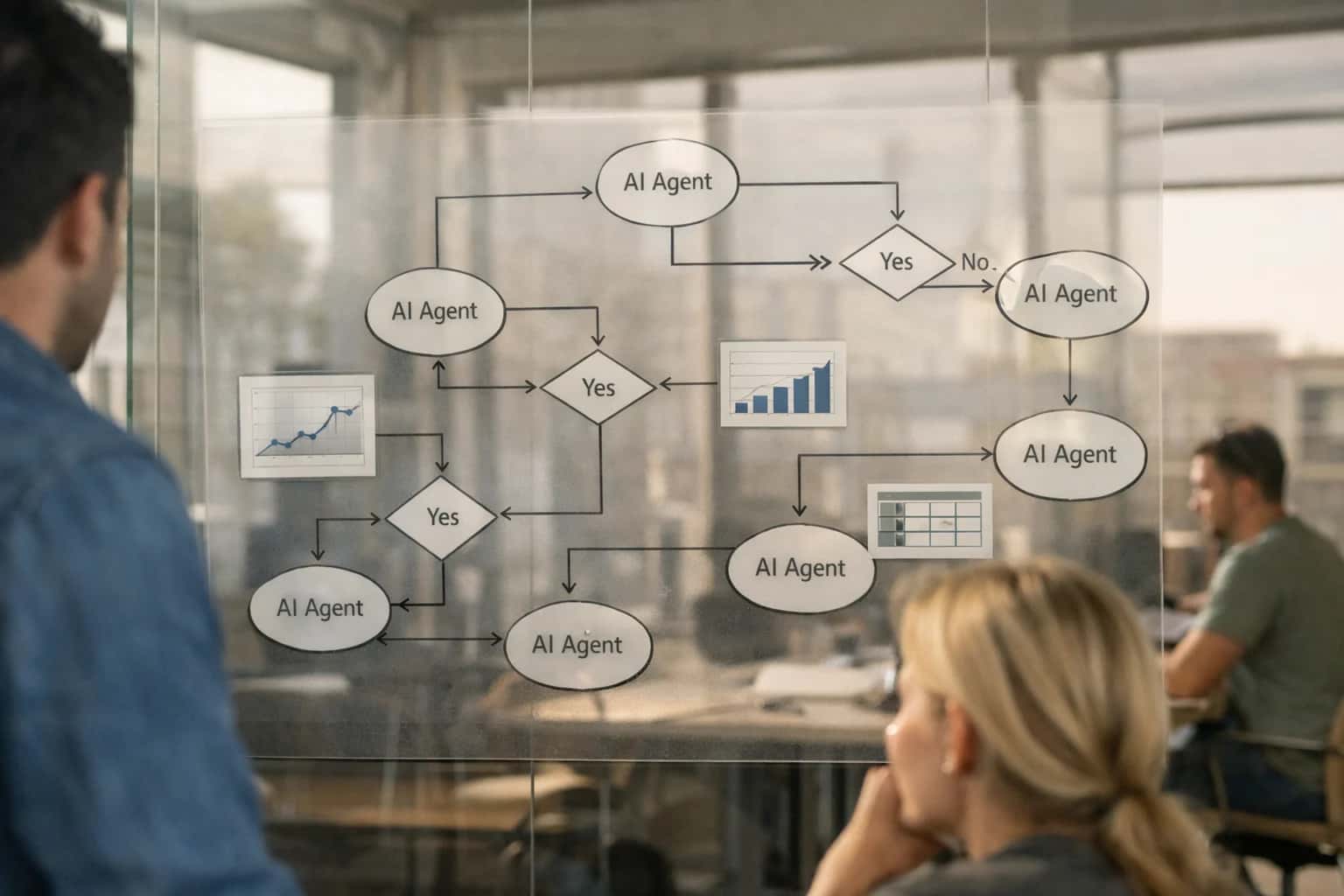
PROMPT CHAINING TECHNIQUE
What is Tool-Use Chaining?
Tool-use chaining is a core prompt orchestration pattern for building complex AI applications.
This technique is foundational to agentic architectures and is often implemented using frameworks that support the ReAct (Reasoning + Acting) paradigm. It directly addresses hallucination mitigation by grounding model outputs in external data and computations. Key engineering considerations include managing chain latency, preventing error propagation, and designing robust verification prompts or fallback paths to handle tool failures, ensuring reliable execution in production environments.
ARCHITECTURAL PATTERN
Core Components of a Tool-Use Chain
A tool-use chain is a deterministic workflow that interleaves model reasoning with external tool execution. Its reliability depends on several key components working in concert.
01
Orchestrator / Controller
The central logic unit that manages the workflow's state and flow. It is responsible for:
- Parsing the initial user request or system trigger.
- Sequencing the steps of reasoning and tool calls.
- Maintaining the chain's state and context between steps.
- Handling conditional logic and error states. This component is often implemented as a finite-state machine or a lightweight application server, not the LLM itself.
02
Reasoning Engine (LLM)
The large language model acts as the planner and decider within the chain. Its core functions are:
- Task Decomposition: Breaking a high-level goal into executable subtasks.
- Tool Selection: Determining which external tool or API is required for a given step, based on its capabilities.
- Parameter Generation: Formulating the precise inputs (arguments, queries) needed for the selected tool.
- Output Interpretation: Analyzing the raw results from a tool to extract meaning and decide the next action.
03
Tool Registry & Schema
A structured catalog of available external capabilities. Each tool entry includes a machine-readable schema that defines:
- Function Name: A unique identifier for the tool.
- Description: A natural language explanation of the tool's purpose, used by the LLM for selection.
- Parameter Schema: The expected inputs (type, format, constraints) and the structure of the output.
- Endpoint / Invocation Details: The technical instructions for calling the tool (e.g., REST API URL, library function). Formats like OpenAPI specifications or Model Context Protocol (MCP) tool definitions are commonly used.
04
Execution Environment
The secure runtime where external tools are invoked and their code executes. This component provides:
- Sandboxing: Isolating tool execution to prevent side effects on the core system.
- Authentication & Credential Management: Securely handling API keys and tokens for external services.
- Network Access: Controlled outbound communication to APIs, databases, or other services.
- Timeout & Error Handling: Enforcing execution limits and catching runtime failures from tools.
05
Context Manager
The subsystem responsible for maintaining and passing relevant information throughout the chain's lifecycle. It manages:
- Conversation History: The full transcript of user inputs, model reasoning, and tool outputs.
- Intermediate State: Variables, partial results, and metadata generated during execution.
- Working Memory: A compressed, relevant summary of past steps to fit within the LLM's context window.
- Session Persistence: Storing state across potentially long-running or asynchronous chains.
06
Output Parser & Validator
Ensures the final deliverable is usable and correct. This component performs:
- Structured Parsing: Extracting data from the LLM's natural language or semi-structured output into a strict format (e.g., JSON, Pydantic model).
- Schema Validation: Checking that the output conforms to an expected type and structure.
- Fact Verification: Cross-referencing key claims from the final answer against tool-derived data or knowledge bases.
- Fallback Triggering: Initiating a correction or re-prompting step if validation fails.
PROMPT ORCHESTRATION PATTERNS
Tool-Use Chaining vs. Related Techniques
A comparison of key orchestration patterns that combine language model reasoning with external tool execution, highlighting their structural and operational differences.
| Feature / Characteristic | Tool-Use Chaining | ReAct Loop | Function Calling | Prompt Chaining (General) |
|---|---|---|---|---|
Core Paradigm | Sequential workflow of reasoning and tool calls | Cyclical loop of reasoning and action | Single-turn model invocation of a tool | Sequential composition of prompts |
External Tool Integration | ||||
Primary Flow Structure | Linear or conditional sequence | Fixed iterative loop | Single request-response | Linear, branching, or graph-based |
State Management Between Steps | Explicit context passing | Implicit within loop context | Stateless; single interaction | Explicit context passing |
Typical Use Case | Multi-step task requiring diverse tools (e.g., research, data analysis) | Interactive problem-solving with feedback (e.g., troubleshooting) | Simple data retrieval or computation (e.g., get weather, calculate) | Complex text transformation without tools (e.g., summarization, style transfer) |
Error Handling Strategy | Fallback prompts and validation steps | Self-correction within the reasoning step | Client-side validation of tool response | Verification prompts and iterative refinement |
Inherent Support for Parallel Execution | ||||
Complexity of Implementation | Medium (orchestrator required) | Medium (loop controller required) | Low (direct API call) | Low to High (depends on graph complexity) |
TOOL-USE CHAINING
Common Use Cases and Examples
Tool-use chaining is a core pattern for building complex, reliable AI applications. Below are key scenarios where this technique is applied to solve real-world problems by orchestrating reasoning with external tools.
01
Data Analysis & Visualization
A classic use case where a model's analytical reasoning is augmented with computational tools. A typical chain might:
- Reason about a user's query (e.g., "Show sales trends by region last quarter").
- Act by calling a database API with a generated SQL query to fetch raw data.
- Reason again to interpret the results and determine the best chart type.
- Act by calling a visualization library (e.g., Matplotlib, Plotly) to generate the chart. This separates the cognitive task of understanding the request from the deterministic execution of code, ensuring accurate data retrieval and presentation.
02
Multi-Step Research & Synthesis
Chains enable comprehensive research by orchestrating searches, reads, and summaries. For example, to answer "What are the latest advancements in solid-state batteries?":
- A routing prompt classifies the query's intent and triggers a research chain.
- A tool-calling prompt formulates search queries for a web search API (e.g., SerpAPI).
- A summarization chain processes the top search results, extracting key points.
- A synthesis prompt combines the summaries into a coherent, cited report. This pattern grounds the final answer in live, external data, mitigating hallucination by using tools for fact retrieval.
03
Automated Code Review & Refactoring
Tool-use chaining creates sophisticated coding assistants. A chain can:
- Ingest a code snippet via a file system tool.
- Reason about potential bugs, security issues, or style violations.
- Act by calling a linter or static analysis tool (e.g., ESLint, Pylint) for objective validation.
- Generate suggested fixes or refactored code based on the combined reasoning and tool output.
- Verify the new code by attempting to run it in a sandboxed execution environment. This creates a self-correcting loop where the model's suggestions are continuously validated by tools.
04
Dynamic Customer Support Workflows
Beyond simple chatbots, chains can handle complex support tickets by integrating with backend systems.
- An intent classification prompt analyzes the customer's message.
- Based on intent, the chain branches: for a billing issue, it calls the CRM API to fetch the user's account; for a technical bug, it queries the error logs database.
- A reasoning prompt formulates a response using the retrieved context.
- If a ticket needs escalation, a final tool call creates an issue in a system like Jira. This demonstrates conditional chaining and stateful prompting, where tool outputs provide the context needed for personalized, accurate assistance.
05
Content Generation with Fact-Checking
This chain interleaves creative generation with verification to ensure accuracy.
- Drafting Prompt: Generates an initial piece of content (e.g., a blog post section).
- Extraction Chain: Identifies key factual claims (dates, names, statistics) from the draft.
- Tool Act: For each claim, performs a parallel search via a knowledge graph or search API.
- Verification Prompt: Compares claims against search results, flagging discrepancies.
- Correction Prompt: Revises the original draft to align with verified facts. This pattern directly combats error propagation by inserting automated fact-checking steps into the creative workflow.
06
Scientific & Financial Modeling
In quantitative domains, chains link conceptual reasoning with numerical computation.
- A model reasons through a problem's setup (e.g., "Calculate the net present value of this cash flow stream with a variable discount rate").
- It then acts by generating and executing Python code using a tool like a Jupyter kernel to perform the complex calculations.
- The results are fed back to the model for interpretation and integration into a final narrative answer. This leverages the model's strength in understanding natural language intent while offloading precise, error-prone math to specialized tools, a core principle of Program-Aided Language Models (PAL).
TOOL-USE CHAINING
Frequently Asked Questions
Tool-use chaining is a core prompt orchestration pattern for building complex AI applications. These FAQs address its mechanisms, implementation, and relationship to other architectural concepts.
Tool-use chaining is a prompt orchestration pattern that interleaves model-generated reasoning with sequential calls to external tools, APIs, or functions within a single, automated workflow. It works by structuring a multi-turn interaction where a large language model (LLM) first reasons about a task, then selects and invokes a tool using a structured format like JSON, processes the tool's result, and repeats this Reason-Act-Observe loop until the task is complete. The chain's state—comprising the original query, accumulated reasoning, tool results, and partial answers—is passed between each step to maintain context.
Key Mechanism: The pattern is often implemented using frameworks that support ReAct (Reasoning + Acting). A system prompt defines the available tools and the output schema (e.g., {"action": "calculator", "action_input": "2+2"}). The model's reasoning and the next tool call are generated in a single response, which is parsed to execute the tool. The tool's result is then appended to the conversation history, and the loop continues.
Enabling Efficiency, Speed & Accuracy
Intelligent Analysis, Decision & Execution
We build AI systems for teams that need search across company data, workflow automation across tools, or AI features inside products and internal software.
Talk to Us
Search across company data
Give teams answers from docs, tickets, runbooks, and product data with sources and permissions.
Useful when people spend too long searching or get different answers from different systems.
Enterprise searchRAGPermissions
Read more
Automate internal workflows
Use AI to route work, draft outputs, trigger actions, and keep approvals and logs in place.
Useful when repetitive work moves across multiple tools and teams.
AI agentsWorkflow automationGovernance
Read more
Add AI to products and internal tools
Build assistants, guided actions, or decision support into the software your team or customers already use.
Useful when AI needs to be part of the product, not a separate tool.
AI integrationDecision supportModel routing
Read more
About the author
Prasad Kumkar
CEO & MD, Inference Systems
Prasad Kumkar is the CEO & MD of Inference Systems and writes about AI systems architecture, LLM infrastructure, model serving, evaluation, and production deployment. Over 5+ years, he has worked across computer vision models, L5 autonomous vehicle systems, and LLM research, with a focus on taking complex AI ideas into real-world engineering systems.
His work and writing cover AI systems, large language models, AI agents, multimodal systems, autonomous systems, inference optimization, RAG, evaluation, and production AI engineering.
LinkedIn
Limited slotsGet a Free AI Consultation
Partnered with leading AI, data, and software stack.





How We Work
Custom AI workflows for your Business
One-fit-all AI don't work for modern businesses. At Inferensys, we aim to understand your business & custom requirements; which we use to define most efficient agentic workflows, the data, and the tools for your business.
01
Review the use case
We understand the task, the users, and where AI can actually help.
Read more02
Pick the right approach
We define what needs search, automation, or product integration.
Read more03
Build the first useful version
We implement the part that proves the value first.
Read more04
Improve from there
We add the checks and visibility needed to keep it useful.
Read moreThe first call is a practical review of your use case and the right next step.
Talk to Us