PAL Orchestration refers to the architectural framework and control logic that manages the complete lifecycle of a Program-Aided Language Model (PAL) system. It coordinates the sequence from receiving a natural language query, generating executable intermediate code, securely running that code in a sandboxed execution backend, handling the result substitution, and implementing robust error recovery and logging. This orchestration is critical for moving PAL from a research technique to a reliable, production-grade service.

Glossary
PAL Orchestration
PAL Orchestration is the system design and workflow management required to handle the end-to-end process of code generation, secure execution, result handling, and error recovery at scale in Program-Aided Language Models.
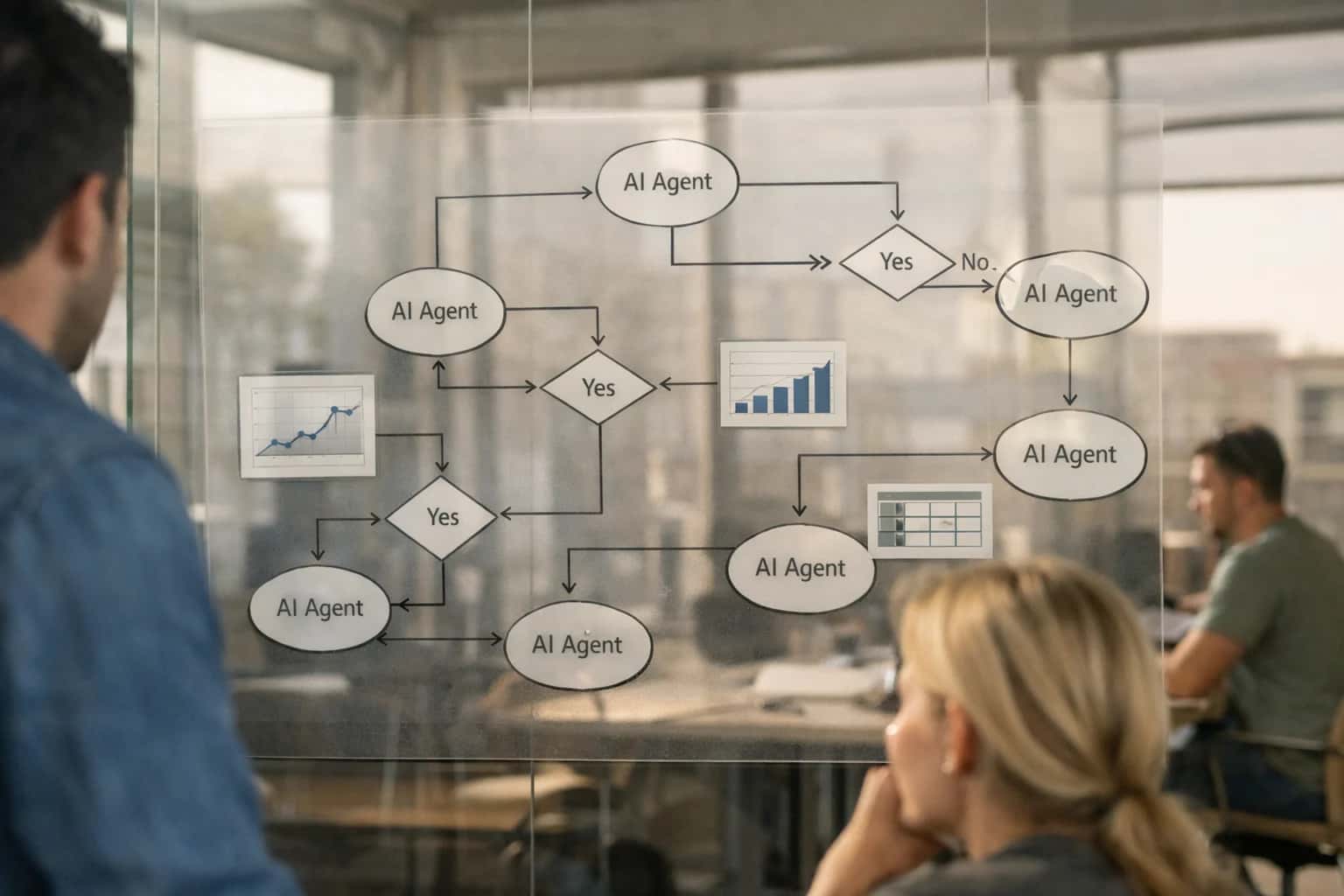
SYSTEM DESIGN
What is PAL Orchestration?
PAL Orchestration is the comprehensive system design and workflow management required to handle the end-to-end process of code generation, secure execution, result handling, and error recovery at scale.
Effective orchestration addresses key operational challenges: managing PAL latency from generation to execution, ensuring PAL security by preventing sandbox escapes, and maintaining high execution success rates. It often integrates with broader Agentic Cognitive Architectures, using execution feedback for iterative refinement. The design must also handle concurrent requests, version different PAL templates, and provide the observability needed for enterprise deployment, making it a cornerstone of scalable, deterministic AI systems.
SYSTEM DESIGN
Core Components of a PAL Orchestrator
A PAL Orchestrator is a production system that manages the end-to-end workflow of generating, executing, and validating code from a language model. It transforms the academic PAL prompting technique into a reliable, scalable service.
01
Prompt Management & Template Engine
This component is responsible for constructing the precise instructions that guide the language model to generate executable code. It manages PAL templates, which are structured prompts that define the task, specify the output format (e.g., code within ````python` blocks), and often include few-shot examples. The engine dynamically injects problem statements, context, and system instructions while managing the token budget to stay within the model's context window. Robust versions support A/B testing, versioning, and logging of prompt variants.
02
Secure Code Execution Backend
The most critical security component, this is a sandboxed execution environment for running untrusted, model-generated code. Key features include:
- Resource Limitation: Strict CPU, memory, and runtime constraints.
- Network & Filesystem Isolation: Blocks unauthorized external calls and file access.
- Allowed Imports: A whitelist of safe Python libraries (e.g.,
math,datetime,json). - Ephemeral Containers: Each execution runs in a fresh, disposable environment (e.g., using gVisor, Firecracker, or Docker). This backend directly determines the system's execution success rate and is fundamental to PAL security.
03
Result Handler & Validation Layer
This component processes the raw output from the code execution backend. Its functions include:
- Result Substitution: Inserting the computed result into a final answer template.
- Type & Format Validation: Ensuring the output matches an expected schema (e.g., a number, a list, a JSON object).
- Sanitization: Scrubbing the output of any sensitive data or erroneous artifacts from the execution environment.
- Fallback Logic: Triggering a retry or an alternative workflow if the result is invalid, null, or an error occurs. This layer is essential for achieving PAL for structured output.
04
Error Recovery & Iteration Loop
A robust orchestrator implements intelligent error handling beyond simple retries. This involves:
- Execution Feedback: Parsing interpreter errors (syntax errors,
NameError,ZeroDivisionError) and feeding them back into the model with a request for a corrected code generation. - Logic Error Detection: Using code reward models or heuristic checks to identify when code runs but produces a plausible yet incorrect answer.
- Multi-Attempt Strategies: Defining fallback chains, such as trying a different code generation approach, simplifying the problem, or ultimately deferring to a human operator. This embodies principles of recursive error correction.
05
Observability & Telemetry
This subsystem provides full visibility into the PAL workflow for monitoring, debugging, and optimization. It tracks:
- Performance Metrics: PAL latency (broken into generation, execution, and overhead), token usage, and cost.
- Success Rates: Execution success rate, answer correctness rate, and error type distributions.
- Audit Trails: Logs of all generated code, execution results, and model interactions for reproducibility and PAL interpretability.
- Hallucination Detection: Flags potential code hallucination by comparing generated code patterns against known solutions. This data feeds into evaluation-driven development.
06
Integration & State Management
The orchestrator must operate within a larger application. This component handles:
- Session & Context Management: Maintaining conversation history and variable state across multiple turns of a PAL interaction, which is crucial for multi-step problems.
- External Data Binding: Injecting live data from APIs, databases, or user uploads into the code generation context.
- Tool & API Orchestration: Enabling the PAL system to act as a component within an agentic cognitive architecture, where code generation is one tool among many. This facilitates building PAL-Agent hybrid systems.
SYSTEM WORKFLOW
How PAL Orchestration Works: A Step-by-Step Process
PAL orchestration is the end-to-end system design that manages the lifecycle of a Program-Aided Language Model request, from prompt ingestion to final answer delivery, ensuring reliability, security, and performance at scale.
The process begins with a problem prompt being routed to a PAL-optimized language model. The model, conditioned by a PAL template, generates executable intermediate code—typically Python—as its reasoning step. This raw code output is captured and passed to a code execution backend. This backend is a critical security component, as it must perform sandboxed execution within a tightly controlled, resource-limited environment to prevent system compromise from potentially malicious or erroneous generated code.
Upon execution, the system captures the stdout, stderr, and return value. A successful execution triggers result substitution, where the computed output is formatted into the final answer. If execution fails, error recovery mechanisms engage, which may involve feeding the error trace back to the model for self-correction or routing the task to a fallback handler. The final step involves telemetry logging, recording metrics like execution success rate and PAL latency for observability, completing the orchestrated loop.
APPLICATION DOMAINS
Primary Use Cases for PAL Orchestration
PAL orchestration is the system design for managing the end-to-end process of code generation, secure execution, and result handling. Its primary applications solve problems where deterministic computation, data manipulation, or integration with external systems is required.
01
Complex Mathematical & Symbolic Reasoning
PAL orchestration excels at solving problems requiring precise, multi-step calculation that pure language models often get wrong. The system generates executable code (e.g., Python with SymPy) to perform arithmetic, algebra, calculus, and symbolic manipulation.
- Key Benefit: Eliminates arithmetic hallucinations by offloading computation to a deterministic interpreter.
- Example Tasks: Solving differential equations, calculating compound interest, performing unit conversions, and evaluating statistical formulas.
- System Role: The orchestrator manages the generation, validates the code's intent against the problem, executes it in a sandbox, and formats the numerical result into a natural language answer.
02
Structured Data Analysis & Transformation
This use case involves querying, cleaning, and analyzing datasets by generating and executing code against real or provided data. The orchestrator handles the full pipeline from problem statement to visualized insight.
- Core Mechanism: The model generates Pandas, NumPy, or SQL code snippets based on a natural language query about a dataset.
- Orchestration Duties: Securely injects the dataset into the execution sandbox, runs the generated code, captures outputs like dataframes or plots, and renders the final answer. It manages errors like missing columns or unsupported operations.
- Example: A user asks, "What was the average sales in Q3 for the top-performing region?" The system generates Pandas code to filter, group, and calculate, then returns the exact figure.
03
Dynamic Content & Template Generation
PAL orchestration is used to produce perfectly formatted, syntactically valid structured outputs by treating code generation as a guaranteed formatting engine. This is critical for API calls and document automation.
- Process: Instead of asking a model to output JSON directly, the prompt instructs it to write a small program whose
printstatement outputs the desired structure. - Orchestration Role: Executes the code and captures the
stdout, ensuring the output is always valid JSON, XML, YAML, or HTML. The orchestrator handles parsing and delivery of this structured result. - Advantage: 100% syntactic validity for downstream systems, bypassing model tendencies to produce malformed brackets or trailing commas.
04
Integration with External Tools & APIs
Here, PAL orchestration acts as a secure bridge, generating code that interacts with databases, web APIs, or software libraries, then managing the execution and result flow.
- How it Works: The model is prompted to generate code that uses libraries like
requestsfor API calls,sqlite3for database queries, ordatetimefor complex time calculations. - Security & Orchestration: The system runs this code in a severely restricted sandbox with controlled network access and no filesystem write permissions. It manages timeouts, parses API responses, and handles authentication token injection (securely) if needed.
- Use Case: Automating the fetch-transform-return cycle for data housed in internal tools without granting the LLM direct API access.
05
Iterative Problem-Solving & Debugging Loops
For complex problems, a single code generation may fail. PAL orchestration frameworks implement multi-turn loops where execution errors are fed back to the model for correction.
- Orchestration Logic: The system executes the generated code. If it fails (syntax error, exception), the execution feedback (traceback) is packaged into a new prompt asking the model to debug and fix its code.
- Key Components: This requires state management, turn counting, and failover logic to avoid infinite loops. It effectively creates a self-correcting system.
- Application: Essential for tasks like writing data parsers for irregular formats or solving algorithmic coding challenges where the solution path isn't obvious in one step.
06
Educational & Explainable Problem-Solving
PAL orchestration provides a transparent reasoning trace in the form of code, making it valuable for tutoring systems and explainable AI where users need to see the "workings."
- Process: The system is designed to output both the generated code and the execution result, presenting them side-by-side as the solution.
- Orchestration Output: Formats a final answer that explains the steps taken in the code in natural language, using the computed values.
- Benefit: Offers auditability and trust. A user can inspect the code to verify the logic, unlike opaque chain-of-thought reasoning. This is crucial for domains like finance or education where process matters as much as the answer.
SYSTEM ARCHITECTURE COMPARISON
PAL Orchestration vs. Related Concepts
A technical comparison of the system-level responsibilities and design patterns for managing code generation and execution workflows.
| Architectural Concern | PAL Orchestration | Agentic System Orchestration | Standard API-Based LLM Call |
|---|---|---|---|
Primary Objective | Manage end-to-end code generation, secure execution, and result handling for deterministic computation. | Coordinate planning, action, and observation loops across multiple autonomous agents to achieve complex goals. | Generate a single, direct text or structured response to a user query. |
Core Workflow | Prompt → Code Generation → Sandboxed Execution → Result Substitution → Final Output. | Plan → Act (Tool Use) → Observe → Reflect → Repeat. | Prompt → Inference → Response. |
State Management | Manages execution state (variables, results, errors) within a single, deterministic code run. | Manages complex, episodic agent memory (short/long-term) and inter-agent communication state. | Typically stateless; context is limited to the prompt and session history. |
Error Handling & Recovery | Automated retry on execution failure, code correction loops, and fallback to non-code reasoning. | Recursive error correction, plan re-evaluation, and conflict resolution between agents. | Limited; may involve prompt rephrasing or basic retry logic at the application layer. |
Security Posture | Requires strict sandboxing (resource limits, network isolation), code analysis, and dependency control. | Focuses on agentic threat modeling (prompt injection, cascading failures) and tool access governance. | Relies on input/output sanitization and standard API authentication; no code execution risk. |
Key Performance Metrics | Execution success rate, end-to-end latency (generation + execution), computational accuracy. | Task completion rate, step efficiency, cost per agent run, conflict resolution time. | Token latency, throughput (requests/sec), and task-specific accuracy (e.g., benchmark scores). |
System Complexity | High, due to managing a secure, isolated runtime environment and deterministic code paths. | Very High, due to concurrency, emergent behaviors, and dynamic coordination logic. | Low to Moderate, primarily involving API integration and prompt management. |
Typical Use Case | Solving mathematical problems, generating structured data outputs, or performing data analysis via code. | Autonomous research, multi-step customer support, or dynamic supply chain optimization. | Chatbots, content generation, classification, and simple data extraction. |
PAL ORCHESTRATION
Frequently Asked Questions
PAL orchestration is the system design and workflow management required to handle the end-to-end process of code generation, secure execution, result handling, and error recovery at scale. These FAQs address the core components, challenges, and implementation strategies for production-grade PAL systems.
PAL Orchestration is the comprehensive system design and workflow management required to reliably execute the end-to-end Program-Aided Language Model (PAL) process at scale. It is needed because a naive implementation—simply generating code and running it—is fraught with production risks. Orchestration manages the full lifecycle: prompt templating, secure code generation, isolated execution, result parsing, error handling, logging, and potentially iterative refinement. Without it, systems are vulnerable to security breaches, inconsistent outputs, and operational failures.
Key orchestration responsibilities include:
- Workflow Sequencing: Managing the order of operations from user query to final answer.
- State Management: Tracking the context, generated code, execution results, and any errors across steps.
- Fallback Mechanisms: Defining what happens when code fails to execute or produces an invalid result.
- Resource Governance: Controlling compute, memory, and time limits for code execution to prevent system abuse.
Enabling Efficiency, Speed & Accuracy
Intelligent Analysis, Decision & Execution
We build AI systems for teams that need search across company data, workflow automation across tools, or AI features inside products and internal software.
Talk to Us
Search across company data
Give teams answers from docs, tickets, runbooks, and product data with sources and permissions.
Useful when people spend too long searching or get different answers from different systems.
Enterprise searchRAGPermissions
Read more
Automate internal workflows
Use AI to route work, draft outputs, trigger actions, and keep approvals and logs in place.
Useful when repetitive work moves across multiple tools and teams.
AI agentsWorkflow automationGovernance
Read more
Add AI to products and internal tools
Build assistants, guided actions, or decision support into the software your team or customers already use.
Useful when AI needs to be part of the product, not a separate tool.
AI integrationDecision supportModel routing
Read more
About the author
Prasad Kumkar
CEO & MD, Inference Systems
Prasad Kumkar is the CEO & MD of Inference Systems and writes about AI systems architecture, LLM infrastructure, model serving, evaluation, and production deployment. Over 5+ years, he has worked across computer vision models, L5 autonomous vehicle systems, and LLM research, with a focus on taking complex AI ideas into real-world engineering systems.
His work and writing cover AI systems, large language models, AI agents, multimodal systems, autonomous systems, inference optimization, RAG, evaluation, and production AI engineering.
LinkedIn
Limited slotsGet a Free AI Consultation
Partnered with leading AI, data, and software stack.





How We Work
Custom AI workflows for your Business
One-fit-all AI don't work for modern businesses. At Inferensys, we aim to understand your business & custom requirements; which we use to define most efficient agentic workflows, the data, and the tools for your business.
01
Review the use case
We understand the task, the users, and where AI can actually help.
Read more02
Pick the right approach
We define what needs search, automation, or product integration.
Read more03
Build the first useful version
We implement the part that proves the value first.
Read more04
Improve from there
We add the checks and visibility needed to keep it useful.
Read moreThe first call is a practical review of your use case and the right next step.
Talk to Us