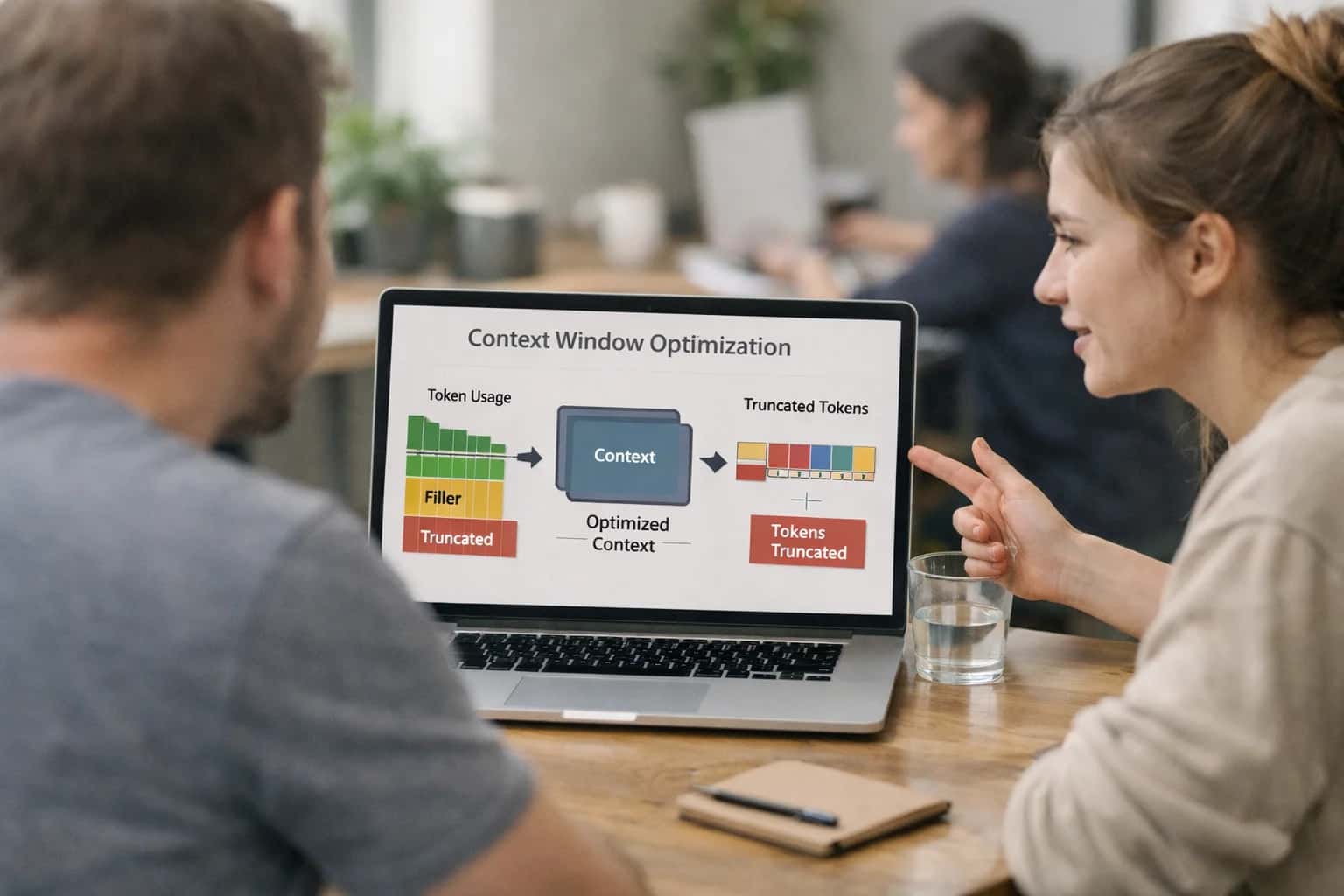
Token-efficient demonstrations are few-shot examples that are strategically compressed or summarized to convey the necessary task pattern using the minimal number of tokens, thereby preserving precious context window space for instructions and the primary query. This practice is a critical component of context window optimization, balancing the informational value of examples against their token cost to improve overall in-context learning (ICL) efficiency and performance.

Glossary
Token-Efficient Demonstrations
Token-efficient demonstrations are few-shot examples that are compressed or summarized to convey the necessary task pattern using the minimal number of tokens, preserving context window space.
IN-CONTEXT LEARNING OPTIMIZATION
What is Token-Efficient Demonstrations?
Token-efficient demonstrations are a core technique in prompt engineering designed to maximize the utility of a model's limited context window.
The goal is to maintain task-example alignment and demonstration relevance while removing redundant verbiage. Techniques include using concise templates, abbreviations, or omitting obvious context. This allows for including a greater diversity of examples or more complex instructions within the same token budget, directly addressing the constraints of models with fixed context lengths and reducing inference latency and cost.
IN-CONTEXT LEARNING OPTIMIZATION
Key Techniques for Creating Token-Efficient Demonstrations
Token-efficient demonstrations are few-shot examples compressed to convey the necessary task pattern using minimal tokens, preserving valuable context window space. These techniques are critical for cost-effective and performant in-context learning.
01
Semantic Summarization
This technique involves condensing verbose examples into their core semantic essence. Instead of providing a full, detailed conversation or document, you extract the key reasoning pattern or structural template. For example, a multi-turn customer service dialogue can be summarized as:
- Input Pattern: User complaint about [issue] + order #[number].
- Agent Action Pattern: Apologize + request details ([specific field]) + promise resolution timeline ([time unit]).
- Output Pattern: Provide summary ticket #[generated_id] and outline next steps. This reduces token count while preserving the task logic the model must learn.
02
Abbreviation & Symbolic Substitution
Replace repeated, predictable phrases with consistent abbreviations or single symbols. This is highly effective for structured data formatting tasks.
- Example: Instead of
"Convert the following date: 'January 15, 2023' to ISO format."and"Convert the following date: 'March 3, 2024' to ISO format." - Token-Efficient Version:
"Date: 'Jan 15, 2023' -> ISO: 2023-01-15"and"Date: 'Mar 3, 2024' -> ISO: 2024-03-03"Key principles: - Define the substitution key once in the system prompt (e.g.,
->means "outputs"). - Use abbreviations (
Msg:forMessage:,Src:forSource:). - Maintain absolute consistency across all demonstrations to avoid confusing the model.
03
Template-Based Placeholders
Use a single canonical template with clear placeholders for variable content, rather than repeating full examples with different values. This teaches the model the abstract schema of the task.
- Inefficient: Two full JSON output examples with different key-value pairs.
- Efficient: One demonstration with a commented template:
codeInput: Extract name and company from: '{user_input}' Output: { "schema": "contact_info", "data": { "name": "<extracted_name>", // Placeholder "company": "<extracted_company>" // Placeholder } }
The model learns the JSON structure and intent from one heavily annotated example, which is then applied to subsequent queries. This is a cornerstone of program-aided language model (PAL) prompting.
04
Instruction-Integrated Demonstrations
Fuse the task instruction directly into the demonstration's format, eliminating the need for separate, verbose instructional preamble. The demonstration itself becomes the instruction.
- Separate (Inefficient):
"Translate the following technical terms to Spanish. Be concise."followed by"Input: 'latency' Output: 'latencia'". - Integrated (Efficient):
"Term->ES: 'latency' -> 'latencia'"and"Term->ES: 'throughput' -> 'rendimiento'". TheTerm->ES:prefix implicitly carries the instruction. This technique relies on the model's ability to perform meta-learning from the demonstration's framing, drastically reducing instructional overhead.
05
Chained or Stepwise Compression
For complex, multi-step reasoning tasks, break the demonstration into core logical steps rather than a monolithic block of text. Use symbolic reasoning chains (like a compressed Chain-of-Thought).
- Verbose CoT:
"The user is asking for the total. The first item is $10. The second is $20. $10 + $20 = $30. So the total is $30." - Compressed Chain:
"Q: cost of A($10) and B($20)? Steps: 1. Identify costs: 10, 20. 2. Op: sum. 3. Calc: 10+20=30. A: $30"This preserves the causal reasoning structure—which is critical for model performance on arithmetic or logic tasks—while using a fraction of the tokens. It explicitly models the algorithm the model should follow.
06
Negative & Contrastive Examples
A single, well-chosen negative example (showing what not to do) can be more token-efficient than multiple positive examples for establishing boundaries. Use a contrastive format.
- Example:
"Classify sentiment: 'I'm okay.' -> Neutral. NOT Positive. (Reason: 'okay' is weak, not affirmative.)"This one demonstration teaches both the correct classification and a key disambiguation rule. It efficiently addresses edge cases and common failure modes. TheNOTand parentheticalReason:provide high-density learning signals, reducing the need for several positive examples to cover the same conceptual ground.
IN-CONTEXT LEARNING OPTIMIZATION
How Token-Efficient Demonstrations Work
Token-efficient demonstrations are few-shot examples compressed to convey a task's pattern using minimal tokens, preserving valuable context window space for other instructions or longer queries.
Token-efficient demonstrations are a core technique in in-context learning optimization, designed to maximize the utility of a model's finite context window. Instead of using verbose, full-length examples, these demonstrations are strategically compressed, summarized, or reformatted to retain the essential task-example alignment and pattern while consuming fewer tokens. This compression directly addresses the trade-off between providing sufficient instructional context and reserving capacity for the user's actual query, a key concern in context window management.
The methodology involves techniques like extracting only the most salient features of an example, using symbolic shorthand, or employing structured output generation formats that are inherently concise. By reducing the token footprint of each demonstration, engineers can include a greater diversity of examples or more complex instructions within the same context limit, often improving in-context learning generalization. This practice is critical for production systems where demonstration pipelines must operate within strict latency and cost constraints tied to context length.
IN-CONTEXT LEARNING OPTIMIZATION
Examples of Token-Efficient Demonstrations
Token-efficient demonstrations are few-shot examples compressed to convey a task's core pattern using minimal tokens, preserving valuable context window space. Below are key techniques for creating such demonstrations.
01
Abbreviated Variable Names
This technique replaces verbose, descriptive variable names with short, conventional abbreviations within code examples.
- Example: Instead of
customer_first_name = "Alex", usefn = "Alex". - Impact: Drastically reduces token count in programming demonstrations while preserving the logical structure the model must learn.
- Best Practice: Maintain internal consistency (e.g., always using
fnfor first name) and include a brief key if the abbreviations are non-standard.
02
Semantic Summarization
This method replaces lengthy, narrative-style examples with dense, factual summaries that capture the same logical relationship.
- Example:
- Inefficient: "The user, named John Doe who lives in London, asked for the weather. The assistant replied, 'It is currently sunny and 22 degrees in London.'"
- Efficient: "User: Weather in London. Assistant: Sunny, 22°C."
- Mechanism: Removes syntactic filler and conversational markers, distilling the example to its core task schema (input intent → output fact).
03
Schema Placeholders
Instead of full, concrete examples, this uses abstract templates with typed placeholders, teaching the model the required output format.
- Example: For a JSON generation task:
- Full Example:
{"input": "Translate 'hello' to Spanish", "output": {"translation": "hola"}} - Schema Placeholder:
{"input": "<text>", "output": {"translation": "<translated_text>"}}
- Full Example:
- Use Case: Highly effective for structured output generation tasks where the format, not the content, is the primary learning objective.
04
Instruction-Integrated Demonstrations
This approach merges the task instruction directly into the demonstration's format, eliminating redundant explanatory text.
- Example:
- Standard: Instruction: "Extract the date." Example: "Text: 'Meeting on 2023-12-25' → Date: 2023-12-25"
- Integrated:
Extract Date: 'Meeting on 2023-12-25' → 2023-12-25
- Benefit: The model learns the instruction and the demonstration pattern simultaneously, a form of task-example alignment that reduces total prompt length.
05
Differential Demonstrations
This advanced technique shows only the difference between a correct and incorrect output, focusing the model on critical decision boundaries.
- Example: For a sentiment classification task:
- Inefficient: Two full examples showing a positive and a negative review.
- Efficient:
Review: 'The product was okay, not great.' Sentiment: Neutral. [*Not Positive*]
- Mechanism: Uses concise meta-annotations (e.g.,
[*Not X*]) to highlight subtle distinctions, teaching the model to avoid common pitfalls with minimal tokens.
06
Compressed Multi-Task Demonstrations
A single, densely constructed example is designed to demonstrate patterns for multiple related subtasks.
- Example: For a data extraction pipeline:
Input: 'Invoice #501 from ACME on Jan 5 for $500.' → Output: {"id": 501, "vendor": "ACME", "date": "2024-01-05", "amount": 500} - Impact: This one demonstration teaches entity recognition, date normalization, and numeric extraction simultaneously, serving as a multi-purpose pattern that reduces the need for separate examples for each subtask.
IN-CONTEXT LEARNING OPTIMIZATION
Token-Efficient vs. Standard Demonstrations
A comparison of demonstration strategies based on their token usage, information density, and impact on model performance within a fixed context window.
| Feature / Metric | Standard Demonstrations | Token-Efficient Demonstrations |
|---|---|---|
Primary Objective | Provide clear, verbose task examples | Maximize task pattern conveyance per token |
Token Consumption | High (100-500+ tokens per example) | Low (< 100 tokens per example, often 30-70) |
Information Density | Low to Moderate | High |
Common Techniques | Full input-output pairs, natural narrative | Summarization, templating, placeholder substitution, acronyms |
Impact on Context Window | Rapidly consumes available tokens, limiting query/complexity | Preserves context for longer queries, chain-of-thought, or more examples |
Best For | Novel or highly complex tasks requiring explicit nuance | Well-understood tasks, production systems with strict latency/context limits, batch processing |
Risk of Task Misalignment | Low (explicit examples) | Moderate (requires careful design to avoid ambiguity) |
Performance on Complex Reasoning | Often higher with sufficient context | Can match standard if core logical pattern is preserved |
Implementation Overhead | Low (curate examples) | High (requires compression algorithm or manual design) |
Example Format | Q: What is the capital of France? A: The capital is Paris. | Cap(France) -> Paris |
TOKEN-EFFICIENT DEMONSTRATIONS
Frequently Asked Questions
Token-efficient demonstrations are a core technique in in-context learning, focusing on maximizing the information density of few-shot examples to preserve valuable context window space. This FAQ addresses common questions about their implementation, benefits, and trade-offs.
Token-efficient demonstrations are few-shot examples that have been compressed, summarized, or otherwise optimized to convey the necessary task pattern to a language model using the minimal number of tokens. The goal is to preserve the limited context window for other critical components like system instructions, the user query, and the model's own generated response.
Instead of providing verbose, natural language examples, token-efficient methods might use:
- Abbreviated syntax or shorthand.
- Structured placeholders (e.g.,
{entity}) instead of full phrases. - Removal of redundant or instructional text already covered by the system prompt.
- Dense formatting like JSON or CSV lines that the model can parse. This practice is essential for complex tasks where many demonstrations are needed or when working with models with smaller context windows.
Enabling Efficiency, Speed & Accuracy
Intelligent Analysis, Decision & Execution
We build AI systems for teams that need search across company data, workflow automation across tools, or AI features inside products and internal software.
Talk to Us
Search across company data
Give teams answers from docs, tickets, runbooks, and product data with sources and permissions.
Useful when people spend too long searching or get different answers from different systems.
Enterprise searchRAGPermissions
Read more
Automate internal workflows
Use AI to route work, draft outputs, trigger actions, and keep approvals and logs in place.
Useful when repetitive work moves across multiple tools and teams.
AI agentsWorkflow automationGovernance
Read more
Add AI to products and internal tools
Build assistants, guided actions, or decision support into the software your team or customers already use.
Useful when AI needs to be part of the product, not a separate tool.
AI integrationDecision supportModel routing
Read more
About the author
Prasad Kumkar
CEO & MD, Inference Systems
Prasad Kumkar is the CEO & MD of Inference Systems and writes about AI systems architecture, LLM infrastructure, model serving, evaluation, and production deployment. Over 5+ years, he has worked across computer vision models, L5 autonomous vehicle systems, and LLM research, with a focus on taking complex AI ideas into real-world engineering systems.
His work and writing cover AI systems, large language models, AI agents, multimodal systems, autonomous systems, inference optimization, RAG, evaluation, and production AI engineering.
LinkedIn
Limited slotsGet a Free AI Consultation
Partnered with leading AI, data, and software stack.





How We Work
Custom AI workflows for your Business
One-fit-all AI don't work for modern businesses. At Inferensys, we aim to understand your business & custom requirements; which we use to define most efficient agentic workflows, the data, and the tools for your business.
01
Review the use case
We understand the task, the users, and where AI can actually help.
Read more02
Pick the right approach
We define what needs search, automation, or product integration.
Read more03
Build the first useful version
We implement the part that proves the value first.
Read more04
Improve from there
We add the checks and visibility needed to keep it useful.
Read moreThe first call is a practical review of your use case and the right next step.
Talk to Us