Dynamic few-shot prompting is an advanced in-context learning technique where the selection, number, and sometimes order of demonstrations in a prompt are determined dynamically for each query, rather than using a fixed, static set. This is typically achieved by using a retrieval system, such as a vector database, to find the most semantically similar examples to the current input from a large corpus. The goal is to provide the model with the most relevant contextual clues, improving accuracy and generalization compared to static few-shot methods.

Glossary
Dynamic Few-Shot
Dynamic few-shot prompting is an adaptive in-context learning technique where the selection and number of demonstrations in a prompt are determined dynamically for each query, often using retrieval or query complexity.
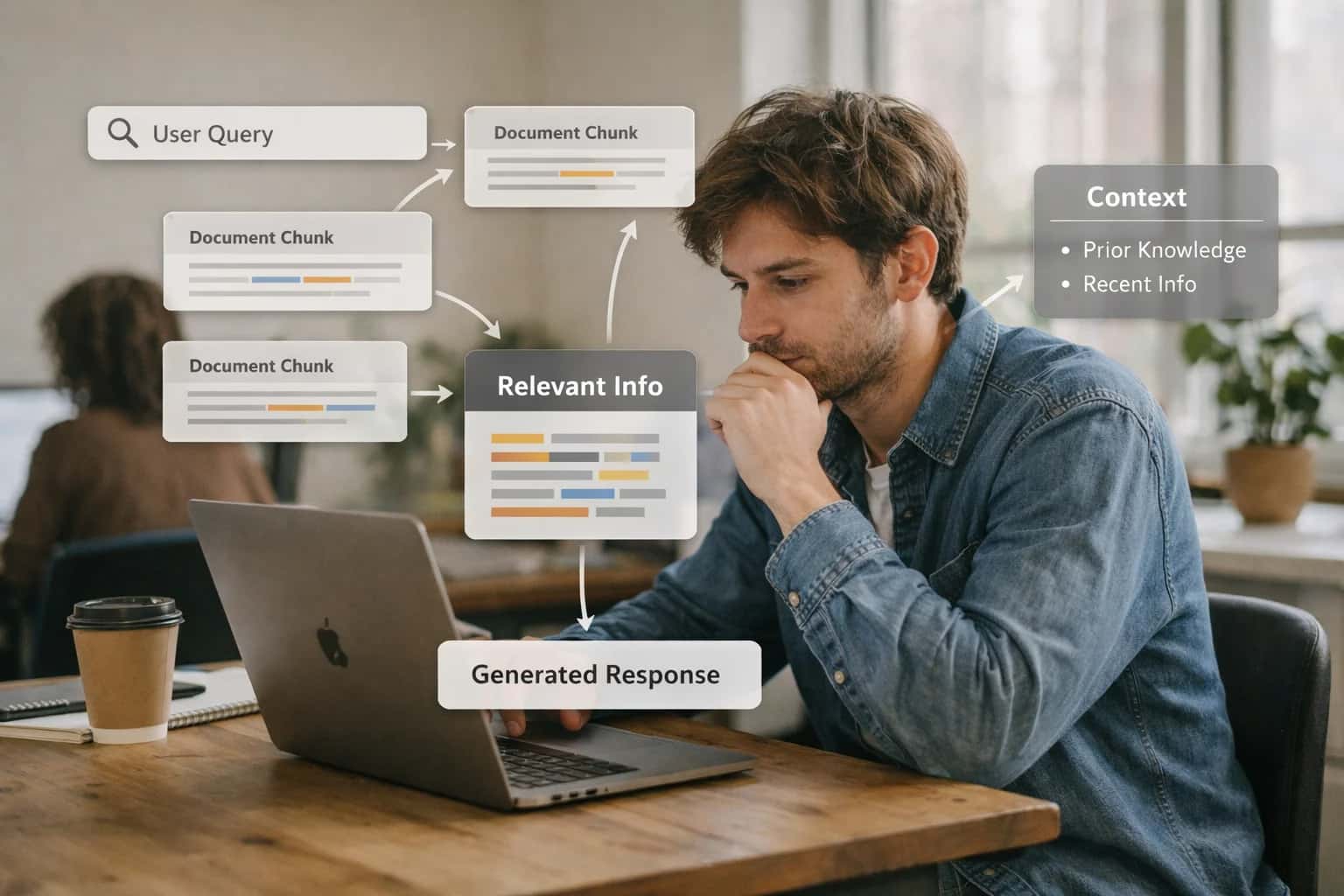
FEW-SHOT LEARNING PARADIGMS
What is Dynamic Few-Shot?
Dynamic few-shot prompting is an adaptive in-context learning technique that customizes the demonstrations in a prompt for each individual query.
This approach directly addresses key limitations of static prompting, such as context window inefficiency and poor performance on out-of-distribution queries. By retrieving demonstrations on-the-fly, the system can adapt to query complexity, domain specificity, and available context space. It is a core component of retrieval-augmented generation (RAG) architectures for in-context learning, enabling more robust and scalable parameter-free adaptation without model fine-tuning.
CONTEXT ENGINEERING
Core Characteristics of Dynamic Few-Shot
Dynamic few-shot prompting is an adaptive technique where the selection and number of demonstrations in a prompt are determined on-the-fly for each query, often based on retrieval or query complexity.
01
Query-Adaptive Retrieval
Unlike static few-shot prompts, dynamic few-shot uses semantic similarity selection to retrieve the most relevant demonstrations for each specific user query. This is typically achieved through embedding-based retrieval, where both the query and a corpus of candidate examples are converted into vector representations. A k-NN demonstration retrieval search then selects the top-k examples with the highest cosine similarity to the query, ensuring the provided context is maximally informative for the task at hand.
02
Context Window Optimization
A key engineering challenge is managing the model's fixed context window. Dynamic selection allows for intelligent packing of the most useful demonstrations without exceeding token limits. Strategies include:
- Adaptive demonstration counts, where the number of examples (k) is tuned based on query complexity or desired confidence.
- Pruning or summarizing less relevant parts of long examples to fit more high-signal content.
- This optimization is central to in-context learning optimization, balancing example quantity with quality.
03
Retrieval-Augmented ICL Architecture
This technique is a specific implementation of Retrieval-Augmented ICL. It requires a two-stage pipeline:
- Offline Indexing: A datastore (e.g., a vector database) is populated with embeddings of potential demonstration examples.
- Online Retrieval & Prompt Construction: For each query, the system performs a fast similarity search, constructs a tailored prompt with the retrieved examples, and sends it to the frozen model for frozen model inference. This decouples the model's knowledge from its parametric memory, grounding responses in relevant, retrieved context.
04
Contrast to Static Few-Shot
Dynamic few-shot fundamentally differs from standard few-shot prompting by its lack of fixed demonstrations.
- Static: Uses the same hand-picked examples for every query. Performance depends heavily on the exemplar quality and demonstration diversity of that fixed set.
- Dynamic: Examples are fluid, changing per query. This improves generalization across a broader input distribution and adapts to edge cases not covered by a static seed set. It turns in-context learning from a fixed template into a retrieval-based system.
05
Key Implementation Components
Building a robust dynamic few-shot system involves several integrated components:
- Retriever Model: An encoder (e.g., text-embedding model) for generating query and example embeddings.
- Vector Index: A scalable similarity search engine (e.g., using FAISS, Pinecone, Weaviate).
- Demonstration Corpus: A high-quality, curated set of input-output pairs covering the task domain.
- Prompt Assembler: Logic to format retrieved examples with the query and any system instructions into a final prompt. Failure points often lie in the query-example matching quality or noise in the demonstration corpus.
06
Performance and Trade-offs
Dynamic few-shot can significantly boost performance on heterogeneous tasks but introduces new trade-offs:
- Pros: Higher accuracy on diverse queries; better utilization of context window; more scalable than crafting static prompts for every task variant.
- Cons: Adds latency for the retrieval step; requires maintaining and indexing a demonstration corpus; performance is bounded by the quality and coverage of that corpus. It exemplifies inference-time adaptation, providing task-specific guidance without any parameter-free adaptation of the underlying model weights.
COMPARISON
Dynamic Few-Shot vs. Static Few-Shot Prompting
A feature-by-feature comparison of adaptive, retrieval-based prompting against fixed, pre-defined prompting.
| Feature / Characteristic | Dynamic Few-Shot Prompting | Static Few-Shot Prompting |
|---|---|---|
Core Mechanism | On-the-fly retrieval of demonstrations from a datastore based on query similarity. | Pre-selected, fixed demonstrations embedded directly within the prompt template. |
Demonstration Selection | Semantic similarity (e.g., k-NN search in embedding space). | Manual curation or random selection during prompt design. |
Context Window Efficiency | High. Retrieves only the most relevant examples, optimizing token usage. | Low. Uses the same fixed examples regardless of query relevance, potentially wasting tokens. |
Adaptability to Query | High. Tailors examples to each specific input, improving relevance. | None. Provides identical context for all queries within a task. |
Implementation Complexity | High. Requires a retrieval system (vector database, embedding model) and integration logic. | Low. Involves simple string templating with hard-coded examples. |
Performance on Edge Cases | Superior. Can retrieve niche examples similar to an unusual query. | Variable. Depends entirely on the breadth of the pre-selected static examples. |
Inference Latency | Higher. Adds overhead for retrieval and embedding computation. | Lower. No additional computational steps beyond the base model call. |
Maintenance Overhead | Low for example updates (just modify the datastore). High for system integrity. | High for example updates (requires redeploying prompt templates). Low for system complexity. |
Example Diversity per Query | Dynamic. Can vary the number and content of demonstrations for each query. | Static. Always presents the same number and sequence of examples. |
Optimal Use Case | Production systems with large, varied example corpora and diverse user queries. | Prototyping, tasks with very consistent query patterns, or where latency is critical. |
DYNAMIC FEW-SHOT
Common Use Cases and Applications
Dynamic few-shot prompting is applied where static, one-size-fits-all demonstrations are insufficient. Its adaptive nature excels in complex, variable, or data-rich environments requiring precision and context-awareness.
01
Semantic Search & Retrieval-Augmented Generation (RAG)
This is the most prevalent application. For each user query, a vector database or semantic search system retrieves the most relevant examples from a knowledge base to construct the prompt. This ensures the model is conditioned on demonstrations that are semantically similar to the current question, dramatically improving answer relevance and reducing hallucinations compared to static prompts.
- Example: A customer support chatbot retrieves past ticket resolutions similar to the new issue before generating a response.
- Key Benefit: Grounds the model in the most pertinent context for each unique query.
02
Complex & Multi-Step Reasoning Tasks
Dynamic selection tailors the complexity and type of demonstrations to the user's query. For a simple arithmetic question, it might retrieve basic examples. For a multi-step physics problem, it retrieves demonstrations showing detailed chain-of-thought reasoning.
- Example: A math tutoring system analyzes query difficulty and retrieves 2 examples of solving linear equations or 5 examples of calculus word problems, as needed.
- Key Benefit: Optimizes the use of the context window by providing only the necessary scaffolding, improving performance on tasks with high variance in complexity.
03
Personalized AI Assistants & Chatbots
Systems can dynamically inject examples of a user's past preferences, interaction style, or domain-specific terminology into the prompt. This personalizes the model's output without retraining.
- Example: A coding assistant retrieves snippets from the developer's own codebase that are similar to the current function they are writing to maintain consistent style.
- Key Benefit: Enables personalized in-context learning that adapts to individual users or sessions, creating a more tailored and effective assistant.
04
Domain-Specific Information Extraction
In fields like legal, medical, or financial analysis, where terminology and output formats are highly specialized, dynamic retrieval fetches the most relevant domain examples. This teaches the model the specific entity types, relationships, and JSON/XML schemas required.
- Example: To extract clauses from a new contract, the system retrieves examples of similar clause extractions from a corpus of legal documents.
- Key Benefit: Achieves high accuracy in specialized domains without costly fine-tuning, by leveraging a curated demonstration datastore.
05
Adaptive Tool & API Calling
In agentic architectures, determining which tool to use requires context. Dynamic few-shot can retrieve examples of successful tool-calling sequences (e.g., search_database -> format_results -> send_email) that are analogous to the current user goal.
- Example: An agent tasked with "book a flight" retrieves demonstrations of successful interactions with travel booking APIs.
- Key Benefit: Improves the reliability of function calling and complex action planning by providing in-context precedents for tool use.
06
Context Window Optimization
Instead of using a fixed, large set of examples that consume the entire context window, dynamic systems retrieve only the k most relevant examples. This preserves precious context tokens for the user's actual query and any necessary retrieved documents in a RAG pipeline.
- Example: A system with a 128K context window might dynamically use 3-5 examples (consuming ~1K tokens) instead of 50 static examples (consuming ~10K tokens).
- Key Benefit: Enables more efficient context management, allowing longer conversations or the inclusion of larger reference documents alongside demonstrations.
DYNAMIC FEW-SHOT
Frequently Asked Questions
Dynamic few-shot prompting is an adaptive in-context learning technique where the selection and number of demonstrations in a prompt are determined on-the-fly for each query, often based on retrieval or query complexity.
Dynamic few-shot prompting is an advanced in-context learning technique where the demonstrations provided to a language model are not fixed but are instead selected and formatted uniquely for each incoming query, typically by retrieving the most relevant examples from a datastore. Unlike static few-shot prompting with a pre-defined set of examples, this method adapts the prompt's context dynamically, allowing the model to condition its response on demonstrations that are semantically closest to the current task. This retrieval-augmented approach improves generalization and accuracy, especially for tasks with a broad or nuanced input space, by ensuring the model receives the most pertinent guidance possible for every specific inference request.
Enabling Efficiency, Speed & Accuracy
Intelligent Analysis, Decision & Execution
We build AI systems for teams that need search across company data, workflow automation across tools, or AI features inside products and internal software.
Talk to Us
Search across company data
Give teams answers from docs, tickets, runbooks, and product data with sources and permissions.
Useful when people spend too long searching or get different answers from different systems.
Enterprise searchRAGPermissions
Read more
Automate internal workflows
Use AI to route work, draft outputs, trigger actions, and keep approvals and logs in place.
Useful when repetitive work moves across multiple tools and teams.
AI agentsWorkflow automationGovernance
Read more
Add AI to products and internal tools
Build assistants, guided actions, or decision support into the software your team or customers already use.
Useful when AI needs to be part of the product, not a separate tool.
AI integrationDecision supportModel routing
Read more
About the author
Prasad Kumkar
CEO & MD, Inference Systems
Prasad Kumkar is the CEO & MD of Inference Systems and writes about AI systems architecture, LLM infrastructure, model serving, evaluation, and production deployment. Over 5+ years, he has worked across computer vision models, L5 autonomous vehicle systems, and LLM research, with a focus on taking complex AI ideas into real-world engineering systems.
His work and writing cover AI systems, large language models, AI agents, multimodal systems, autonomous systems, inference optimization, RAG, evaluation, and production AI engineering.
LinkedIn
Limited slotsGet a Free AI Consultation
Partnered with leading AI, data, and software stack.





How We Work
Custom AI workflows for your Business
One-fit-all AI don't work for modern businesses. At Inferensys, we aim to understand your business & custom requirements; which we use to define most efficient agentic workflows, the data, and the tools for your business.
01
Review the use case
We understand the task, the users, and where AI can actually help.
Read more02
Pick the right approach
We define what needs search, automation, or product integration.
Read more03
Build the first useful version
We implement the part that proves the value first.
Read more04
Improve from there
We add the checks and visibility needed to keep it useful.
Read moreThe first call is a practical review of your use case and the right next step.
Talk to Us