Streaming context is a system architecture designed to handle continuous, unbounded input streams by dynamically managing a rolling context window and its associated KV cache. Unlike static batch processing, it incrementally encodes new tokens while selectively evicting or compressing older ones, enabling real-time interaction with data flows longer than a model's fixed token limit. This is critical for applications like live transcription, real-time analytics, and conversational agents that process never-ending data.

Glossary
Streaming Context
Streaming context is a system architecture designed to handle continuous, unbounded input streams by dynamically managing a rolling context window and KV cache.
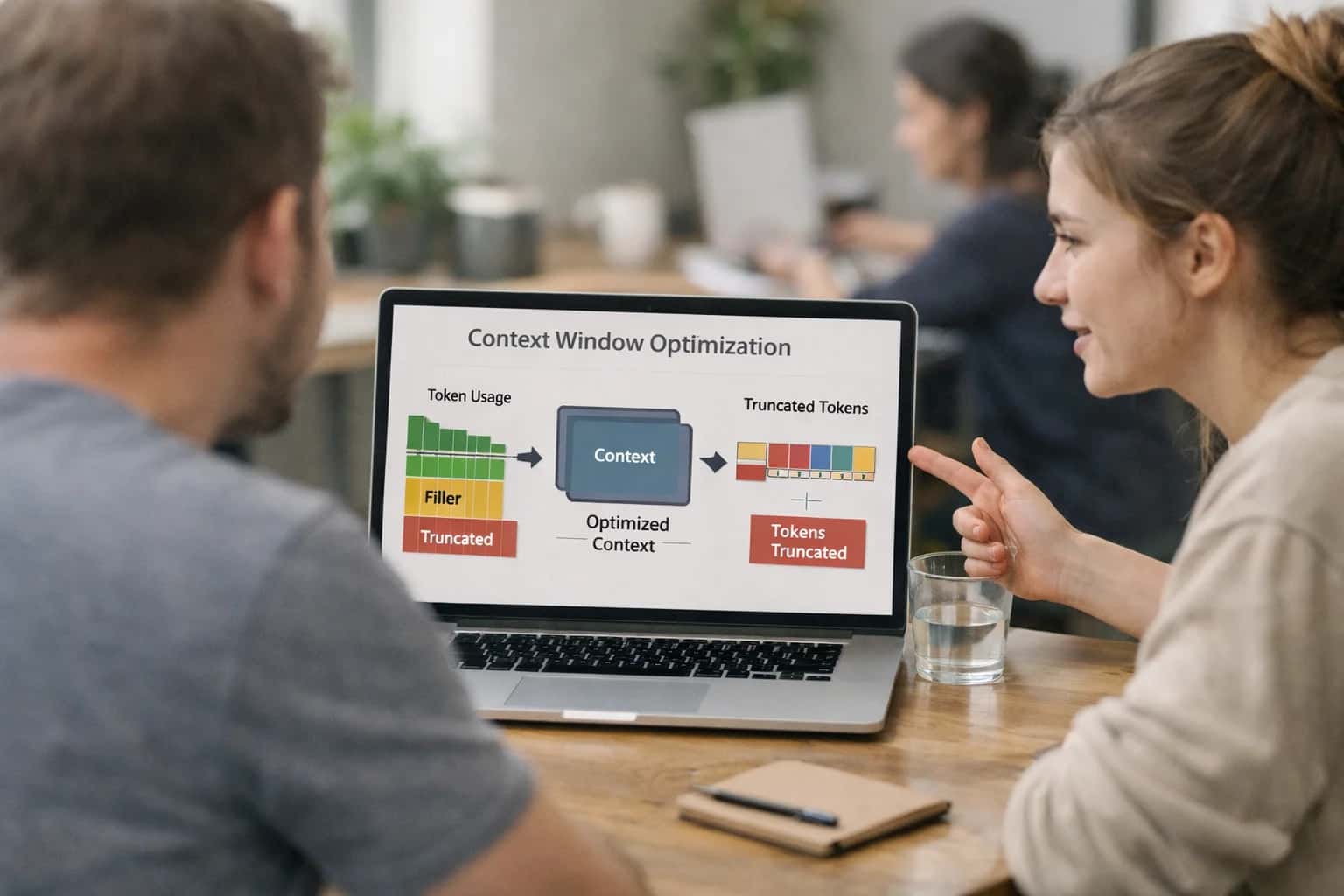
CONTEXT WINDOW MANAGEMENT
What is Streaming Context?
A system architecture for processing continuous, unbounded data streams by dynamically managing a model's working memory.
Core techniques include incremental encoding to update the KV cache without full recomputation and cache eviction policies (e.g., LRU) to manage GPU memory. It works in tandem with context compression and sliding window attention to maintain context freshness and high information density. This architecture is foundational for building low-latency, continuous AI systems that operate on perpetual data streams.
ARCHITECTURAL PRINCIPLES
Key Features of Streaming Context
Streaming context is a system architecture designed for continuous, unbounded data streams. It fundamentally rethinks static context windows by implementing dynamic, rolling management of the KV cache and attention scope to enable real-time, long-context interactions.
01
Dynamic KV Cache Management
At the core of streaming context is the dynamic management of the Key-Value (KV) cache. Unlike static models that recompute the entire sequence, a streaming system maintains a rolling cache. As new tokens stream in, the system:
- Appends new KV vectors for incoming tokens.
- Evicts older vectors based on policies like Least-Recently-Used (LRU) or task-specific importance scoring.
- Avoids full recomputation, enabling O(1) complexity for appending new tokens versus O(n²) for full attention. This allows the model to maintain a "working memory" of a fixed size that slides over an infinite stream, crucial for applications like live transcription or real-time agent monitoring.
02
Rolling Attention Window
Streaming context enforces a rolling or sliding window attention pattern. Each new token's attention is restricted to a fixed number of preceding tokens within the active cache, implementing a form of sparse attention.
- Mechanism: A causal attention mask is applied so token
tcan only attend to tokens[t-w, t], wherewis the window size. - Benefit: This creates a predictable, constant memory footprint regardless of total stream length, preventing GPU memory overflow.
- Trade-off: It imposes a hard limit on long-range dependencies; information outside the immediate window is inaccessible unless explicitly summarized and retained. This is a key differentiator from models with full long-context recall.
03
Incremental Encoding & Low-Latency Inference
The architecture is optimized for incremental encoding, where the processing of each new token is an amortized constant-time operation.
- Process: The system ingests tokens one-by-one or in small chunks, updating the KV cache incrementally without reprocessing the entire history.
- Result: This enables sub-second latency for generating the next token in a response, which is critical for conversational interfaces and real-time decision systems.
- Contrast: Batch processing of long contexts introduces significant latency as the entire sequence must be processed before any output begins. Streaming context pipelines output almost concurrently with input.
04
Stateful Session Management
Streaming context systems are inherently stateful, maintaining session-specific context across multiple discrete API calls or user turns.
- Session Cache: A unique KV cache is maintained for each user or conversation session.
- Persistence: This cache may be serialized and stored between interactions, allowing a long-running dialogue to resume exactly where it left off without re-transmitting the entire history.
- Orchestration: In multi-agent systems, this enables agents to maintain independent streams of context for different tasks or user threads, which are then coordinated by an orchestrator. This is foundational for persistent digital assistants.
05
Context Summarization & Eviction Policies
To manage the finite cache, streaming systems employ intelligent context eviction and summarization policies.
- Eviction Policies: Algorithms decide which parts of the cache to discard. Simple methods include FIFO (First-In, First-Out) or LRU. Advanced systems use attention score or relevance heuristics to prioritize retaining semantically important tokens.
- Summarization: Instead of blunt eviction, a separate model or process can summarize content leaving the active window into a dense context vector or a few summary tokens, which are then prepended to the stream. This preserves high-level semantic information beyond the strict window limit, mitigating information loss.
06
Integration with External Memory Systems
Pure streaming context has a limited working memory. For long-term retention, it is architecturally paired with external memory systems.
- Vector Databases: The system can periodically encode evicted context chunks into embeddings and insert them into a vector store. Relevant memories can be retrieved via semantic search and re-injected into the active context window when needed.
- Knowledge Graphs: Structured facts extracted from the stream can be written to a knowledge graph, providing a persistent, queryable memory.
- Hybrid Architecture: This creates a two-tier memory system: a fast, rolling KV cache for immediate context and a larger, slower external memory for long-term facts and episodic recall. This pattern is central to advanced agentic memory and context management.
ARCHITECTURAL COMPARISON
Streaming Context vs. Static Context Processing
A comparison of system design paradigms for handling continuous, unbounded data streams versus discrete, bounded inputs.
| Architectural Feature | Streaming Context System | Static Context System |
|---|---|---|
Core Data Paradigm | Continuous, unbounded input stream | Discrete, bounded input document |
Context Window Management | Dynamic, rolling window; old data is evicted | Fixed, contiguous block; entire input is loaded |
KV Cache Behavior | Incremental encoding with cache eviction policies (e.g., LRU) | Full computation for the static sequence; cache is discarded after generation |
Latency Profile | Constant, low-latency token-by-token processing | Higher initial latency for full-sequence encoding, then fast generation |
Memory Usage Over Time | Bounded, constant (managed by eviction) | Scales linearly with input size, then released |
Suitability for Long Interactions | ✅ Designed for infinite-duration dialogues/feeds | ❌ Limited by fixed context window; requires truncation or chunking |
Information Freshness | High; context contains most recent data | Static; determined at input time, can become stale |
Example Applications | Real-time chatbots, live data monitoring, sensor telemetry processing | Document summarization, single-turn Q&A, batch code generation |
STREAMING CONTEXT
Frequently Asked Questions
Streaming context is a system architecture designed for continuous, unbounded data streams. These questions address its core mechanisms, trade-offs, and practical applications in AI systems.
Streaming context is a system architecture designed to handle continuous, unbounded input streams by dynamically managing a rolling context window and KV cache. It works by processing data in sequential chunks: as new tokens stream in, the system incrementally updates the KV cache for the most recent tokens while strategically evicting older ones based on a defined policy (e.g., FIFO or attention-score-based eviction). This creates a moving "window" of active context, allowing the model to maintain a coherent understanding of the immediate past without being constrained by a fixed total sequence length. The core components are a token buffer, a cache manager, and an eviction algorithm that determines which prior states to discard to make room for new information, enabling real-time interaction with data feeds like live chat, sensor telemetry, or audio streams.
Enabling Efficiency, Speed & Accuracy
Intelligent Analysis, Decision & Execution
We build AI systems for teams that need search across company data, workflow automation across tools, or AI features inside products and internal software.
Talk to Us
Search across company data
Give teams answers from docs, tickets, runbooks, and product data with sources and permissions.
Useful when people spend too long searching or get different answers from different systems.
Enterprise searchRAGPermissions
Read more
Automate internal workflows
Use AI to route work, draft outputs, trigger actions, and keep approvals and logs in place.
Useful when repetitive work moves across multiple tools and teams.
AI agentsWorkflow automationGovernance
Read more
Add AI to products and internal tools
Build assistants, guided actions, or decision support into the software your team or customers already use.
Useful when AI needs to be part of the product, not a separate tool.
AI integrationDecision supportModel routing
Read more
About the author
Prasad Kumkar
CEO & MD, Inference Systems
Prasad Kumkar is the CEO & MD of Inference Systems and writes about AI systems architecture, LLM infrastructure, model serving, evaluation, and production deployment. Over 5+ years, he has worked across computer vision models, L5 autonomous vehicle systems, and LLM research, with a focus on taking complex AI ideas into real-world engineering systems.
His work and writing cover AI systems, large language models, AI agents, multimodal systems, autonomous systems, inference optimization, RAG, evaluation, and production AI engineering.
LinkedIn
Limited slotsGet a Free AI Consultation
Partnered with leading AI, data, and software stack.





How We Work
Custom AI workflows for your Business
One-fit-all AI don't work for modern businesses. At Inferensys, we aim to understand your business & custom requirements; which we use to define most efficient agentic workflows, the data, and the tools for your business.
01
Review the use case
We understand the task, the users, and where AI can actually help.
Read more02
Pick the right approach
We define what needs search, automation, or product integration.
Read more03
Build the first useful version
We implement the part that proves the value first.
Read more04
Improve from there
We add the checks and visibility needed to keep it useful.
Read moreThe first call is a practical review of your use case and the right next step.
Talk to Us