Dynamic context refers to a model architecture or system design where the effective size of the working context window, or the specific information retained within it, can adapt during inference based on the immediate input, task complexity, or system state. Unlike a static token limit, this paradigm enables more efficient use of computational resources by allocating attention and KV cache memory where it is most needed, potentially handling longer or more variable sequences than the model's nominal training context.

Glossary
Dynamic Context
Dynamic context refers to AI systems where a model's effective working memory size or content adapts at runtime based on input and task requirements.
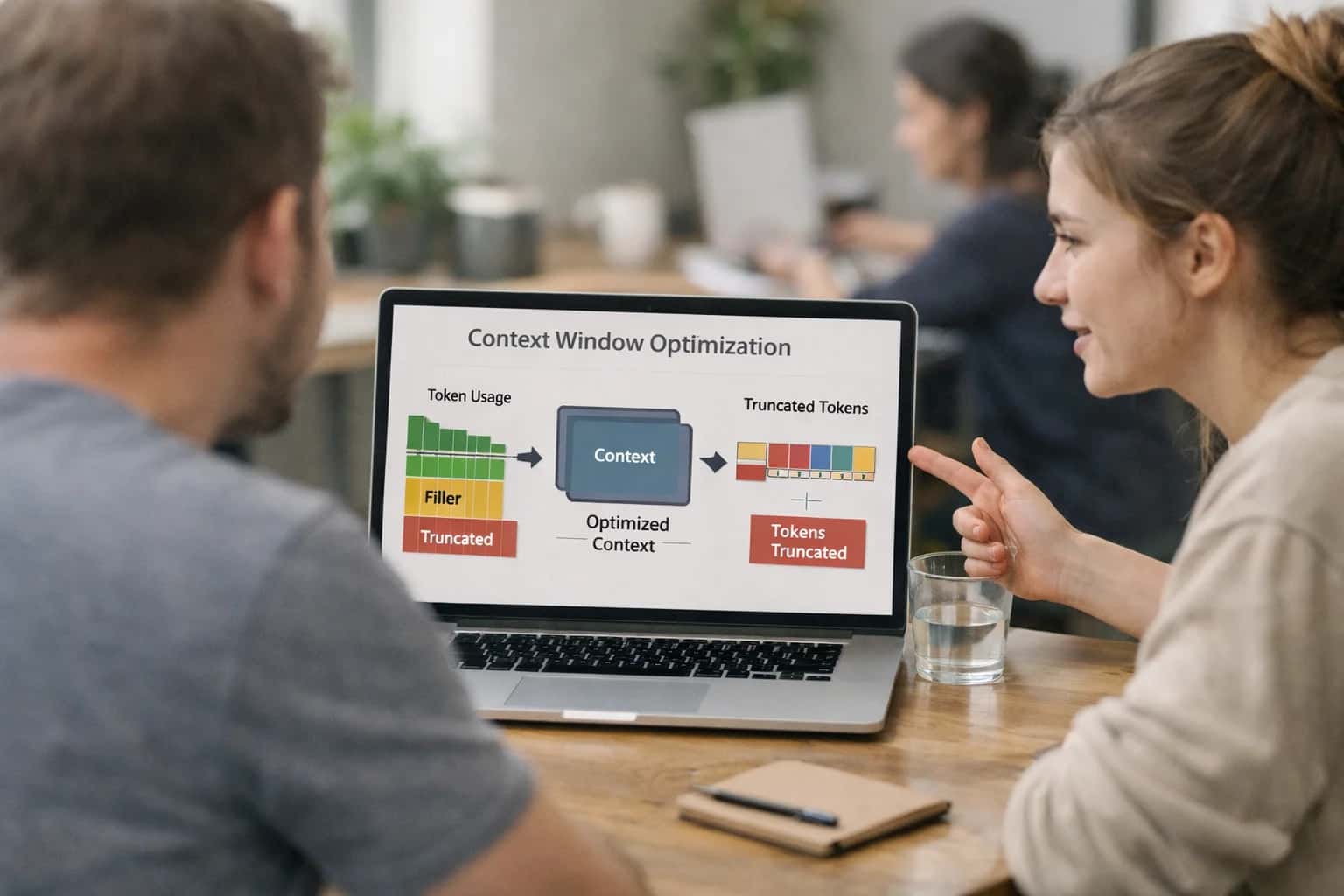
CONTEXT WINDOW MANAGEMENT
What is Dynamic Context?
A runtime-adaptive approach to managing a model's working memory, contrasting with a fixed context window.
This adaptability is achieved through mechanisms like sparse attention patterns, context prioritization algorithms for selective retention, and incremental encoding of streaming inputs. It is a core engineering concern for applications requiring long-form reasoning, real-time dialogue, or processing of unbounded data streams, directly impacting inference latency and the quality of in-context learning. The goal is to maximize information density within the available token budget.
ARCHITECTURAL PATTERNS
Core Mechanisms for Dynamic Context
Dynamic context systems move beyond fixed token limits by employing adaptive architectures that can expand, compress, or selectively focus the model's working memory based on real-time task demands.
01
Sparse Attention Mechanisms
Sparse attention is a class of transformer modifications that reduce the quadratic computational cost of full self-attention by restricting each token to attend only to a strategically chosen subset of other tokens. This enables models to process sequences far longer than their standard training context.
- Key Patterns: Sliding window attention (local context), dilated attention (skip connections), and block-sparse patterns.
- Real-World Impact: Models like Longformer and BigBird use these patterns to handle documents of 4,096+ tokens efficiently, enabling tasks like long-document QA and summarization.
02
Recurrent Memory Networks
These architectures integrate a recurrent neural network (RNN) or a recurrent controller with a transformer to maintain a compressed, evolving state across segments of a long sequence. The transformer processes local context windows, while the recurrent module summarizes and carries forward crucial long-range dependencies.
- How it Works: The RNN's hidden state acts as a dynamic memory bank, updated with each segment and provided as additional context to the transformer.
- Example: The Transformer-XL architecture uses a segment-level recurrence mechanism, allowing it to learn dependencies that span thousands of tokens.
03
Hierarchical Chunk Processing
This mechanism breaks a long input into hierarchical chunks (e.g., sentences, paragraphs, sections) and processes them in a bottom-up or top-down manner. A higher-level model or attention layer then integrates summaries or embeddings from these chunks to form a coherent understanding of the whole.
- Process Flow: 1) Encode individual chunks. 2) Aggregate chunk representations via pooling or a second-stage encoder. 3) Use the aggregated context for final reasoning.
- Use Case: Essential for processing legal contracts or scientific papers, where understanding the relationship between sections is critical.
04
Content-Based Retrieval & Gating
Instead of passively holding all recent tokens, these systems use the current query or hidden state to actively retrieve the most relevant information from a larger, external memory store or from earlier parts of a long context. A gating mechanism decides what to bring into the active working context.
- Core Components: A retriever (e.g., a dense vector search) and a gating function (often a small neural network or attention over retrieved items).
- Dynamic Behavior: The effective context shrinks or expands based on retrieval relevance, focusing compute on pertinent information. This is a foundational idea in Memory-Augmented Neural Networks (MANNs).
05
Adaptive Computation Time
This mechanism allows the model to dynamically allocate more processing power (e.g., more transformer layers or more attention steps) to difficult or information-dense parts of the input sequence. The model learns to decide where and for how long to compute.
- Technical Implementation: Often involves a halting probability or a ponder cost that the model optimizes during training.
- Benefit: It creates a dynamic context in the computational dimension, spending more latent "thinking" effort on complex context segments, leading to more efficient inference.
06
Learned Token Pruning & Compression
These systems employ auxiliary models or learned scoring functions to evaluate the utility of each token in the context window. Low-scoring, redundant, or irrelevant tokens are pruned or merged in real-time, freeing up space for new information.
- Methods: Token dropping (removing low-attention tokens), token merging (fusing similar token embeddings), and learned summarization modules.
- Result: The context window's informational density is increased dynamically, effectively extending its capacity without changing the underlying architecture's hard token limit.
CONTEXT WINDOW MANAGEMENT
How Dynamic Context Systems Work
Dynamic context systems enable models to adaptively manage their working memory, moving beyond the constraints of a fixed token limit.
Dynamic context is a model architecture or system design where the effective size and content of the context window can adapt at runtime based on the input's complexity or the task's requirements. Unlike a static token limit, these systems use mechanisms like context compression, context eviction, and context prioritization to intelligently manage which information is retained, updated, or discarded. This allows for more efficient handling of long documents or extended multi-turn conversations without catastrophic information loss from simple truncation.
Core implementations often involve a KV cache manager that selectively prunes or summarizes cached key-value vectors, or an external memory-augmented network that provides a scalable, queryable store. Techniques like sliding window attention and incremental encoding enable processing of sequences longer than the model's native training context. The goal is to maximize information density and context freshness, dynamically allocating the limited 'working memory' to the most relevant tokens for the current reasoning step.
DYNAMIC CONTEXT
Primary Use Cases & Applications
Dynamic context systems enable models to adapt their effective working memory at runtime. This flexibility is critical for applications where input length, information relevance, or task complexity is highly variable.
01
Long-Form Document Analysis
Enables processing of books, legal contracts, or technical manuals by dynamically loading relevant sections into the active context. This overcomes fixed token limits by treating the document as a stream and using attention mechanisms or a retrieval system to focus on pertinent passages.
- Example: Analyzing a 200-page regulatory document by loading only the chapters relevant to a specific query.
- Mechanism: Often paired with a vector database for semantic retrieval of document chunks.
02
Extended Conversational Agents
Powers chatbots and virtual assistants that maintain coherent dialogue over hundreds of turns. Instead of a fixed rolling window, dynamic context systems can selectively retain key pieces of information (e.g., user preferences, stated goals) while summarizing or evicting less relevant conversational history.
- Benefit: Maintains long-term coherence and user intent without proportionally increasing compute cost.
- Technique: Uses attention sinks or context summarization to preserve critical tokens from early in the conversation.
03
Real-Time Data Stream Processing
Critical for applications monitoring live feeds like financial tickers, sensor telemetry, or social media. The system implements a streaming context window that continuously ingests new data points while dynamically evicting stale or low-priority information based on recency or anomaly scores.
- Use Case: A trading bot analyzing the last hour of high-volatility market data while retaining a compressed summary of the day's trend.
- Architecture: Relies on incremental encoding and efficient KV cache management for low-latency updates.
04
Multi-Tool Agentic Workflows
Supports autonomous agents that execute complex, multi-step plans involving numerous API calls. Each step (tool result, observation) adds to the context. Dynamic context prunes intermediate reasoning or compresses previous results to prevent the context from being filled with procedural details, reserving space for new actions and critical state.
- Example: An agent booking travel may compress the results of hotel searches after a selection is made, keeping the itinerary and next steps active.
- Framework: Integral to ReAct (Reasoning and Acting) and hierarchical planning architectures.
05
Interactive Code Generation & Debugging
Assists developers by managing the context of an entire codebase during an editing session. The system dynamically loads relevant files, function definitions, and error traces into the model's context based on the developer's active file and cursor position, simulating an IDE's awareness.
- Process: As a developer asks a question about a function, the system retrieves its definition, call sites, and related documentation into the active window.
- Enabler: Uses semantic search and symbolic parsing to understand code structure and dependencies.
06
Personalized Content Recommendation
Drives hyper-personalized experiences by dynamically constructing a context window from a user's historical interactions, profile, and real-time behavior. Instead of a static prompt, the system assembles a unique, task-specific context for each inference call.
- Application: A news app compiling a context from the user's read articles, clicked topics, and current session to generate a personalized digest.
- Core Tech: Leverages vector similarity search and metadata filtering for rapid context assembly from a user memory store.
CONTEXT WINDOW MANAGEMENT
Static Context vs. Dynamic Context
A comparison of two fundamental approaches to managing the information a language model can access during a single inference call.
| Feature | Static Context | Dynamic Context |
|---|---|---|
Core Definition | A fixed, immutable set of tokens provided at the start of generation that the model cannot modify. | An adaptive context where the content, size, or focus can change during runtime based on the model's intermediate outputs or external triggers. |
Context Window Size | Fixed for the duration of the call. Determined solely by the initial prompt length. | Can be variable. May expand, contract, or shift focus via mechanisms like retrieval, summarization, or agentic loops. |
Information Flow | Unidirectional (Input -> Output). All relevant information must be pre-loaded. | Bidirectional or cyclic. The model's output can trigger updates to its own context (e.g., via tool calls, ReAct). |
Architectural Paradigm | Standard transformer inference with a pre-computed KV cache. | Augmented with external systems like vector databases, summarizers, or orchestration frameworks that modify the active context. |
Primary Use Case | Single-turn tasks, straightforward Q&A, and generation where all parameters are known upfront. | Multi-step reasoning, agentic workflows, long-form interaction, and tasks requiring real-time information retrieval. |
Token Efficiency | Can be inefficient if the full context is not utilized throughout the task. | Aims for higher efficiency by fetching or retaining only contextually relevant information as needed. |
Implementation Complexity | Low. Handled natively by model APIs. | High. Requires custom pipelines for retrieval, cache management, and context update logic. |
Example Systems | Basic chat completion, simple text summarization. | Retrieval-Augmented Generation (RAG) agents, ReAct frameworks, systems using the Model Context Protocol (MCP). |
DYNAMIC CONTEXT
Frequently Asked Questions
Dynamic context refers to advanced techniques and model architectures that allow the effective working memory of an AI system to adapt in real-time. This FAQ addresses how these systems manage information beyond fixed token limits.
Dynamic context is a system capability where the effective size or the specific information retained within a model's working memory can adapt at runtime based on the input, task, or a learned policy. Unlike a fixed context window—a rigid, pre-defined token limit like 128K—dynamic context systems can prioritize, compress, or selectively recall information, creating a more flexible and efficient memory footprint.
Key differentiators:
- Fixed Context: All tokens within the window are treated uniformly for attention; old information is lost once the window slides or is truncated.
- Dynamic Context: The system can implement policies like context summarization, selective retention of key entities, or on-demand retrieval from an external memory, making the 'active' context a function of the query rather than a static buffer.
Enabling Efficiency, Speed & Accuracy
Intelligent Analysis, Decision & Execution
We build AI systems for teams that need search across company data, workflow automation across tools, or AI features inside products and internal software.
Talk to Us
Search across company data
Give teams answers from docs, tickets, runbooks, and product data with sources and permissions.
Useful when people spend too long searching or get different answers from different systems.
Enterprise searchRAGPermissions
Read more
Automate internal workflows
Use AI to route work, draft outputs, trigger actions, and keep approvals and logs in place.
Useful when repetitive work moves across multiple tools and teams.
AI agentsWorkflow automationGovernance
Read more
Add AI to products and internal tools
Build assistants, guided actions, or decision support into the software your team or customers already use.
Useful when AI needs to be part of the product, not a separate tool.
AI integrationDecision supportModel routing
Read more
About the author
Prasad Kumkar
CEO & MD, Inference Systems
Prasad Kumkar is the CEO & MD of Inference Systems and writes about AI systems architecture, LLM infrastructure, model serving, evaluation, and production deployment. Over 5+ years, he has worked across computer vision models, L5 autonomous vehicle systems, and LLM research, with a focus on taking complex AI ideas into real-world engineering systems.
His work and writing cover AI systems, large language models, AI agents, multimodal systems, autonomous systems, inference optimization, RAG, evaluation, and production AI engineering.
LinkedIn
Limited slotsGet a Free AI Consultation
Partnered with leading AI, data, and software stack.





How We Work
Custom AI workflows for your Business
One-fit-all AI don't work for modern businesses. At Inferensys, we aim to understand your business & custom requirements; which we use to define most efficient agentic workflows, the data, and the tools for your business.
01
Review the use case
We understand the task, the users, and where AI can actually help.
Read more02
Pick the right approach
We define what needs search, automation, or product integration.
Read more03
Build the first useful version
We implement the part that proves the value first.
Read more04
Improve from there
We add the checks and visibility needed to keep it useful.
Read moreThe first call is a practical review of your use case and the right next step.
Talk to Us