A context window is the fixed-size, contiguous block of tokens—the basic units of text like words or subwords—that a transformer-based language model can process in a single forward pass. It represents the model's total working memory for a given interaction, encompassing both the input prompt and the model's generated output. This limit is a fundamental architectural constraint determined during the model's pre-training, governing how much information it can consider at once. Exceeding it requires strategies like context truncation or context chunking.

Glossary
Context Window
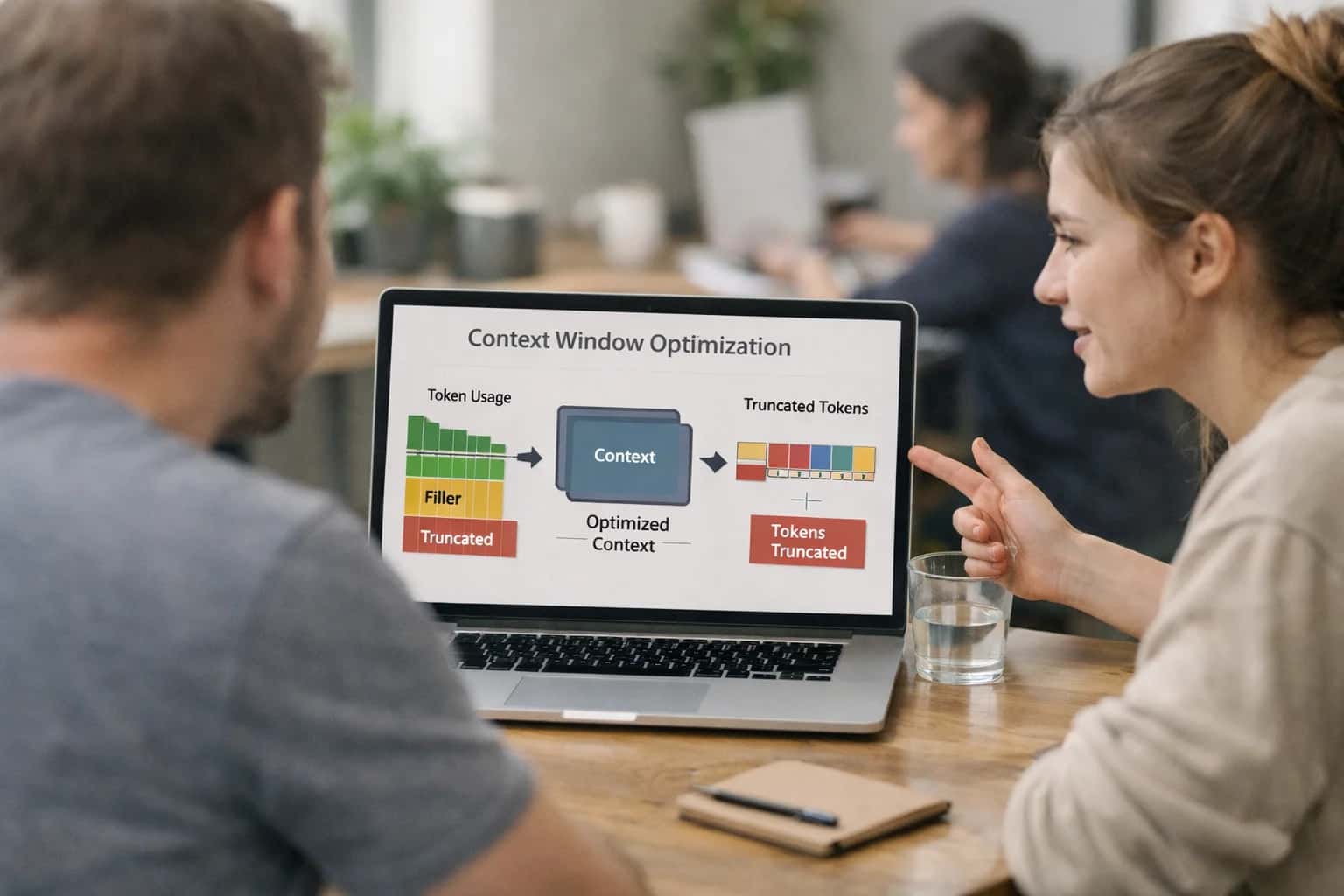
A context window is the fixed-size, contiguous block of tokens that a transformer-based language model can process in a single forward pass, representing its working memory.
AI GLOSSARY
What is a Context Window?
A foundational concept in transformer-based language models defining their operational memory.
The window's size directly impacts a model's ability to handle long documents, maintain coherent multi-turn conversations, and perform in-context learning with many examples. Internally, the self-attention mechanism computes relationships between all tokens within the window, leading to quadratic computational complexity. This drives the need for optimizations like KV caching and sparse attention. Efficiently managing information within this finite space, through techniques like context compression and context prioritization, is a core challenge in deploying models for complex enterprise tasks.
ARCHITECTURAL PRIMER
Key Characteristics of a Context Window
A context window is not a simple input box; it is a core architectural constraint defining a transformer model's working memory. Understanding its properties is essential for efficient system design.
01
Fixed & Contiguous Memory
A context window is a fixed-size, contiguous block of tokens. Unlike a computer's RAM, its size (e.g., 128K tokens) is hardcoded during model training and cannot be dynamically expanded at runtime. All input and generated output tokens must fit within this single, unbroken sequence. This constraint necessitates techniques like context chunking and truncation for processing long documents.
02
Token-Based Accounting
Every character, word, and punctuation mark consumed or produced is counted in tokens, not bytes or words. The context budget is shared between:
- Input (Prompt) Tokens: The user's query, instructions, and provided examples.
- Output (Completion) Tokens: The model's generated response. Exceeding the total limit results in an error. This requires careful token limit management, especially for long conversations or document analysis.
03
Attention as the Governing Mechanism
The context window's contents are processed via the transformer's self-attention mechanism. Each token can attend to all other tokens within the window, allowing the model to establish contextual relationships. However, this attention has a quadratic computational cost (O(n²)) relative to sequence length, which is the fundamental reason for the fixed context limit. Architectures like sparse attention and sliding window attention were invented to mitigate this cost.
04
Stateful via KV Cache
During autoregressive generation, the model maintains a KV Cache (Key-Value Cache) for all previous tokens in the window. This cache stores intermediate computations, allowing the model to generate the next token without re-processing the entire sequence from scratch. Efficient management of this cache is critical for inference speed and handling long contexts, leading to strategies like cache eviction.
05
Information Degradation & Eviction
Not all parts of the context are equally accessible. Models often exhibit positional bias, where information in the middle of a very long context may be less reliably attended to than information at the beginning or end. When the window is full, context eviction policies (e.g., removing the oldest tokens) must be applied, potentially discarding critical information. This makes context prioritization and summarization key engineering challenges.
06
The Core Bottleneck for Long Context Tasks
The fixed context window is the primary bottleneck for applications requiring long-term memory or processing of extensive documents, such as legal review, long-form conversation, or codebase analysis. This has spurred entire subfields like Retrieval-Augmented Generation (RAG) and memory-augmented networks, which use external databases to circumvent the inherent memory limitation of the transformer architecture itself.
MECHANISM
How the Context Window Works Technically
A technical breakdown of the transformer architecture's fixed-size working memory and its operational constraints.
A context window is the fixed-size, contiguous block of tokens a transformer model processes in a single forward pass, functioning as its working memory. This limit is enforced by the self-attention mechanism, which computes relationships between all token pairs, resulting in quadratic computational complexity. The model's positional encodings and the KV cache for autoregressive generation are also fundamentally constrained by this predefined sequence length. Exceeding it requires strategies like context truncation or chunking.
During inference, the KV cache stores computed key and value vectors for previous tokens, allowing efficient generation without recomputation. However, this cache grows linearly with sequence length, consuming GPU memory. Techniques like sliding window attention or sparse attention modify the attention pattern to handle longer sequences efficiently. Context compression methods, such as summarization, aim to preserve semantic information while reducing token count, directly addressing the core technical constraint of the fixed window.
ARCHITECTURAL COMPARISON
Context Window vs. Related Concepts
This table clarifies the distinct technical role of the context window by contrasting it with related architectural components and operational strategies.
| Feature / Concept | Context Window | KV Cache | External Memory (e.g., Vector DB) | Context Compression |
|---|---|---|---|---|
Primary Function | Working memory for a single forward pass | Inference optimization for autoregressive generation | Long-term, persistent storage for retrieval | Token reduction within the active context |
Scope & Lifetime | Fixed-size, per-request/forward-pass | Persists for the duration of a generation session | Persistent across sessions and requests | Applied dynamically within a single context |
Information Capacity | Fixed token limit (e.g., 128K) | Limited by allocated GPU memory | Theoretically unlimited, scalable with storage | Reduces active tokens, capacity remains fixed |
Access Pattern | Full, contiguous sequence attention | Cached computation for previous tokens | Semantic/nearest-neighbor search | Selective retention or summarization |
Key Limitation | Fixed size imposes hard token budget | Memory-bound; requires eviction policies | Latency and potential relevance of retrieval | Risk of information loss or distortion |
Typical Operations | Token ingestion, attention computation | Cache read/update, eviction (e.g., LRU) | Embedding, indexing, similarity search | Summarization, pruning, deduplication |
Architectural Layer | Core transformer model definition | Runtime inference optimization | External system component (RAG) | Pre-processing or in-context strategy |
Determinism | High (fixed, contiguous block) | High (deterministic caching) | Variable (depends on retrieval accuracy) | Variable (algorithm-dependent fidelity) |
GLOSSARY
Context Window Management Techniques
Strategies and algorithms for efficiently utilizing, compressing, and navigating the fixed token memory of transformer-based language models.
01
Context Compression
A set of techniques used to reduce the token footprint of information within the context window while preserving semantic utility. This is critical for fitting more relevant data into a fixed token budget.
Key methods include:
- Summarization: Condensing long passages into concise, information-dense representations.
- Redundancy Elimination: Identifying and removing duplicate or highly similar content.
- Selective Pruning: Algorithmically scoring and removing tokens deemed less critical to the current task.
These techniques are foundational for applications like long-document analysis and multi-turn conversational agents.
02
Context Chunking
The strategy of dividing a long document or input stream into smaller, contiguous segments that fit within the model's context limit for sequential or parallel processing.
Common patterns:
- Sequential Processing: Processing chunks in order, often passing a summary or key context forward.
- Hierarchical Processing: Using a smaller model to summarize chunks before feeding summaries to a larger model.
- Map-Reduce: Processing chunks independently (map) and then combining the results (reduce).
This is a fundamental technique for handling inputs that exceed the native context window, such as legal documents or codebases.
03
KV Cache Management
The optimization of the Key-Value (KV) Cache, a transformer mechanism that stores computed attention vectors to avoid redundant computation during autoregressive generation.
Critical management operations:
- Cache Eviction: Using algorithms like Least-Recently-Used (LRU) to discard parts of the cache when GPU memory is full during long generations.
- Incremental Encoding: Adding new tokens to an existing cache without recomputing the entire sequence, enabling low-latency streaming.
- Cache Compression: Applying quantization or pruning to the KV cache to reduce its memory footprint.
Efficient KV cache management is directly tied to inference speed and the practical length of generated sequences.
04
Sliding Window Attention
A specific sparse attention pattern where each token can only attend to a fixed number of preceding tokens within a local window. This reduces the computational complexity of self-attention from quadratic to linear with respect to sequence length.
Key implications:
- Enables models to process sequences far longer than their training context window (e.g., 1M+ tokens).
- The effective context is dynamic; as the window slides, the model loses access to information outside the local window unless explicitly managed.
- Architectures like Mistral's and Llama's use this to achieve superior long-context performance.
This is a core architectural technique for scaling context without prohibitive compute costs.
05
Context Prioritization & Eviction
The algorithmic scoring and selective removal of information from the context window to make room for new inputs.
Eviction strategies include:
- Time-based (FIFO): Removing the oldest tokens first.
- Importance-based: Using attention scores or a learned scorer to identify and remove low-utility tokens.
- Structured Eviction: Removing entire turns from a conversation history or specific document sections.
Prioritization often works in tandem, ranking system instructions, recent user queries, and retrieved documents to determine what must be retained. This is essential for maintaining context freshness in long-running sessions.
06
Dynamic Context & Streaming
System architectures designed to handle continuous, unbounded input streams by dynamically managing a rolling context window and KV cache.
Core components:
- Streaming Context: A continuously updated buffer of the most recent tokens, often using a sliding window.
- State Management: Persisting condensed state (e.g., vector summaries) between windows to maintain coherence.
- Low-Latency Inference: Leveraging incremental encoding to add tokens without full forward passes.
This paradigm is critical for real-time applications like live transcription, conversational AI, and monitoring systems, where the input has no predefined end.
CONTEXT WINDOW
Frequently Asked Questions
A context window is the fixed-size, contiguous block of tokens that a transformer-based language model can process in a single forward pass, representing its working memory for a given input and output sequence. These questions address its core mechanics, limitations, and optimization strategies.
A context window is the fixed-size, contiguous block of tokens (text fragments) that a transformer-based language model can process in a single forward pass, representing its entire working memory for a given input prompt and generated output. It is a fundamental architectural constraint, not a configurable setting, determined during the model's pre-training phase. The model's self-attention mechanism computes relationships between every pair of tokens within this window, which creates the quadratic computational complexity that necessitates a fixed limit. Exceeding this limit requires strategies like context truncation, chunking, or using models with sparse attention patterns designed for longer sequences.
Enabling Efficiency, Speed & Accuracy
Intelligent Analysis, Decision & Execution
We build AI systems for teams that need search across company data, workflow automation across tools, or AI features inside products and internal software.
Talk to Us
Search across company data
Give teams answers from docs, tickets, runbooks, and product data with sources and permissions.
Useful when people spend too long searching or get different answers from different systems.
Enterprise searchRAGPermissions
Read more
Automate internal workflows
Use AI to route work, draft outputs, trigger actions, and keep approvals and logs in place.
Useful when repetitive work moves across multiple tools and teams.
AI agentsWorkflow automationGovernance
Read more
Add AI to products and internal tools
Build assistants, guided actions, or decision support into the software your team or customers already use.
Useful when AI needs to be part of the product, not a separate tool.
AI integrationDecision supportModel routing
Read more
About the author
Prasad Kumkar
CEO & MD, Inference Systems
Prasad Kumkar is the CEO & MD of Inference Systems and writes about AI systems architecture, LLM infrastructure, model serving, evaluation, and production deployment. Over 5+ years, he has worked across computer vision models, L5 autonomous vehicle systems, and LLM research, with a focus on taking complex AI ideas into real-world engineering systems.
His work and writing cover AI systems, large language models, AI agents, multimodal systems, autonomous systems, inference optimization, RAG, evaluation, and production AI engineering.
LinkedIn
Limited slotsGet a Free AI Consultation
Partnered with leading AI, data, and software stack.





How We Work
Custom AI workflows for your Business
One-fit-all AI don't work for modern businesses. At Inferensys, we aim to understand your business & custom requirements; which we use to define most efficient agentic workflows, the data, and the tools for your business.
01
Review the use case
We understand the task, the users, and where AI can actually help.
Read more02
Pick the right approach
We define what needs search, automation, or product integration.
Read more03
Build the first useful version
We implement the part that proves the value first.
Read more04
Improve from there
We add the checks and visibility needed to keep it useful.
Read moreThe first call is a practical review of your use case and the right next step.
Talk to Us