Context vectorization is the process of converting the entire informational content within a model's context window into a single, dense numerical vector (an embedding). This compressed representation captures the semantic essence of the context, enabling efficient retrieval, caching, and similarity comparison for tasks like semantic search or contextual memory in agentic systems. It transforms sequential token data into a fixed-dimensional latent space.

Glossary
Context Vectorization
Context vectorization is the process of converting the information within a language model's context window into a dense, numerical vector representation for retrieval, caching, or similarity comparison.
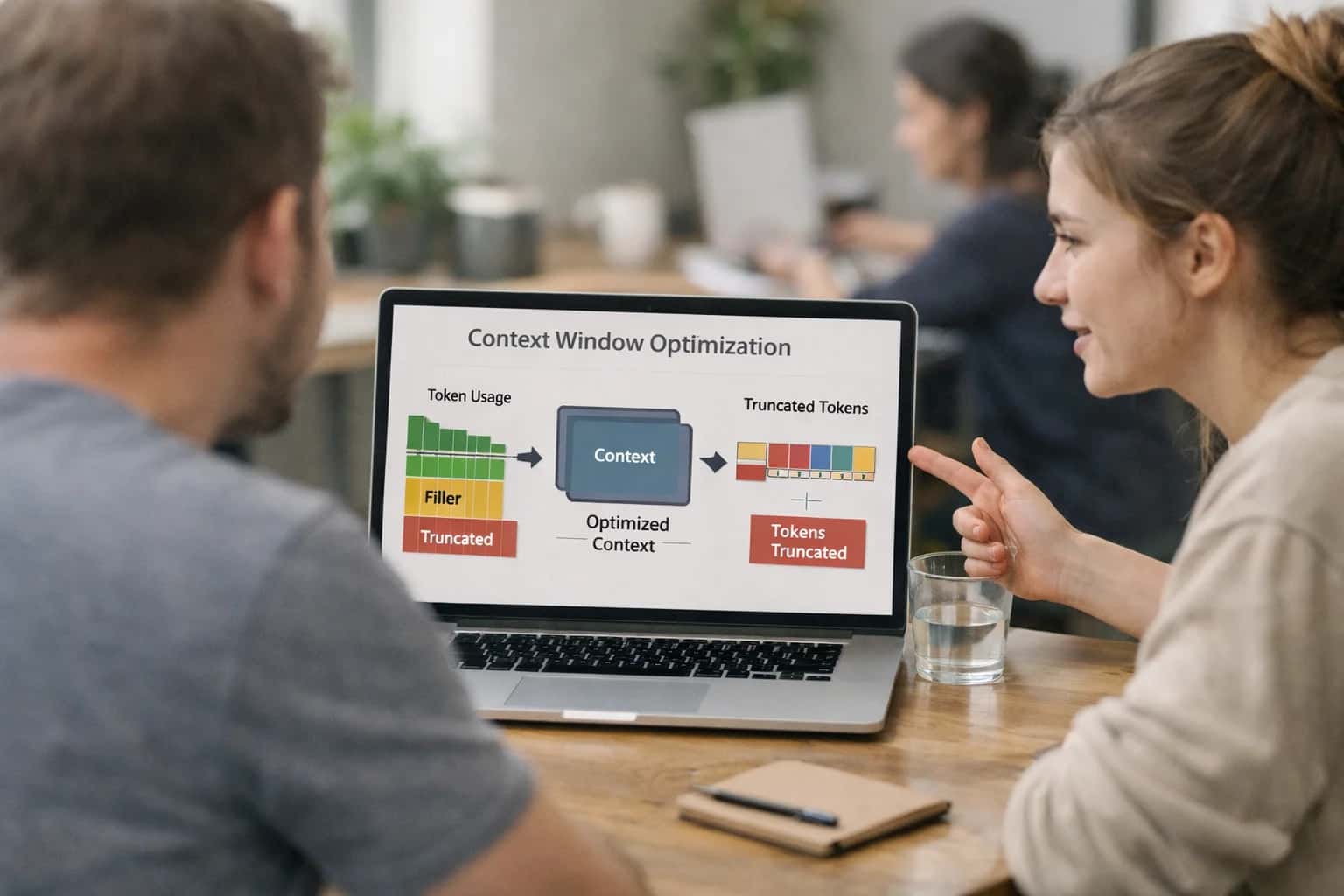
CONTEXT WINDOW MANAGEMENT
What is Context Vectorization?
A core technique for managing the limited working memory of large language models.
This technique is fundamental for architectures that need to reference or compare different context states without reprocessing the full token sequence. It enables operations like caching conversational history as vectors or rapidly finding relevant past contexts via vector similarity search, which is more efficient than token-by-token comparison. It is a key enabler for long-context management and retrieval-augmented generation (RAG) systems that operate over vast corpora.
CORE USE CASES
Key Applications of Context Vectorization
Context vectorization transforms a model's active context into a dense vector for efficient storage, retrieval, and comparison. This enables advanced systems that move beyond the limitations of a single forward pass.
01
Semantic Caching for Inference
Context vectorization enables semantic caching, where the vector representation of an input query and its context is compared against a cache of previous interactions. If a semantically similar query is found, the stored output can be returned, bypassing a full model inference and reducing latency and cost by up to 90% for repetitive queries. This is critical for high-traffic applications like chatbots and search APIs.
- Key Mechanism: Uses vector similarity (e.g., cosine similarity) on context embeddings.
- Benefit: Dramatically reduces compute costs for common user intents.
- Challenge: Requires careful tuning of similarity thresholds to balance cache hits with response accuracy.
02
Long-Term Memory for Autonomous Agents
In agentic architectures, context vectorization is the foundation for long-term memory. The agent's current state, observations, and plan are periodically vectorized and stored in a vector database. When the agent needs relevant past experiences, it performs a similarity search over these stored context vectors to retrieve and inject the most pertinent memories into its active context window. This creates continuity across sessions and enables learning from history.
- Key Mechanism: Creates episodic memory traces as vectors for later retrieval-augmented generation (RAG).
- Benefit: Allows agents to operate over time horizons far exceeding a single model's context limit.
- Example: A customer service agent recalling a user's issue from a previous conversation.
03
Contextual Similarity for RAG
Beyond document retrieval, context vectorization enables contextual similarity search within Retrieval-Augmented Generation (RAG) pipelines. The entire conversation history or task context is vectorized and used as the query to find the most relevant document chunks. This ensures retrieved information is relevant not just to the last user message, but to the entire dialogue or problem-solving context, significantly improving answer quality.
- Key Mechanism: Uses the full dialogue embedding, not just the last utterance, as a retrieval query.
- Benefit: Reduces hallucination by grounding generation in contextually relevant facts.
- Contrast: More sophisticated than simple term-matching or standalone query embedding.
04
State Compression for Tool Orchestration
In complex, multi-step workflows involving tool calling and API execution, the agent's state (past actions, results, goals) can grow beyond the context limit. Context vectorization compresses this operational history into a dense summary vector. This vector can be stored efficiently and later decompressed (via a prompt to the model) to resume a task after an interruption or to provide continuity between different specialized agents in a workflow.
- Key Mechanism: Encodes the state of a running process for checkpointing and resumption.
- Benefit: Enables reliable execution of long-horizon tasks that require many tool calls.
- Use Case: Resuming a data analysis pipeline after a system reboot.
05
Training Data Deduplication & Clustering
During dataset preparation for fine-tuning or evaluation, context vectorization is used to identify and remove near-duplicate training examples or to cluster similar instruction-response pairs. By vectorizing each example's context (instruction + few-shot examples + expected output), duplicates can be found based on semantic similarity rather than exact string matching, leading to more diverse and higher-quality training data.
- Key Mechanism: Applies clustering algorithms (e.g., K-means) on context embeddings.
- Benefit: Improves model generalization by reducing dataset redundancy.
- Impact: Directly influences the efficiency of Parameter-Efficient Fine-Tuning (PEFT).
06
Anomaly Detection in Model Interactions
By vectorizing the context of model inputs and outputs in production, organizations can monitor for behavioral anomalies. A drift in the distribution of context vectors over time can signal changes in user behavior, emerging attack patterns like prompt injection, or model degradation. This provides a powerful signal for AI observability platforms beyond simple output logging.
- Key Mechanism: Establishes a baseline distribution of normal context vectors and flags statistical outliers.
- Benefit: Enables proactive detection of adversarial attacks or unexpected model use.
- Integration: A core component of Agentic Observability and Telemetry pillars.
COMPARISON
Context Vectorization vs. Other Context Management Techniques
A technical comparison of methods for managing information within a model's finite context window, focusing on mechanisms, trade-offs, and primary use cases.
| Feature / Mechanism | Context Vectorization | Context Compression (e.g., Summarization) | Context Chunking | Context Truncation |
|---|---|---|---|---|
Core Mechanism | Encodes context into a dense numerical vector (embedding). | Algorithmically condenses text to preserve semantic meaning with fewer tokens. | Divides long input into fixed-size segments for sequential processing. | Removes tokens from the start/end of the sequence to meet a token limit. |
Information Retention | High-dimensional semantic representation; original token sequence is lost. | Attempts to preserve key information; fidelity loss is inevitable. | Preserves all original information but scatters it across chunks. | Discards information outright from the removed section. |
Primary Use Case | Semantic search, retrieval, caching, and similarity comparison. | Freeing up token budget within a single, continuous context window. | Processing documents longer than the context limit (e.g., QA, analysis). | Enforcing hard token limits for API calls; a baseline fallback. |
Computational Overhead | High (requires a forward pass through an encoder model). | High (requires a model call to generate the summary). | Low (simple text splitting). | Negligible. |
State Management | External vector store; context is statically captured. | Active context window; summary must be regenerated as context evolves. | Requires orchestration logic to manage chunk flow and aggregate results. | Active context window; operation is destructive and one-way. |
Cross-Reference Capability | True (enables similarity search across vast, external corpora). | Limited to the condensed content within the current window. | Limited; requires explicit logic to pass information between chunks. | None; truncated information is permanently unavailable. |
Real-time Viability | Lower (best for offline indexing and retrieval). | Medium (summary generation introduces latency). | High for processing; medium for tasks requiring cross-chunk context. | High. |
Typical Fidelity Loss | Lossy (abstract representation). | Lossy (summarization artifacts). | Lossless within chunks; lossy for cross-chunk relationships. | Complete loss of evicted tokens. |
CONTEXT VECTORIZATION
Frequently Asked Questions
Context vectorization is a core technique for managing information within a model's fixed memory. This FAQ addresses common technical questions about its mechanisms, applications, and relationship to other context management strategies.
Context vectorization is the process of converting the entire informational content of a model's active context window into a single, dense, fixed-dimensional vector representation. It works by using a secondary neural network, often called an encoder or a context encoder, to process the sequence of token embeddings (and often their positional information) and produce a condensed context vector. This vector aims to capture the salient semantic and task-relevant features of the context in a form suitable for retrieval, caching, or as an initial state for further processing. The process is distinct from per-token embeddings, as it generates a holistic representation of the entire input segment.
Enabling Efficiency, Speed & Accuracy
Intelligent Analysis, Decision & Execution
We build AI systems for teams that need search across company data, workflow automation across tools, or AI features inside products and internal software.
Talk to Us
Search across company data
Give teams answers from docs, tickets, runbooks, and product data with sources and permissions.
Useful when people spend too long searching or get different answers from different systems.
Enterprise searchRAGPermissions
Read more
Automate internal workflows
Use AI to route work, draft outputs, trigger actions, and keep approvals and logs in place.
Useful when repetitive work moves across multiple tools and teams.
AI agentsWorkflow automationGovernance
Read more
Add AI to products and internal tools
Build assistants, guided actions, or decision support into the software your team or customers already use.
Useful when AI needs to be part of the product, not a separate tool.
AI integrationDecision supportModel routing
Read more
About the author
Prasad Kumkar
CEO & MD, Inference Systems
Prasad Kumkar is the CEO & MD of Inference Systems and writes about AI systems architecture, LLM infrastructure, model serving, evaluation, and production deployment. Over 5+ years, he has worked across computer vision models, L5 autonomous vehicle systems, and LLM research, with a focus on taking complex AI ideas into real-world engineering systems.
His work and writing cover AI systems, large language models, AI agents, multimodal systems, autonomous systems, inference optimization, RAG, evaluation, and production AI engineering.
LinkedIn
Limited slotsGet a Free AI Consultation
Partnered with leading AI, data, and software stack.





How We Work
Custom AI workflows for your Business
One-fit-all AI don't work for modern businesses. At Inferensys, we aim to understand your business & custom requirements; which we use to define most efficient agentic workflows, the data, and the tools for your business.
01
Review the use case
We understand the task, the users, and where AI can actually help.
Read more02
Pick the right approach
We define what needs search, automation, or product integration.
Read more03
Build the first useful version
We implement the part that proves the value first.
Read more04
Improve from there
We add the checks and visibility needed to keep it useful.
Read moreThe first call is a practical review of your use case and the right next step.
Talk to Us