Context summarization is the algorithmic process of condensing a long passage of text within a language model's context window into a shorter, information-dense representation to free up token budget for new inputs. It is a critical context compression technique used to manage the fixed token limit of transformer models, enabling them to handle longer conversations or documents by replacing verbose history with a concise summary. This process directly combats context truncation by preserving semantic utility while reducing token count.

Glossary
Context Summarization
Context summarization is the process of algorithmically condensing a long passage of text within a model's context into a shorter, information-dense representation to free up token budget for new inputs.
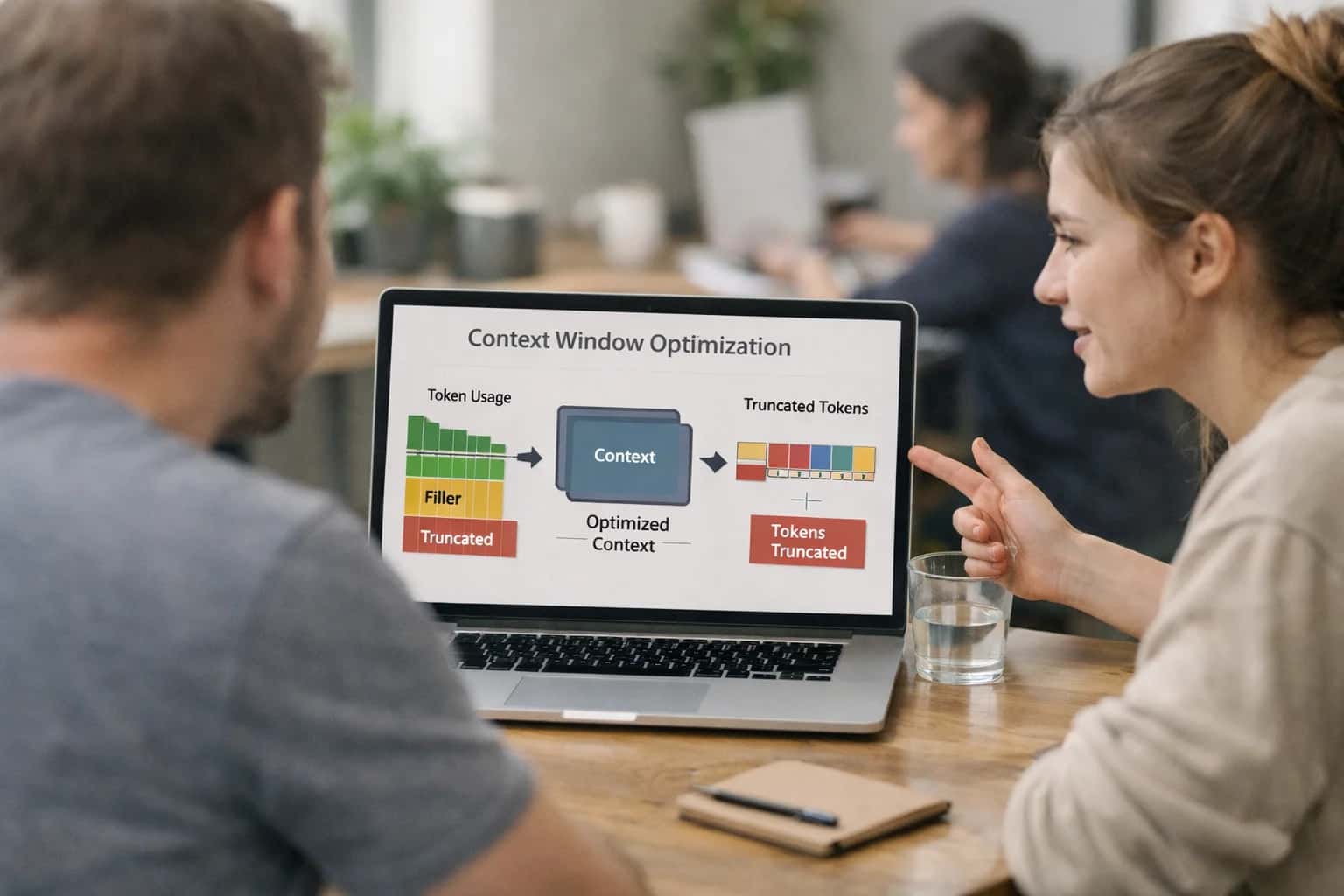
CONTEXT WINDOW MANAGEMENT
What is Context Summarization?
Context summarization is a core technique in context window management for algorithmically condensing long text passages into shorter, information-dense representations.
The technique operates by analyzing the existing context window to extract key entities, relationships, and narrative intent, then generating a new, condensed prompt segment. Effective summarization must balance information density with factual fidelity to avoid hallucination. It is often used in tandem with context eviction policies and context chunking for processing extensive documents. This allows systems to maintain context freshness and relevance over extended interactions without exceeding model constraints.
CONTEXT WINDOW MANAGEMENT
Key Techniques for Context Summarization
Context summarization is the process of algorithmically condensing a long passage of text within a model's context into a shorter, information-dense representation to free up token budget for new inputs. These are the primary technical methodologies used to achieve this compression.
01
Extractive Summarization
Extractive summarization creates a summary by selecting and concatenating the most important sentences or phrases verbatim from the source text. It relies on algorithms to score and rank sentences based on features like:
- Term frequency-inverse document frequency (TF-IDF) for keyword significance.
- Sentence position (e.g., first/last sentences often contain key points).
- Lexical centrality within a semantic graph of sentences. This method preserves factual accuracy and original phrasing but can produce less fluent or cohesive summaries. It is computationally efficient and forms the basis for many early-stage compression systems before more advanced abstractive techniques are applied.
02
Abstractive Summarization
Abstractive summarization generates a novel, condensed representation that paraphrases and synthesizes the core ideas of the source text, often using new words and sentence structures not present in the original. Modern implementations leverage sequence-to-sequence transformer models (e.g., T5, BART) fine-tuned on summarization datasets. This technique:
- Can produce more concise, human-like summaries.
- Requires significant computational resources for training and inference.
- Introduces risk of hallucination if the model fabricates unsupported details. It is the dominant approach in state-of-the-art systems where fluency and compression ratio are prioritized, though it requires careful validation of output fidelity.
03
Query-Focused Summarization
Query-focused summarization tailors the condensed output to answer a specific user query or information need, rather than providing a generic summary. The technique involves:
- Joint encoding of the source document and the query.
- Attention mechanisms that bias the model's focus toward query-relevant passages.
- Relevance scoring to filter and prioritize context segments. This is critical for Retrieval-Augmented Generation (RAG) pipelines, where a retrieved document chunk must be summarized in the context of the user's question before being passed to the LLM. It maximizes the utility of the limited context window for task-specific reasoning.
04
Incremental & Rolling Summarization
Incremental summarization maintains a running summary that is updated as new text arrives in a stream, essential for long conversations or live documents. Rolling summarization is a specific pattern where the context window acts as a sliding buffer; as new tokens are added, the oldest summarized content is evicted. Key mechanisms include:
- Stateful summarization models that update a summary vector.
- Hierarchical approaches that summarize local chunks before integrating them into a global summary.
- Cache management policies determining what summarized information to retain or discard. This technique is foundational for applications like multi-turn AI assistants and real-time analytics over continuous data feeds.
05
Selective Context Pruning (Token-Level)
Selective context pruning operates at the token level, removing tokens deemed less important based on learned attention scores or heuristic rules to free up space, rather than generating a natural language summary. Methods include:
- Attention-based scoring: Tokens receiving lower aggregate attention across layers or heads are candidates for removal.
- Gradient-based importance: Using gradients from a downstream task to identify and retain critical tokens.
- Learned token gating: A small auxiliary network predicts which tokens to keep. This is a lossy compression technique that preserves the original format of remaining tokens. It is extremely fast and integrates directly with the transformer's KV Cache, but can disrupt syntactic coherence if applied aggressively.
06
Density-Based Prompt Compression
Density-based prompt compression focuses on maximizing the information density of the context by removing redundancy and verbose language, often guided by the prompt itself. It combines extractive and abstractive techniques with a focus on the prompt's instructional segments. Common strategies are:
- Instruction shortening: Rewriting verbose system prompts into their most concise form while preserving semantic intent.
- Example pruning: Selecting the most informative few-shot examples or removing redundant ones.
- Semantic deduplication: Using embeddings to identify and merge similar concepts expressed in different words. This technique is a core component of prompt optimization, directly reducing token consumption without altering the fundamental task specification.
CONTEXT WINDOW MANAGEMENT
How Context Summarization Works in AI Systems
A technical overview of the algorithms and strategies used to condense information within a model's fixed context window.
Context summarization is the algorithmic process of condensing a long passage of text within a model's context window into a shorter, information-dense representation to free up token budget for new inputs. It is a core context compression technique within context window management, directly addressing the fixed token limit of transformer-based models. The goal is to preserve the most semantically critical information while discarding redundancy, enabling extended dialogues or document analysis without exceeding the model's working memory.
Common implementations include extractive summarization, which selects and concatenates key sentences, and more advanced abstractive summarization, where a model generates a concise paraphrase. These summaries are then strategically re-injected into the context, often replacing older content via context eviction. Effective summarization requires context prioritization to score information relevance and is fundamental to architectures handling streaming context or long documents via a context sliding window.
APPLICATION DOMAINS
Primary Use Cases for Context Summarization
Context summarization is not a monolithic technique but a foundational capability applied across diverse AI workflows. Its primary function is to algorithmically condense long-form information into a dense, utility-preserving representation, directly addressing the fixed-token constraints of transformer models.
01
Long-Form Document Analysis
Enables comprehensive reasoning over documents exceeding a model's native context limit, such as legal contracts, research papers, or technical manuals. The process involves:
- Chunking the source material into context-sized segments.
- Generating a summary vector or condensed narrative for each chunk.
- Using these summaries as a compressed representation for final cross-document querying or synthesis. This allows models to answer questions about a 200-page document without ever having the full text in context simultaneously.
02
Multi-Turn Conversation Memory
Maintains coherence in extended dialogues with AI assistants by preventing context window overflow. Instead of retaining every past exchange verbatim, the system:
- Periodically summarizes the conversation history into a concise narrative.
- Evicts old, verbatim turns while injecting the summary to preserve key facts, user intent, and decisions.
- This creates a rolling context window where the most recent interactions are detailed, and the broader history is compressed, enabling sessions that can last for thousands of turns without performance degradation.
03
Retrieval-Augmented Generation (RAG) Pre-processing
Optimizes the information density of retrieved documents before they are injected into the model's context. When a retrieval system fetches multiple relevant documents, they often contain filler text and redundancy. Summarization acts as a filtering and compression layer:
- Each retrieved document is condensed to its core factual claims or relevant passages.
- This reduces token consumption, allowing more source documents to fit within the context budget.
- It also reduces noise, minimizing the chance the model is distracted by irrelevant details, which improves answer precision and reduces hallucination.
04
Agentic Workflow State Management
Allows autonomous agents to operate over long horizons by maintaining a condensed log of actions, observations, and results. In complex, multi-step tasks, an agent's plan and execution history can quickly exhaust context. Summarization provides episodic memory:
- After completing a sub-task (e.g., 'analyzed dataset X'), the agent summarizes its actions, findings, and any errors.
- This summary becomes a persistent state token within the context, replacing the verbose step-by-step log.
- The agent can then reference this compressed history for planning subsequent steps, enabling it to tackle problems requiring hundreds of discrete actions.
05
Real-Time Data Stream Monitoring
Enables continuous analysis of high-volume telemetry, log, or market data feeds. Instead of processing every raw data point, a summarization model maintains a dynamic, rolling summary of trends, anomalies, and aggregate statistics.
- Incremental summarization updates the context with a condensed view of each new time window.
- This allows a language model to answer analytical questions (e.g., 'What was the system's behavior in the last hour?') based on the summary rather than gigabytes of raw data.
- It effectively turns a streaming data problem into a manageable context window problem.
06
Codebase Comprehension and Navigation
Assists developers in understanding large, unfamiliar code repositories. When a developer asks a question about a codebase, the system:
- Retrieves relevant files, classes, and function definitions.
- Applies semantic code summarization to generate concise, natural language descriptions of each code unit's purpose and key logic.
- Injects these summaries, rather than the full source code, into the model's context. This allows the AI to reason about architectural patterns and cross-file dependencies without hitting token limits, enabling effective queries like 'How does the authentication flow work?' across dozens of files.
COMPARISON
Context Summarization vs. Other Compression Methods
A technical comparison of algorithmic approaches for reducing the token footprint of information within a model's fixed context window.
| Feature / Metric | Context Summarization | Context Truncation | Context Eviction | Redundancy Elimination |
|---|---|---|---|---|
Core Mechanism | Generates a condensed, abstractive summary of the original content. | Removes tokens from the beginning or end of the sequence. | Selectively removes tokens from the middle or earliest parts of the sequence. | Identifies and removes duplicate or highly similar phrases or sentences. |
Information Fidelity | High (semantic intent preserved) | Low (information is permanently lost) | Variable (depends on eviction policy) | Medium (removes repetition, preserves unique info) |
Computational Overhead | High (requires a model inference pass) | None (simple string operation) | Low (requires scoring heuristics) | Medium (requires similarity scoring) |
Typical Latency Added | 100-500 ms | < 1 ms | 1-10 ms | 10-50 ms |
Preserves Narrative Flow | ||||
Use Case Example | Condensing a long meeting transcript for a follow-up query. | Enforcing a hard API token limit on a single user message. | Making space in a long conversation by removing old turns. | Cleaning a document with repeated legal boilerplate. |
Primary Risk | Introduction of summarization bias or error. | Loss of critical introductory or concluding context. | Removal of key factual details referenced later. | Over-aggressive removal of stylistically similar but distinct info. |
Optimal for Sequences Longer Than | 2x context window | 1x context window | 1.5x context window | Any length with high repetition |
CONTEXT SUMMARIZATION
Frequently Asked Questions
Context summarization is a core technique for managing the finite context window of large language models. These questions address its mechanisms, applications, and how it differs from related compression strategies.
Context summarization is the process of algorithmically condensing a long passage of text within a model's context window into a shorter, information-dense representation to free up token budget for new inputs. It works by using the language model itself, or a dedicated summarization model, to process the existing context and generate a concise summary that captures the core semantic content, key entities, and relationships. This summary then replaces the original, verbose text in the context window, allowing the conversation or task to continue with a preserved understanding of prior information. The technique is crucial for long-dialog sessions, document analysis, and multi-step agentic workflows where the complete history exceeds the model's token limit.
Enabling Efficiency, Speed & Accuracy
Intelligent Analysis, Decision & Execution
We build AI systems for teams that need search across company data, workflow automation across tools, or AI features inside products and internal software.
Talk to Us
Search across company data
Give teams answers from docs, tickets, runbooks, and product data with sources and permissions.
Useful when people spend too long searching or get different answers from different systems.
Enterprise searchRAGPermissions
Read more
Automate internal workflows
Use AI to route work, draft outputs, trigger actions, and keep approvals and logs in place.
Useful when repetitive work moves across multiple tools and teams.
AI agentsWorkflow automationGovernance
Read more
Add AI to products and internal tools
Build assistants, guided actions, or decision support into the software your team or customers already use.
Useful when AI needs to be part of the product, not a separate tool.
AI integrationDecision supportModel routing
Read more
About the author
Prasad Kumkar
CEO & MD, Inference Systems
Prasad Kumkar is the CEO & MD of Inference Systems and writes about AI systems architecture, LLM infrastructure, model serving, evaluation, and production deployment. Over 5+ years, he has worked across computer vision models, L5 autonomous vehicle systems, and LLM research, with a focus on taking complex AI ideas into real-world engineering systems.
His work and writing cover AI systems, large language models, AI agents, multimodal systems, autonomous systems, inference optimization, RAG, evaluation, and production AI engineering.
LinkedIn
Limited slotsGet a Free AI Consultation
Partnered with leading AI, data, and software stack.





How We Work
Custom AI workflows for your Business
One-fit-all AI don't work for modern businesses. At Inferensys, we aim to understand your business & custom requirements; which we use to define most efficient agentic workflows, the data, and the tools for your business.
01
Review the use case
We understand the task, the users, and where AI can actually help.
Read more02
Pick the right approach
We define what needs search, automation, or product integration.
Read more03
Build the first useful version
We implement the part that proves the value first.
Read more04
Improve from there
We add the checks and visibility needed to keep it useful.
Read moreThe first call is a practical review of your use case and the right next step.
Talk to Us