Context prioritization is the algorithmic scoring and ranking of information within a model's context window to determine which elements are most critical to retain during compression or eviction operations. It is a strategic component of context window management, enabling efficient use of a model's finite working memory by dynamically identifying high-utility content, such as core instructions or recent dialogue turns, while deprioritizing redundant or tangential information. This process is essential for maintaining task performance in long-context interactions.

Glossary
Context Prioritization
Context prioritization is the algorithmic scoring and ranking of information within a model's context window to determine which elements are most critical to retain during compression or eviction operations.
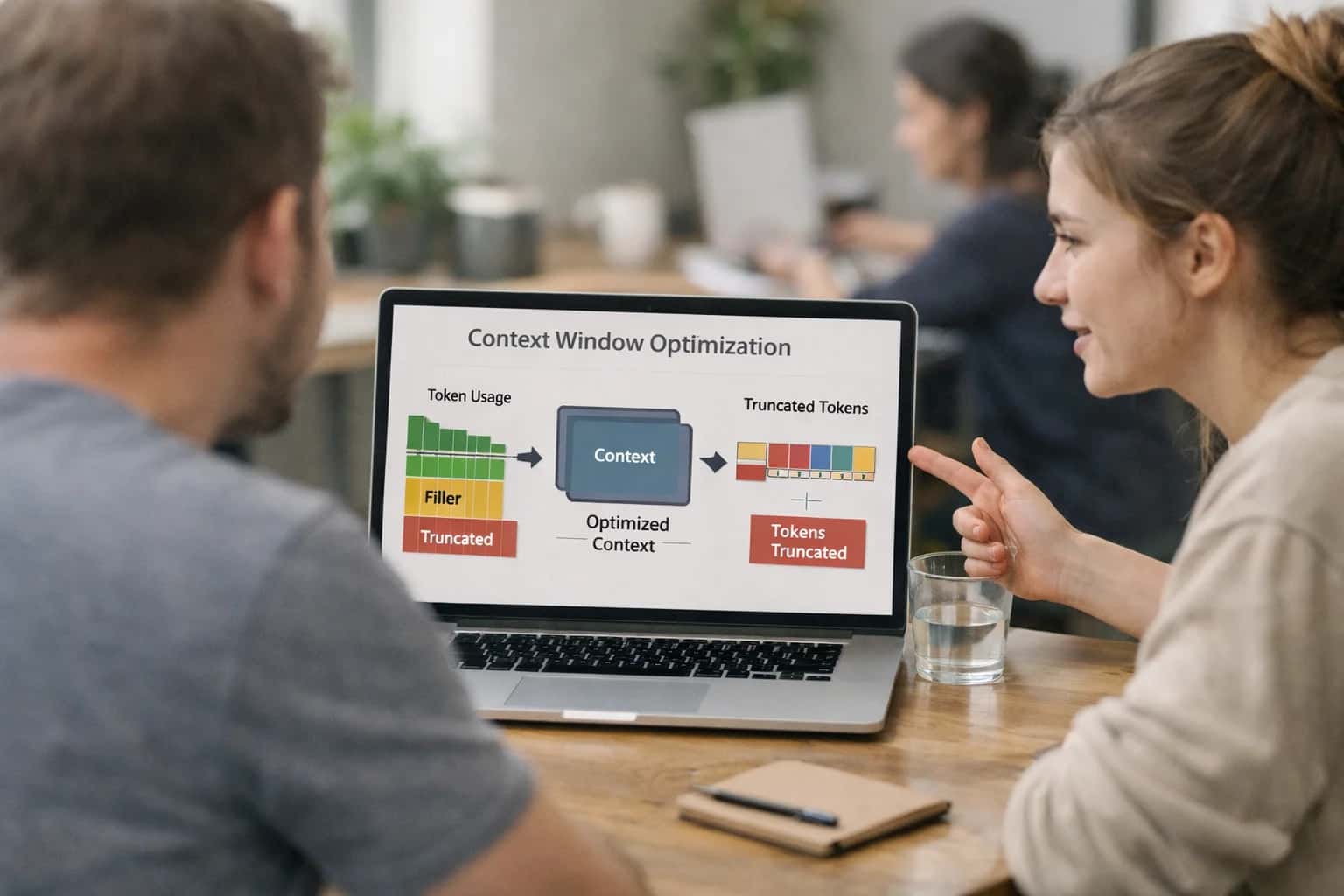
CONTEXT WINDOW MANAGEMENT
What is Context Prioritization?
A core technique in context window management for optimizing large language model performance within fixed token limits.
The mechanism typically involves calculating a relevance score for each context segment—based on factors like recency, semantic similarity to the active query, or predefined importance markers—and then applying a policy to preserve the highest-ranked content. This enables techniques like selective context summarization or intelligent cache eviction, directly supporting inference optimization by reducing computational waste on irrelevant tokens. It is a foundational capability for building responsive, long-horizon AI applications.
CONTEXT PRIORITIZATION
Key Scoring Heuristics & Methods
Context prioritization algorithms score and rank information within a model's limited context window to determine which elements are most critical to retain during compression or eviction. These heuristics are essential for efficient context window management.
01
Recency Scoring
This fundamental heuristic assigns higher priority to the most recently added tokens, based on the observation that recent information is often most relevant to the immediate next-token prediction. It's often implemented as a simple linear decay or as part of a Least-Recently-Used (LRU) eviction policy for the KV Cache. While effective for dialogue, it can fail for tasks requiring long-range dependencies.
02
Attention-Based Scoring
This method uses the model's own self-attention weights as a signal for importance. Tokens that receive high aggregate attention from other tokens in the sequence are deemed more critical.
- Implementation: Calculate the mean attention score received by each token across layers and heads.
- Advantage: Directly reflects the model's internal reasoning pathways.
- Challenge: Computationally expensive to compute in real-time during inference.
03
Semantic Density & Novelty Detection
This heuristic prioritizes tokens that convey unique semantic content, eliminating redundancy. It involves:
- Embedding Similarity: Using a lightweight model to generate embeddings for text chunks and evicting those with high cosine similarity to others.
- Keyword/Term Frequency: Identifying and retaining sentences with high concentrations of rare or topic-specific terms.
- Goal: Maximizes the information density of the compressed context.
04
Query-Relevance Scoring (For RAG)
In Retrieval-Augmented Generation pipelines, context prioritization is often performed at retrieval time. The retrieved passages are scored and ranked by their relevance to the user's query using models like cross-encoders (high accuracy, slower) or bi-encoders (fast, approximate). Only the top-k most relevant chunks are injected into the context window, making relevance the primary prioritization signal.
05
Learnable Gating Networks
An advanced, parametric approach where a small neural network (a gating function) is trained to predict the utility of keeping a token. This network can be optimized end-to-end for a downstream task.
- Input: Token embeddings, positional data, and metadata.
- Output: A keep/evict probability or a continuous importance score.
- Use Case: Specialized systems where compression policies can be learned from data rather than hand-designed.
06
Task-Specific & Rule-Based Heuristics
For deterministic applications, explicit rules can govern prioritization.
- Retain Structured Data: Prioritize JSON, XML, or code blocks over prose.
- Retain System Prompts: Anchor and protect the initial system instructions from eviction.
- Retain Function Definitions: In tool calling scenarios, keep function schemas accessible.
- Retain Chain-of-Thought: Preserve intermediate reasoning steps in a ReAct loop. These rules provide predictable, auditable context management.
CONTEXT MANAGEMENT COMPARISON
Context Prioritization vs. Alternative Strategies
A technical comparison of strategies for managing information within a fixed model context window, highlighting the algorithmic approach of context prioritization against simpler, more lossy methods.
| Strategy / Feature | Context Prioritization | Context Truncation | Context Chunking | Context Summarization |
|---|---|---|---|---|
Core Mechanism | Algorithmic scoring & ranking of tokens for selective retention/eviction | Brute-force removal of tokens from sequence start/end | Segmenting long input into discrete, non-overlapping blocks | Generating a condensed textual summary of the original context |
Information Loss Profile | Targeted & selective; aims to discard low-utility information | Blind & sequential; discards oldest or newest tokens regardless of utility | Isolated & fragmented; loses cross-chunk coherence | Interpretive & lossy; summary may omit nuanced details or introduce bias |
Computational Overhead | High (requires scoring model or heuristic per token/chunk) | Negligible (simple slice operation) | Low (requires segmentation logic) | Very High (requires a full inference pass with a summarization prompt) |
Preserves Cross-Sequence Coherence | Partial (within summary) | |||
Optimal For | Long-running dialogues, agentic loops, complex multi-step tasks | Simple Q&A where recent context is most relevant, API call optimization | Document processing where tasks are segment-independent (e.g., per-chapter analysis) | Creating an executive overview for human review or for seeding a new context |
Token Efficiency (Utility/Token) | High | Low to Moderate | Moderate (within a chunk) | Variable (depends on summary quality) |
Implementation Complexity | High (requires eviction policy, scoring, integration with KV cache) | Trivial | Moderate (requires chunking logic and result aggregation) | High (requires robust summarization prompts and quality validation) |
Latency Impact | Moderate (scoring overhead) | Minimal | Minimal (segmentation) | High (additional LLM call) |
CONTEXT PRIORITIZATION
Frequently Asked Questions
Context prioritization is the algorithmic scoring and ranking of information within a model's context window to determine which elements are most critical to retain during compression or eviction operations. These questions address its core mechanisms and applications.
Context prioritization is the algorithmic scoring and ranking of information within a model's fixed context window to determine which elements are most critical to retain during compression or eviction operations. It is a core component of context window management, enabling models to handle sequences longer than their native token limit by intelligently selecting what to keep in active memory. Unlike simple truncation, which discards information based solely on position, prioritization uses learned or heuristic scoring functions to evaluate the semantic utility and relevance of each context segment relative to the current task. This allows systems to maintain a higher information density and preserve critical reasoning chains, user instructions, or recent conversational turns, thereby improving performance on long-context tasks like document analysis, extended dialogues, and multi-step agentic workflows.
Enabling Efficiency, Speed & Accuracy
Intelligent Analysis, Decision & Execution
We build AI systems for teams that need search across company data, workflow automation across tools, or AI features inside products and internal software.
Talk to Us
Search across company data
Give teams answers from docs, tickets, runbooks, and product data with sources and permissions.
Useful when people spend too long searching or get different answers from different systems.
Enterprise searchRAGPermissions
Read more
Automate internal workflows
Use AI to route work, draft outputs, trigger actions, and keep approvals and logs in place.
Useful when repetitive work moves across multiple tools and teams.
AI agentsWorkflow automationGovernance
Read more
Add AI to products and internal tools
Build assistants, guided actions, or decision support into the software your team or customers already use.
Useful when AI needs to be part of the product, not a separate tool.
AI integrationDecision supportModel routing
Read more
About the author
Prasad Kumkar
CEO & MD, Inference Systems
Prasad Kumkar is the CEO & MD of Inference Systems and writes about AI systems architecture, LLM infrastructure, model serving, evaluation, and production deployment. Over 5+ years, he has worked across computer vision models, L5 autonomous vehicle systems, and LLM research, with a focus on taking complex AI ideas into real-world engineering systems.
His work and writing cover AI systems, large language models, AI agents, multimodal systems, autonomous systems, inference optimization, RAG, evaluation, and production AI engineering.
LinkedIn
Limited slotsGet a Free AI Consultation
Partnered with leading AI, data, and software stack.





How We Work
Custom AI workflows for your Business
One-fit-all AI don't work for modern businesses. At Inferensys, we aim to understand your business & custom requirements; which we use to define most efficient agentic workflows, the data, and the tools for your business.
01
Review the use case
We understand the task, the users, and where AI can actually help.
Read more02
Pick the right approach
We define what needs search, automation, or product integration.
Read more03
Build the first useful version
We implement the part that proves the value first.
Read more04
Improve from there
We add the checks and visibility needed to keep it useful.
Read moreThe first call is a practical review of your use case and the right next step.
Talk to Us