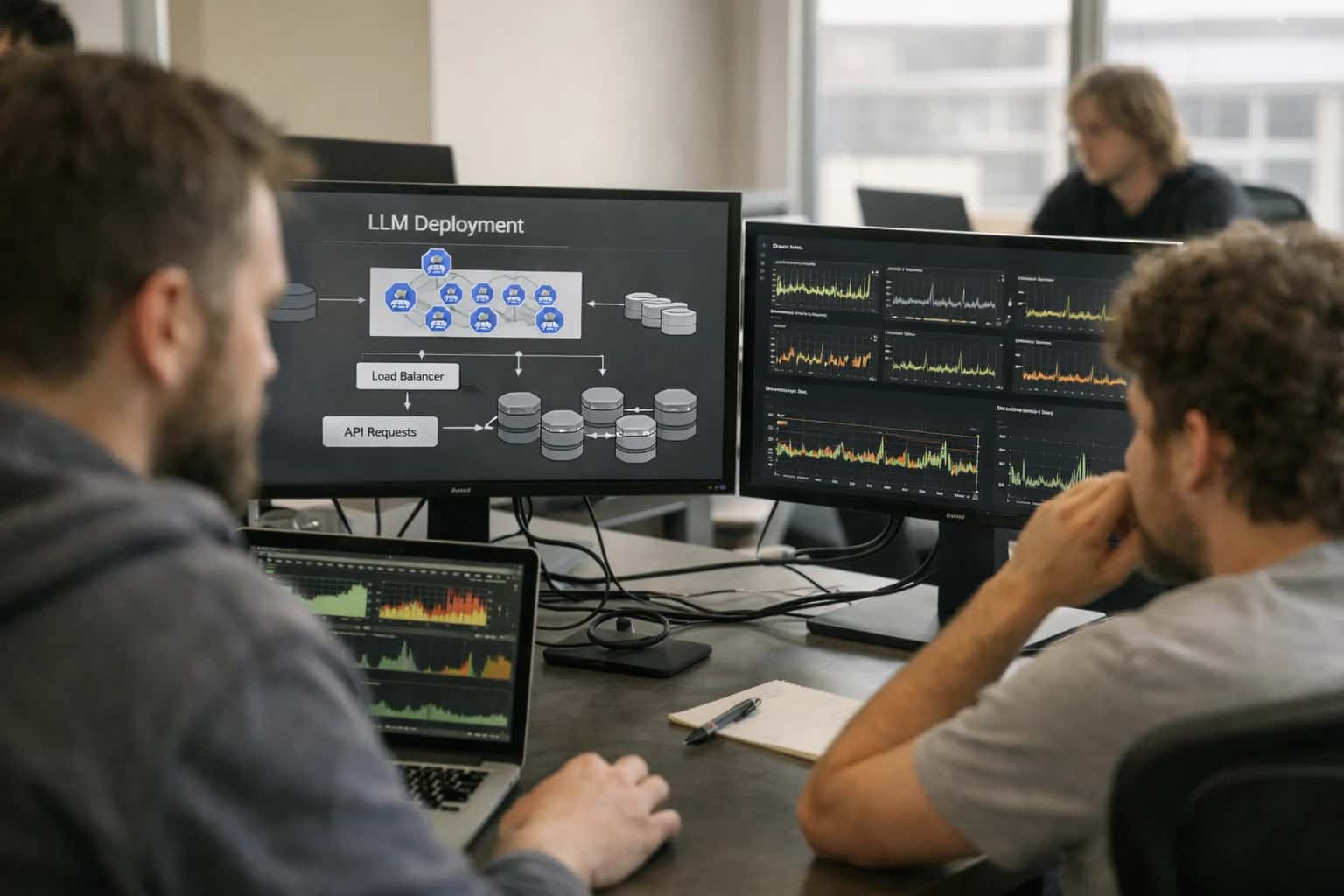
Shadow Mode is a risk-mitigation deployment strategy where a new or updated AI model executes silently alongside the live production system, ingesting real-world data and generating predictions that are logged and compared against the production output or human decisions, without exerting any influence on the active clinical workflow.

Glossary
Shadow Mode
A safe deployment strategy where a new AI model runs silently in parallel with the production system, logging its predictions for human comparison without affecting live clinical operations.
DEPLOYMENT STRATEGY
What is Shadow Mode?
A safe deployment strategy where a new AI model runs silently in parallel with the production system, logging its predictions for human comparison without affecting live clinical operations.
This parallel execution allows engineering and clinical operations teams to rigorously evaluate a model's real-world accuracy, latency, and failure modes under authentic load conditions. By comparing the shadow model's outputs against a golden dataset or existing production logic, teams can quantify the straight-through processing rate and calibrate confidence thresholds before promoting the model to a live human-in-the-loop or autonomous state.
Safe Deployment Strategy
Key Characteristics of Shadow Mode
Shadow Mode is a risk-mitigation deployment pattern where a new AI model executes silently alongside the production system, logging predictions for offline comparison without affecting live clinical operations.
01
Read-Only Parallel Execution
The shadow model receives an exact copy of live production traffic but operates in a strictly read-only capacity. It generates predictions and logs them to an isolated data store, ensuring zero impact on the existing clinical workflow. The primary system remains the sole source of truth, and no shadow output ever reaches an end-user, EHR system, or downstream API. This isolation is critical for validating model behavior under real-world load and data distributions without introducing clinical risk.
02
Silent Logging and Diff Analysis
Every prediction from the shadow model is captured alongside the production system's output and the eventual ground truth. This enables automated diff analysis to quantify performance deltas:
- Exact match accuracy between shadow and production
- Error type distribution on cases where shadow diverges
- Latency profiling under realistic throughput conditions Engineers use these logs to identify regressions, edge cases, and unexpected model behaviors before a full cutover.
03
Confidence Threshold Calibration
Shadow Mode provides a safe environment to calibrate confidence thresholds without operational consequences. By analyzing the relationship between predicted probability scores and actual correctness across thousands of silent predictions, teams can:
- Identify the optimal threshold for flagging cases for human review
- Measure the trade-off between Straight-Through Processing (STP) Rate and error risk
- Detect calibration drift where high confidence does not correlate with high accuracy This data-driven calibration is essential before enabling any automated decision-making in clinical contexts.
04
A/B Comparison Without User Impact
Shadow Mode enables rigorous A/B testing of model versions, prompts, or preprocessing pipelines against live data without splitting user traffic. Multiple candidate models can shadow simultaneously, each logging predictions to separate partitions. Key comparison dimensions include:
- Clinical entity extraction recall on rare disease mentions
- Hallucination rate on ambiguous or incomplete documentation
- Performance degradation on out-of-distribution document types This approach provides statistically significant evaluation data far faster than synthetic benchmarks alone.
05
Gradual Rollout Prerequisite
Shadow Mode is the foundational first stage of a progressive deployment strategy. The typical maturity path is:
- Shadow Mode — silent logging, zero user impact
- Dry Run with Review — predictions surfaced to internal reviewers only
- Low-Stakes Automation — automated processing of low-risk, high-confidence cases
- Full Production — model becomes the primary system with human-in-the-loop fallback Each stage gates on quantitative performance metrics gathered during the prior phase, ensuring clinical safety at every transition.
06
Concept Drift Early Warning System
Because the shadow model continuously processes live data, it serves as an early warning system for concept drift. By comparing shadow performance metrics over rolling time windows, teams can detect:
- Sudden accuracy drops indicating a shift in clinical documentation patterns
- Feature distribution changes such as new drug names or procedure codes appearing in the data stream
- Seasonal or event-driven drift like documentation changes during a public health emergency Alerts trigger before the production model is affected, enabling proactive retraining or recalibration.
SHADOW MODE DEPLOYMENT
Frequently Asked Questions
Clear, technical answers to the most common questions about running AI models in parallel with production clinical systems for safe, silent validation.
Shadow Mode is a safe deployment strategy where a new AI model runs silently in parallel with the existing production system, logging its predictions for human comparison without affecting live clinical operations. The shadow model receives an identical copy of the production input stream and generates outputs that are stored for offline analysis rather than being surfaced to end-users. This allows teams to measure real-world inference latency, evaluate prediction accuracy against production ground truth, and identify concept drift before committing to a full cutover. In clinical workflow automation, shadow mode is essential for validating high-stakes extraction models—such as those performing medical named entity recognition or FHIR resource mapping—against live electronic health record data without risking patient safety or billing integrity.
VALIDATION STRATEGIES
Shadow Mode Use Cases in Healthcare
Shadow mode enables healthcare organizations to rigorously evaluate AI performance against real-world clinical data without risking patient safety or operational integrity. These use cases demonstrate how silent parallel processing builds the statistical evidence required for regulatory approval and clinician trust.
01
Medical Coding Co-Pilot Validation
A new ICD-10-CM auto-coding model runs silently alongside certified professional coders, logging its suggested codes against the human-assigned reference standard. Discrepancy analysis between the shadow model and the coder identifies systematic errors in the AI's medical ontology alignment before it ever touches a claim.
- Compares AI-derived codes to human-assigned codes on live charts
- Measures inter-annotator agreement between model and coder
- Identifies high-error code families requiring retraining
Zero
Billing Impact During Validation
02
Radiology Report Triage
A deep learning model for detecting critical findings like pulmonary embolism or intracranial hemorrhage runs in shadow mode on all radiology reports. The model silently flags suspected positives, and its timestamps are compared against the actual radiologist communication to measure time-to-notification improvement without altering the existing STAT protocol.
- Logs predicted critical findings against actual radiologist calls
- Measures latency reduction potential without workflow disruption
- Builds sensitivity and specificity evidence for FDA submission
03
Prior Authorization Decision Support
An AI engine that predicts payer medical necessity determinations runs in shadow mode, comparing its approve/deny predictions against actual adjudication outcomes. This silent audit quantifies how often the model aligns with payer clinical guidelines, identifying concept drift in denial patterns before the model is trusted to auto-adjudicate low-risk cases.
- Matches predicted determinations to actual payer responses
- Tracks alignment with clinical validation rules engines
- Surfaces ambiguous cases requiring policy clarification
100%
Manual Review Preserved
04
Clinical Trial Eligibility Screening
A natural language processing pipeline parses unstructured oncology notes to identify patients matching complex inclusion and exclusion criteria for active trials. Running in shadow mode, the system logs its candidate matches against the manual screening performed by research coordinators, measuring recall to ensure no eligible patients are missed before automating the pre-screening workflow.
- Compares AI-identified candidates to coordinator-flagged patients
- Measures false negative rate on missed eligible patients
- Validates negation and uncertainty detection for criteria like 'no brain metastases'
05
Medication Reconciliation Discrepancy Detection
An AI model designed to reconcile admission medication lists against discharge orders runs silently, flagging potential unintentional discrepancies such as omitted home medications or therapeutic duplications. The shadow output is compared against the pharmacist's manual reconciliation to measure the model's positive predictive value before it triggers alerts in the live EHR.
- Logs flagged discrepancies against pharmacist-identified issues
- Quantifies alert fatigue risk by measuring false positive rate
- Validates RxNorm mapping accuracy on real medication lists
06
Social Determinants of Health Extraction
A model that extracts housing insecurity, food insecurity, and transportation barriers from social work notes runs in shadow mode. The extracted structured data is compared against manual abstraction by population health analysts, measuring F1 score per social determinant domain to ensure the model does not introduce bias or miss vulnerable patients before integration into value-based care dashboards.
- Compares structured SDOH outputs to manual chart review
- Measures performance stratified by demographic subgroups
- Validates extraction across diverse note types and authoring styles
DEPLOYMENT COMPARISON
Shadow Mode vs. Other Deployment Strategies
A comparison of safe AI deployment strategies for clinical workflows, evaluating risk, feedback quality, and operational impact.
| Feature | Shadow Mode | Canary Release | A/B Testing | Big Bang Cutover |
|---|---|---|---|---|
Live Clinical Impact | ||||
Risk to Patient Safety | None | Low | Medium | High |
Human-in-the-Loop Required | ||||
Feedback Signal Quality | High (full audit) | Medium (metrics only) | Medium (metrics only) | Low (incident-driven) |
Rollback Complexity | None | Instant | Instant | Difficult |
Data Drift Detection Speed | Immediate | Delayed | Delayed | Delayed |
Operational Overhead | High (dual run) | Medium | Medium | Low |
Suitable for High-Stakes Clinical Use |
Enabling Efficiency, Speed & Accuracy
Intelligent Analysis, Decision & Execution
We build AI systems for teams that need search across company data, workflow automation across tools, or AI features inside products and internal software.
Talk to Us
Search across company data
Give teams answers from docs, tickets, runbooks, and product data with sources and permissions.
Useful when people spend too long searching or get different answers from different systems.
Enterprise searchRAGPermissions
Read more
Automate internal workflows
Use AI to route work, draft outputs, trigger actions, and keep approvals and logs in place.
Useful when repetitive work moves across multiple tools and teams.
AI agentsWorkflow automationGovernance
Read more
Add AI to products and internal tools
Build assistants, guided actions, or decision support into the software your team or customers already use.
Useful when AI needs to be part of the product, not a separate tool.
AI integrationDecision supportModel routing
Read more
About the author
Prasad Kumkar
CEO & MD, Inference Systems
Prasad Kumkar is the CEO & MD of Inference Systems and writes about AI systems architecture, LLM infrastructure, model serving, evaluation, and production deployment. Over 5+ years, he has worked across computer vision models, L5 autonomous vehicle systems, and LLM research, with a focus on taking complex AI ideas into real-world engineering systems.
His work and writing cover AI systems, large language models, AI agents, multimodal systems, autonomous systems, inference optimization, RAG, evaluation, and production AI engineering.
LinkedIn
Limited slotsGet a Free AI Consultation
Partnered with leading AI, data, and software stack.





How We Work
Custom AI workflows for your Business
One-fit-all AI don't work for modern businesses. At Inferensys, we aim to understand your business & custom requirements; which we use to define most efficient agentic workflows, the data, and the tools for your business.
01
Review the use case
We understand the task, the users, and where AI can actually help.
Read more02
Pick the right approach
We define what needs search, automation, or product integration.
Read more03
Build the first useful version
We implement the part that proves the value first.
Read more04
Improve from there
We add the checks and visibility needed to keep it useful.
Read moreThe first call is a practical review of your use case and the right next step.
Talk to Us