An Incident Response Plan (IRP) is a documented, structured approach with clear procedures for detecting, responding to, and limiting the consequences of a malicious cyber attack against healthcare IT systems containing ePHI. It defines the roles, communication protocols, and technical steps required to transition an organization from a state of chaos during a breach to a state of controlled, compliant remediation, directly satisfying the HIPAA Security Rule's administrative safeguard requirements.

Glossary
Incident Response Plan
A documented, structured approach with clear procedures for detecting, responding to, and limiting the consequences of a malicious cyber attack against healthcare IT systems containing ePHI.
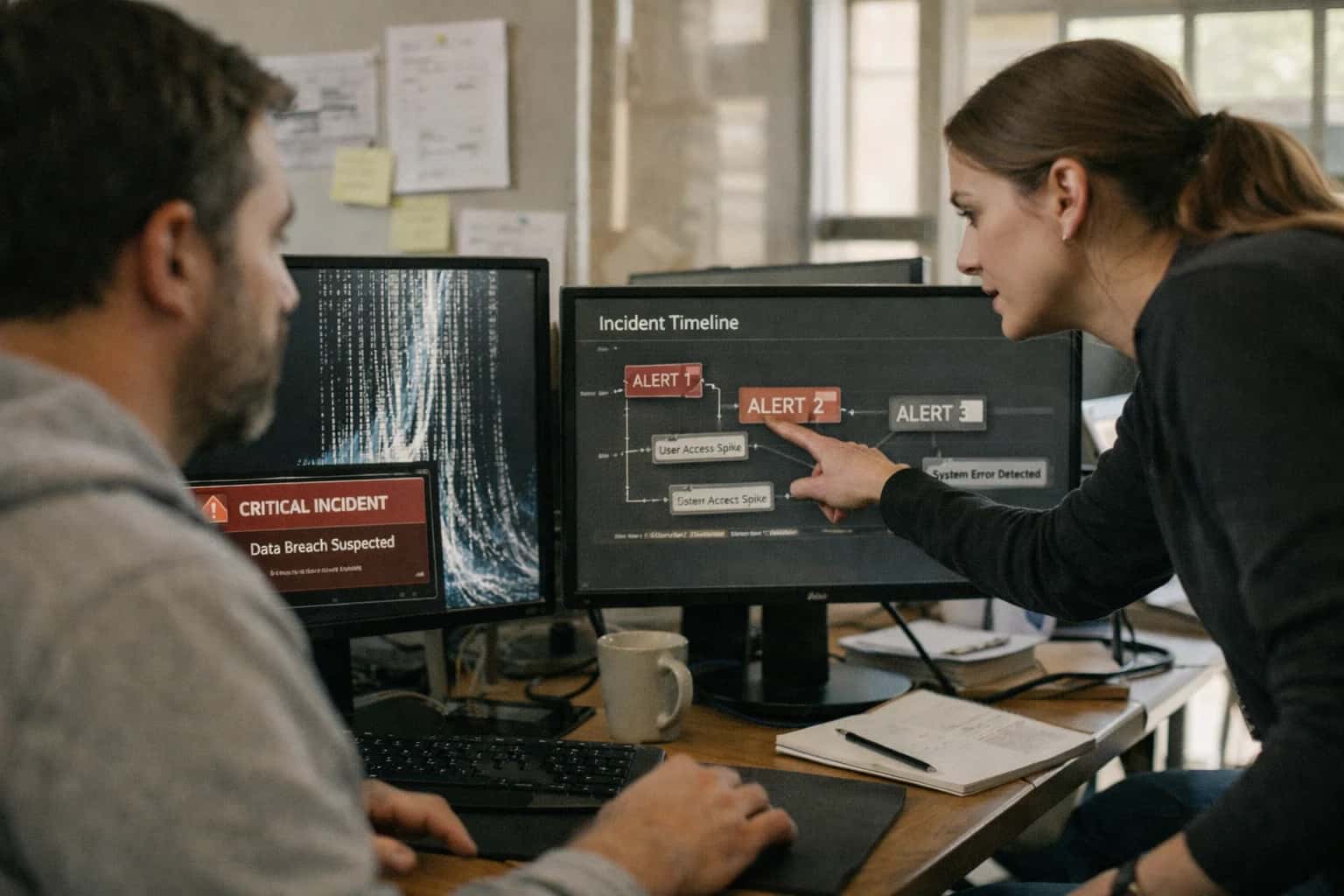
CYBERSECURITY FRAMEWORK
What is an Incident Response Plan?
A formalized, documented strategy for managing and mitigating the lifecycle of a cybersecurity breach involving electronic Protected Health Information (ePHI).
The plan operationalizes the six-phase lifecycle defined by NIST SP 800-61: Preparation, Detection & Analysis, Containment & Eradication, and Recovery, followed by rigorous Post-Incident Activity. For a HIPAA-compliant model deployment, the IRP must specifically address scenarios like model inversion attacks, training data exfiltration, and the compromise of Kubernetes pods processing PHI, ensuring that the Breach Notification Rule obligations are met within the mandated 60-day window.
Incident Response Plan
Core Components of a HIPAA-Compliant IRP
A documented, structured approach with clear procedures for detecting, responding to, and limiting the consequences of a malicious cyber attack against healthcare IT systems containing ePHI.
01
Preparation
The foundational phase establishing the organizational capability to respond. This involves developing and formally approving the IRP policy, conducting regular tabletop exercises simulating ransomware or data exfiltration scenarios, and defining clear roles for the Incident Response Team (IRT). Preparation includes integrating the IRP with the Business Associate Agreement (BAA) framework to ensure third-party vendors are contractually obligated to report incidents. It also mandates the pre-deployment of forensic tooling and the establishment of an immutable logging infrastructure to ensure evidence integrity.
02
Detection & Analysis
The phase focused on identifying potential security events and determining their scope. This relies on automated alerts from Data Loss Prevention (DLP) systems, Intrusion Detection Systems (IDS), and anomaly detection on audit trails. Analysts must rapidly distinguish between a security incident and a breach—defined as the actual acquisition, access, use, or disclosure of unsecured PHI. The analysis includes determining the type of data involved (e.g., ePHI), the extent of the compromise, and the root cause, often using Kubernetes Network Policy logs to trace lateral movement in microservice environments.
03
Containment, Eradication & Recovery
A multi-stage tactical response to stop the incident and restore operations. Short-term containment may involve isolating affected AWS Nitro Enclaves or revoking Just-in-Time Access credentials. Long-term containment applies temporary security patches and system hardening. Eradication involves removing malware, resetting compromised accounts, and closing the attack vector. Recovery is the careful, phased restoration of systems from clean backups, often using a Blue-Green Deployment strategy to cut over to a verified, uncompromised environment while maintaining clinical system availability.
04
Notification & Reporting
The legally mandated process of disclosing a breach of unsecured PHI. The Breach Notification Rule requires notifying affected individuals without unreasonable delay and no later than 60 days after discovery. If a breach impacts more than 500 residents of a state or jurisdiction, prominent media outlets must be notified. All breaches must be reported to the Secretary of HHS, with those affecting 500+ individuals reported concurrently. This phase requires precise coordination with legal counsel to ensure all regulatory deadlines are met and communications are compliant.
05
Post-Incident Activity
The critical retrospective phase that closes the loop on the incident lifecycle. This involves conducting a formal lessons learned meeting with all IRT members within two weeks of resolution. The output is a detailed report identifying failures in detection, gaps in Role-Based Access Control (RBAC), or weaknesses in encryption in transit configurations. The primary goal is to update the IRP, improve security controls, and update the HITRUST CSF corrective action plan to prevent recurrence, transforming the incident into a catalyst for a stronger security posture.
06
Integration with BAA Obligations
A HIPAA-specific requirement mandating that the IRP explicitly governs the relationship with Business Associates. The plan must detail procedures for a BA to report a security incident to the Covered Entity, including the timeline and required forensic evidence. Conversely, it must outline how the Covered Entity will oversee the BA's own containment and remediation efforts. This integration ensures that a breach at a cloud provider or SaaS vendor triggers a coordinated, legally sound response, preventing gaps in liability and notification.
INCIDENT RESPONSE PLAN
Frequently Asked Questions
Essential questions and answers about developing, implementing, and testing an incident response plan for healthcare AI systems handling electronic Protected Health Information.
An incident response plan (IRP) is a documented, structured approach with clear procedures for detecting, responding to, and limiting the consequences of a malicious cyber attack against healthcare IT systems containing electronic Protected Health Information (ePHI). In the context of AI model deployment, the IRP specifically addresses threats unique to machine learning pipelines, including model inversion attacks, data poisoning, and unauthorized access to training datasets containing PHI. The plan defines roles, communication protocols, and technical remediation steps required to contain a breach, preserve forensic evidence, and restore HIPAA-compliant operations. A healthcare-specific IRP must align with the HIPAA Security Rule and the Breach Notification Rule, which mandates notifying affected individuals, the Secretary of HHS, and potentially the media within 60 days of breach discovery.
Enabling Efficiency, Speed & Accuracy
Intelligent Analysis, Decision & Execution
We build AI systems for teams that need search across company data, workflow automation across tools, or AI features inside products and internal software.
Talk to Us
Search across company data
Give teams answers from docs, tickets, runbooks, and product data with sources and permissions.
Useful when people spend too long searching or get different answers from different systems.
Enterprise searchRAGPermissions
Read more
Automate internal workflows
Use AI to route work, draft outputs, trigger actions, and keep approvals and logs in place.
Useful when repetitive work moves across multiple tools and teams.
AI agentsWorkflow automationGovernance
Read more
Add AI to products and internal tools
Build assistants, guided actions, or decision support into the software your team or customers already use.
Useful when AI needs to be part of the product, not a separate tool.
AI integrationDecision supportModel routing
Read more
About the author
Prasad Kumkar
CEO & MD, Inference Systems
Prasad Kumkar is the CEO & MD of Inference Systems and writes about AI systems architecture, LLM infrastructure, model serving, evaluation, and production deployment. Over 5+ years, he has worked across computer vision models, L5 autonomous vehicle systems, and LLM research, with a focus on taking complex AI ideas into real-world engineering systems.
His work and writing cover AI systems, large language models, AI agents, multimodal systems, autonomous systems, inference optimization, RAG, evaluation, and production AI engineering.
LinkedIn
Limited slotsGet a Free AI Consultation
Partnered with leading AI, data, and software stack.





How We Work
Custom AI workflows for your Business
One-fit-all AI don't work for modern businesses. At Inferensys, we aim to understand your business & custom requirements; which we use to define most efficient agentic workflows, the data, and the tools for your business.
01
Review the use case
We understand the task, the users, and where AI can actually help.
Read more02
Pick the right approach
We define what needs search, automation, or product integration.
Read more03
Build the first useful version
We implement the part that proves the value first.
Read more04
Improve from there
We add the checks and visibility needed to keep it useful.
Read moreThe first call is a practical review of your use case and the right next step.
Talk to Us