A Business Associate Agreement (BAA) is a mandatory, legally binding contract between a HIPAA-covered entity and a business associate that dictates the specific, permitted uses and disclosures of protected health information (PHI). The agreement contractually obligates the business associate—which can be a vendor, subcontractor, or service provider—to implement appropriate administrative, physical, and technical safeguards to ensure the confidentiality, integrity, and availability of electronic PHI (ePHI).

Glossary
Business Associate Agreement (BAA)
A legally binding contract between a HIPAA-covered entity and a business associate that establishes the permitted uses and disclosures of protected health information (PHI) by the business associate.
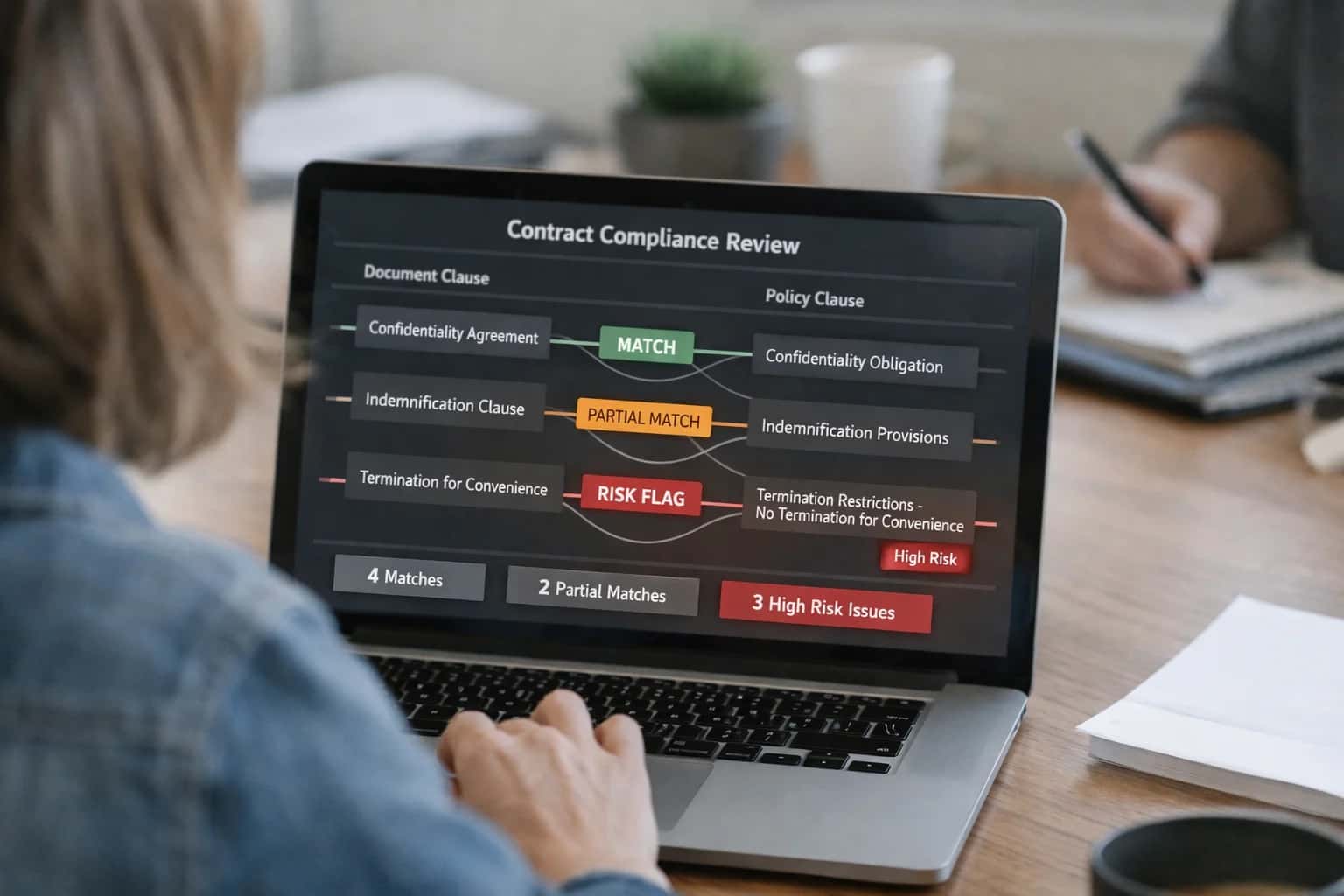
HIPAA COMPLIANCE CONTRACT
What is a Business Associate Agreement (BAA)?
A Business Associate Agreement is a legally binding contract that establishes the specific permitted uses and disclosures of protected health information (PHI) by a business associate, as required by the HIPAA Privacy Rule.
The BAA explicitly defines the business associate's liability and reporting obligations, including the requirement to report any security incident or breach of unsecured PHI to the covered entity without unreasonable delay. For AI and cloud computing vendors handling clinical data, executing a BAA is a prerequisite for deployment, as it legally binds the vendor to comply with the HIPAA Security Rule and Breach Notification Rule, ensuring that the model's data processing environment meets regulatory standards.
CONTRACTUAL SAFEGUARDS
Key Components of a BAA
A Business Associate Agreement is not a boilerplate document; it is a legally binding contract that operationalizes HIPAA compliance. The following components define the specific obligations, limitations, and liability structures required to safeguard Protected Health Information (PHI).
01
Permitted Uses and Disclosures
The BAA strictly defines the scope of work for the business associate. It explicitly states that PHI can only be used for the specific services outlined in the underlying service agreement—such as data de-identification or clinical entity extraction—and for no other purpose.
- Prohibition: The associate cannot use PHI for its own independent research, marketing, or to train models unless explicitly authorized.
- Minimum Necessary: The agreement binds the associate to the HIPAA principle of using only the minimum necessary PHI to accomplish the task.
- Subcontractor Flow-Down: It must specify that any subcontractors creating, receiving, or transmitting PHI must agree to the same restrictions.
02
Safeguards and Security Obligations
This component mandates the implementation of administrative, physical, and technical safeguards to prevent unauthorized use or disclosure of electronic PHI (ePHI). It directly ties the contract to the HIPAA Security Rule.
- Encryption Standards: Specifies requirements for encryption at rest (e.g., AES-256) and encryption in transit (e.g., TLS 1.3) to render data unusable if intercepted.
- Access Controls: Requires Role-Based Access Control (RBAC) and unique user identification to ensure only authorized personnel access PHI.
- Audit Controls: Mandates the implementation of hardware, software, and procedural mechanisms to record and examine activity in information systems containing ePHI.
03
Reporting and Breach Notification
The BAA establishes a strict timeline and protocol for reporting security incidents. The business associate is contractually obligated to report any breach of unsecured PHI to the covered entity without unreasonable delay, typically within 24 to 72 hours of discovery.
- Incident Identification: The associate must identify and report both successful and attempted security incidents.
- Mitigation Duty: The associate is required to take immediate steps to mitigate any harmful effects of a breach.
- Forensic Cooperation: The agreement often includes a clause requiring the associate to assist the covered entity in forensic investigation and fulfilling obligations under the HIPAA Breach Notification Rule.
04
Termination and Data Disposition
Upon termination of the contract, the BAA dictates the fate of the PHI. The business associate must either return or destroy all PHI received from or created on behalf of the covered entity.
- Infeasibility Clause: If return or destruction is infeasible—such as data locked in immutable backup logs—the BAA extends protections indefinitely and prohibits further use or disclosure.
- Certification of Destruction: The associate must provide written certification that the data has been securely destroyed in accordance with NIST SP 800-88 guidelines for media sanitization.
- Survival of Obligations: The duty to protect the confidentiality of the PHI survives the termination of the agreement.
HIPAA COMPLIANCE
Frequently Asked Questions
Clear, technically precise answers to the most common questions about Business Associate Agreements and their role in healthcare AI deployment.
A Business Associate Agreement (BAA) is a legally binding contract mandated by the HIPAA Privacy Rule between a covered entity (such as a hospital or health plan) and a business associate that establishes the permitted uses and disclosures of Protected Health Information (PHI) by the business associate. The agreement functions as a contractual chain of liability, extending HIPAA obligations beyond the covered entity to any vendor that creates, receives, maintains, or transmits PHI on the covered entity's behalf. A BAA must specify the scope of permitted PHI use, require the business associate to implement appropriate administrative, physical, and technical safeguards, mandate breach notification within specific timeframes, and ensure that any subcontractors of the business associate are bound by equivalent terms. Without a fully executed BAA, any disclosure of PHI to a third party constitutes a HIPAA violation, exposing the covered entity to significant civil monetary penalties from the Office for Civil Rights (OCR).
Enabling Efficiency, Speed & Accuracy
Intelligent Analysis, Decision & Execution
We build AI systems for teams that need search across company data, workflow automation across tools, or AI features inside products and internal software.
Talk to Us
Search across company data
Give teams answers from docs, tickets, runbooks, and product data with sources and permissions.
Useful when people spend too long searching or get different answers from different systems.
Enterprise searchRAGPermissions
Read more
Automate internal workflows
Use AI to route work, draft outputs, trigger actions, and keep approvals and logs in place.
Useful when repetitive work moves across multiple tools and teams.
AI agentsWorkflow automationGovernance
Read more
Add AI to products and internal tools
Build assistants, guided actions, or decision support into the software your team or customers already use.
Useful when AI needs to be part of the product, not a separate tool.
AI integrationDecision supportModel routing
Read more
About the author
Prasad Kumkar
CEO & MD, Inference Systems
Prasad Kumkar is the CEO & MD of Inference Systems and writes about AI systems architecture, LLM infrastructure, model serving, evaluation, and production deployment. Over 5+ years, he has worked across computer vision models, L5 autonomous vehicle systems, and LLM research, with a focus on taking complex AI ideas into real-world engineering systems.
His work and writing cover AI systems, large language models, AI agents, multimodal systems, autonomous systems, inference optimization, RAG, evaluation, and production AI engineering.
LinkedIn
Limited slotsGet a Free AI Consultation
Partnered with leading AI, data, and software stack.





How We Work
Custom AI workflows for your Business
One-fit-all AI don't work for modern businesses. At Inferensys, we aim to understand your business & custom requirements; which we use to define most efficient agentic workflows, the data, and the tools for your business.
01
Review the use case
We understand the task, the users, and where AI can actually help.
Read more02
Pick the right approach
We define what needs search, automation, or product integration.
Read more03
Build the first useful version
We implement the part that proves the value first.
Read more04
Improve from there
We add the checks and visibility needed to keep it useful.
Read moreThe first call is a practical review of your use case and the right next step.
Talk to Us