An audit trail is a chronological, immutable record of discrete events occurring within an information system, capturing who accessed what data, when, and from where. In a HIPAA-compliant healthcare environment, it serves as the definitive evidentiary log for every interaction with protected health information (PHI), enabling the detection of unauthorized access and supporting mandatory breach investigations.

Glossary
Audit Trail
A chronological, immutable record of system activities, including who accessed what PHI and when, that provides the necessary documentation for HIPAA security compliance and forensic analysis.
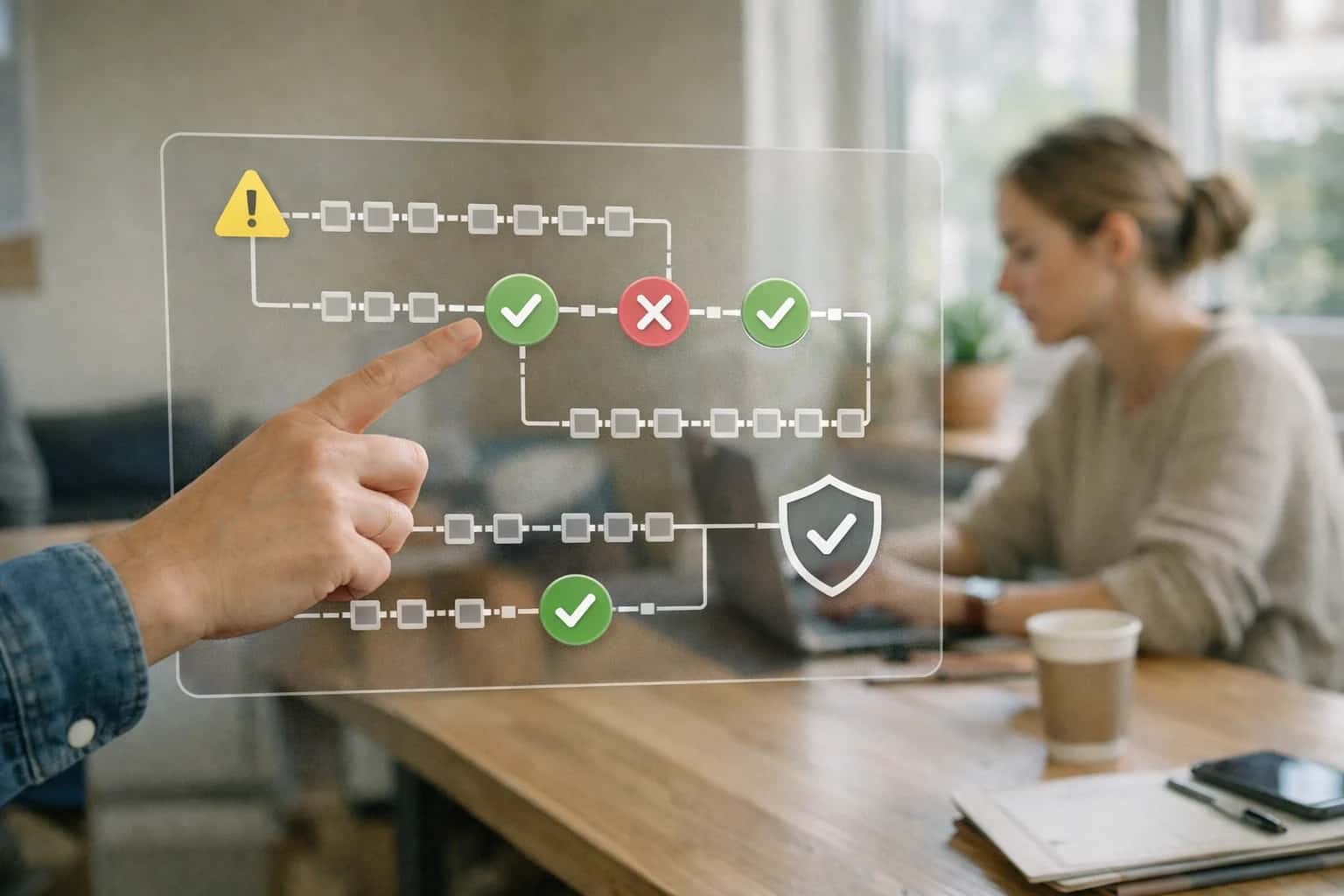
COMPLIANCE & FORENSICS
What is an Audit Trail?
An audit trail is a chronological, immutable record of system activities that provides the necessary documentation for HIPAA security compliance and forensic analysis.
Technically, a compliant audit trail must be immutable, meaning records cannot be altered or deleted after creation, and must capture specific data elements including user identification, timestamp, type of action, and the affected data object. These logs are foundational to meeting the HIPAA Security Rule's technical safeguards and are continuously monitored by Security Information and Event Management (SIEM) systems for anomalous access patterns.
HIPAA SECURITY RULE
Core Characteristics of a Compliant Audit Trail
A compliant audit trail is more than a log file—it is a chronological, immutable record of system activities that documents who accessed what protected health information (PHI) and when. For HIPAA-covered entities and business associates, the audit trail serves as both a deterrent to unauthorized access and a critical forensic tool for post-incident analysis.
01
Immutability and Write-Once, Read-Many (WORM) Storage
The foundational characteristic of a compliant audit trail is tamper-proof immutability. Once an event record is written, it must be impossible to alter or delete it without detection.
- Mechanism: Utilizes WORM-compliant storage or append-only distributed ledgers.
- Implementation: Cloud-native solutions like AWS CloudTrail with S3 Object Lock or Azure Immutable Blob Storage enforce retention policies at the hardware level.
- Compliance Mapping: Directly satisfies the HIPAA Security Rule requirement to protect audit logs from modification (45 CFR § 164.312(b)).
WORM
Storage Model
02
Granular Event Attribution
Every entry must answer who, what, when, and where with forensic precision. Anonymous or shared service accounts are insufficient for PHI access auditing.
- Required Fields:
- User ID: Unique identifier of the authenticated individual (not a role).
- Action: Specific operation (e.g.,
PHI_VIEW,RECORD_EXPORT). - Timestamp: Synchronized to a trusted NTP source with microsecond accuracy.
- Resource: The specific patient record or data object accessed.
- Technical Standard: Events should conform to structured schemas like the Cloud Auditing Data Federation (CADF) standard for interoperability.
03
Automated Integrity Verification
Compliance is not a one-time configuration; it requires continuous, automated proof that logs have not been tampered with.
- Hash Chaining: Each log entry includes a cryptographic hash of the previous entry, creating a Merkle tree structure. Breaking the chain is computationally infeasible.
- Digital Signatures: Log files are signed using a hardware security module (HSM) to provide non-repudiation.
- File Integrity Monitoring (FIM): Agents like Tripwire or OSSEC alert security teams immediately if a log file's hash deviates from its known-good state.
04
Strict Access Control and Segregation of Duties
The audit trail system itself is a high-value target. Access to logs must be restricted to a minimum necessary set of security personnel, completely separate from clinical or administrative users.
- Role-Based Access Control (RBAC): Define distinct roles like
Audit_ViewerandAudit_Admin. - Just-in-Time (JIT) Access: Privileged access to raw logs should be granted on a temporary, per-incident basis, not as a standing permission.
- Segregation: No individual who creates or modifies PHI should have the ability to view or delete the logs of those actions.
05
Comprehensive Retention and Lifecycle Management
HIPAA requires retaining audit logs for a minimum of six years from the date of creation. A compliant system automates the entire lifecycle from hot storage to cold archive.
- Hot Storage: Recent logs (30-90 days) kept on high-performance SSDs for rapid forensic queries using tools like Elasticsearch or Splunk.
- Cold Archive: Older logs automatically transitioned to low-cost object storage (e.g., AWS S3 Glacier Deep Archive) while maintaining immutability.
- Destruction: A documented, automated process for secure deletion after the retention period expires, with its own audit trail.
06
Real-Time Alerting on Suspicious Patterns
A passive log is a reactive tool. A compliant audit system actively monitors for anomalous access patterns that indicate a breach or insider threat.
- Behavioral Analytics: Machine learning models establish a baseline of normal access patterns for each user role.
- Trigger Events:
- Bulk PHI Export: A single user downloading an abnormally high volume of records.
- Break-Glass Access: Emergency access to a VIP patient's record outside of a clinical encounter.
- Geolocation Anomaly: A login from an impossible travel distance.
- Integration: Alerts must be forwarded to a SIEM (Security Information and Event Management) system like Splunk ES or Azure Sentinel for orchestrated response.
AUDIT TRAIL ESSENTIALS
Frequently Asked Questions
Clear answers to the most common questions about audit trails in HIPAA-compliant healthcare AI deployments, covering regulatory requirements, technical implementation, and forensic analysis.
An audit trail is a chronological, immutable record of all system activities that documents who accessed what Protected Health Information (PHI), when they accessed it, and what actions they performed. Under the HIPAA Security Rule (45 CFR § 164.312(b)), covered entities and business associates must implement hardware, software, and procedural mechanisms that record and examine activity in information systems containing ePHI. A compliant audit trail captures event types including user logins, data access, modifications, deletions, exports, and permission changes, each stamped with a trusted timestamp and attributed to a specific authenticated identity. These records serve dual purposes: providing the accountability documentation required for regulatory compliance and enabling forensic analysis during security incident investigations. In modern healthcare AI deployments, audit trails extend beyond traditional database access logs to include model inference requests, embedding lookups, and FHIR API transactions, creating a comprehensive chain of custody for every interaction with clinical data.
Enabling Efficiency, Speed & Accuracy
Intelligent Analysis, Decision & Execution
We build AI systems for teams that need search across company data, workflow automation across tools, or AI features inside products and internal software.
Talk to Us
Search across company data
Give teams answers from docs, tickets, runbooks, and product data with sources and permissions.
Useful when people spend too long searching or get different answers from different systems.
Enterprise searchRAGPermissions
Read more
Automate internal workflows
Use AI to route work, draft outputs, trigger actions, and keep approvals and logs in place.
Useful when repetitive work moves across multiple tools and teams.
AI agentsWorkflow automationGovernance
Read more
Add AI to products and internal tools
Build assistants, guided actions, or decision support into the software your team or customers already use.
Useful when AI needs to be part of the product, not a separate tool.
AI integrationDecision supportModel routing
Read more
About the author
Prasad Kumkar
CEO & MD, Inference Systems
Prasad Kumkar is the CEO & MD of Inference Systems and writes about AI systems architecture, LLM infrastructure, model serving, evaluation, and production deployment. Over 5+ years, he has worked across computer vision models, L5 autonomous vehicle systems, and LLM research, with a focus on taking complex AI ideas into real-world engineering systems.
His work and writing cover AI systems, large language models, AI agents, multimodal systems, autonomous systems, inference optimization, RAG, evaluation, and production AI engineering.
LinkedIn
Limited slotsGet a Free AI Consultation
Partnered with leading AI, data, and software stack.





How We Work
Custom AI workflows for your Business
One-fit-all AI don't work for modern businesses. At Inferensys, we aim to understand your business & custom requirements; which we use to define most efficient agentic workflows, the data, and the tools for your business.
01
Review the use case
We understand the task, the users, and where AI can actually help.
Read more02
Pick the right approach
We define what needs search, automation, or product integration.
Read more03
Build the first useful version
We implement the part that proves the value first.
Read more04
Improve from there
We add the checks and visibility needed to keep it useful.
Read moreThe first call is a practical review of your use case and the right next step.
Talk to Us