GraphRAG (Graph Retrieval-Augmented Generation) is a hybrid AI architecture that replaces traditional vector-based document retrieval with a knowledge graph as the grounding source. Instead of retrieving semantically similar text chunks, the system executes graph traversals—often via Cypher or SPARQL—to fetch structured semantic triples and entity relationships, providing the language model with deterministic, relational context for improved factual accuracy and complex, multi-hop reasoning.

Glossary
GraphRAG (Graph Retrieval-Augmented Generation)
An advanced RAG architecture that uses a knowledge graph as the retrieval source, allowing a large language model to ground its responses in structured, relational context for improved factual accuracy and complex reasoning.
ARCHITECTURE
What is GraphRAG (Graph Retrieval-Augmented Generation)?
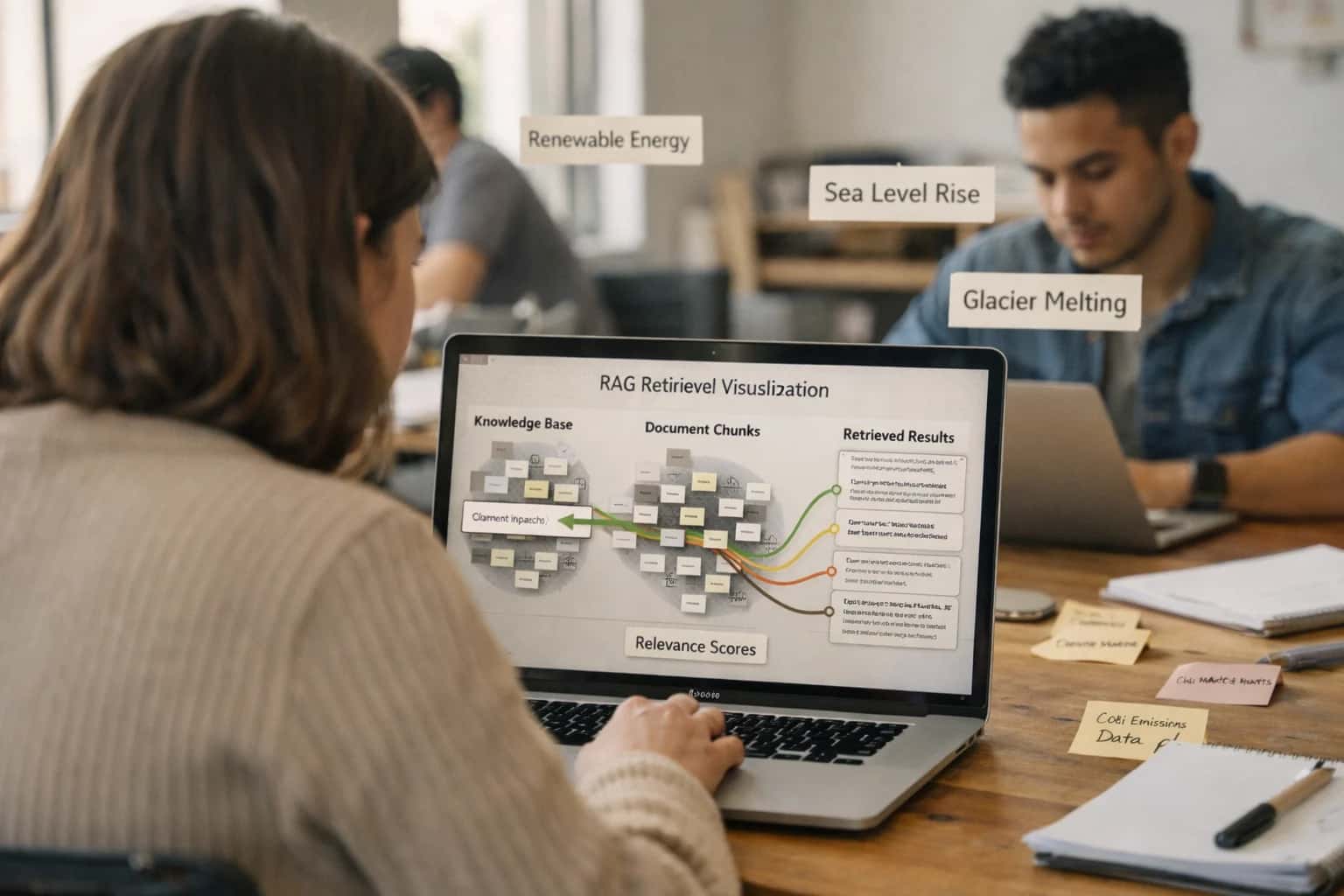
GraphRAG is an advanced retrieval-augmented generation architecture that uses a knowledge graph, rather than unstructured text chunks, as the primary retrieval source to ground a large language model's responses in structured, relational context.
This approach excels in domains requiring high precision and relational logic, such as clinical decision support and legal analysis. By grounding generation in a curated ontology, GraphRAG mitigates hallucination and enables the model to synthesize answers that require connecting disparate facts across an enterprise knowledge graph, moving beyond surface-level semantic similarity to explicit, logical connections.
ARCHITECTURAL COMPONENTS
Key Features of GraphRAG
GraphRAG enhances standard RAG by replacing flat vector search with structured knowledge graph traversal, enabling multi-hop reasoning and grounded, high-fidelity responses.
01
Structured Retrieval via Knowledge Graphs
Instead of retrieving isolated text chunks by vector similarity, GraphRAG queries a knowledge graph composed of semantic triples (subject-predicate-object). This allows the retriever to follow explicit, named relationships between entities, fetching a structured subgraph of interconnected facts rather than a flat list of documents. The retrieval is deterministic and relationship-aware, eliminating the noise of keyword or embedding drift.
02
Multi-Hop Reasoning and Traversal
GraphRAG excels at queries requiring the synthesis of multiple, non-adjacent facts. The system performs graph traversal to navigate paths between entities, such as connecting a patient's symptom to a drug's mechanism of action through intermediate genes and pathways. This multi-hop capability is powered by query languages like Cypher or SPARQL, which express complex pattern-matching logic that a simple vector search cannot replicate.
03
Community Summarization for Global Context
A key innovation in Microsoft's GraphRAG is the Leiden community detection algorithm. The system partitions the knowledge graph into hierarchical communities of closely related entities and generates natural language summaries for each. When a query is received, these summaries provide a high-level, thematic understanding of the entire dataset, allowing the LLM to answer broad, abstract questions that require synthesizing information across thousands of documents.
04
Entity-Centric Grounding and Factuality
By anchoring retrieval in canonical entity nodes with unique identifiers, GraphRAG dramatically reduces hallucination. The system resolves ambiguous mentions through entity linking to a controlled vocabulary, ensuring that the context provided to the LLM is about the correct, specific real-world object. This is critical in domains like healthcare, where confusing a drug's brand name with its generic ingredient can have severe consequences.
05
Hybrid Dense-Sparse Retrieval
Production GraphRAG systems often combine node embeddings (dense vectors) with graph traversal (sparse, symbolic logic). An initial vector search locates entry points into the knowledge graph, and then a graph traversal expands the context by following edges. This hybrid approach marries the fuzzy, semantic understanding of embeddings with the precise, logical rigor of a graph database, optimizing for both recall and precision.
06
Dynamic Graph Construction from Unstructured Text
The pipeline begins with an LLM extracting entities and relations from source documents to construct the graph. This process, known as relation extraction, identifies subject-predicate-object triples directly from text. The result is a dynamic, queryable property graph where nodes and edges hold attributes. This transforms a static corpus into a living, interconnected knowledge base that can be updated incrementally without full re-indexing.
GRAPHRAG CLARIFIED
Frequently Asked Questions
Concise, technically precise answers to the most common questions about Graph Retrieval-Augmented Generation, designed for engineers and architects evaluating its role in clinical workflow automation.
GraphRAG (Graph Retrieval-Augmented Generation) is an advanced RAG architecture that uses a knowledge graph as its primary retrieval source instead of a vector database of text chunks. When a user submits a query, the system first performs a graph traversal—often using a declarative language like Cypher or SPARQL—to extract a relevant subgraph of structured entities and their relationships. This structured context, which captures the semantic connections between concepts, is then serialized and injected into the large language model's prompt window. By grounding generation in the deterministic relationships of a graph rather than the statistical similarity of vector embeddings, GraphRAG dramatically improves the model's ability to perform complex, multi-hop reasoning and answer questions that require synthesizing facts across disparate documents, such as understanding a patient's longitudinal medication history or the cascading effects of a drug interaction.
ARCHITECTURAL COMPARISON
GraphRAG vs. Standard RAG vs. Knowledge Graph
A feature-level comparison of three distinct approaches to grounding language model outputs in structured and unstructured data sources.
| Feature | GraphRAG | Standard RAG | Knowledge Graph |
|---|---|---|---|
Retrieval Source | Knowledge Graph (structured triples) | Vector Database (dense embeddings) | Graph Database (nodes and edges) |
Primary Query Mechanism | Graph traversal + vector similarity | Semantic similarity search | SPARQL or Cypher pattern matching |
Contextual Grounding | Relational paths and entity neighborhoods | Top-k semantically similar text chunks | Explicit, deterministic relationships |
Handles Multi-hop Reasoning | |||
Handles Unstructured Text | |||
Native LLM Integration | |||
Hallucination Reduction Method | Constrained by graph schema and paths | Constrained by retrieved context | No generative component; query returns facts |
Data Freshness | Real-time graph updates | Requires re-indexing of embeddings | Real-time graph updates |
Enabling Efficiency, Speed & Accuracy
Intelligent Analysis, Decision & Execution
We build AI systems for teams that need search across company data, workflow automation across tools, or AI features inside products and internal software.
Talk to Us
Search across company data
Give teams answers from docs, tickets, runbooks, and product data with sources and permissions.
Useful when people spend too long searching or get different answers from different systems.
Enterprise searchRAGPermissions
Read more
Automate internal workflows
Use AI to route work, draft outputs, trigger actions, and keep approvals and logs in place.
Useful when repetitive work moves across multiple tools and teams.
AI agentsWorkflow automationGovernance
Read more
Add AI to products and internal tools
Build assistants, guided actions, or decision support into the software your team or customers already use.
Useful when AI needs to be part of the product, not a separate tool.
AI integrationDecision supportModel routing
Read moreClinical Knowledge Graph Applications
GraphRAG Use Cases in Healthcare
GraphRAG architectures ground large language model responses in structured, relational context from knowledge graphs, enabling precise, multi-hop reasoning across interconnected medical entities for high-stakes clinical applications.
01
Adverse Drug Event Investigation
GraphRAG enables pharmacovigilance teams to traverse complex networks of drugs, targets, pathways, and adverse events to identify causal signals.
- Traverses drug-protein-disease pathways to explain unexpected side effects
- Links patient demographics and comorbidities to adverse event clusters
- Grounds LLM-generated safety narratives in structured biomedical ontologies like MedDRA and RxNorm
Example: A GraphRAG system can connect a patient's medication list to a knowledge graph of metabolic pathways, identifying that Drug A inhibits the enzyme metabolizing Drug B, explaining a toxicity spike.
02
Clinical Trial Cohort Matching
GraphRAG accelerates patient recruitment by reasoning over complex inclusion/exclusion criteria against a knowledge graph of patient histories.
- Models patient journeys as temporal graphs of diagnoses, procedures, and lab results
- Performs multi-hop reasoning to verify complex criteria like 'failed two prior lines of therapy'
- Links genomic variants to trial eligibility through SNOMED CT and Human Phenotype Ontology mappings
Example: A query for 'non-small cell lung cancer patients with EGFR exon 20 insertion mutations who progressed on platinum-based chemotherapy' is resolved by traversing diagnosis, genomic, and treatment edges in the graph.
03
Differential Diagnosis Generation
GraphRAG enhances diagnostic decision support by grounding LLM reasoning in structured relationships between symptoms, diseases, and patient context.
- Traverses symptom-disease edges weighted by prevalence and co-occurrence
- Incorporates patient-specific factors like age, sex, and comorbidities as graph constraints
- Ranks candidate diagnoses using graph centrality and semantic proximity algorithms
Example: For a patient presenting with fatigue, weight loss, and hypercalcemia, the system traverses from symptoms to diseases, prioritizing conditions that explain all three findings while considering the patient's cancer history.
04
Prior Authorization Evidence Synthesis
GraphRAG automates the assembly of clinical evidence for payer-provider authorization workflows by linking patient data to coverage policies and medical literature.
- Maps extracted clinical findings to policy criteria encoded as graph patterns
- Retrieves supporting evidence from guideline-to-recommendation edges
- Generates audit-ready justification narratives grounded in structured clinical logic
Example: For a biologic therapy request, the system verifies step therapy requirements by traversing the patient's medication history graph, confirming failure of first-line treatments before generating the approval summary.
05
Comorbidity Risk Stratification
GraphRAG identifies latent disease risks by analyzing patient comorbidity graphs against population-level disease progression networks.
- Constructs personalized disease graphs from longitudinal patient records
- Applies graph neural network embeddings to predict future diagnoses
- Grounds predictions in known pathophysiological pathways from biomedical knowledge graphs
Example: A patient with type 2 diabetes and hypertension triggers traversal of downstream complication nodes, surfacing elevated risk for chronic kidney disease and recommending preemptive nephrology referral.
06
Treatment Pathway Optimization
GraphRAG supports clinical decision-making by reasoning over treatment protocol graphs that encode guideline-directed therapy sequences and their outcomes.
- Models National Comprehensive Cancer Network (NCCN) guidelines as directed treatment graphs
- Matches patient-specific biomarkers to therapy eligibility nodes
- Compares alternative pathways using outcome-weighted edge traversal
Example: For a breast cancer patient with HER2+ status, the system navigates the guideline graph to recommend first-line trastuzumab-based therapy, while flagging clinical trial nodes for patients with specific resistance mutations.

About the author
Prasad Kumkar
CEO & MD, Inference Systems
Prasad Kumkar is the CEO & MD of Inference Systems and writes about AI systems architecture, LLM infrastructure, model serving, evaluation, and production deployment. Over 5+ years, he has worked across computer vision models, L5 autonomous vehicle systems, and LLM research, with a focus on taking complex AI ideas into real-world engineering systems.
His work and writing cover AI systems, large language models, AI agents, multimodal systems, autonomous systems, inference optimization, RAG, evaluation, and production AI engineering.
LinkedIn
Limited slotsGet a Free AI Consultation
Partnered with leading AI, data, and software stack.





How We Work
Custom AI workflows for your Business
One-fit-all AI don't work for modern businesses. At Inferensys, we aim to understand your business & custom requirements; which we use to define most efficient agentic workflows, the data, and the tools for your business.
01
Review the use case
We understand the task, the users, and where AI can actually help.
Read more02
Pick the right approach
We define what needs search, automation, or product integration.
Read more03
Build the first useful version
We implement the part that proves the value first.
Read more04
Improve from there
We add the checks and visibility needed to keep it useful.
Read moreThe first call is a practical review of your use case and the right next step.
Talk to Us