Rule versioning is the discipline of applying version control principles to deterministic rule engines and business rules management systems. It captures the exact state of a decision table, expectation suite, or validation script at a specific point in time, assigning it a unique identifier. This process ensures that every modification—whether a reference range check update or a new cross-field validation—is logged with metadata, including the author, timestamp, and rationale, creating a transparent lineage for compliance with frameworks like HIPAA.

Glossary
Rule Versioning
The practice of tracking and managing changes to validation logic over time, allowing for rollback to previous rule sets and providing an audit trail for compliance purposes.
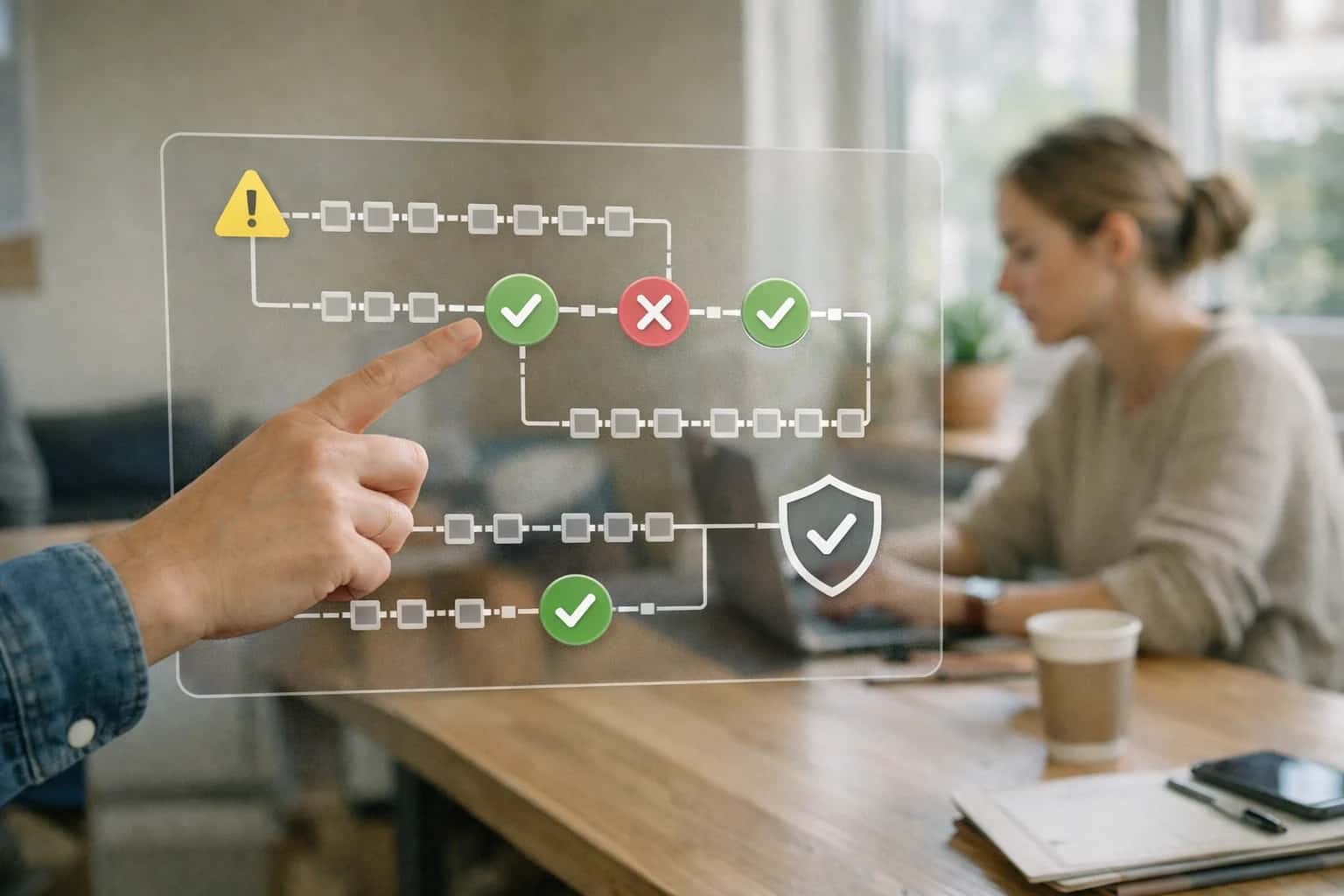
AUDITABLE LOGIC GOVERNANCE
What is Rule Versioning?
Rule versioning is the systematic practice of tracking, managing, and deploying iterative changes to validation logic, ensuring an immutable audit trail and enabling instant rollback to previous rule sets.
In production clinical systems, rule versioning enables instantaneous rollback to a previous golden record of logic if a newly deployed rule generates false positives or disrupts prior authorization automation. It decouples logic deployment from application code releases, allowing clinical informaticists to safely test candidate rules against historical data using temporal consistency checks before promoting them to active status, thereby preventing data corruption and maintaining strict data provenance.
IMMUTABLE LOGIC GOVERNANCE
Core Capabilities of Rule Versioning
Rule versioning provides the foundational audit trail and rollback mechanisms required to manage the lifecycle of deterministic validation logic in regulated clinical environments, ensuring that every change to a decision table or inference rule is tracked, attributable, and reversible.
01
Immutable Audit Trail
Every modification to a validation rule is captured as an immutable commit within a version history. This creates a tamper-proof log that records who made the change, when it was deployed, and the exact diff of the logic modification. For compliance with FDA and EU MDR regulations, this audit trail proves that clinical decision support logic has not been altered without proper authorization, linking directly to data provenance checks and 21 CFR Part 11 requirements for electronic signatures.
02
Semantic Versioning for Rulesets
Validation logic is packaged using a MAJOR.MINOR.PATCH semantic versioning scheme adapted for clinical rules:
- MAJOR: Breaking changes to the rule's output logic or clinical intent
- MINOR: New validation conditions added without altering existing behavior
- PATCH: Bug fixes, typo corrections, or performance optimizations This allows Business Rules Management Systems to automatically resolve dependencies and prevents incompatible rule versions from being deployed into production pipelines.
03
Instantaneous Rollback
If a newly deployed rule version introduces unexpected false positives or blocks legitimate clinical workflows, the system can revert to the previous stable version in milliseconds. Unlike code deployments that require rebuilds, rule rollback operates at the decision engine layer, immediately restoring the prior logic without interrupting the inference engine or requiring application restarts. This capability is critical for high-stakes prior authorization automation where erroneous denials carry regulatory risk.
04
A/B Testing of Validation Logic
Multiple versions of a rule can run concurrently in shadow mode, where the candidate version evaluates data silently without affecting production outcomes. This enables statistical comparison of rule performance:
- Compare false positive rates between v1.2 and v1.3
- Validate that a new reference range check does not over-flag normal lab results
- Measure the impact on confidence thresholding before full cutover Once the candidate version proves superior, a single flag promotes it to the active ruleset.
05
Tagged Release Snapshots
Specific rule configurations can be tagged with meaningful labels such as CMS-2025-Q1-COMPLIANT or HIPAA-SAFE-HARBOR-v2. These immutable snapshots capture the exact state of all validation logic at a regulatory milestone, enabling auditors to replay historical transactions against the precise rules that were active at that time. This directly supports data provenance checks and demonstrates to regulators that clinical data was validated against the correct, time-bound logic.
06
Conflict-Free Merge Resolution
When multiple clinical informaticists modify the same decision table concurrently, the versioning system automatically detects merge conflicts at the rule-condition level. Unlike text-based code merges, the system understands the semantic structure of cross-field validation logic and can intelligently resolve non-overlapping changes. For true conflicts—where two authors modify the same condition—the system quarantines the rule and requires explicit human resolution before the version can be committed.
Enabling Efficiency, Speed & Accuracy
Intelligent Analysis, Decision & Execution
We build AI systems for teams that need search across company data, workflow automation across tools, or AI features inside products and internal software.
Talk to Us
Search across company data
Give teams answers from docs, tickets, runbooks, and product data with sources and permissions.
Useful when people spend too long searching or get different answers from different systems.
Enterprise searchRAGPermissions
Read more
Automate internal workflows
Use AI to route work, draft outputs, trigger actions, and keep approvals and logs in place.
Useful when repetitive work moves across multiple tools and teams.
AI agentsWorkflow automationGovernance
Read more
Add AI to products and internal tools
Build assistants, guided actions, or decision support into the software your team or customers already use.
Useful when AI needs to be part of the product, not a separate tool.
AI integrationDecision supportModel routing
Read moreRULE GOVERNANCE
Frequently Asked Questions
Explore the critical practice of managing the lifecycle of clinical validation logic to ensure auditability, reproducibility, and safe evolution of automated decision-making systems.
Rule versioning is the systematic practice of tracking and managing discrete iterations of validation logic over time, creating an immutable history of every change made to a clinical validation rules engine. It is critical because healthcare regulations like HIPAA and FDA's SaMD guidance require strict audit trails demonstrating exactly which logic was active when a specific clinical decision was made. Without versioning, an organization cannot reproduce a past state to investigate an appeal or adverse event. Each version captures the full rule definition, its author, timestamp, and a rationale for the change, enabling deterministic rollback to a previous rule set if a newly deployed rule introduces errors or unintended denials. This transforms rule management from an ad-hoc script edit into a governed software lifecycle, ensuring that patient safety and reimbursement decisions are always traceable to a specific, approved logic artifact.

About the author
Prasad Kumkar
CEO & MD, Inference Systems
Prasad Kumkar is the CEO & MD of Inference Systems and writes about AI systems architecture, LLM infrastructure, model serving, evaluation, and production deployment. Over 5+ years, he has worked across computer vision models, L5 autonomous vehicle systems, and LLM research, with a focus on taking complex AI ideas into real-world engineering systems.
His work and writing cover AI systems, large language models, AI agents, multimodal systems, autonomous systems, inference optimization, RAG, evaluation, and production AI engineering.
LinkedIn
Limited slotsGet a Free AI Consultation
Partnered with leading AI, data, and software stack.





How We Work
Custom AI workflows for your Business
One-fit-all AI don't work for modern businesses. At Inferensys, we aim to understand your business & custom requirements; which we use to define most efficient agentic workflows, the data, and the tools for your business.
01
Review the use case
We understand the task, the users, and where AI can actually help.
Read more02
Pick the right approach
We define what needs search, automation, or product integration.
Read more03
Build the first useful version
We implement the part that proves the value first.
Read more04
Improve from there
We add the checks and visibility needed to keep it useful.
Read moreThe first call is a practical review of your use case and the right next step.
Talk to Us