Dynamic Buffer Management is a pull-based replenishment methodology that algorithmically resizes inventory and time buffers in response to real-time changes in demand variability and supply lead time reliability. Unlike static safety stock formulas, it monitors actual consumption rates and supply disruptions to dynamically recalculate the optimal buffer size required to prevent stockouts without overstocking.

Glossary
Dynamic Buffer Management
An algorithm that continuously adjusts inventory safety stock levels and time buffers based on real-time demand and supply variability to maintain target service levels while minimizing working capital.
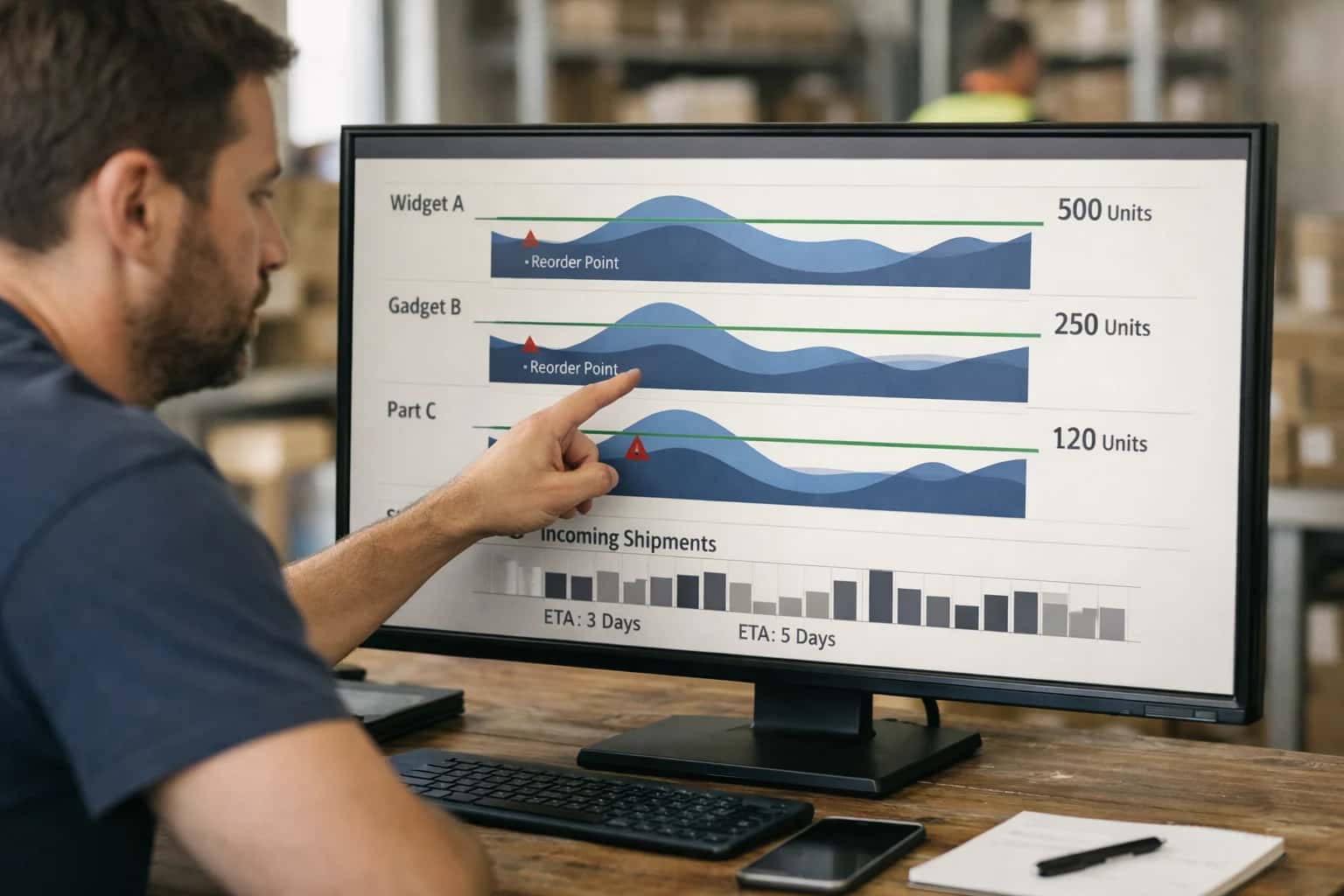
INVENTORY OPTIMIZATION
What is Dynamic Buffer Management?
Dynamic Buffer Management is an algorithm that continuously adjusts inventory safety stock levels and time buffers based on real-time demand and supply variability.
The system operates by tracking buffer penetration—how deeply demand consumes into the safety stock zone—and automatically triggers replenishment orders when penetration exceeds dynamically adjusted thresholds. This closed-loop mechanism ensures that buffers expand during volatile periods and contract during stability, directly linking inventory investment to actual risk exposure rather than historical averages.
ADAPTIVE INVENTORY LOGIC
Key Characteristics of Dynamic Buffer Management
Dynamic Buffer Management (DBM) is a pull-based replenishment methodology that continuously recalculates optimal inventory safety stock levels and time buffers in response to real-time demand signals and supply variability, replacing static, forecast-driven safety stock calculations.
01
Buffer Profile Segmentation
DBM classifies every SKU-location combination into distinct buffer profiles based on demand variability and volume. High-volume, stable items receive lean green buffers; erratic, low-volume items receive larger red buffers. This segmentation ensures that safety stock investment is allocated where it statistically prevents the most stock-outs, rather than applying a blanket policy across all inventory.
30-50%
Typical inventory reduction
02
Dynamic Adjustment Triggers
Unlike static safety stock formulas, DBM algorithms automatically resize buffers based on actual consumption velocity. Key triggers include:
- Demand spikes: A sustained increase in daily usage automatically expands the buffer.
- Supply latency: If a supplier's actual lead time drifts beyond the planned lead time, the time buffer is extended.
- Demand decay: As a product enters end-of-life, buffers are systematically compressed to prevent obsolete stock. This creates a self-correcting system that adapts without manual planner intervention.
03
Buffer Penetration Status
DBM visualizes inventory health through buffer penetration—a color-coded system indicating how deeply demand has consumed the buffer:
- Green (0-33%): Stock is healthy; no action required.
- Yellow (33-66%): Consumption is ahead of plan; expedite orders.
- Red (66-100%): High risk of stock-out; immediate replenishment priority. This provides a universal priority signal across thousands of SKUs, enabling teams to focus only on items penetrating the red zone.
04
Net Flow Equation
The core calculation driving DBM is the Net Flow Equation: On-Hand + Open Supply – Qualified Demand. A positive net flow indicates a healthy buffer; a negative net flow signals that demand commitments exceed available and incoming stock. This equation is recalculated daily or in real-time, providing a precise, forward-looking availability signal that accounts for both physical stock and in-transit replenishments.
05
Decoupling Point Optimization
DBM strategically positions decoupling points—inventory buffers that separate dependent demand from independent demand. By placing these buffers at critical nodes in the bill of materials or distribution network, variability is absorbed and prevented from cascading downstream. The algorithm continuously evaluates whether to move decoupling points closer to the customer or upstream based on lead time compression and demand volatility patterns.
06
Planned vs. Actual Lead Time Monitoring
A critical input to DBM is the continuous comparison of planned lead time against actual lead time. The system tracks the exact duration from order placement to receipt for every purchase order. If actual lead times consistently exceed planned values, the time buffer is automatically extended to prevent stock-outs. Conversely, if suppliers consistently deliver early, buffers are compressed to reduce working capital. This feedback loop eliminates the manual maintenance of lead time master data.
DYNAMIC BUFFER MANAGEMENT
Frequently Asked Questions
Explore the core mechanisms behind Dynamic Buffer Management, an algorithm that continuously adjusts inventory safety stock levels and time buffers based on real-time demand and supply variability to optimize flow and protect against disruptions.
Dynamic Buffer Management (DBM) is an algorithm that continuously adjusts inventory safety stock levels and time buffers based on real-time demand and supply variability, rather than relying on static, periodic forecasts. It works by monitoring the 'buffer status'—typically divided into green (healthy), yellow (caution), and red (risk of stockout) zones—and automatically resizing the buffer when the system detects that consumption rates or replenishment lead times have structurally changed. Unlike traditional safety stock formulas that use historical averages, DBM applies demand-driven logic to recalculate buffer levels dynamically, ensuring that capital is not tied up in excess inventory during stable periods while maintaining high service levels during volatile spikes. The algorithm often integrates with Complex Event Processing (CEP) engines to trigger immediate resizing actions when a supply disruption or demand surge is detected, making it a core component of autonomous supply chain control towers.
BUFFER STRATEGY COMPARISON
Dynamic vs. Static Buffer Management
A technical comparison of static, rule-based safety stock logic versus continuous, algorithm-driven dynamic buffer adjustment in supply chain inventory management.
| Feature | Static Buffer Management | Rule-Based Buffer Management | Dynamic Buffer Management |
|---|---|---|---|
Recalculation Frequency | Quarterly or annually | Weekly or monthly | Continuous (real-time) |
Demand Variability Input | Historical average only | Manual forecast override | Probabilistic demand signal |
Supply Variability Input | Fixed lead time assumption | Supplier scorecard data | Real-time lead time analytics |
Buffer Adjustment Mechanism | Manual planner review | Predefined threshold triggers | Automated algorithm execution |
Exception Handling | Expediting after stockout | Alert-based escalation | Autonomous resolution agent |
Inventory Optimization | 20-30% excess safety stock | 10-15% excess safety stock | 3-5% excess safety stock |
Data Integration Depth | ERP transaction history | ERP + supplier portals | ERP + IoT + external risk signals |
Response to Demand Spike | Stockout risk | Delayed buffer increase | Preemptive buffer expansion |
Enabling Efficiency, Speed & Accuracy
Intelligent Analysis, Decision & Execution
We build AI systems for teams that need search across company data, workflow automation across tools, or AI features inside products and internal software.
Talk to Us
Search across company data
Give teams answers from docs, tickets, runbooks, and product data with sources and permissions.
Useful when people spend too long searching or get different answers from different systems.
Enterprise searchRAGPermissions
Read more
Automate internal workflows
Use AI to route work, draft outputs, trigger actions, and keep approvals and logs in place.
Useful when repetitive work moves across multiple tools and teams.
AI agentsWorkflow automationGovernance
Read more
Add AI to products and internal tools
Build assistants, guided actions, or decision support into the software your team or customers already use.
Useful when AI needs to be part of the product, not a separate tool.
AI integrationDecision supportModel routing
Read more
About the author
Prasad Kumkar
CEO & MD, Inference Systems
Prasad Kumkar is the CEO & MD of Inference Systems and writes about AI systems architecture, LLM infrastructure, model serving, evaluation, and production deployment. Over 5+ years, he has worked across computer vision models, L5 autonomous vehicle systems, and LLM research, with a focus on taking complex AI ideas into real-world engineering systems.
His work and writing cover AI systems, large language models, AI agents, multimodal systems, autonomous systems, inference optimization, RAG, evaluation, and production AI engineering.
LinkedIn
Limited slotsGet a Free AI Consultation
Partnered with leading AI, data, and software stack.





How We Work
Custom AI workflows for your Business
One-fit-all AI don't work for modern businesses. At Inferensys, we aim to understand your business & custom requirements; which we use to define most efficient agentic workflows, the data, and the tools for your business.
01
Review the use case
We understand the task, the users, and where AI can actually help.
Read more02
Pick the right approach
We define what needs search, automation, or product integration.
Read more03
Build the first useful version
We implement the part that proves the value first.
Read more04
Improve from there
We add the checks and visibility needed to keep it useful.
Read moreThe first call is a practical review of your use case and the right next step.
Talk to Us