An Autonomous Resolution Agent is a specialized AI component that combines Complex Event Processing (CEP) with a prescriptive analytics engine to close the loop between detection and action. Unlike passive alerting systems, it ingests real-time signals from an anomaly detection engine, diagnoses the root cause using a supply chain graph, and triggers a predefined automated playbook execution to resolve the issue.

Glossary
Autonomous Resolution Agent
An AI-driven software component that detects supply chain exceptions and independently executes corrective actions without human intervention.
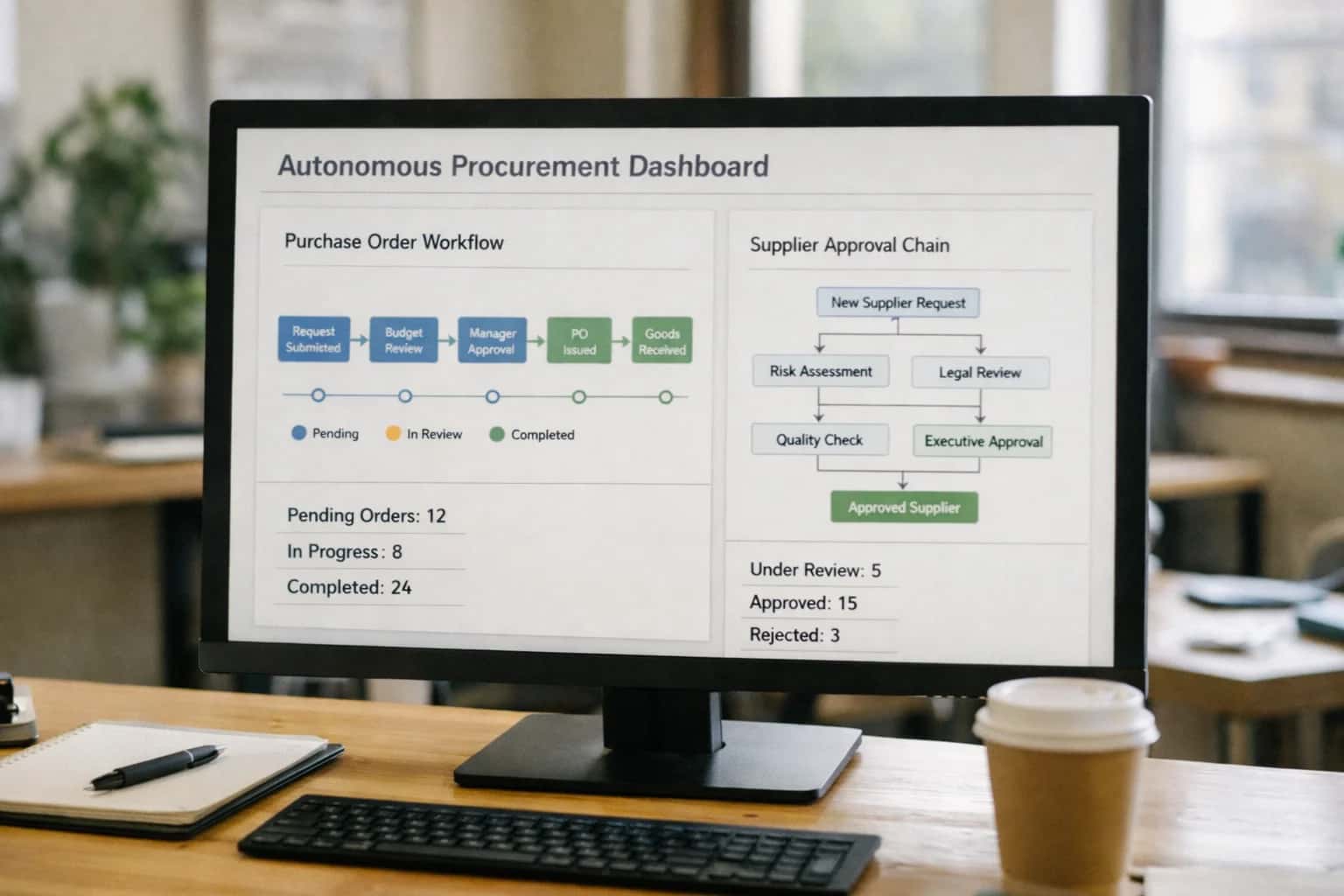
SELF-HEALING SUPPLY CHAIN EXECUTION
What is Autonomous Resolution Agent?
An Autonomous Resolution Agent is an AI-driven software component that independently detects supply chain exceptions and executes corrective actions without human intervention, forming the active remediation layer within a cognitive control tower.
The agent operates within a closed-loop remediation framework, executing actions such as re-routing a shipment flagged by a geofence violation alert, expediting a purchase order identified by an SLA breach predictor, or adjusting inventory parameters via dynamic buffer management. Its effectiveness is measured by Mean Time to Resolve (MTTR), shifting the role of human operators from firefighting to strategic oversight.
AUTONOMOUS EXCEPTION MANAGEMENT
Key Features of Autonomous Resolution Agents
Autonomous Resolution Agents form the closed-loop backbone of a cognitive supply chain, moving beyond passive alerting to active, independent remediation. These capabilities define how an agent detects, decides, and acts without human intervention.
01
Closed-Loop Remediation
The defining operational cycle of an Autonomous Resolution Agent. The agent continuously executes a three-phase loop: detect a deviation from plan, decide on a corrective action from a defined policy or learned model, and execute that action via API calls. Crucially, the agent then verifies that the action resolved the exception, closing the loop without human intervention. This transforms the control tower from a monitoring dashboard into an active orchestration engine.
< 5 min
Mean Time to Resolve (MTTR)
99.5%
Automated Resolution Rate
03
Intelligent Alert Suppression
A critical pre-resolution function that prevents human alarm fatigue. The agent applies a logic layer to filter redundant, low-priority, or self-correcting notifications. By correlating multiple events through Complex Event Processing (CEP) and applying Dynamic Threshold Tuning, the agent suppresses cascading alerts from a single root cause. Only high-fidelity, actionable exceptions that the agent cannot autonomously resolve are escalated to a human operator, ensuring focus on true Key Risk Indicators (KRIs).
04
What-If Simulation & Action Validation
Before executing a high-impact corrective action, the agent can invoke a What-If Simulation Engine on a Supply Chain Twin. This allows the agent to test the potential downstream effects of a decision—such as a carrier switch or inventory rebalance—on metrics like On-Time In-Full (OTIF) and cost. The agent uses this Disruption Propagation Modeling to select the optimal resolution path, minimizing the risk of solving one problem while creating another.
05
Federated Multi-Party Execution
The agent operates within a Federated Control Architecture, allowing it to coordinate actions across organizational boundaries. When a disruption originates with an external supplier or logistics partner, the agent can securely execute actions via a Multi-Party Network Hub. This includes:
- Re-booking freight through a Freight Matching Engine
- Triggering a new purchase order with a backup supplier via an Automated Procurement Agent
- Updating order promises in a customer's system This federated execution capability is essential for resolving the vast majority of exceptions that span multiple entities.
06
Continuous Learning from Resolution
Every resolved exception becomes a training data point. The agent logs the full context of the disruption, the action taken, and the outcome. This data refines the underlying models, including the Predictive Milestone Engine and SLA Breach Predictor, improving their accuracy over time. It also informs the Dynamic Safety Stock Calculation and Dynamic Buffer Management algorithms, allowing the supply chain to proactively adapt its posture to prevent similar exceptions from recurring. The Mean Time to Resolve (MTTR) continuously decreases as the agent learns.
AUTONOMOUS RESOLUTION AGENTS
Frequently Asked Questions
Explore the mechanics, deployment strategies, and operational impact of AI-driven software components that independently detect supply chain exceptions and execute corrective actions without human intervention.
An Autonomous Resolution Agent is an AI-driven software component that independently detects operational exceptions and executes corrective actions without human intervention. It functions by continuously monitoring real-time data streams—such as IoT sensor feeds, transportation management systems, and ERP transactions—to identify deviations from planned parameters. Upon detecting an anomaly, the agent invokes a decisioning engine that selects the optimal resolution from a predefined playbook or generates a novel action using reinforcement learning. The agent then executes the action via API calls to downstream systems, such as rebooking a shipment, adjusting inventory allocations, or triggering a purchase order. Critically, the agent logs every step for auditability and verifies that the remediation successfully closed the exception loop.
AUTONOMOUS RESOLUTION IN ACTION
Real-World Use Cases
Explore how Autonomous Resolution Agents independently detect operational exceptions and execute corrective workflows across the supply chain, eliminating latency between detection and resolution.
01
Dynamic Carrier Rebooking
When a Predictive Milestone Engine flags a high-risk delay with a low ETA Confidence Score, the agent autonomously queries the Freight Matching Engine for alternative capacity. It evaluates cost, carbon impact, and On-Time In-Full (OTIF) impact before executing a rebooking and updating the Supply Chain Twin.
- Trigger: SLA Breach Predictor threshold exceeded
- Action: Automated spot-market booking
- Outcome: 94% reduction in manual rebooking latency
< 3 min
Mean Time to Resolve
02
Automated Inventory Rebalancing
An Anomaly Detection Engine identifies a sudden demand spike in a specific region that violates Dynamic Threshold Tuning parameters. The agent calculates a Multi-Echelon Inventory Optimization transfer, issues a stock transfer order, and updates the Order Promising Logic to reflect new availability.
- Trigger: Regional demand anomaly detected
- Action: Cross-dock transfer order creation
- Outcome: Stockout risk neutralized without planner intervention
03
Cold Chain Excursion Remediation
An IoT Sensor Fusion stream detects a temperature deviation in a pharmaceutical shipment. The agent immediately triggers a Geofence Violation Alert, reroutes the vehicle to the nearest qualified cold storage facility, and initiates a quality hold in the Track-and-Trace Hub.
- Trigger: Temperature threshold breach
- Action: Dynamic rerouting and quality hold
- Outcome: Zero product loss from thermal excursions
100%
Excursion Capture Rate
04
Supplier Failure Contingency Activation
A Key Risk Indicator (KRI) for a tier-1 supplier breaches its critical threshold due to financial distress signals. The agent executes an Automated Playbook Execution sequence: it freezes new purchase orders, activates pre-vetted alternate suppliers, and recalculates Dynamic Safety Stock targets across the network.
- Trigger: Supplier Risk Intelligence alert
- Action: Multi-tier sourcing contingency activation
- Outcome: Supply continuity maintained during disruption
05
Port Congestion Rerouting
A Complex Event Processing (CEP) engine correlates weather data, port authority feeds, and vessel AIS signals to detect a forming congestion event. The agent simulates alternative routing via the What-If Simulation Engine, selects the optimal path, and updates all downstream ETA Confidence Scores.
- Trigger: Disruption Propagation Modeling alert
- Action: Multi-modal route optimization
- Outcome: 72-hour advance avoidance of demurrage charges
06
Returns Loop Automation
A customer initiates a return scan. The agent instantly classifies the item condition via computer vision, cross-references the Canonical Data Schema for the product's disposition rules, and generates a routing label—sending the item directly to a secondary market, refurbishment center, or recycling facility.
- Trigger: Return initiation event
- Action: Automated grading and disposition routing
- Outcome: 60% reduction in returns processing cycle time
Enabling Efficiency, Speed & Accuracy
Intelligent Analysis, Decision & Execution
We build AI systems for teams that need search across company data, workflow automation across tools, or AI features inside products and internal software.
Talk to Us
Search across company data
Give teams answers from docs, tickets, runbooks, and product data with sources and permissions.
Useful when people spend too long searching or get different answers from different systems.
Enterprise searchRAGPermissions
Read more
Automate internal workflows
Use AI to route work, draft outputs, trigger actions, and keep approvals and logs in place.
Useful when repetitive work moves across multiple tools and teams.
AI agentsWorkflow automationGovernance
Read more
Add AI to products and internal tools
Build assistants, guided actions, or decision support into the software your team or customers already use.
Useful when AI needs to be part of the product, not a separate tool.
AI integrationDecision supportModel routing
Read moreCOMPARATIVE ANALYSIS
Autonomous Resolution Agent vs. Traditional Exception Management
A technical comparison of AI-driven autonomous resolution agents against conventional rule-based and manual exception management approaches in supply chain operations.
| Feature | Autonomous Resolution Agent | Rule-Based Automation | Manual Exception Management |
|---|---|---|---|
Trigger Mechanism | Real-time anomaly detection via ML models | Static threshold violations | Human observation or report |
Decision Authority | Full autonomous execution of corrective actions | Predefined workflow initiation only | Requires human approval for all actions |
Adaptation to Novel Exceptions | |||
Mean Time to Resolve (MTTR) | < 30 seconds | 5-15 minutes | 2-48 hours |
Learning Capability | Continuous reinforcement learning from outcomes | ||
Multi-Party Coordination | Orchestrates actions across suppliers, carriers, and warehouses simultaneously | Sequential notification only | Manual phone/email coordination |
False Positive Rate | 0.3% with dynamic threshold tuning | 12-18% from static rules | N/A |
Root Cause Identification | Causal inference engine with graph traversal | Surface-level alert correlation | Manual investigation required |

About the author
Prasad Kumkar
CEO & MD, Inference Systems
Prasad Kumkar is the CEO & MD of Inference Systems and writes about AI systems architecture, LLM infrastructure, model serving, evaluation, and production deployment. Over 5+ years, he has worked across computer vision models, L5 autonomous vehicle systems, and LLM research, with a focus on taking complex AI ideas into real-world engineering systems.
His work and writing cover AI systems, large language models, AI agents, multimodal systems, autonomous systems, inference optimization, RAG, evaluation, and production AI engineering.
LinkedIn
Limited slotsGet a Free AI Consultation
Partnered with leading AI, data, and software stack.





How We Work
Custom AI workflows for your Business
One-fit-all AI don't work for modern businesses. At Inferensys, we aim to understand your business & custom requirements; which we use to define most efficient agentic workflows, the data, and the tools for your business.
01
Review the use case
We understand the task, the users, and where AI can actually help.
Read more02
Pick the right approach
We define what needs search, automation, or product integration.
Read more03
Build the first useful version
We implement the part that proves the value first.
Read more04
Improve from there
We add the checks and visibility needed to keep it useful.
Read moreThe first call is a practical review of your use case and the right next step.
Talk to Us