A Supply Chain Stress Test Simulator is a digital tool that applies hypothetical shock scenarios—such as a port closure, commodity price spike, or supplier bankruptcy—to a supply chain model to quantify financial and operational impact propagation. It leverages digital twin simulation and causal inference to move beyond static risk scores, revealing how a localized disruption cascades across multi-echelon inventory, transportation lanes, and production nodes in real-time.

Glossary
Supply Chain Stress Test Simulator
A digital tool that applies hypothetical shock scenarios—such as a port closure or commodity price spike—to a supply chain model to quantify financial and operational impact propagation.
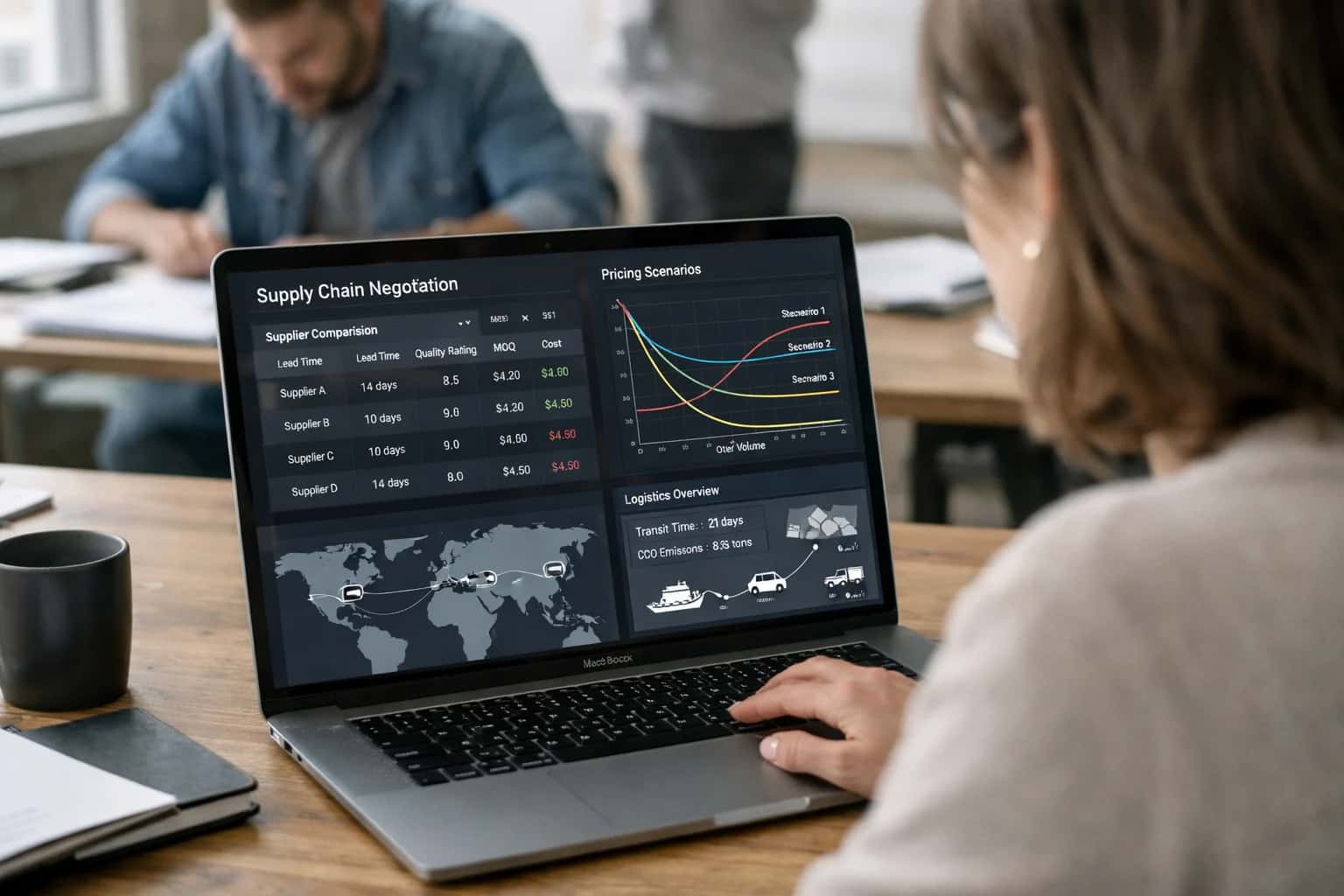
Digital Twin Resilience Analysis
What is a Supply Chain Stress Test Simulator?
A computational framework for quantifying how hypothetical disruptions propagate through a supply network to impact financial and operational performance.
By integrating with supplier risk scoring and sub-tier visibility engines, the simulator models not just direct supplier failures but also fourth-party risk propagation through the extended value chain. The output is a quantified loss exposure—measured in revenue impact, service level degradation, and recovery time—enabling Chief Procurement Officers to preemptively build inventory buffers, diversify sourcing, and validate the ROI of mitigation strategies before a crisis materializes.
CORE CAPABILITIES
Key Features of a Stress Test Simulator
A supply chain stress test simulator provides a controlled digital environment to quantify the financial and operational impact of hypothetical disruptions before they occur. The following features define a robust simulation platform.
01
Shock Scenario Definition
The ability to configure and inject precise, hypothetical disruption events into the digital model. Users define the type (e.g., port closure, supplier bankruptcy, commodity price spike), magnitude (e.g., 100% capacity loss), duration, and geographic scope of the shock. Advanced simulators allow for compound scenarios, such as a natural disaster triggering a simultaneous logistics bottleneck and a demand surge.
02
Bill-of-Materials Explosion
The automated process of mapping a disruption at a single node to all dependent downstream assemblies and products. The simulator traverses the multi-tier bill of materials (BOM) to identify every finished good SKU that relies on a disrupted component, part, or raw material. This reveals the full scope of impact propagation, not just the immediate first-tier effect.
03
Inventory & WIP Stratification
A modeling layer that accounts for all in-transit and on-hand inventory and work-in-progress (WIP) to calculate a time-phased depletion curve. The simulator does not assume zero stock; it precisely calculates the exact day when safety stock is exhausted for each affected node, providing a realistic timeline for when revenue impact begins.
04
Financial Impact Quantification
The translation of operational disruption into a detailed financial loss statement. The simulator calculates Cost of Goods Sold (COGS) impact, lost revenue from unfulfilled orders, expediting costs for alternative sourcing, and contractual penalties for service-level agreement (SLA) breaches. Outputs are aggregated by product line, region, and business unit.
05
Alternative Sourcing Simulation
The capability to model mitigation strategies in real-time. Users can activate pre-qualified alternative suppliers, shift production to a different facility, or change logistics modes (e.g., ocean to air freight). The simulator instantly recalculates the financial and operational impact, allowing for a direct cost-benefit analysis of the proposed recovery action.
06
Time-Phased Recovery Modeling
A dynamic simulation of the recovery trajectory, not just the initial impact. The model incorporates Time-to-Recovery (TTR) curves for each disrupted node, factoring in repair times, production ramp-up rates, and the gradual restoration of capacity. This provides a day-by-day projection of the financial drain until full operational health is restored.
SUPPLY CHAIN STRESS TESTING
Frequently Asked Questions
Clear, technical answers to the most common questions about simulating and quantifying the impact of disruptions on complex supply networks.
A Supply Chain Stress Test Simulator is a digital twin-based analytical engine that applies hypothetical shock scenarios to a computational model of a supply chain to quantify the cascading financial and operational impact. It works by ingesting a graph representation of the supply network—including nodes for suppliers, facilities, and routes, and edges for material flows and dependencies—and then systematically injecting disruptions. The engine uses discrete-event simulation and Monte Carlo methods to propagate the effects of a shock, such as a port closure or a commodity price spike, through the network. It calculates second-order effects like inventory stockouts, lead time inflation, and revenue loss, outputting a probabilistic impact assessment rather than a single deterministic forecast. This allows organizations to understand not just what might happen, but the range of potential financial exposure.
Enabling Efficiency, Speed & Accuracy
Intelligent Analysis, Decision & Execution
We build AI systems for teams that need search across company data, workflow automation across tools, or AI features inside products and internal software.
Talk to Us
Search across company data
Give teams answers from docs, tickets, runbooks, and product data with sources and permissions.
Useful when people spend too long searching or get different answers from different systems.
Enterprise searchRAGPermissions
Read more
Automate internal workflows
Use AI to route work, draft outputs, trigger actions, and keep approvals and logs in place.
Useful when repetitive work moves across multiple tools and teams.
AI agentsWorkflow automationGovernance
Read more
Add AI to products and internal tools
Build assistants, guided actions, or decision support into the software your team or customers already use.
Useful when AI needs to be part of the product, not a separate tool.
AI integrationDecision supportModel routing
Read more
About the author
Prasad Kumkar
CEO & MD, Inference Systems
Prasad Kumkar is the CEO & MD of Inference Systems and writes about AI systems architecture, LLM infrastructure, model serving, evaluation, and production deployment. Over 5+ years, he has worked across computer vision models, L5 autonomous vehicle systems, and LLM research, with a focus on taking complex AI ideas into real-world engineering systems.
His work and writing cover AI systems, large language models, AI agents, multimodal systems, autonomous systems, inference optimization, RAG, evaluation, and production AI engineering.
LinkedIn
Limited slotsGet a Free AI Consultation
Partnered with leading AI, data, and software stack.





How We Work
Custom AI workflows for your Business
One-fit-all AI don't work for modern businesses. At Inferensys, we aim to understand your business & custom requirements; which we use to define most efficient agentic workflows, the data, and the tools for your business.
01
Review the use case
We understand the task, the users, and where AI can actually help.
Read more02
Pick the right approach
We define what needs search, automation, or product integration.
Read more03
Build the first useful version
We implement the part that proves the value first.
Read more04
Improve from there
We add the checks and visibility needed to keep it useful.
Read moreThe first call is a practical review of your use case and the right next step.
Talk to Us