A Know Your Supplier (KYS) Protocol is a structured, technology-driven framework for automating the identity verification, ownership mapping, and compliance screening of third-party vendors before and during the commercial relationship. It digitizes the traditionally manual due diligence process, systematically collecting and validating supplier credentials—including tax IDs, certificates of incorporation, and Ultimate Beneficial Owner (UBO) declarations—against authoritative registries and sanctions lists to establish a verified legal entity profile.

Glossary
Know Your Supplier (KYS) Protocol
A digitized due diligence framework that automates the collection and verification of a supplier's identity, ownership, and compliance credentials during the onboarding process.
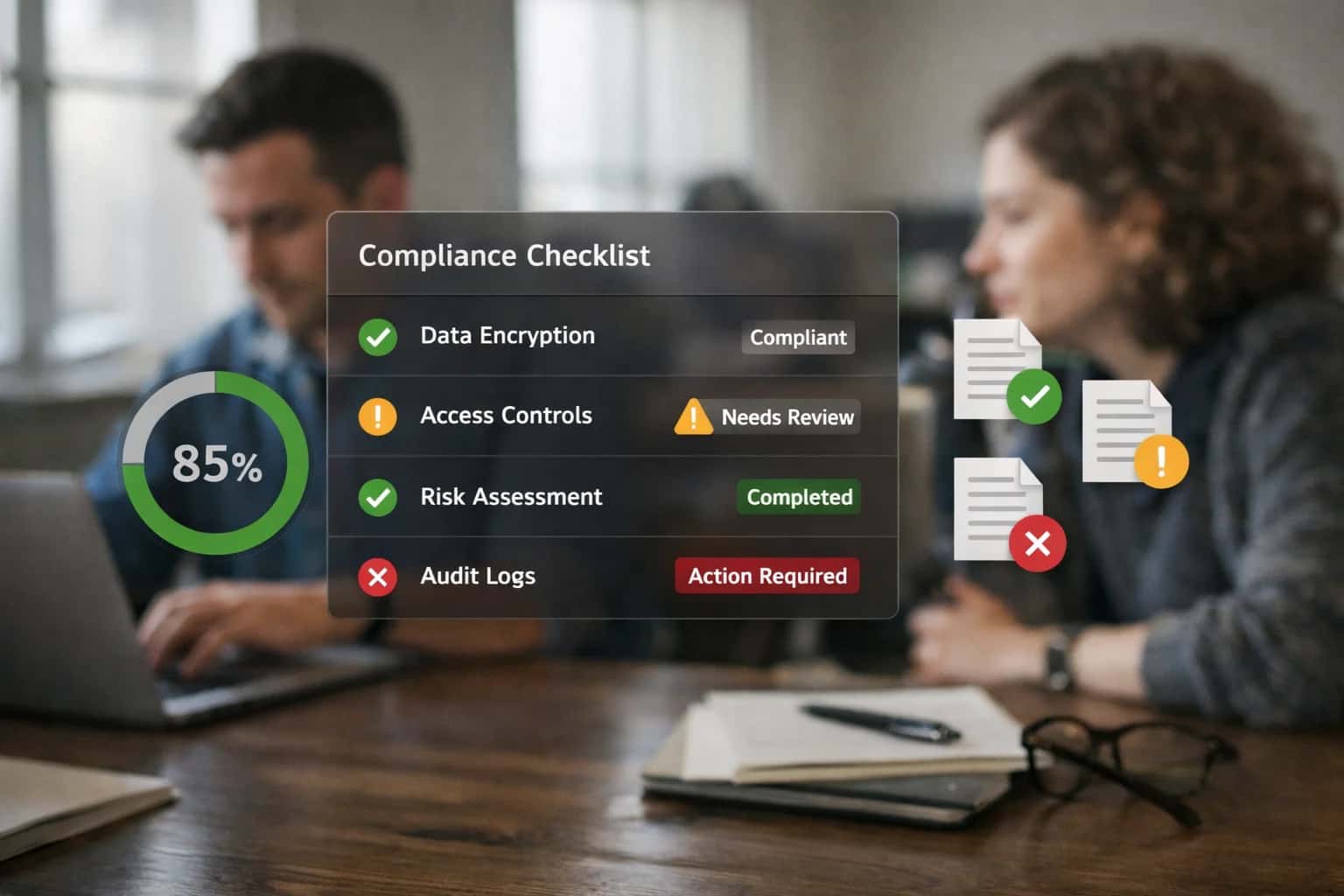
DIGITAL DUE DILIGENCE
What is Know Your Supplier (KYS) Protocol?
A digitized due diligence framework that automates the collection and verification of a supplier's identity, ownership, and compliance credentials during the onboarding process.
The protocol orchestrates a sequence of automated checks, including sanctions list fuzzy matching, beneficial ownership graph traversal, and adverse media monitoring, to generate a risk-calibrated pass/fail decision or escalation flag. By replacing paper-based questionnaires with API-driven verification and continuous monitoring, the KYS protocol reduces onboarding cycle time from weeks to hours while creating an auditable evidentiary trail for regulatory compliance with anti-money laundering (AML) and counter-terrorist financing (CTF) obligations.
DIGITIZED DUE DILIGENCE
Core Components of a KYS Protocol
A modern Know Your Supplier protocol is a multi-layered, AI-driven framework that automates identity verification, ownership mapping, and continuous compliance screening to eliminate manual onboarding friction and hidden risks.
01
Automated Identity Verification
The foundational layer that validates a supplier's legal existence and registration details against authoritative government and commercial registries in real time.
- Document Forensics: AI analyzes uploaded certificates of incorporation and tax IDs for digital tampering or inconsistencies.
- Entity Resolution: Algorithms disambiguate supplier names, addresses, and tax IDs across disparate databases to create a single, unified golden record.
- Sanctions List Fuzzy Matching: Probabilistic string-matching identifies potential hits against global restricted party lists despite variations in spelling, transliteration, or abbreviations.
< 30 sec
Average Verification Time
02
Ultimate Beneficial Ownership (UBO) Mapping
The process of piercing the corporate veil to identify the natural persons who ultimately own or control a legal entity, a critical step for anti-money laundering and anti-corruption compliance.
- Beneficial Ownership Graph Traversal: Maps complex, multi-jurisdictional corporate structures using graph databases to visualize control chains and identify hidden shell companies.
- UBO Disambiguation: AI resolves identity conflicts in fragmented corporate registries to accurately pinpoint the final individual, even through nested offshore structures.
- PEP Screening: Automatically cross-references identified principals against global databases of Politically Exposed Persons to flag heightened bribery and corruption risk.
5+
Average Ownership Layers
03
Continuous Compliance Monitoring
A perpetual surveillance engine that detects changes in a supplier's risk profile long after initial onboarding, replacing static point-in-time checks with dynamic alerting.
- Compliance Drift Detection: Algorithms continuously monitor operational and legal postures to identify subtle deviations from agreed-upon regulatory or contractual standards.
- Adverse Media Monitoring: An NLP pipeline scans global news and public records 24/7 for negative mentions related to financial crime, regulatory actions, or reputational damage.
- Force Majeure Trigger Classification: Models analyze unstructured text to automatically identify and classify events—such as natural disasters or political coups—that could activate contract clauses.
24/7
Monitoring Cadence
04
Financial Health & Solvency Analysis
The automated assessment of a supplier's financial stability using both structured data and unstructured text to predict the probability of bankruptcy or default.
- Bankruptcy Prediction Models: Statistical models, often based on the Altman Z-Score, estimate the probability of a supplier filing for bankruptcy within a specific time horizon.
- Financial Health NLP: Extracts forward-looking risk signals from earnings call transcripts and management discussion and analysis sections that are invisible in balance sheets.
- CDS Monitoring: Tracks credit default swap spreads as a real-time, market-implied indicator of a publicly traded supplier's perceived creditworthiness.
12-18 mo
Predictive Horizon
05
Geopolitical & Climate Risk Exposure
The integration of external threat intelligence to quantify a supplier's vulnerability to macro-level disruptions beyond their direct control.
- Geopolitical Risk Embedding: Encodes country-level political instability, regulatory changes, and conflict data into vector representations for machine learning models.
- Climate Risk Physical Asset Mapping: Overlays a supplier's facility locations with climate projection models to quantify exposure to floods, wildfires, and sea-level rise.
- Concentration Risk Quantifier: Measures the degree to which sourcing is dependent on a limited number of suppliers, geographic regions, or specific facilities, exposing single points of failure.
200+
Risk Indicators Tracked
06
Sub-tier Visibility & Fourth-Party Risk
The capability to illuminate hidden dependencies deep within the extended supply chain by mapping a supplier's own critical vendors and subcontractors.
- Sub-tier Visibility Engine: Uses AI to map and monitor the network of a supplier's own suppliers, revealing vulnerabilities that are invisible to the primary organization.
- Fourth-Party Risk Propagation: Models how a disruption or compliance failure at a subcontractor cascades through the value chain to create direct liability.
- Single Point of Failure (SPOF) Detection: Automatically identifies critical nodes—a specific supplier, facility, or component—whose disruption would cause a complete operational standstill.
N-tier
Depth of Visibility
KNOW YOUR SUPPLIER PROTOCOL
Frequently Asked Questions
Clear, technically precise answers to the most common questions about the digitized due diligence framework that automates supplier identity, ownership, and compliance verification during onboarding.
A Know Your Supplier (KYS) protocol is a digitized due diligence framework that automates the collection, verification, and continuous monitoring of a supplier's legal identity, beneficial ownership structure, and compliance credentials before and during the business relationship. The protocol operates as a multi-stage pipeline: data ingestion pulls structured and unstructured information from corporate registries, sanctions lists, and financial databases via API integrations; entity resolution algorithms disambiguate and link disparate records to create a single, unified supplier profile; risk scoring models then evaluate the entity against configurable rulesets covering financial health, geopolitical exposure, and regulatory compliance. Unlike manual processes, a mature KYS protocol triggers automated workflows—such as escalating a Politically Exposed Person (PEP) match for human review—and maintains an immutable audit trail for regulatory reporting under frameworks like the EU's Anti-Money Laundering Directives.
Enabling Efficiency, Speed & Accuracy
Intelligent Analysis, Decision & Execution
We build AI systems for teams that need search across company data, workflow automation across tools, or AI features inside products and internal software.
Talk to Us
Search across company data
Give teams answers from docs, tickets, runbooks, and product data with sources and permissions.
Useful when people spend too long searching or get different answers from different systems.
Enterprise searchRAGPermissions
Read more
Automate internal workflows
Use AI to route work, draft outputs, trigger actions, and keep approvals and logs in place.
Useful when repetitive work moves across multiple tools and teams.
AI agentsWorkflow automationGovernance
Read more
Add AI to products and internal tools
Build assistants, guided actions, or decision support into the software your team or customers already use.
Useful when AI needs to be part of the product, not a separate tool.
AI integrationDecision supportModel routing
Read more
About the author
Prasad Kumkar
CEO & MD, Inference Systems
Prasad Kumkar is the CEO & MD of Inference Systems and writes about AI systems architecture, LLM infrastructure, model serving, evaluation, and production deployment. Over 5+ years, he has worked across computer vision models, L5 autonomous vehicle systems, and LLM research, with a focus on taking complex AI ideas into real-world engineering systems.
His work and writing cover AI systems, large language models, AI agents, multimodal systems, autonomous systems, inference optimization, RAG, evaluation, and production AI engineering.
LinkedIn
Limited slotsGet a Free AI Consultation
Partnered with leading AI, data, and software stack.





How We Work
Custom AI workflows for your Business
One-fit-all AI don't work for modern businesses. At Inferensys, we aim to understand your business & custom requirements; which we use to define most efficient agentic workflows, the data, and the tools for your business.
01
Review the use case
We understand the task, the users, and where AI can actually help.
Read more02
Pick the right approach
We define what needs search, automation, or product integration.
Read more03
Build the first useful version
We implement the part that proves the value first.
Read more04
Improve from there
We add the checks and visibility needed to keep it useful.
Read moreThe first call is a practical review of your use case and the right next step.
Talk to Us