Force Majeure Trigger Classification is an NLP model trained to automatically scan unstructured text from news feeds, legal filings, and government declarations to identify and categorize events—such as natural disasters, wars, or pandemics—that could legally activate force majeure clauses in supplier contracts.

Glossary
Force Majeure Trigger Classification
An NLP model trained to analyze unstructured text from news and legal filings to automatically identify and classify events that could activate force majeure clauses in supplier contracts.
CONTRACTUAL EXCEPTION DETECTION
What is Force Majeure Trigger Classification?
An automated NLP system that analyzes unstructured text to identify and categorize events that may activate force majeure clauses in supplier contracts.
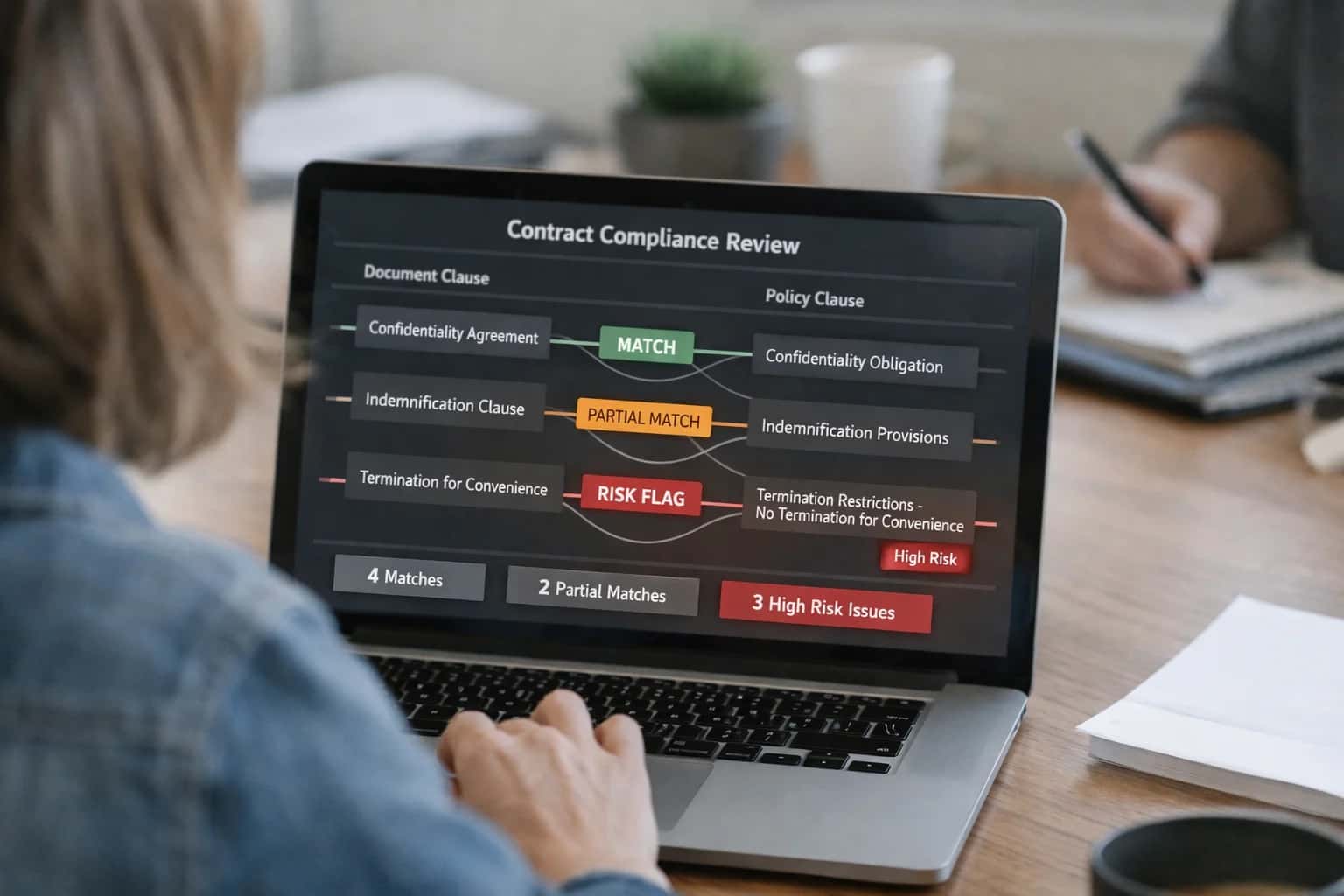
The system employs event extraction and semantic entailment techniques to map real-world incidents to specific contractual language, distinguishing between qualifying triggers like port closures and non-qualifying events like market price fluctuations, thereby enabling automated alerting for procurement and legal teams.
CONTRACTUAL RISK AUTOMATION
Key Features of Force Majeure Trigger Classification
An NLP model trained to analyze unstructured text from news and legal filings to automatically identify and classify events that could activate force majeure clauses in supplier contracts.
01
Multi-Lingual Event Detection
The core NLP engine processes unstructured text across multiple languages to identify force majeure trigger events in real-time. It scans global news feeds, regulatory filings, and legal announcements to detect:
- Natural disasters: earthquakes, floods, hurricanes, and wildfires
- Geopolitical events: war declarations, trade embargoes, and civil unrest
- Government actions: expropriation, nationalization, and regulatory shutdowns
- Infrastructure failures: port closures, grid outages, and transport blockades
The system uses named entity recognition (NER) to extract the specific location, date, and affected parties from each event mention.
50+
Languages Supported
< 500ms
Classification Latency
02
Clause-Specific Classification Taxonomy
Events are classified against a hierarchical taxonomy mapped to standard force majeure clause structures. The model distinguishes between:
- Tier 1 - Catastrophic: Events that unambiguously trigger most clauses (e.g., declared war, sovereign default)
- Tier 2 - Probable: Events with high likelihood of triggering based on jurisdictional precedent (e.g., port strikes, regional flooding)
- Tier 3 - Ambiguous: Events requiring legal interpretation (e.g., market disruption, currency controls)
Each classification includes a confidence score and cites the specific clause language matched, enabling procurement teams to prioritize legal review.
3
Classification Tiers
95%+
Tier 1 Precision
03
Jurisdictional Precedent Integration
The model incorporates a vectorized knowledge base of force majeure case law across major jurisdictions. When classifying an event, it retrieves and weighs relevant precedents:
- Common law jurisdictions: strict interpretation requiring explicit event enumeration
- Civil law jurisdictions: broader application of force majeure and imprévision doctrines
- UNCITRAL/CISG frameworks: international sale of goods standards
This contextual layer ensures the classification reflects not just the event itself, but its legal enforceability in the governing jurisdiction of the contract.
30+
Jurisdictions Modeled
04
Causality and Proximity Scoring
Beyond simple event detection, the model evaluates causal linkage between the event and the supplier's ability to perform. It analyzes:
- Geographic proximity: Is the event within a radius that physically impacts the supplier's facilities?
- Operational dependency: Does the event affect a critical input, logistics route, or utility?
- Temporal alignment: Does the event timeline overlap with contractual delivery obligations?
A causality score (0-100) quantifies the strength of the link, filtering out events that are geographically or operationally irrelevant despite being severe.
3
Causality Dimensions
05
Automated Alerting and Workflow Triggering
When a force majeure trigger is classified with high confidence, the system initiates a pre-configured workflow:
- Immediate notification to contract owners and legal counsel with event summary and classification rationale
- Affected contract enumeration: automatically identifies all active contracts with the impacted supplier or region
- Alternative sourcing trigger: signals procurement systems to initiate contingency sourcing protocols
- Audit trail generation: logs the full classification decision path for compliance and future dispute resolution
This closes the loop from detection to action, reducing the mean time to response (MTTR) from days to minutes.
< 2 min
Mean Time to Response
06
Continuous Model Adaptation
The classification model employs active learning to improve over time. When legal teams review and validate or overturn a classification, that feedback is captured and used to fine-tune the model:
- Human-in-the-loop feedback: legal experts label edge cases, refining the decision boundary
- Drift detection: monitors for shifts in event language patterns (e.g., new terms like 'pandemic lockdown')
- Emerging event taxonomy: automatically proposes new event categories when clusters of unclassified events are detected
This ensures the system remains accurate as contractual language, geopolitical realities, and event typologies evolve.
99.5%
Feedback Incorporation Rate
FORCE MAJEURE TRIGGER CLASSIFICATION
Frequently Asked Questions
Explore the technical mechanisms behind AI systems that automatically identify and classify force majeure events from unstructured text, enabling proactive supply chain risk management.
Force Majeure Trigger Classification is an NLP model trained to analyze unstructured text from news feeds, legal filings, and government announcements to automatically identify and categorize events that could activate force majeure clauses in supplier contracts. The system ingests continuous streams of textual data and applies transformer-based architectures fine-tuned on legal and operational taxonomies to detect specific trigger types—including natural disasters, acts of war, government expropriation, labor strikes, and pandemic-related lockdowns. Unlike keyword-based alerting, these models understand semantic context, distinguishing between a hypothetical discussion of a hurricane and an actual port closure declaration. The output is a structured classification with a confidence score, mapped to specific contract clauses and affected supplier relationships, enabling procurement teams to initiate contingency protocols before formal notifications arrive.
Enabling Efficiency, Speed & Accuracy
Intelligent Analysis, Decision & Execution
We build AI systems for teams that need search across company data, workflow automation across tools, or AI features inside products and internal software.
Talk to Us
Search across company data
Give teams answers from docs, tickets, runbooks, and product data with sources and permissions.
Useful when people spend too long searching or get different answers from different systems.
Enterprise searchRAGPermissions
Read more
Automate internal workflows
Use AI to route work, draft outputs, trigger actions, and keep approvals and logs in place.
Useful when repetitive work moves across multiple tools and teams.
AI agentsWorkflow automationGovernance
Read more
Add AI to products and internal tools
Build assistants, guided actions, or decision support into the software your team or customers already use.
Useful when AI needs to be part of the product, not a separate tool.
AI integrationDecision supportModel routing
Read more
About the author
Prasad Kumkar
CEO & MD, Inference Systems
Prasad Kumkar is the CEO & MD of Inference Systems and writes about AI systems architecture, LLM infrastructure, model serving, evaluation, and production deployment. Over 5+ years, he has worked across computer vision models, L5 autonomous vehicle systems, and LLM research, with a focus on taking complex AI ideas into real-world engineering systems.
His work and writing cover AI systems, large language models, AI agents, multimodal systems, autonomous systems, inference optimization, RAG, evaluation, and production AI engineering.
LinkedIn
Limited slotsGet a Free AI Consultation
Partnered with leading AI, data, and software stack.





How We Work
Custom AI workflows for your Business
One-fit-all AI don't work for modern businesses. At Inferensys, we aim to understand your business & custom requirements; which we use to define most efficient agentic workflows, the data, and the tools for your business.
01
Review the use case
We understand the task, the users, and where AI can actually help.
Read more02
Pick the right approach
We define what needs search, automation, or product integration.
Read more03
Build the first useful version
We implement the part that proves the value first.
Read more04
Improve from there
We add the checks and visibility needed to keep it useful.
Read moreThe first call is a practical review of your use case and the right next step.
Talk to Us