Compliance Drift Detection is an algorithmic process that continuously monitors a supplier's operational and legal posture to identify subtle, non-obvious deviations from agreed-upon regulatory or contractual standards over time. Unlike periodic audits that capture a static point-in-time snapshot, this technique establishes a dynamic baseline of a supplier's compliance state—including their certifications, data handling practices, and sub-tier relationships—and then applies statistical anomaly detection to flag the slow, often unintentional, erosion of those standards before they result in a material breach or regulatory penalty.

Glossary
Compliance Drift Detection
An algorithmic process that continuously monitors a supplier's operational and legal posture to identify subtle deviations from agreed-upon regulatory or contractual standards over time.
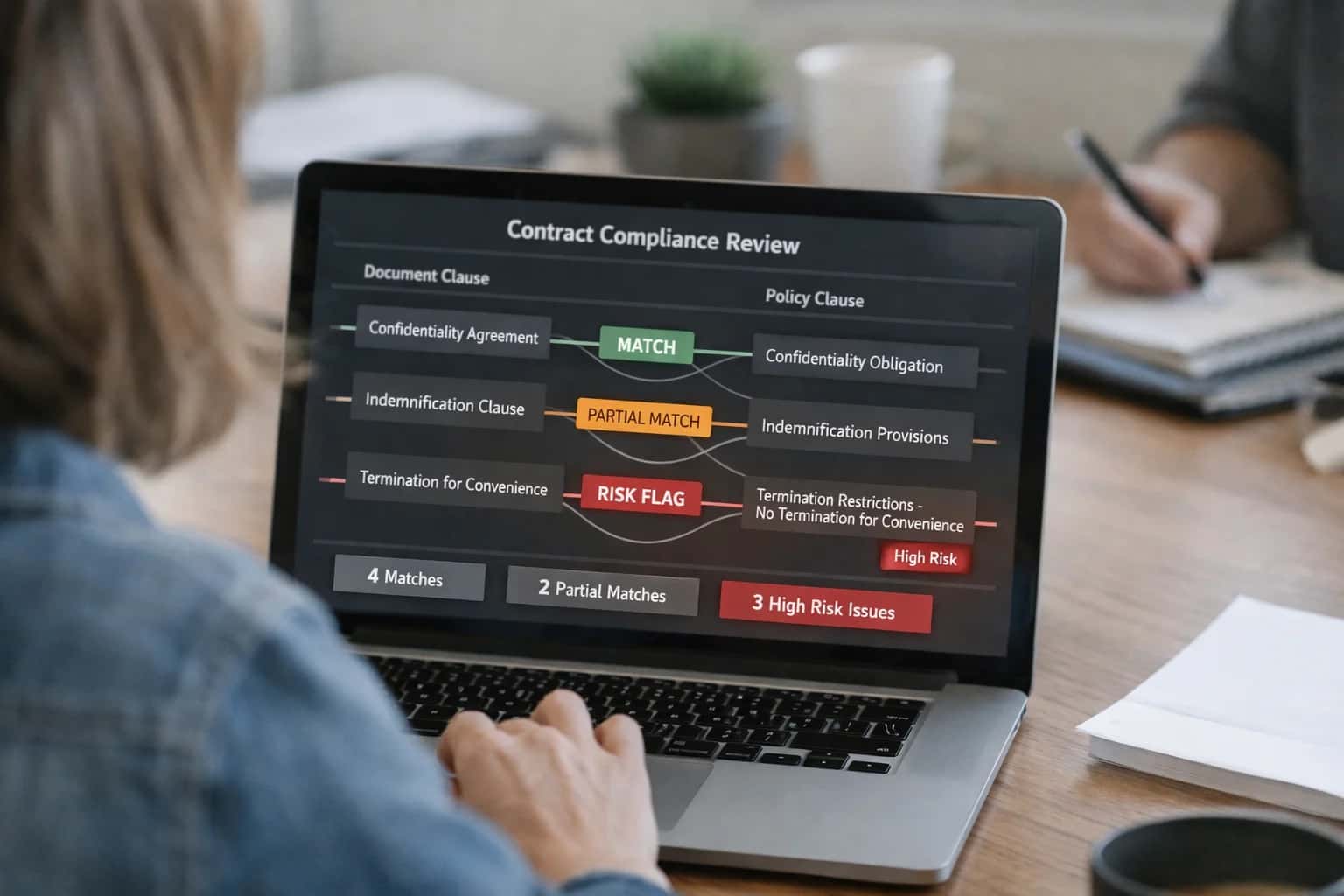
REGULATORY POSTURE MONITORING
What is Compliance Drift Detection?
An algorithmic process that continuously monitors a supplier's operational and legal posture to identify subtle deviations from agreed-upon regulatory or contractual standards over time.
The mechanism relies on ingesting heterogeneous data streams, from automated XBRL tagging of financial filings to adverse media monitoring and changes in a supplier's beneficial ownership graph. By vectorizing this multi-modal data and tracking its trajectory in a high-dimensional space, the system can distinguish between benign operational noise and a genuine drift toward non-compliance, such as a gradual relaxation of data privacy controls or an unregistered shift in subcontractor usage. This provides chief procurement officers with a leading indicator of risk, enabling preemptive remediation rather than reactive damage control.
CONTINUOUS ASSURANCE
Key Characteristics of Compliance Drift Detection
Compliance drift detection is not a periodic audit but a continuous, algorithmic surveillance system. It identifies the subtle, non-obvious degradation of a supplier's regulatory posture before it manifests as a formal violation.
01
Continuous Baseline Comparison
The core mechanism involves establishing a digital fingerprint of a supplier's compliant state at the point of onboarding. The system then continuously compares real-time operational data against this baseline. A drift score is calculated using statistical distance metrics, flagging deviations in areas like safety certifications, labor practices, or data handling protocols long before a scheduled audit would catch them.
02
Multi-Signal Correlation Engine
Drift is rarely signaled by a single data point. The engine correlates weak signals from disparate sources to identify a pattern of non-compliance:
- Structured data: Changes in insurance expiry dates, lapsed certifications, or anomalous shipping routes.
- Unstructured data: Negative sentiment in employee reviews, local news of facility violations, or changes in legal entity registration.
- Third-party data: Drops in external cybersecurity ratings or ESG scores.
03
Temporal Anomaly Detection
This process uses time-series analysis to understand a supplier's normal rhythm of compliance. A factory that has consistently renewed its ISO certification in March for five years but fails to do so by April triggers a drift alert. The system distinguishes between a benign administrative delay and a leading indicator of financial distress or operational failure by analyzing the velocity and direction of the change.
04
Contractual Clause Embedding
Instead of simple keyword matching, specific contractual obligations are encoded as vector embeddings. The system monitors a supplier's public-facing actions and legal filings, comparing them against these embeddings. For example, a clause prohibiting the use of subcontractors in a specific region is continuously checked against shipping manifests and customs data to detect a semantic, not just literal, breach of terms.
05
Explainable Drift Alerts
When drift is detected, the system must provide a human-auditable trail of evidence. An alert is not just a score; it includes the specific signals that contributed to the drift, their weights, and a natural language summary of the suspected issue. This explainability is critical for procurement teams to validate the alert and engage the supplier with a precise, fact-based inquiry rather than a vague accusation.
06
Predictive Drift Trajectory
Beyond detecting current drift, the system models its future trajectory. Using a Markov chain or similar probabilistic model, it forecasts the likelihood that the current minor deviation will escalate into a critical compliance failure within a 30, 60, or 90-day window. This allows risk managers to prioritize interventions on the suppliers most likely to imminently breach a regulatory threshold.
COMPLIANCE DRIFT DETECTION
Frequently Asked Questions
Clear, technical answers to the most common questions about how automated systems identify and alert on subtle deviations in supplier regulatory and contractual postures over time.
Compliance drift detection is an algorithmic monitoring process that continuously compares a supplier's current operational and legal posture against a previously established baseline of regulatory and contractual standards to identify subtle, non-compliant deviations over time. It works by ingesting diverse data streams—such as updated certifications, financial filings, legal registries, and news feeds—and applying statistical anomaly detection and natural language processing (NLP) models to flag statistically significant changes. Unlike periodic audits, which capture a point-in-time snapshot, drift detection systems operate perpetually, quantifying the 'distance' a supplier has moved from its original compliant state and triggering alerts when a pre-defined risk threshold is breached, enabling proactive risk management before a minor deviation becomes a material breach.
Enabling Efficiency, Speed & Accuracy
Intelligent Analysis, Decision & Execution
We build AI systems for teams that need search across company data, workflow automation across tools, or AI features inside products and internal software.
Talk to Us
Search across company data
Give teams answers from docs, tickets, runbooks, and product data with sources and permissions.
Useful when people spend too long searching or get different answers from different systems.
Enterprise searchRAGPermissions
Read more
Automate internal workflows
Use AI to route work, draft outputs, trigger actions, and keep approvals and logs in place.
Useful when repetitive work moves across multiple tools and teams.
AI agentsWorkflow automationGovernance
Read more
Add AI to products and internal tools
Build assistants, guided actions, or decision support into the software your team or customers already use.
Useful when AI needs to be part of the product, not a separate tool.
AI integrationDecision supportModel routing
Read moreCONTINUOUS MONITORING VS. POINT-IN-TIME ASSESSMENT
Compliance Drift Detection vs. Traditional Compliance Audits
A feature-level comparison of algorithmic compliance drift detection against periodic manual audit methodologies for supplier risk management.
| Feature | Compliance Drift Detection | Traditional Compliance Audits |
|---|---|---|
Monitoring Frequency | Continuous, real-time | Periodic (quarterly/annual) |
Detection Latency | < 1 hour from deviation | 30-90 days post-audit |
Data Sources Analyzed | Structured + unstructured (news, filings, registries) | Primarily structured (questionnaires, documents) |
Granularity of Assessment | Attribute-level (individual clauses, metrics) | Aggregate-level (overall compliance status) |
Automated Alerting | ||
NLP-Driven Adverse Media Screening | ||
Regulatory Change Adaptation | Dynamic, model retrained on new regulations | Manual, policy update required |
False Positive Rate | 0.3-1.2% | Not applicable (manual review) |
OPERATIONALIZING CONTINUOUS COMPLIANCE
Real-World Applications of Compliance Drift Detection
Compliance drift detection moves beyond periodic audits to provide a real-time, algorithmic safeguard against regulatory decay. These applications demonstrate how continuous monitoring of a supplier's legal, financial, and operational posture prevents minor deviations from hardening into material breaches.
01
Automated Sanctions List Reconciliation
A core application where drift detection algorithms perform continuous fuzzy matching against dynamic global sanctions lists, rather than relying on point-in-time onboarding checks. The system monitors for subtle changes in a supplier's beneficial ownership structure or corporate registration that might suddenly place them within a sanctioned entity's control sphere. When a minority stake crosses a regulatory threshold, the drift is flagged instantly, triggering an automated hold on pending transactions and a review workflow for the compliance team.
< 1 hour
Mean Time to Detection
02
Regulatory Change Gap Analysis
This application ingests global regulatory feeds—such as updates to the German Supply Chain Due Diligence Act (LkSG) or EU Deforestation Regulation (EUDR)—and algorithmically maps new clauses to existing supplier contracts and attestations. The drift detector identifies gaps where a supplier's current documented practices no longer satisfy the updated legal standard. For example, if a new regulation mandates specific Scope 3 emission reporting granularity, the system flags all suppliers whose submitted data lacks the newly required fields, quantifying the compliance debt in real-time.
200+
Regulatory Feeds Monitored
03
Cybersecurity Posture Degradation Alerts
Compliance drift is not limited to legal text; it extends to technical security postures. This application continuously scans a supplier's external attack surface—checking for expired SSL/TLS certificates, newly exposed remote access ports, or a downgrade in their DNSSEC configuration. A drift event is triggered when a supplier's observed security hygiene falls below the contractual minimum, such as a drop from a required SOC 2 Type II control standard. This provides procurement teams with an early warning before a vulnerability becomes a breach that disrupts the supply chain.
24/7
Continuous Monitoring Cycle
04
Insurance and Liability Coverage Lapse Detection
A critical financial drift vector involves a supplier's insurance coverage. Algorithms parse certificates of insurance (COIs) and compare them against contractual requirements for cyber liability, product recall, or general commercial liability. The system detects drift when a policy's aggregate limit falls below the mandated threshold or when a policy expiration date passes without a renewed COI on file. This automated safeguard prevents the enterprise from unknowingly absorbing catastrophic liability for an underinsured supplier's failure.
100%
COI Compliance Verification
05
Ethical Sourcing and Labor Practice Monitoring
Drift detection extends into ESG (Environmental, Social, and Governance) compliance by monitoring unstructured data for signals of deteriorating labor practices. The system ingests adverse media from local news, NGO reports, and worker forums in the supplier's native language. Using sentiment analysis and entity extraction, it identifies a drift pattern—such as a sudden increase in wage theft allegations or safety violations at a specific facility—that contradicts the supplier's signed Code of Conduct. This allows brands to intervene before a social media exposé causes reputational damage.
50+
Languages Analyzed
06
Product Specification and Material Substitution Drift
In highly regulated industries like aerospace or medical devices, even minor material substitutions can constitute a catastrophic compliance failure. This application uses NLP to parse incoming supplier certificates of analysis (COAs) and compare the declared material composition, tensile strength, or chemical purity against the master specification. A drift alert is generated if a batch's chromium content deviates by even 0.1% from the approved design, or if a supplier begins sourcing a component from an unauthorized sub-tier facility, preventing non-conforming parts from entering the production line.
99.9%
Specification Anomaly Recall

About the author
Prasad Kumkar
CEO & MD, Inference Systems
Prasad Kumkar is the CEO & MD of Inference Systems and writes about AI systems architecture, LLM infrastructure, model serving, evaluation, and production deployment. Over 5+ years, he has worked across computer vision models, L5 autonomous vehicle systems, and LLM research, with a focus on taking complex AI ideas into real-world engineering systems.
His work and writing cover AI systems, large language models, AI agents, multimodal systems, autonomous systems, inference optimization, RAG, evaluation, and production AI engineering.
LinkedIn
Limited slotsGet a Free AI Consultation
Partnered with leading AI, data, and software stack.





How We Work
Custom AI workflows for your Business
One-fit-all AI don't work for modern businesses. At Inferensys, we aim to understand your business & custom requirements; which we use to define most efficient agentic workflows, the data, and the tools for your business.
01
Review the use case
We understand the task, the users, and where AI can actually help.
Read more02
Pick the right approach
We define what needs search, automation, or product integration.
Read more03
Build the first useful version
We implement the part that proves the value first.
Read more04
Improve from there
We add the checks and visibility needed to keep it useful.
Read moreThe first call is a practical review of your use case and the right next step.
Talk to Us