A Reverse Logistics Control Tower is a centralized digital hub that provides real-time, end-to-end visibility and orchestration of the entire returns lifecycle, from customer initiation to final asset recovery. It aggregates data from disparate systems—carriers, warehouses, and disposition engines—into a single pane of glass, enabling proactive exception management and strategic decision-making for the reverse flow.

Glossary
Reverse Logistics Control Tower
A centralized digital hub providing real-time visibility and AI-powered orchestration of the entire returns flow, from customer drop-off to final asset recovery.
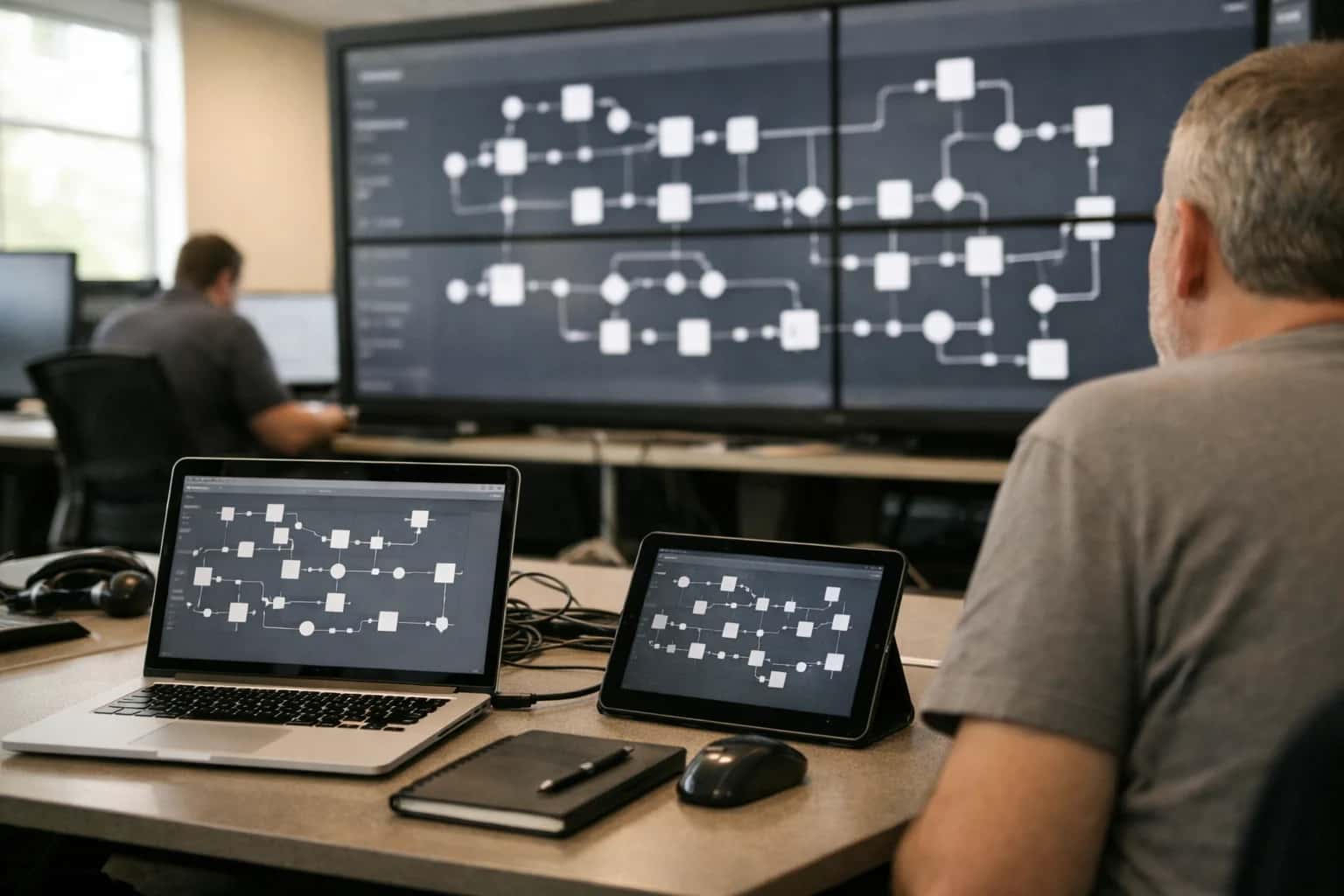
END-TO-END RETURNS ORCHESTRATION
What is a Reverse Logistics Control Tower?
A centralized digital hub providing real-time visibility and orchestration of the entire returns flow, from customer drop-off to final asset recovery.
By integrating with an Automated Disposition Engine and Dynamic Re-routing Algorithm, the control tower transforms a traditionally reactive process into a predictive, autonomous network. It monitors key metrics like Restocking Confidence Score and Grade-to-Net Recovery Rate to continuously optimize for maximum value recovery, minimizing processing latency and preventing bottlenecks before they impact the Digital Twin of Return Stream.
CENTRALIZED ORCHESTRATION
Core Capabilities of a Reverse Logistics Control Tower
A Reverse Logistics Control Tower serves as the centralized digital hub that provides real-time visibility and intelligent orchestration across the entire returns lifecycle, from customer drop-off to final asset recovery.
01
End-to-End Visibility
Provides a single pane of glass for the entire reverse supply chain. The control tower ingests data from carrier APIs, warehouse management systems, and point-of-sale terminals to track every returned unit in real time.
- Milestone Tracking: Monitors key events such as label generation, carrier first scan, in-transit checkpoints, warehouse receipt, and final disposition.
- Exception Flagging: Automatically surfaces shipments that have stalled, deviated from their planned route, or exceeded their expected transit time.
- Inventory Reconciliation: Provides a real-time view of returns inventory in transit, awaiting processing, and already graded, preventing phantom inventory issues.
< 5 min
Data Refresh Latency
02
Intelligent Disposition Orchestration
Integrates with an Automated Disposition Engine to execute the optimal recovery path for each returned item. The control tower acts as the conductor, translating a disposition decision into a physical workflow.
- Workflow Routing: Sends automated sortation instructions to conveyors and handheld scanners, directing items to restock, liquidation, repair, or recycling stations.
- Vendor Compliance: For defective units, triggers the Vendor Chargeback Agent to generate debit notes and routes the physical goods to a designated return-to-vendor staging area.
- Recommerce Integration: For items destined for secondary markets, automatically transmits the Secondary Market Valuation Model price and item data to B2B auction platforms or B2C recommerce storefronts.
03
Predictive & Prescriptive Analytics
Leverages machine learning to move from reactive monitoring to proactive management. The control tower forecasts future states and recommends preemptive actions.
- Return Volume Forecasting: Predicts inbound return volumes by SKU and region using historical patterns, promotional calendars, and current sales data to optimize warehouse labor planning.
- Bottleneck Prediction: Uses a Digital Twin of Return Stream to simulate processing capacity and identify future choke points before they cause service level agreement breaches.
- Prescriptive Alerts: Instead of just flagging a delay, the system recommends a specific action, such as re-routing a truckload of returns to an alternate facility with available capacity.
04
Unified Exception Management
Consolidates alerts from disparate systems into a single prioritized queue for human operators. This prevents alert fatigue and ensures critical issues are addressed first.
- Sentiment-Triggered Escalation: Integrates with the Sentiment-Triggered Exception system to automatically escalate cases where a customer's communication indicates high frustration or legal threat.
- Weight Discrepancy Resolution: Surfaces Weight Discrepancy Alerts from dimensioning systems, linking them directly to the order record for rapid investigation of potential fraud or pick errors.
- Carrier Performance Monitoring: Tracks carrier on-time performance for reverse legs, automatically flagging systemic failures for logistics managers to trigger contract penalties or re-routing rules.
05
Financial Recovery Analytics
Provides a comprehensive dashboard of the financial health of the returns operation, measuring the effectiveness of asset recovery strategies.
- Grade-to-Net Recovery Tracking: Monitors the Grade-to-Net Recovery Rate in real time, correlating cosmetic grades assigned by Computer Vision Grading systems to actual resale prices achieved.
- Cost-to-Serve Analysis: Calculates the total processing cost per return, including inbound freight, labor, packaging, and marketplace fees, to identify unprofitable return channels.
- Chargeback Reconciliation: Tracks the status of all Vendor Chargeback Agent submissions, ensuring that supplier debit notes are issued and settled, directly impacting the bottom line.
06
Sustainability Command Center
Measures and optimizes the environmental impact of the reverse logistics network, supporting circular economy goals and regulatory compliance.
- Circular Economy Routing: Monitors the effectiveness of the Circular Economy Router, tracking the percentage of returns successfully diverted from landfill to repair, refurbishment, or recycling streams.
- Carbon Footprint Tracking: Calculates the carbon emissions associated with reverse logistics transport and processing, enabling data-driven decisions to consolidate shipments or switch to lower-emission carriers.
- Hazmat Compliance: Provides a dashboard for the Hazmat Flagging Agent, ensuring all hazardous returns are accounted for and processed according to environmental regulations, mitigating compliance risk.
CENTRALIZED RETURNS ORCHESTRATION
How a Reverse Logistics Control Tower Operates
A Reverse Logistics Control Tower is a centralized digital hub that aggregates real-time data across the entire returns ecosystem to provide end-to-end visibility, predictive analytics, and automated orchestration of reverse flows from initiation to final asset recovery.
A Reverse Logistics Control Tower ingests streaming data from carrier APIs, warehouse management systems, and IoT sensors to create a unified operational picture. It applies prescriptive analytics to dynamically re-route returned goods, predict processing bottlenecks, and optimize disposition decisions—whether restocking, liquidation, or recycling—based on real-time inventory levels and secondary market demand signals.
The tower functions as an exception management engine, automatically flagging anomalies such as weight discrepancies, hazmat violations, or return rate spikes using machine learning models. By integrating with automated disposition engines and dynamic re-routing algorithms, it orchestrates touchless workflows that minimize manual intervention, reduce processing latency, and maximize net recovery value across the reverse supply chain.
REVERSE LOGISTICS CONTROL TOWER
Frequently Asked Questions
Explore the core concepts, mechanisms, and business impact of a centralized digital hub designed to orchestrate and optimize the entire returns lifecycle.
A Reverse Logistics Control Tower is a centralized digital hub that provides end-to-end, real-time visibility and orchestration of the entire returns flow, from customer drop-off to final asset recovery. It works by aggregating data from disparate systems—such as Return Merchandise Authorization (RMA) Bots, carrier tracking APIs, warehouse management systems, and financial platforms—into a single pane of glass. Advanced analytics and Automated Disposition Engines process this data to prescribe optimal recovery paths, while Dynamic Re-routing Algorithms adjust transit paths in real-time to bypass bottlenecks. This orchestration layer transforms a traditionally reactive and opaque process into a proactive, transparent, and profit-optimized function.
Enabling Efficiency, Speed & Accuracy
Intelligent Analysis, Decision & Execution
We build AI systems for teams that need search across company data, workflow automation across tools, or AI features inside products and internal software.
Talk to Us
Search across company data
Give teams answers from docs, tickets, runbooks, and product data with sources and permissions.
Useful when people spend too long searching or get different answers from different systems.
Enterprise searchRAGPermissions
Read more
Automate internal workflows
Use AI to route work, draft outputs, trigger actions, and keep approvals and logs in place.
Useful when repetitive work moves across multiple tools and teams.
AI agentsWorkflow automationGovernance
Read more
Add AI to products and internal tools
Build assistants, guided actions, or decision support into the software your team or customers already use.
Useful when AI needs to be part of the product, not a separate tool.
AI integrationDecision supportModel routing
Read more
About the author
Prasad Kumkar
CEO & MD, Inference Systems
Prasad Kumkar is the CEO & MD of Inference Systems and writes about AI systems architecture, LLM infrastructure, model serving, evaluation, and production deployment. Over 5+ years, he has worked across computer vision models, L5 autonomous vehicle systems, and LLM research, with a focus on taking complex AI ideas into real-world engineering systems.
His work and writing cover AI systems, large language models, AI agents, multimodal systems, autonomous systems, inference optimization, RAG, evaluation, and production AI engineering.
LinkedIn
Limited slotsGet a Free AI Consultation
Partnered with leading AI, data, and software stack.





How We Work
Custom AI workflows for your Business
One-fit-all AI don't work for modern businesses. At Inferensys, we aim to understand your business & custom requirements; which we use to define most efficient agentic workflows, the data, and the tools for your business.
01
Review the use case
We understand the task, the users, and where AI can actually help.
Read more02
Pick the right approach
We define what needs search, automation, or product integration.
Read more03
Build the first useful version
We implement the part that proves the value first.
Read more04
Improve from there
We add the checks and visibility needed to keep it useful.
Read moreThe first call is a practical review of your use case and the right next step.
Talk to Us