Digital Twin Synchronization is the engineering discipline of maintaining a high-fidelity, real-time data link between a physical logistics asset—such as an autonomous mobile robot (AMR) or a conveyor system—and its virtual representation. This process relies on streaming telemetry data from IoT sensors and edge devices to update the digital model's state, while simultaneously allowing control commands and optimization parameters computed in the simulation to be pushed back to the physical asset, creating a closed-loop cyber-physical system.

Glossary
Digital Twin Synchronization
The process of maintaining a real-time, bi-directional data link between a physical logistics asset and its virtual representation for simulation and control.
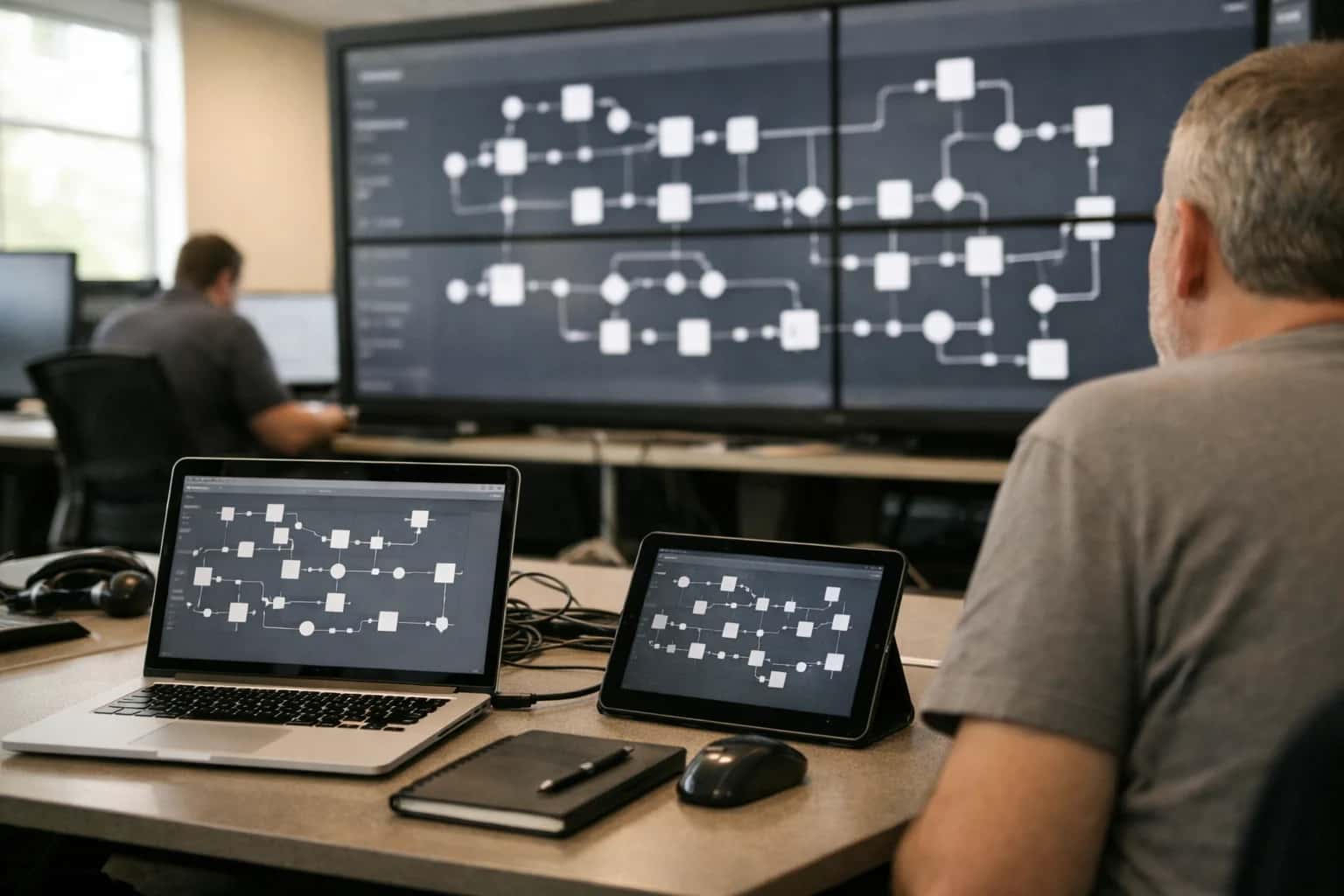
REAL-TIME VIRTUAL-PHYSICAL ALIGNMENT
What is Digital Twin Synchronization?
Digital twin synchronization is the continuous, bi-directional data flow process that ensures a virtual model precisely mirrors the current state, behavior, and context of its physical counterpart in real time.
Effective synchronization requires resolving the sim-to-real gap by managing network latency, data schema alignment, and state estimation errors. Techniques such as domain randomization during simulation training and the use of digital shadows for asynchronous validation ensure the digital twin remains a trustworthy proxy for monitoring, predictive maintenance, and autonomous control within dynamic logistics environments.
REAL-TIME MIRRORING
Key Characteristics of Synchronized Digital Twins
Digital twin synchronization is defined by a set of core architectural and operational characteristics that distinguish a live, controllable virtual replica from a static simulation model. These features ensure the virtual and physical states remain causally linked.
01
Bi-Directional Data Flow
The defining characteristic of a synchronized twin is a two-way persistent connection. Telemetry streams from the physical asset to the virtual model, while control commands and optimization parameters flow back from the model to the physical controller. This is distinct from a digital shadow, which only has a one-way data flow.
- Physical-to-Virtual: IoT sensors stream temperature, vibration, and GPS data.
- Virtual-to-Physical: The model sends updated set points to a PLC or rerouting instructions to a fleet management system.
02
Temporal Fidelity & Latency
Synchronization is defined by its time window. High-fidelity twins operate with sub-second latency, enabling real-time control. Lower-fidelity operational twins may synchronize in near-real-time (seconds to minutes) for planning purposes.
- Hard Real-Time: Required for collision avoidance in autonomous mobile robots (AMRs).
- Near-Real-Time: Sufficient for warehouse heat map analysis and dynamic slotting.
- Batch Synchronization: Used for daily stress-testing of supply chain networks against new demand forecasts.
03
State Persistence & Event Sourcing
A synchronized twin does not just mirror the current state; it maintains an immutable, time-series log of all state transitions. This is typically implemented via an event-sourcing architecture.
- Auditability: Every state change is recorded, allowing operators to rewind the twin to any point in time for root cause analysis.
- Replayability: Historical event streams can be replayed against a new version of the twin's logic to validate model updates before production deployment.
04
Semantic Contextualization
Raw telemetry is meaningless without context. Synchronization involves enriching data streams with semantic metadata from the enterprise knowledge graph.
- Example: A temperature reading of 2°C is contextualized by the twin as 'Reefer Unit #RF-8842, Trailer #TR-101, Shipment #SH-5592 (Pharmaceutical, Range: 2°C-8°C)'.
- This allows the twin to trigger specific exception workflows based on business rules, not just raw threshold breaches.
05
Multi-Resolution Modeling
Synchronization occurs at multiple levels of granularity simultaneously. A change in a low-level component automatically propagates to higher-level aggregate models.
- Component Level: A specific motor's RPM and thermal state.
- Asset Level: The overall health and throughput of a conveyor system.
- System-of-Systems Level: The impact of that conveyor's slowdown on the entire warehouse's order fulfillment rate.
06
Conflict Resolution & Optimistic Concurrency
When a human operator physically intervenes (e.g., manually moving a pallet), a state divergence occurs between the physical world and the twin's predicted state. Synchronization requires a conflict resolution strategy.
- Physical Wins: The twin's state is overwritten by the latest observed physical state.
- Merge Logic: The twin recalculates the downstream effects of the manual intervention and proposes a new optimized plan, alerting the operator to any constraint violations.
Enabling Efficiency, Speed & Accuracy
Intelligent Analysis, Decision & Execution
We build AI systems for teams that need search across company data, workflow automation across tools, or AI features inside products and internal software.
Talk to Us
Search across company data
Give teams answers from docs, tickets, runbooks, and product data with sources and permissions.
Useful when people spend too long searching or get different answers from different systems.
Enterprise searchRAGPermissions
Read more
Automate internal workflows
Use AI to route work, draft outputs, trigger actions, and keep approvals and logs in place.
Useful when repetitive work moves across multiple tools and teams.
AI agentsWorkflow automationGovernance
Read more
Add AI to products and internal tools
Build assistants, guided actions, or decision support into the software your team or customers already use.
Useful when AI needs to be part of the product, not a separate tool.
AI integrationDecision supportModel routing
Read moreDIGITAL TWIN SYNCHRONIZATION
Frequently Asked Questions
Explore the core mechanisms and architectural patterns that enable a real-time, bi-directional data link between physical logistics assets and their virtual counterparts for simulation and control.
Digital Twin Synchronization is the continuous, bi-directional data flow process that maintains a real-time virtual representation of a physical logistics asset, such as a warehouse robot, conveyor belt, or delivery truck. It works by ingesting streaming telemetry from IoT sensors, PLCs, and edge gateways into a digital model hosted on a simulation or control platform. The physical asset transmits its current state—position, temperature, vibration, or operational mode—to the twin, while the twin can send back optimized control parameters, predictive maintenance alerts, or re-routing instructions. This closed-loop architecture relies on message brokers like MQTT or Apache Kafka to ensure low-latency data consistency, effectively making the digital twin a live, executable mirror of reality rather than a static snapshot.

About the author
Prasad Kumkar
CEO & MD, Inference Systems
Prasad Kumkar is the CEO & MD of Inference Systems and writes about AI systems architecture, LLM infrastructure, model serving, evaluation, and production deployment. Over 5+ years, he has worked across computer vision models, L5 autonomous vehicle systems, and LLM research, with a focus on taking complex AI ideas into real-world engineering systems.
His work and writing cover AI systems, large language models, AI agents, multimodal systems, autonomous systems, inference optimization, RAG, evaluation, and production AI engineering.
LinkedIn
Limited slotsGet a Free AI Consultation
Partnered with leading AI, data, and software stack.





How We Work
Custom AI workflows for your Business
One-fit-all AI don't work for modern businesses. At Inferensys, we aim to understand your business & custom requirements; which we use to define most efficient agentic workflows, the data, and the tools for your business.
01
Review the use case
We understand the task, the users, and where AI can actually help.
Read more02
Pick the right approach
We define what needs search, automation, or product integration.
Read more03
Build the first useful version
We implement the part that proves the value first.
Read more04
Improve from there
We add the checks and visibility needed to keep it useful.
Read moreThe first call is a practical review of your use case and the right next step.
Talk to Us