In-transit inventory is the stock currently moving between two nodes in a supply chain network, such as from a manufacturing plant to a distribution center or from a port to a warehouse. Although physically inaccessible, this inventory is a vital asset in order promising logic because it represents future supply that can be committed to customer orders. By including in-transit goods in the ATP netting process, systems can provide accurate delivery dates earlier, reducing the need to wait for physical receipt before making a commitment.

Glossary
In-Transit Inventory
Goods that have been shipped from a supplier or distribution center but have not yet been received at the destination, which can be included in the ATP calculation as a scheduled receipt.
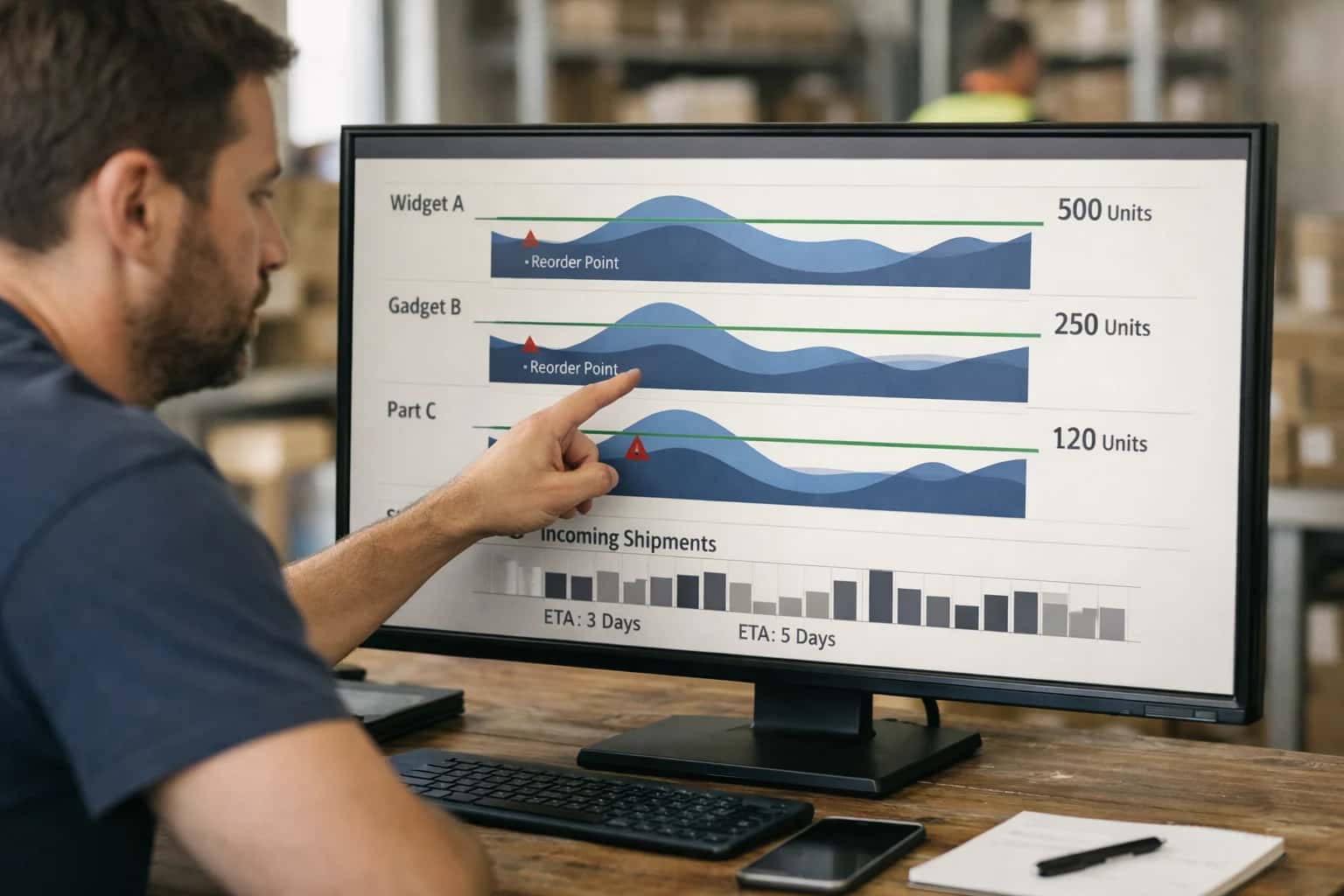
SUPPLY CHAIN VISIBILITY
What is In-Transit Inventory?
In-transit inventory refers to goods that have been shipped from a supplier or distribution center but have not yet been received at the destination, representing a critical component of the Available-to-Promise (ATP) calculation as a scheduled receipt.
The precise calculation of in-transit availability relies on dynamic lead time estimates and real-time visibility data from transportation management systems. Advanced global ATP engines treat in-transit inventory as a scheduled receipt with a specific arrival date and quantity, allowing the system to promise against it for orders due after the expected delivery. This capability is essential for omnichannel ATP strategies, where goods in transit can be re-routed or allocated to different channels before they even reach a warehouse.
DYNAMIC SUPPLY ASSET
Key Characteristics of In-Transit Inventory
In-transit inventory represents goods that have been shipped but not yet received, functioning as a critical bridge between static stock and dynamic fulfillment. Understanding its unique attributes is essential for accurate order promising and network optimization.
01
Legal Ownership and Incoterms
The point at which title transfer occurs defines whether in-transit goods are an asset on the buyer's or seller's balance sheet. This is governed by Incoterms such as FOB (Free On Board) or DAP (Delivered at Place).
- FOB Origin: Buyer assumes ownership and risk the moment goods leave the seller's dock, making them the buyer's in-transit inventory.
- FOB Destination: Seller retains ownership until goods arrive, so they remain the seller's asset during transit.
- This distinction is critical for ATP inclusion—only inventory you legally own can be promised against.
02
Visibility and Trackability
Modern in-transit inventory is no longer a black hole. Real-time telemetry from IoT sensors, GPS, and carrier APIs transforms a static ETA into a dynamic data stream.
- Milestone Tracking: Events like gate-in at port, customs clearance, and departure from a cross-dock provide granular status updates.
- Predictive ETAs: Machine learning models consume this telemetry to forecast arrival times with higher accuracy than carrier-provided dates.
- Exception Alerts: Automated systems flag deviations—such as a container missing a vessel connection—triggering immediate replanning of dependent orders.
03
ATP Inclusion as Scheduled Receipt
In-transit inventory is treated as a scheduled receipt in the Available-to-Promise (ATP) calculation, representing a future supply increment. Its inclusion expands the ATP horizon beyond what is physically on hand.
- Hard Pegging: A specific in-transit purchase order is linked to a specific customer order, guaranteeing that supply.
- Soft Pegging: The in-transit quantity is added to the general available pool for promising against any demand.
- Risk Adjustment: Advanced ATP engines may discount in-transit quantities by a reliability factor based on the supplier's historical on-time delivery performance.
04
Financial Carrying Cost
While in transit, inventory incurs a continuous carrying cost that includes tied-up capital, insurance, and potential deterioration. This cost is often underestimated.
- Cost of Capital: The working capital locked in goods from shipment to receipt cannot be deployed elsewhere.
- Insurance Premiums: Cargo insurance costs accrue daily during transit, especially for high-value or hazardous goods.
- Shrinkage Risk: Theft, damage, and loss are elevated during multi-modal handoffs, contributing to inventory shrinkage.
- Perishability Decay: For shelf-life-sensitive goods, every day in transit directly reduces the remaining window for sale, impacting Shelf-Life ATP calculations.
05
Multi-Modal and Multi-Leg Complexity
Global in-transit inventory rarely follows a simple point-to-point path. It traverses a multi-echelon journey involving ocean, rail, truck, and air segments.
- Transshipment Hubs: Goods may sit at intermediate ports or cross-docks, creating nested in-transit segments.
- Mode Switching: A shipment might begin as ocean freight, transfer to rail at a port, and complete the final mile via truck. Each handoff introduces variability.
- Consolidation and Deconsolidation: Less-than-container-load (LCL) shipments are consolidated at origin and deconsolidated at destination, complicating individual SKU-level tracking until final breakdown.
06
Customs and Regulatory Status
For cross-border shipments, in-transit inventory exists in a regulatory limbo until customs clearance is secured. This status directly impacts its availability for promising.
- Bonded Warehousing: Goods may be held in a bonded facility, technically in the country but not yet cleared for domestic sale.
- Documentation Holds: Missing or incorrect commercial invoices, certificates of origin, or packing lists can delay clearance indefinitely.
- Duty and Tax Liability: The obligation to pay import duties is triggered upon clearance, adding a known cost that must be factored into Cost-to-Serve and Profitable-to-Promise calculations.
- Clearance Probability: Advanced systems model customs clearance times based on historical data for the specific port, commodity code, and broker performance.
IN-TRANSIT INVENTORY
Frequently Asked Questions
Clear answers to common questions about managing and accounting for goods in transit within order promising and supply chain systems.
In-transit inventory refers to finished goods, raw materials, or components that have been shipped from a supplier or distribution center but have not yet been physically received at the destination point. In supply chain management, this inventory is legally owned by the buyer under FOB shipping point terms and represents a critical scheduled receipt in time-phased planning. The system tracks these goods using a unique shipment identifier, such as a bill of lading or container number, and assigns an estimated time of arrival (ETA). During the transit window, these goods are unavailable for physical picking but are visible to the Available-to-Promise (ATP) engine as a future supply source, allowing the system to commit delivery dates against inbound stock before it arrives, a process known as in-transit lead time promising.
Enabling Efficiency, Speed & Accuracy
Intelligent Analysis, Decision & Execution
We build AI systems for teams that need search across company data, workflow automation across tools, or AI features inside products and internal software.
Talk to Us
Search across company data
Give teams answers from docs, tickets, runbooks, and product data with sources and permissions.
Useful when people spend too long searching or get different answers from different systems.
Enterprise searchRAGPermissions
Read more
Automate internal workflows
Use AI to route work, draft outputs, trigger actions, and keep approvals and logs in place.
Useful when repetitive work moves across multiple tools and teams.
AI agentsWorkflow automationGovernance
Read more
Add AI to products and internal tools
Build assistants, guided actions, or decision support into the software your team or customers already use.
Useful when AI needs to be part of the product, not a separate tool.
AI integrationDecision supportModel routing
Read more
About the author
Prasad Kumkar
CEO & MD, Inference Systems
Prasad Kumkar is the CEO & MD of Inference Systems and writes about AI systems architecture, LLM infrastructure, model serving, evaluation, and production deployment. Over 5+ years, he has worked across computer vision models, L5 autonomous vehicle systems, and LLM research, with a focus on taking complex AI ideas into real-world engineering systems.
His work and writing cover AI systems, large language models, AI agents, multimodal systems, autonomous systems, inference optimization, RAG, evaluation, and production AI engineering.
LinkedIn
Limited slotsGet a Free AI Consultation
Partnered with leading AI, data, and software stack.





How We Work
Custom AI workflows for your Business
One-fit-all AI don't work for modern businesses. At Inferensys, we aim to understand your business & custom requirements; which we use to define most efficient agentic workflows, the data, and the tools for your business.
01
Review the use case
We understand the task, the users, and where AI can actually help.
Read more02
Pick the right approach
We define what needs search, automation, or product integration.
Read more03
Build the first useful version
We implement the part that proves the value first.
Read more04
Improve from there
We add the checks and visibility needed to keep it useful.
Read moreThe first call is a practical review of your use case and the right next step.
Talk to Us